Technical Knowledge
What is the principle of infrared laser concrete leveling machine?

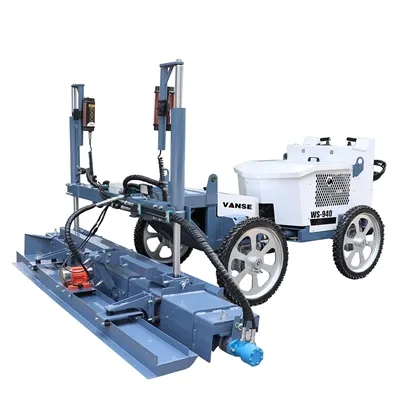
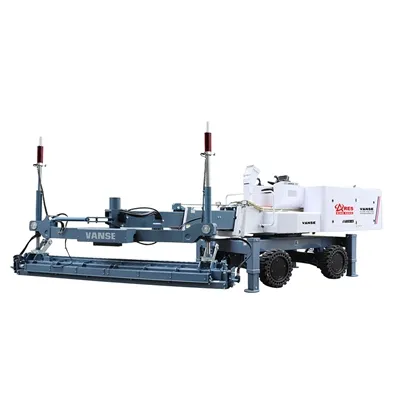
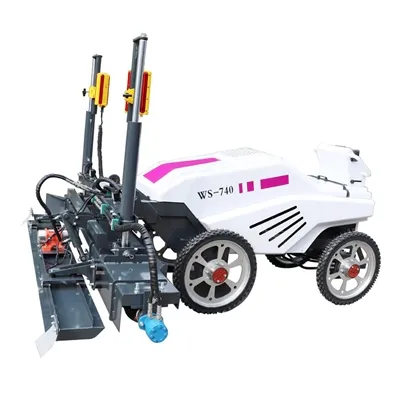
The principle of the infrared laser concrete leveler is mainly a special floor equipment that uses laser guidance to pave, level and vibrate concrete. Here's how it works:
Set the laser transmitter to the required height, then place the handheld receiver pole on the elevation reference, adjust the height of the pole according to the laser emitted by the transmitter, and lock the corresponding height.
Transfer height measurements from the handheld receiver pole directly to the laser leveling handpiece laser receiver pole.
It relies on a hydraulic (electric) driven leveling head, working with the laser system and computer control system to complete the leveling work while automatically leveling.
The leveling head is equipped with an integrated scraper, vibrator and leveling plate, which integrates all leveling, leveling, vibrating, compacting and paddle lifting work into one and completes it at one time.
The computer control system automatically adjusts the height 10 times per second in real time, and the balanced designed vibrator has a vibration frequency of 4,000 times per minute.
Infrared laser concrete leveling machine can greatly reduce unnecessary construction joints, speed up construction, save labor, and improve construction quality.
Thanks to All the Friends Who Support and Trust Shandong Vanse Machinery Technology Co., Ltd.
If you want to know more about Shandong Vanse Machinery Technology Co., Ltd. or have any questions, please feel free to contact us:
Our Factory
Shandong Vanse Machinery Technology Co., Ltd.








Share this article

About the Author: Shandong Vanse Machinery Technology Co., Ltd.
Shandong Vanse Machinery Technology Co., Ltd. is a high-tech manufacturer specializing in concrete construction machinery, including laser screeds and related equipment. The company integrates R&D, production, and global sales, with products exported to over 60 countries and widely used in infrastructure projects worldwide.
Previous Post
Next Post
Related Articles
You Might Also Like
How does the concrete laser leveling machine work?
Concrete laser leveling machine is a device that uses laser technology for floor leveling. Its working principle is mainly based on laser measurement and control systems, combined with mechanical automation technology, to achieve high-precision and efficient floor leveling. During the specific work process, the laser leveling machine first emits a laser beam through the laser transmitter, which is projected onto the ground to be constructed and received by the laser receiver. The receiver then feeds back the received signal to the control system, and the control system adjusts the position and height of the leveling head based on the feedback signal to ensure that the leveling head always remains at the set elevation position for operation. The leveling head is the core part of the laser leveling machine. It integrates functional modules such as scraper, spiral and vibrating plate, and can complete the initial leveling, vibration and leveling of concrete at one time. During the leveling process, the role of the scraper and spiral is to evenly distribute the concrete, while the vibrating plate vibrates the concrete to achieve the desired flatness. At the same time, the laser leveling machine adopts a computer laser control system, which receives and processes laser signals through the laser receiver of the mechanical head to make real-time adjustments at a monitoring frequency of 10 times per second to accurately control the floor elevation. This allows the flatness of the entire floor to be accurately controlled and avoids manual errors and construction joint problems in traditional construction methods. In addition, in order to achieve large-area construction, laser leveling machines are usually equipped with automatic navigation systems or remote control systems to achieve automated and efficient construction. This construction method can not only improve construction efficiency and shorten the construction cycle, but also reduce manual operating errors and improve construction quality. To sum up, the working principle of the concrete laser leveling machine is based on the laser measurement and control system. By accurately controlling the floor elevation and flatness, combined with mechanical automation technology, efficient and high-precision floor leveling can be achieved.Why does the road appear uneven?Is there any chance of getting better with laser leveling?
Due to the limitation of construction technology, the road surface is uneven in many cases, and the vehicle cannot maintain a very good stability during driving, and it may cause ruts after repeated rolling, which is equivalent to being stuck in a car. vicious circle. Wouldn't it be better to use concrete laser leveling? Nowadays, many roads are uneven, and there are many reasons. Now I will introduce the reasons for uneven roads: 1. The unevenness of the base layer affects the flatness of the road surface, resulting in uneven paving thickness, and the control of the base layer construction is not strict. Some even use bulldozers and graders to lay the base layer. The construction quality and flatness are difficult to control. 2. The influence of road paving machinery and technology on the smoothness: A. Improper selection of paver structure parameters, resulting in uneven paving thickness and waves; B. Improper control of the base line of the paver, resulting in waves; C. Improper operation of the paver causes uneven paving speed and frequent starting, resulting in rough and uneven surface layers; D. When a slipform paver is used for the concrete pavement, it is affected by the paver itself, control datum line and operation. 3. The influence of the quality of surface paving materials on the flatness: A. The ratio of asphalt pavement materials, mixing, oil temperature and shutdown due to material failure; B. Raw materials, proportioning and stoppage of materials for concrete pavement. 4. Effect of rolling on flatness: A. The use of low-frequency, high-amplitude road rollers will cause jumping and tamping phenomena, and excessive initial tonnage will cause pushing deformation; B. Uneven rolling speed, sudden braking, sudden start, random parking and U-turn, parking on the rolled and formed road without turning off the vibration device will cause road congestion, and stopping on the uncooled road will cause sunken; C. Improper rolling route, if you don't pay attention to wrong wheel rolling, turning back at the same cross section every time will cause uneven road surface; D. The number of times of rolling is not enough, the compaction is not enough, and ruts are easy to form after opening to traffic. The leveling mechanism of the laser leveling machine is driven by hydraulic pressure, cooperates with the laser system and the computer control system to complete the leveling work while automatically leveling, and the work efficiency is extremely high. The laser transmitter used to control the ground level is arranged independently, and the level of the ground will not produce cumulative errors. Compared with the traditional method, the flatness of the super-large area is as easy to control, and at the same time, the construction joints and formwork usage of the floor are greatly reduced. Fast construction speed: use laser leveling machine and other equipment to construct concrete slabs, which improves the work efficiency by 3 times and saves 30% compared with the traditional beam vibrator method. It can complete 2000 square meters per day on average. It is especially suitable for simple shapes and large-scale operations. pavement construction. High degree of automation and low labor intensity: the use of laser leveling machines and other equipment changes heavy manual labor into mechanical paving, vibrating, leveling, slurry extraction, and surface plastering, reducing the number of operators by 30% and reducing labor intensity at the same time. High economic benefit: the application of laser leveling machine and other equipment saves the cost by 2-3 yuan/㎡ compared with the traditional process, with fewer joints and lower maintenance costs in the later period, so that the economic benefit is significantly improved. Advanced equipment such as laser leveling machines are especially suitable for projects such as docks, storage yards, expressways, airports, large squares, parking lots, and municipal roads that have relatively simple shapes, large amounts of action, and high construction quality requirements.Welfare! Four steps to clean the laser leveler
With the addition of concrete laser leveling machines in the construction industry and road construction, both quality and speed have been improved, and users have saved a lot of costs. However, in the face of high-frequency use, users cannot ignore the cleaning of the equipment. This step must not be sloppy. Let's take a look at the steps of cleaning the leveling machine! 1. The liquid crystal surface on the body of the laser leveling machine also needs to be cleaned. You can use organic resin or lens cleaning cloth to wipe the dirt. If there is too much dirt, you can use lens cleaning fluid to remove it. 2. There will be a lot of dust and mud on the laser leveling machine after construction. First, wipe the dust on the laser leveling machine clean, and wipe the dirt and oil stains with thin paper or cotton cloth. 3. If the laser signal is lost during the construction of the laser leveling machine, the machine needs to be restarted, and the interval time needs to be more than ten seconds. 4. If there are too many stains, you can soak a soft cloth in water diluted with a neutral detergent, wring it out and wash it. The best laser leveling machine manufacturers remind everyone not to use volatile oil, thinner, gasoline and other chemicals for cleaning and wiping. The laser leveling machine uses a scraper to take away the raised concrete and initially scrape it flat to reach the design elevation. The hydraulically driven vibration motor produces vibrations at a frequency of 4000 times/minute, driving the entire vibration plate to vibrate the concrete together. The laser paver does not need to pull a control line or support a side template to control the ground elevation. Instead, it is controlled in real time by the laser measurement and control system on the laser leveling machine. As long as the laser transmitter is not disturbed, no matter where the laser leveling machine moves, it can ensure that the overall elevation of the paved ground is not affected. The concrete floor laser leveling machine is a construction machine that spreads the mixed concrete along the roadbed according to the given thickness, width and road type requirements, and then completes the paving of the concrete road through vibration, leveling and polishing procedures. The working device of the concrete floor laser leveling machine generally consists of a distributor, a scraper, a vibrator (including a vibrator and a vibrator), a leveler, a trowel and other devices. At the same time, it also requires the organic coordination of the frame, the walking mechanism, the operating control system and some other auxiliary mechanisms. Some models integrate all the devices into one, and some are divided into two or more independent units.