Technical Knowledge
In what scenarios is the concrete laser leveling used?
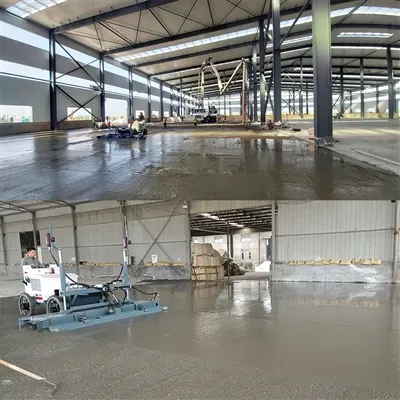
Concrete laser leveling machine, also known as floor laser leveling machine, ground laser leveling machine, concrete paver, etc., is an advanced machine for leveling concrete floors. Its application range is very wide, mainly including indoor flooring engineering and outdoor flooring engineering.
In indoor flooring projects,
concrete laser leveling machines can be used in large industrial plants, workshops, automated three-dimensional warehouses, as well as clean workshops such as electronic appliances, food materials, and medicine. In addition, it can also be used in large warehouse supermarkets, logistics centers, convention and exhibition centers and other scenarios.
In outdoor flooring projects,
concrete laser leveling machines are also widely used. For example, it can be used in terminals, container yards, cargo yards, airport runways, aprons, parking lots, squares, residential grounds, municipal roads, etc.
It can be seen that concrete laser leveling machines have been widely used in construction, logistics, transportation and other fields since 2000. However, specific application scenarios and methods may vary depending on specific engineering needs and conditions. Therefore, in practical applications, selection and adjustment need to be made according to specific conditions.


Thanks to All the Friends Who Support and Trust Shandong Vanse Machinery Technology Co., Ltd.
If you want to know more about Shandong Vanse Machinery Technology Co., Ltd. or have any questions, please feel free to contact us:
Our Factory
Shandong Vanse Machinery Technology Co., Ltd.








Share this article

About the Author: Shandong Vanse Machinery Technology Co., Ltd.
Shandong Vanse Machinery Technology Co., Ltd. is a high-tech manufacturer specializing in concrete construction machinery, including laser screeds and related equipment. The company integrates R&D, production, and global sales, with products exported to over 60 countries and widely used in infrastructure projects worldwide.
Previous Post
Next Post
Related Articles
You Might Also Like
Does the operating skills of power trowel machine have a big impact on the trowel effect?
– Correct starting position: When starting the trowel, it is important to place it in an area where the concrete surface is flat and has been preliminarily processed (such as vibrated and scraped). If it is started in an uneven place or with debris, the trowel will be subject to uneven resistance at the beginning, which may cause the trowel blade to jump, thereby affecting the trowel effect. For example, on the newly poured concrete floor, if there are protruding stones or uncompacted parts, after starting the trowel, the trowel blade is likely to vibrate here, causing wavy patterns on the surrounding ground. – Stable starting speed: Starting the trowel smoothly can avoid the trowel blade suddenly accelerating and causing impact on the ground. For electric trowels, avoid quickly connecting the power supply to cause the motor to run at a high speed instantly; for gasoline trowels, when starting, you should follow the operating procedures and slowly pull the starting rope to allow the engine to gradually reach the working speed. If the starting speed is too fast, the impact force between the trowel and the ground is too large, which may leave scratches on the ground or cause partial peeling of the mortar layer on the concrete surface. – Travel speed control: The travel speed of the trowel directly affects the quality and efficiency of the trowel. If the speed is too fast, the trowel will stay in each area for too short a time, and the concrete surface cannot be fully compacted and smoothed, which can easily cause the ground to be rough and uneven. If the speed is too slow, although the trowel effect can be more refined, it will reduce work efficiency. For example, when troweling a large area of industrial plant floor, it is generally more appropriate to keep the travel speed at 3-5 meters per minute, which can not only ensure the quality of troweling, but also improve work efficiency to a certain extent. – Travel track planning: A reasonable travel track can make the trowel effect more uniform. Usually, a zigzag, circular or spiral travel track is used. The zigzag track is suitable for narrow and long areas, so that the trowel can fully cover every corner; the circular and spiral tracks are suitable for large circular or square areas, which can ensure that the trowel can evenly trowel from the center to the periphery or from the periphery to the center. If the walking track is chaotic, such as turning randomly or repeatedly over-troweling in certain areas, it will cause uneven troweling of the ground, high and low differences or local over-troweling. – Adjust pressure according to stage: Different pressures need to be applied at different stages during the troweling process. In the rough grinding stage after the initial setting of concrete, a larger pressure can be appropriately applied to compact the concrete surface and eliminate bubbles and pores. In the fine grinding stage, the pressure should be reduced so that the trowel slides gently on the ground, mainly used to improve the finish of the ground. For example, during rough grinding, the hand-held trowel can increase the pressure by pressing the operating handle appropriately; during fine grinding, the handle is relaxed to let the trowel contact the ground naturally. If the pressure is not properly controlled, excessive pressure during the fine grinding stage may damage the ground that has been initially leveled, resulting in new scratches and unevenness. – Importance of even pressure: Ensure that pressure is evenly distributed on the trowel blade, whether in the rough or fine grinding stage. Uneven pressure can cause some parts of the trowel blade to exert too much force on the ground, while other parts exert insufficient force, resulting in local unevenness and inconsistent gloss on the ground. Operators need to achieve even pressure through skilled operation and good control of the trowel. – Special tools or techniques for corners: For areas such as corners and edges that are difficult for the trowel to cover directly, operating skills are particularly critical. You can use a small handheld trowel or a special corner trowel tool for processing. When using a handheld trowel, keep it perpendicular to the corner or edge and rotate it slowly with a small radius to ensure that the concrete in the corner can be fully compacted and smoothed. Without the correct corner treatment skills, these areas can easily be overlooked, resulting in uneven and rough corners, affecting the finishing quality of the entire floor.What is the difference between a concrete laser leveling and a polisher?
Concrete laser levelings and polishers are two different types of mechanical equipment with different functions and application fields. Here are their main differences: ✔How it works The concrete laser leveling machine uses laser measurement technology to emit a laser beam through a laser transmitter. The laser receiver receives the reflected laser signal and calculates the distance and direction of the leveling machine's movement, thereby accurately controlling the leveling machine's traveling route and direction. height to achieve the purpose of leveling the concrete surface. A concrete grinder is a mechanical device that uses an electrically driven grinding wheel or grinding wheel for grinding. The grinding wheel rotates under the drive of the motor and grinds the concrete surface smooth through a manual or automatic control system. ✔Application areas Concrete laser leveling machines are mainly used for leveling operations in large-area concrete projects, such as highways, bridges, parking lots, etc. It has the advantages of high precision, high efficiency, automation, etc., and can complete the leveling work of a large number of concrete surfaces in a short time. Concrete grinders are mainly used for grinding on construction sites and small-area concrete projects. It can grind various concrete surfaces, such as floors, walls, columns, etc. ✔How to operate Concrete laser levelings usually use automated control systems that can be operated via a computer or remote control. The operator only needs to set relevant parameters and routes, and the leveling machine can automatically perform leveling operations. The concrete grinder requires manual control by the operator, and the depth and uniformity of grinding can be controlled by adjusting the height and angle of the grinding wheel. Operators need to have certain skills and experience to achieve good grinding results. ✔Processing quality Due to the use of laser measurement technology, the concrete laser leveling machine can complete large-area leveling operations in a short time and can achieve high precision and flatness. It can control the flatness error of the concrete surface within a small range and improve the quality and service life of the concrete surface. The processing quality of a concrete grinder mainly depends on the skill and experience of the operator. If the operator has rich experience and high skill level, he can achieve better smoothing results. However, if the operator's technical level is not high or unskilled, it may lead to uneven grinding depth or excessive grinding, affecting the processing quality and service life. ✔Processing efficiency The processing efficiency of concrete laser leveling machines is usually high. It can achieve automated control and high-precision measurement to complete the leveling operations of a large number of concrete surfaces in a short time. At the same time, due to the use of laser measurement technology, it can avoid errors and delays in traditional measurement methods. The processing efficiency of concrete grinders is relatively low. It requires operators to manually control the height and angle of the grinding wheel, as well as the grinding time and speed, which requires more time and manpower to complete large-area concrete projects. ✔Maintenance and care Maintenance and maintenance of a concrete laser leveling is relatively simple. It requires regular inspection of the cleanliness and accuracy of the laser transmitter and receiver, as well as routine lubrication and maintenance of the machine. At the same time, regular cleaning and maintenance of the machine is also required to maintain the normal operation and service life of the machine. The maintenance and upkeep of concrete polishers is relatively complicated. It requires regular inspection of the working status of the grinding wheel and motor, and regular lubrication and maintenance of the machine. At the same time, the grinding wheel also needs to be replaced and adjusted to ensure the normal operation and service life of the machine. In summary, although concrete laser levelings and polishers are both used for concrete surface treatment, there are certain differences in their working principles, application fields, operating methods, processing quality, processing efficiency, and maintenance. difference. When choosing to use, you need to choose the appropriate machinery according to the actual situationWhat accessories should I consider when buying a concrete power trowel?
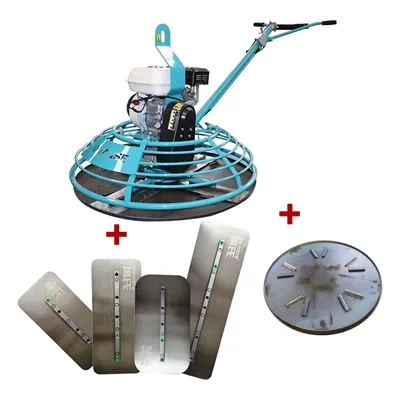
– Trowelling blades are made of various materials, such as alloy steel, rubber, polyurethane, etc. Alloy steel trowels are highly wear-resistant and suitable for large-area, high-strength concrete troweling, such as large-scale factory buildings, warehouses and other ground construction. Rubber trowels have good elasticity and have a certain buffering and protective effect on the ground. They are suitable for use in more delicate indoor floors or occasions with high requirements for ground flatness, such as residential floors and indoor floors of shopping malls. Polyurethane trowels are more suitable for troweling special floors such as epoxy floors with high surface quality requirements. – The size of the trowel should be selected according to the model of the trowel machine and the construction scene. Common round trowels have diameters of 60 cm, 80 cm, 1 meter, etc. Large-diameter trowels are suitable for troweling large areas of ground, which can improve work efficiency; small-diameter trowels are more flexible in corner areas. Square trowels can better fit the shape for troweling in right-angle areas such as corners. When purchasing, consider whether there are matching square trowels or special-shaped trowels (such as special-shaped trowels for edge troweling). – Since trowels are easily worn parts, in order to ensure the continuity of construction, it is best to purchase an appropriate number of spare trowels. It is generally recommended to equip at least 2-3 sets of trowels, especially in large-scale construction or long-term continuous construction, so that the trowels can be replaced in time after wear. – For belt-driven trowels, consider the quality and specifications of the belt. High-quality drive belts have good flexibility and wear resistance, and can stably transmit power from the motor to the trowel parts. When purchasing, pay attention to whether the belt model matches the trowel machine. For example, the belt length, width and tooth shape (if it is a synchronous belt) and other parameters must meet the design requirements of the trowel machine. For chain-driven trowels, attention should be paid to the strength and precision of the chain. High-strength chains can ensure the stability of power transmission and prevent chain breakage or tooth skipping during operation. – The quality of pulleys and sprockets is also important. Their dimensional accuracy and surface quality will affect the efficiency and stability of transmission. When purchasing, check the material of the pulley or sprocket. Generally, metal materials (such as cast iron and steel) are used, and ensure that its processing accuracy is high. For example, the groove size of the pulley is accurate and can fit tightly with the transmission belt; the tooth shape of the sprocket is high in precision and meshes well with the chain to reduce energy loss and vibration during power transmission. – The design of the operating handle should be ergonomic, comfortable to hold, and convenient for long-term operation. Some handles have anti-slip designs, such as rubber wrapping or textured surfaces, which can reduce hand fatigue and operating errors. When purchasing, you can actually hold and feel the comfort of the handle and the convenience of operation. – Control components include start/stop buttons, speed adjustment buttons, steering control buttons (for ride-on trowels), etc. These buttons should be sensitive and reliable, with reasonable layout and easy operation. For example, the speed adjustment button should be able to accurately control the working speed of the trowel and can be used normally in different working environments (such as different ground hardness and trowel requirements). At the same time, the waterproof performance of the control components is also important, especially in outdoor construction or scenes where water may be exposed, to prevent short circuits or damage caused by water ingress. – In some construction scenes with high environmental requirements, such as indoor decoration or food processing workshop floor construction, dust collection devices are required. When purchasing, consider the suction power, dust collection capacity and quality of the filtration system of the dust collection device. A dust collection device with strong enough suction can effectively collect dust and debris generated during the troweling process and keep the construction environment clean. A larger dust collection capacity can reduce the number of dumping times and improve work efficiency. A good filtration system can prevent dust leakage and protect the health of construction workers and the environment. – When a walk-behind trowel is not in use or needs to be moved over long distances, transport wheels can facilitate the movement of the machine. When purchasing, pay attention to the quality and size of the transport wheels. Good quality transport wheels can bear the weight of the trowel and roll flexibly, making it easy to move the trowel on different terrains (such as uneven ground, stairs, etc. on the construction site). At the same time, the installation method of the transport wheels should be simple and convenient, and easy to disassemble and install.