Technical Knowledge
What are the angles of the power trowel disc and blade?
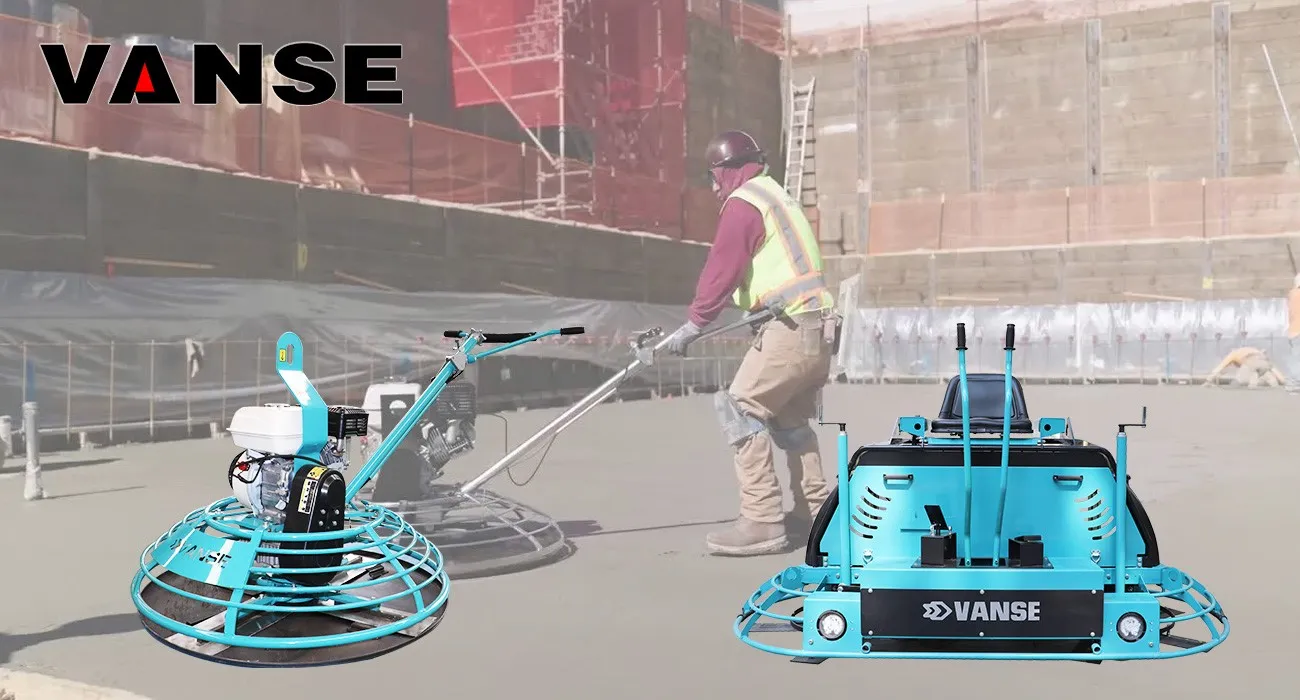
In the operation of concrete power trowel, the angle adjustment of the disc and blade is crucial to the finishing effect. The specific parameters are as follows
1. Power trowel disc
Angle range:
Usually there is no need to adjust the angle (the disc is flat design), and the slurry lifting effect is controlled by speed and pressure.
Applicable stage:
After the initial setting of concrete (there is a slight indentation when pressing with fingers but it is not sticky), it is used for surface slurry lifting and preliminary leveling.
2. Power trowel blade
First finishing:
The blade angle is 10°~15°, and the operation is low speed (300~400rpm), mainly to eliminate surface floating slurry and slight bumps.
Second finishing:
The angle is gradually increased to 25°~30°, and compacted at medium and high speed (400~600rpm) to enhance the surface density and gloss.
Special needs:
If an ultra-flat surface is required (such as industrial floor), the angle can be adjusted to 30°~45° during the last finishing, but it is necessary to ensure that the concrete strength is sufficient for support.
3. Adjustment principles
Degree of concrete hardening:
As the initial setting time of concrete goes by, gradually increase the blade angle to avoid roughening or sanding of the surface due to overly soft concrete.
Ambient temperature:
In hot and dry weather, the angle needs to be appropriately reduced to reduce the cutting force of the blade on the concrete and prevent surface cracking.
Surface requirements:
Conventional angles can be used for ordinary pavements, and high-precision projects (such as airport runways) need to be strictly adjusted according to design parameters.
4. Common errors and solutions
Angle is too small:
It is easy to leave floating slurry, resulting in insufficient surface strength, and the angle needs to be increased in time to make up for it.
Angle is too large:
It may scratch the hardened concrete, so the angle needs to be reduced and the finishing speed needs to be accelerated.
By reasonably controlling the angle and rotation speed, the surface flatness of the concrete can be within ±2mm/3m to meet the needs of different projects.
Thanks to All the Friends Who Support and Trust Shandong Vanse Machinery Technology Co., Ltd.
If you want to know more about Shandong Vanse Machinery Technology Co., Ltd. or have any questions, please feel free to contact us:
Our Factory
Shandong Vanse Machinery Technology Co., Ltd.








Share this article

About the Author: Shandong Vanse Machinery Technology Co., Ltd.
Shandong Vanse Machinery Technology Co., Ltd. is a high-tech manufacturer specializing in concrete construction machinery, including laser screeds and related equipment. The company integrates R&D, production, and global sales, with products exported to over 60 countries and widely used in infrastructure projects worldwide.
Previous Post
Next Post
Related Articles
You Might Also Like
How to care and maintain the concrete power trowel?
The concrete trowel is a piece of equipment widely used in the field of concrete construction. In order to ensure its long-term stable operation and increase its service life, regular maintenance and upkeep is essential. This article will introduce in detail the care and maintenance methods of concrete trowels, including regular inspection of equipment, cleaning and maintenance of equipment, adjusting equipment parameters, and maintaining equipment safety. 1. Regular inspection of equipment 1.1 Check each component of the equipment Before using the concrete trowel, all its components must be inspected, including the motor, reducer, trowel plate, grinding wheel, etc. Check whether these parts are loose, damaged or worn. If there are any abnormalities, repair or replace them in time. 1.2 Replace worn parts During long-term use, various parts of the concrete trowel will be subject to wear and tear. When some parts are found to be severely worn or damaged, they should be replaced in time to avoid greater damage to the equipment. 2. Cleaning and maintaining equipment 2.1 Clean the surface of the equipment Clean the concrete trowel surface regularly to remove dust, dirt and other impurities. Use a soft cloth or brush to gently wipe the surface of the device and avoid using sharp objects to scratch the surface of the device. 2.2 Clean the inside of the equipment After cleaning the surface of the device, the inside of the device should be opened for cleaning. Use a vacuum cleaner or brush to remove dust and debris from inside to make sure the inside of the device is clean and tidy. At the same time, check whether the internal components are loose or damaged. If there are any abnormalities, repair or replace them in time. 3. Adjust equipment parameters 3.1 Adjust the trowel speed During the construction process, the speed of the trowel should be adjusted according to different concrete strengths and textures. Excessively high rotational speed may cause scratches or damage to the surface of the compacted soil, while too low rotational speed may affect construction efficiency. Therefore, you should pay close attention to the rotation speed of the equipment during use and make adjustments according to the actual situation. 3.2 Adjust the trowel pressure The pressure of the trowel is also one of the important factors affecting the construction effect. Excessive pressure may cause indentations or damage to the concrete surface, while too little pressure may affect the construction effect. Therefore, the pressure of the equipment should be paid close attention to during use and adjusted according to the actual situation. At the same time, when adjusting the pressure, care should be taken not to exceed the maximum bearing capacity of the equipment to avoid damage to the equipment. 4. Maintain equipment safety 4.1 Check equipment safety devices Before using a concrete trowel, its safety devices must be inspected. Including whether the braking system, protective devices, limiters, etc. are intact and effective. If any abnormality or damage to the safety device is found, it should be repaired or replaced in time to ensure the safety of construction workers. 4.2 Comply with safe operating procedures When using a concrete trowel, safe operating procedures must be followed. Operators should wear protective glasses, gloves and other personal protective equipment to avoid accidental injuries caused by improper operation. At the same time, attention should be paid to the safety of the surrounding environment during the construction process to avoid accidents caused by improper construction operations. 5. Summary Through regular inspection, cleaning and maintenance of the concrete trowel, as well as adjusting equipment parameters and maintaining equipment safety, the long-term stable operation of the equipment can be ensured and the service life can be improved. At the same time, operators should also pay attention to observing safe operating procedures and paying attention to the use of personal protective equipment to ensure the safety and smooth progress of the construction process.Do you know the importance of pre-sales and after-sales services for laser leveling machines?
In the process of purchasing laser leveling equipment, manufacturing quality, market price, technical indicators, manufacturer strength, etc. are all important aspects that can be used to measure the performance of laser leveling equipment. However, in addition to these more important reference factors, the pre-sales and after-sales service of the product should also be fully considered. So, what is the importance of ensuring the pre-sales and after-sales service of the laser leveling machine? See below for a detailed analysis. In modern society, pre-sales and after-sales service is undoubtedly an extremely important link in the development of enterprises. However, there is a saying circulating in the market: "Good equipment does not require after-sales service, no matter how long it is used, it will not break down; and those with good after-sales service are because the equipment is always broken, so they have to rely on after-sales to provide maintenance services continuously." This sentence sounds quite right to laymen at first glance, but it is not the case when you think about it carefully. For products like concrete laser leveling machines, no matter how excellent the equipment itself is, it is inevitable that certain parts will be lost during normal operation. Moreover, how can good after-sales service just stay on "repairing" the machine? After-sales service can be said to be a significant advantage of domestic laser leveling machines. Most of the laser leveling equipment purchased by large concrete floor construction companies is undoubtedly a "big item" in terms of price and equipment size. In addition, the installation, debugging and maintenance of laser leveling equipment require special personnel to operate, which makes the purchase of laser leveling equipment more cautious. However, my country's floor construction companies have many doubts about purchasing laser leveling equipment products in terms of purchase, transportation distance, language communication, and after-sales communication. These doubts are precisely the advantages of domestic laser leveling equipment. Compared with foreign equipment, my country's laser leveling equipment companies are produced and sold domestically, which is convenient for buyers to conduct on-site inspections of products and production workshops. Purchasing domestic equipment is more convenient in terms of purchase procedures, transportation, and later debugging and maintenance. Our service team provides customers with a full set of solutions, from the production, arrival, assembly of the whole equipment, performance debugging, application training, production and maintenance guidance to delivery to customers. The post-service also includes timely repair, maintenance, technical training and other work of laser leveling equipment. This kind of technical support is a good embodiment of after-sales service. Our after-sales service and product quality complement each other and fully reflect the strength of the enterprise. We not only have good quality machines and equipment, but also better after-sales service. In order to facilitate everyone to better understand, the analysis of the importance of pre-sales and after-sales service of laser leveling machines ends here. Our company is a comprehensive enterprise integrating R&D, manufacturing, sales and other technical services of concrete laser leveling machines. If you are interested in cooperating with us, please feel free to call us to discuss more details of cooperation.The importance of after-sales service when purchasing a laser leveling machine
Today's building floor construction uses laser leveling machines, and the quality of the floor paved is much better than that of traditional methods – first, the flatness and levelness of the floor are improved by more than 3 times, and the density and strength of the floor are increased by more than 20%. At the same time, it can also shorten the construction period by 40% and save about 49% of labor. It can also greatly save costs in later maintenance, because laser leveling machine construction can more easily lay high-strength concrete, low-slump concrete and fiber mud concrete. The construction effect of the laser leveling machine is good, and it is a step for laser leveling machine manufacturers to gain praise from users, but if they want to gain a long-term foothold, they still need solid after-sales service to support them. As a laser leveling machine manufacturer, Shandong Vanse Machinery has been working hard to provide services to all customers, no matter where you are in the world. But words are not enough. You can only understand our services when you need help. Here are 4 reasons why after-sales support is particularly important when purchasing a laser leveling machine. 1. Time is money When you encounter problems during the construction of your equipment and need assistance, you can immediately contact the after-sales service engineer. You don't have to wait a few days to call. This is why you need excellent after-sales support. It will be critical when you need it, especially when you invest in a laser leveling machine. We know that all contractors are located in different time zones and work at different times. This is why we provide support services for our products. 2. Get solutions immediately when you need them When you encounter problems, our services are always available to help you identify the root cause of the problem and find solutions. The value of our products is that on the job site, you only need to take care of your own affairs. Our excellent products can help you complete most of the work. 3. Make your equipment available anytime, anywhere Before construction, you need to ensure that the machine is properly maintained and in good condition. Whether you are an experienced operator or a novice operator, or your machine has been idle for a long time, we can provide corresponding services. Our service agreement can ensure that you will not encounter any problems when you are ready to work and need to run the machine. 4. Understand how to maintain your laser leveler For every product we manufacture, we will provide after-sales support at any time, and at the same time we hope that our customers will know some knowledge about how to maintain the product. In addition to providing maintenance plans for each customer, customer service will also follow your every step of maintenance. The service life of a leveler is generally very long, and it is inevitable to encounter after-sales maintenance services in the middle, so when purchasing, you must understand the importance of laser leveling after-sales service, and examine the company's after-sales service capabilities.