Technical Knowledge
Can power trowels do both rough grinding and fine polishing
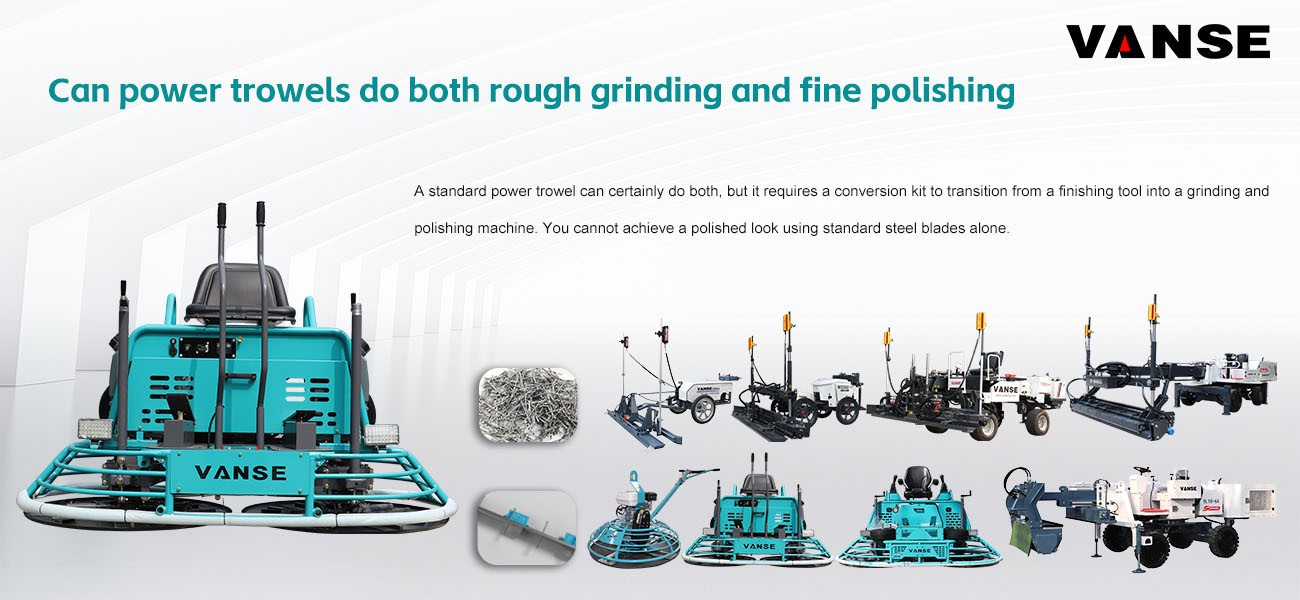
A standard power trowel can certainly do both, but it requires a conversion kit to transition from a finishing tool into a grinding and polishing machine. You cannot achieve a polished look using standard steel blades alone.
By attaching planetary grinding heads or diamond abrasive pads to the bottom of a power trowel, you turn it into a high-speed polishing monster capable of covering 10,000+ square feet a day.
1. Rough Grinding (The "Hone" Phase)
To perform rough grinding with a power trowel, you swap the blades for diamond segments (metal-bond diamonds).
How it works: You attach a drive plate to the trowel arms that holds aggressive diamond "plugs."
The Goal: To remove the "cream" layer, expose the aggregate (salt and pepper or large stone), and flatten the floor.
The Benefit: A power trowel is much heavier and faster than a walk-behind grinder, meaning you can "cut" a floor much faster.
The Risk: If the floor isn't perfectly flat, a power trowel can "bridge" low spots, meaning it won't grind the dips in the floor.
2. Fine Polishing (The "Shine" Phase)
Once the floor is ground flat, you switch to resin-bond diamond pads.
The Process: You move through "grits," typically starting at 50 or 100 grit and working up to 1,500 or 3,000 grit for a mirror finish.
The Setting: You run the trowel at high RPM with plenty of water (wet polishing). The high speed of the trowel blades allows the diamonds to heat up and "pop" the shine much faster than traditional grinders.
Chemicals: During this stage, you must apply a densifier (typically lithium silicate) to harden the concrete so it can take a high-gloss polish.
Power Trowel Polishing VS Traditional Grinders
| Feature | Traditional Floor Grinder | Power Trowel Polishing |
| Speed | Slower (Precise) | Extremely Fast (High Production) |
| Edge Work | Can get within 1" of walls | Poor (Requires separate edging) |
| Pressure | High downward pressure | Lower (Relies on centrifugal force) |
| Best For | Residential / Small Commercial | Large Warehouses / Logistics Hubs |
Can you do this with "Standard" blades?
No. If you try to "polish" using only steel finish blades, you are technically burnishing the floor, not polishing it.
Burnishing: Friction-heats the surface paste to make it shiny and dark. It is a temporary "mechanical" shine.
Polishing: Uses abrasives to physically smooth the stones and paste. It is a permanent "structural" shine.
Critical Equipment Warning
If you plan to use your power trowel for grinding and polishing, you must ensure the machine has:
A Water Tank/Spray System: Essential for wet grinding to keep the diamonds cool and suppress dust.
Heavy Duty Gearboxes: Grinding creates significantly more torque/drag than finishing wet concrete. Some light-duty trowels may burn out their clutches.
Would you like me to look up a conversion kit that fits your specific brand of power trowel? Contact us NOW
Note: The parameters provided in this document are for reference only and are not mandatory. Due to differences in technical characteristics between different brands and models of laser levelers, please consult the manufacturer for a suitable solution before actual operation. This reference document assumes no responsibility for any issues arising from failure to follow the manufacturer's instructions.
Thanks to All the Friends Who Support and Trust Shandong Vanse Machinery Technology Co., Ltd.
If you want to know more about Shandong Vanse Machinery Technology Co., Ltd. or have any questions, please feel free to contact us:
Our Factory
Shandong Vanse Machinery Technology Co., Ltd.








Share this article

About the Author: Shandong Vanse Machinery Technology Co., Ltd.
Shandong Vanse Machinery Technology Co., Ltd. is a high-tech manufacturer specializing in concrete construction machinery, including laser screeds and related equipment. The company integrates R&D, production, and global sales, with products exported to over 60 countries and widely used in infrastructure projects worldwide.
Previous Post
Next Post
Related Articles
You Might Also Like
Uses and features of high-quality concrete laser leveling machines
High-quality concrete laser leveling machine is a key equipment for high efficiency and precision in modern concrete construction, and is widely used in various large-area, high-precision concrete base surface construction. The following is a detailed introduction from the two aspects of purpose and features: – Mainly used for large-area concrete slabs and ground paving and leveling in industrial plants, warehouses, large supermarkets, logistics centers, etc., and can quickly handle construction areas of thousands to tens of thousands of square meters. – Suitable for municipal engineering (such as squares, parking lots), airport runways, highway service areas and other scenes with high requirements for ground flatness. – Cooperate with the laser system to achieve precise leveling of the concrete surface, ensuring that the base surface flatness error is controlled at the millimeter level (usually ≤3mm/2m), meeting the basic requirements for subsequent fine construction such as epoxy flooring and wear-resistant flooring. – Replace traditional manual scraper, vibrator and other tools, greatly reduce labor costs, and the construction efficiency can reach 3-5 times that of traditional methods (such as paving 300-500㎡ per hour). – Through mechanical vibration and laser positioning, reduce concrete bubbles, honeycomb surface and other defects, and enhance the density and strength of the base surface. – Equipped with imported laser transmitters and receivers, the height of the leveling mechanism is controlled in real time through laser signals to ensure that the leveling plane is consistent with the laser plane, avoiding the accumulation of errors in manual operation. – Integrate paving, vibration, leveling and slurry raising functions: the spiral spreader is used to evenly spread concrete, and the high-frequency vibrator (vibration frequency can reach 3000 times/minute) removes bubbles and compacts the concrete, and then the leveling beam is used to complete precise leveling, reducing the connection time of the process. – Some models adopt four-wheel drive or crawler design, which can be stably driven on ramps (slope ≤5°) and uneven ground; the width of the fuselage can be adjusted (such as 2-6 meters) to adapt to different construction spaces. – Support manual/automatic mode switching, manual operation can be performed near corners and obstacles, taking into account large-scale construction and detail processing. – Equipped with an LCD display, which displays laser signals, vibration frequency, driving speed and other parameters in real time, which is convenient for operators to monitor; some high-end models have fault self-diagnosis function to reduce maintenance difficulty. – Key components (such as laser receivers, hydraulic systems, and vibration motors) are made of high-quality materials, with excellent waterproof and dustproof performance. They can work stably for a long time in high temperature and humidity construction sites, and their service life can reach more than 10 years (under normal maintenance). – Reduce manual bending operations and reduce the labor intensity of workers; mechanical operation reduces the number of people stepping on the concrete before initial setting, avoids damage to the base surface, and reduces the risk of safety accidents. The high-quality concrete laser leveling machine solves the pain points of poor flatness, low efficiency, and high labor costs in traditional concrete construction through laser precision control and integrated efficient construction. It is the core equipment for achieving high-standard ground construction in modern industrial and civil buildings, especially suitable for projects with strict requirements on ground accuracy and strength. Click the below to jump immediately!!! ARMOUR JOINT CONCRETE LEVELING MACHINE LIGHT TOWER POWER TROWEL SLIPFORM MACHINE STEEL FIBER TOPPING SPREADER TRACKED MINI DUMPERWhat are the advantages of concrete laser leveling machine in construction?
With the continuous advancement of modern construction engineering technology, concrete laser leveling machine has been widely used in the field of construction as an efficient and precise construction equipment. This machine achieves high-precision leveling of the concrete surface through a laser precision control system, significantly improving the construction quality and efficiency. This article will elaborate on the advantages of concrete laser leveling machine in construction from the aspects of high-quality flatness, improved construction efficiency, significantly reduced costs, highly automated operations, wide applicability, laser precision control, and easy maintenance. 1. High-quality flatness The most significant advantage of the concrete laser leveling machine is that it can achieve high-quality flatness. Through the laser beam emitted by the laser transmitter, the leveling machine can adjust the position and height of the leveling head in real time to ensure that the concrete surface meets the predetermined flatness requirements. Compared with traditional construction methods, laser leveling machines can not only greatly improve flatness, but also effectively reduce the errors of manual operation, making the entire construction process more precise and controllable. This high-precision leveling effect can not only improve the beauty of the building, but also effectively prevent cracks, dents and other quality problems on the concrete surface, thereby extending the service life of the building. 2. Improved construction efficiency The use of concrete laser leveling machines can significantly improve construction efficiency. Traditional construction methods often require a lot of manual operation, which is not only time-consuming and labor-intensive, but also inefficient. The laser leveling machine can greatly speed up the construction progress through automated control and precise adjustment. In large-scale engineering projects, the laser leveling machine can quickly complete large-area concrete leveling work, significantly improve construction efficiency, and shorten the construction period. In addition, the laser leveling machine can also reduce the damage to the concrete surface caused by manual operation, further improving the construction quality and efficiency. 3. Significantly reduced costs The application of concrete laser leveling machines can not only improve construction efficiency, but also significantly reduce construction costs. On the one hand, the laser leveling machine can reduce a large number of manual operations, thereby reducing labor costs. On the other hand, since the laser leveling machine can achieve high-precision leveling effects, it reduces the rework and repair costs caused by construction quality problems. In addition, the laser leveling machine also has a long service life and low maintenance costs, so that the comprehensive cost of the entire construction process is effectively controlled. This cost advantage has made concrete laser leveling machines widely used in construction projects. 4. Highly automated operation The concrete laser leveling machine has the characteristics of highly automated operation. During the construction process, the laser leveling machine can automatically adjust the position and height of the leveling head according to the preset parameters and the instructions of the laser control system to achieve continuous and high-precision leveling operations. This automated operation method not only reduces the possibility of manual intervention and reduces operating errors, but also improves the continuity and stability of construction. At the same time, the highly automated operation method also reduces the workload of operators and improves the safety of construction. 5. Wide applicability The concrete laser leveling machine has strong wide applicability. Whether in large commercial buildings, road construction or industrial plant construction, the laser leveling machine can perform excellent performance. Its precise laser control system can adapt to the needs of concrete construction of different scales and shapes, whether it is a flat ground or an area with a complex slope, it can achieve high-precision leveling effects. In addition, the laser leveling machine can also seamlessly cooperate with other construction equipment to form a complete construction system to meet the needs of different engineering projects. 6. Laser precision control The core advantage of the concrete laser leveling machine lies in its laser precision control technology. The laser emitted by the laser transmitter has a high degree of directionality and stability, and can form a precise plane in space. The laser receiver can receive laser signals in real time and convert them into control signals to accurately guide the movement of the leveling head. This laser precision control technology enables the leveling machine to monitor and adjust the leveling effect in real time to ensure that the concrete surface meets the predetermined flatness requirements. At the same time, the laser control system also has strong anti-interference ability and can maintain stable performance in complex construction environments. 7. Easy maintenance The maintenance of the concrete laser leveling machine is relatively simple. Its structural design is reasonable and easy to clean and maintain. During use, you only need to regularly check whether the various components of the equipment are operating normally and replace the worn parts in time to ensure the good performance of the equipment. In addition, the maintenance cost of the laser leveling machine is relatively low, and only a small amount of manpower and material resources are required to complete the maintenance work. This simple maintenance method reduces the cost of equipment use and improves the efficiency of equipment use. In summary In summary, the advantages of concrete laser leveling machines in construction are mainly reflected in high-quality flatness, improved construction efficiency, significantly reduced costs, highly automated operations, wide applicability, laser precision control and easy maintenance. These advantages have made concrete laser leveling machines widely used and recognized in the field of construction engineering. With the continuous advancement and innovation of technology, it is believed that concrete laser leveling machines will play a more important role in future construction and provide strong guarantees for the quality and efficiency of construction projects. However, we must also realize that the advantages of any technology or equipment are relative, and concrete laser leveling machines are no exception. In the process of use, we still need to combine the specific construction environment and needs, reasonably select and use equipment, give full play to its advantages, and avoid possible limitations and deficiencies. At the same time, we need to continuously strengthen technological research and development and innovation, and improve the performance and intelligence level of equipment to meet the growing construction needs. In the future field of construction engineering, with the continuous advancement of science and technology and the improvement of people's requirements for construction quality, concrete laser leveling machines will surely play a more important role. We have reason to believe that in the near future, concrete laser leveling machines will make greater contributions to our construction industry with a more intelligent, efficient and environmentally friendly attitude. In summary, the advantages of concrete laser leveling machines in construction are reflected in many aspects, from high-quality flatness to improved construction efficiency, to significantly reduced costs and highly automated operations, all of which make it an important position in modern construction projects. At the same time, its wide applicability, laser precision control and simple maintenance have further enhanced the market competitiveness of concrete laser leveling machines. When talking about the wide applicability of concrete laser leveling machines, we must note that it can adapt to various working environments and ground conditions. Whether it is a flat indoor floor or a complex outdoor terrain, the laser leveling machine can achieve high-precision leveling operations through a precise laser control system and a flexible mechanical structure. This wide applicability enables the concrete laser leveling machine to perform excellent performance in various engineering projects to meet different construction needs. Laser precision control is another highlight of the concrete laser leveling machine. The use of laser technology makes the leveling process more precise and controllable. Through the precise guidance of the laser beam, the leveling machine can adjust the position and height of the leveling head in real time to ensure that the flatness of the concrete surface meets the preset requirements. This precise control not only improves the construction quality, but also reduces the difficulty and error rate of manual operation, making the entire construction process more efficient and stable. In addition, the maintenance of the concrete laser leveling machine is relatively simple. Its structural design is reasonable and easy to clean and maintain. During use, you only need to perform simple inspections and maintenance on the equipment regularly to ensure the normal operation of the equipment and extend its service life. This simple maintenance method reduces the cost of equipment use and improves the efficiency of equipment use. However, despite the many advantages of concrete laser leveling machines, some issues still need to be noted during use. First, operators need to have certain professional knowledge and operating skills to give full play to the performance of the equipment. Secondly, during the construction process, it is necessary to ensure the safe and stable operation of the equipment to avoid accidents caused by improper operation or equipment failure. Finally, it is also necessary to pay attention to regular maintenance of the equipment to ensure long-term stable operation and extend the service life of the equipment. In summary, the advantages of concrete laser leveling machines in construction are significant and have broad application prospects. With the continuous advancement and innovation of technology, it is believed that concrete laser leveling machines will play a more important role in future construction projects. We look forward to it achieving more outstanding results in improving construction quality, reducing construction costs, and improving construction efficiency, and contributing more to the development of the construction industry. At the same time, we should also see that the development of any technology and equipment is inseparable from the cultivation and introduction of talents. In order to give full play to the advantages of concrete laser leveling machines, we need to strengthen the cultivation and introduction of relevant talents and improve the professional quality and skill level of operators. In addition, we should also strengthen technology research and development and innovation, and continuously improve the performance and intelligence level of concrete laser leveling machines to adapt to the increasingly complex construction environment and the ever-increasing construction quality requirements. In addition, with the increasing awareness of environmental protection, we should also pay attention to the environmental protection performance of concrete laser leveling machines. In the design and manufacturing process, environmentally friendly materials and energy-saving technologies should be used as much as possible to reduce the impact of equipment on the environment during operation. At the same time, during use, environmental protection management of the construction site should also be strengthened to ensure that waste and pollutants in the construction process are effectively handled and controlled. In short, the advantages of concrete laser leveling machines in construction are self-evident, but it is also necessary to pay attention to related issues and challenges during use. By strengthening efforts in talent training, technological innovation and environmental protection management, we can give full play to the advantages of concrete laser leveling machines and make greater contributions to the quality improvement and efficiency improvement of construction projects.Case Study: How Laser Leveling Technology Enhances Construction Efficiency for a 10,000 Square Meter Logistics Warehouse Floor
The laser leveling technology can increase the construction efficiency of a 10,000-square-meter logistics warehouse by more than twice compared to the traditional method. It also improves the leveling accuracy from the millimeter level to the standard of a perfectly flat floor, creating conditions for the warehouse to achieve high-density storage (such as narrow channel systems). Below, I will elaborate on the specific data of efficiency improvement, the implementation path, and the additional value it brings through multiple practical engineering cases. Based on the actual application data of Jiangxi Jian Gong San Jian Co., Ltd. in the Yida Logistics Industrial Park in Yushan (approximately 35,000 square meters of ground area), the efficiency advantage of the laser leveling machine is extremely significant: Comparison dimensions Traditional manual method Laser leveling machine Efficiency improvement Construction speed Approximately 800 square meters per day Approximately 2,000㎡ per day 2.5 times Personnel allocation 4 to 6 people 1 person operation Reduce by 3-5 people Flatness accuracy ±4mm ±3mm or less Accuracy increased by more than 25% Pass rate About 70% Over 90% Increase by 20-25 percentage points Based on this efficiency calculation, for a 10,000-square-meter area, using a laser leveling machine can complete the main leveling work in just 5-6 days, which is nearly half the construction period compared to the traditional method. The laser leveling machine can significantly enhance efficiency mainly due to the following technical advantages: Human-machine collaboration, streamlined process: One operator can plan the route in advance, and the machine can automatically perform high-precision leveling construction. In traditional construction, a large number of workers were required to carry out tasks such as stringing lines, leveling, and vibrating, but all these have now been integrated into the machine. Laser guidance, one-time completion: The machine is equipped with a vibrating plate, which can complete vibration while leveling. There is no need for additional manual vibration processes. Laser recognition measurement and real-time control technology ensure that the machine can complete the three processes of scraping, vibrating, and leveling in one trip. Simplified formwork, faster turnover: When using the laser leveling method, only the formwork needed for the area to be poured on the same day needs to be erected, instead of setting up all the formwork as in the traditional method. This greatly reduces the amount of formwork and the material turnover time. Laser leveling not only brings about an increase in efficiency, but also a significant improvement in quality standards, which is particularly important for logistics warehouses. Case 1: Xingang Meikai Long Smart Logistics City (60,000㎡) The Xingang Meikai Long Smart Logistics City project in Xianyang, which was constructed in 2019, used a large telescopic arm laser leveling machine in conjunction with a spreading machine for construction. The floor design thickness of this project was 15 cm, and steel fiber reinforcement (with a dosage of 12 kg/m³) was adopted. The surface was spread with wear-resistant aggregates. Despite encountering unfavorable factors such as rainy weather and high sand and stone moisture content during the construction period, the construction team maintained a stable progress of 1,500㎡ per day, ensuring the project was advanced on schedule. Ultimately, the floor reached the flatness standard required for high-rack warehouses. Case 2: Prologus Warehouse (Suzhou) After adopting laser leveling technology, a certain Prologus warehouse in Suzhou Industrial Park successfully solved the long-standing problems of unsatisfactory flatness, surface fine cracks, and slow construction pace in traditional construction. The acceptance of this project adopted the FF/FL value standard of the American Concrete Institute (ACI), which is an internationally accepted evaluation system for super-flat floors, capable of providing statistical information on the surface condition of the floor and providing quality assurance for high-density storage. The high-precision floor achieved through laser leveling brings significant value to logistics warehouses, far beyond the efficiency gains during the construction phase. Implementing the narrow aisle (VNA) system: In a warehouse project, a 1,500㎡ seamless floor system was laid using laser leveling technology, achieving the "defined movement" (DM) flatness standard for the floor, enabling the warehouse to introduce ultra-narrow aisle (VNA) shelf systems. This renovation significantly increased the storage capacity of the warehouse and maximized the property value. Extending floor lifespan: Laser leveling combined with steel fiber reinforcement and wear-resistant aggregates can form a seamless, crack-resistant, and wear-resistant floor surface layer, significantly reducing the maintenance costs in the later stages. Preparing the ground for automation: With the development of the Internet of Things and intelligent warehousing, AGVs (automated guided vehicles) and automated storage warehouses have higher requirements for floor flatness. Floors constructed using laser leveling technology provide conditions for the future intelligent upgrade of the warehouse. For a 10,000-square-meter logistics warehouse floor, the use of laser leveling technology can shorten the construction period from 10-12 days to 5-6 days, while saving 3-5 workers and increasing the qualification rate of the leveling to over 90%. More importantly, it brings an ultra-flat floor quality level to the warehouse, creating the necessary conditions for future high-density storage and automated operations. Do you have any plans for using narrow aisle shelves or AGV handling equipment in your logistics warehouse project in the future? Please tell me the specific storage plan so that I can help you further confirm the required floor leveling grade and corresponding construction parameters. Contact us NOW Note: The parameters provided in this document are for reference only and are not mandatory. Due to differences in technical characteristics between different brands and models of laser levelers, please consult the manufacturer for a suitable solution before actual operation. This reference document assumes no responsibility for any issues arising from failure to follow the manufacturer's instructions.