Technical Knowledge
What is the slump of concrete during the concrete pavement construction?

In concrete pavement construction, the reasonable control of concrete slump directly affects the construction quality and mechanical operation efficiency. The specific standards are as follows
1. Conventional slump range
Ordinary concrete pavement
Slump: 120~180mm (about 150mm is appropriate)
Applicable scenarios: Applicable to laser leveling machine or paver construction to ensure that the fluidity of concrete meets the requirements of mechanical paving and vibration.
Special requirements pavement
High slump: 180~220mm (when adding water reducer)
Applicable scenarios: Complex reinforcement structure or high temperature dry environment, it is necessary to improve the fluidity of concrete to avoid segregation.
Low slump: 80~120mm (dry hard concrete)
Applicable scenarios: Construction with slipform paver, or projects with high early strength requirements.
2. Key factors affecting slump selection
Construction process
Laser leveling machine: requires a higher slump (120~180mm) to facilitate mechanical vibration and leveling.
Slipform paver: The slump should be strictly controlled at 80~120mm to avoid deformation of the structure due to excessive fluidity.
Environmental conditions
Hot and dry weather: The slump can be appropriately increased (+20~30mm) to reduce the slump loss caused by water evaporation.
Low temperature or rainy season: The slump can be appropriately reduced (-10~20mm) to prevent concrete segregation.
Material properties
When the coarse aggregate particle size is large and the grading is poor, the slump needs to be increased to ensure workability.
Adding water reducer can reduce the water-cement ratio and improve strength while maintaining the slump.
3. Construction precautions
Slump test
Each truck of concrete needs to be tested for slump before unloading. If the deviation exceeds ±20mm, it needs to be adjusted (such as adding admixtures or secondary mixing).
Time control
The mixing and pouring of concrete must be completed before the initial setting (usually ≤2 hours) to avoid slump loss due to too long time.
Common Problems
Slump is too large: it is easy to cause bleeding and segregation, which can be improved by adding fly ash or reducing the water-cement ratio.
Slump is too small: poor fluidity, it is necessary to add water reducer or increase the water consumption appropriately (need to be verified by the laboratory).
4. Reference Standards
"Technical Specifications for Construction of Highway Cement Concrete Pavement" (JTG/T 3650-2020): The recommended slump is 100~180mm, which is adjusted according to the construction machinery.
"Concrete Structure Engineering Construction Quality Acceptance Code" (GB 50204-2015): The slump detection frequency is required to be no less than once every 100m³.
Reasonable control of slump can ensure the construction quality, durability and appearance smoothness of concrete pavement. The specific parameters need to be determined in combination with design requirements, construction technology and environmental conditions.
Thanks to All the Friends Who Support and Trust Shandong Vanse Machinery Technology Co., Ltd.
If you want to know more about Shandong Vanse Machinery Technology Co., Ltd. or have any questions, please feel free to contact us:
Our Factory
Shandong Vanse Machinery Technology Co., Ltd.








Share this article

About the Author: Shandong Vanse Machinery Technology Co., Ltd.
Shandong Vanse Machinery Technology Co., Ltd. is a high-tech manufacturer specializing in concrete construction machinery, including laser screeds and related equipment. The company integrates R&D, production, and global sales, with products exported to over 60 countries and widely used in infrastructure projects worldwide.
Previous Post
Next Post
Related Articles
You Might Also Like
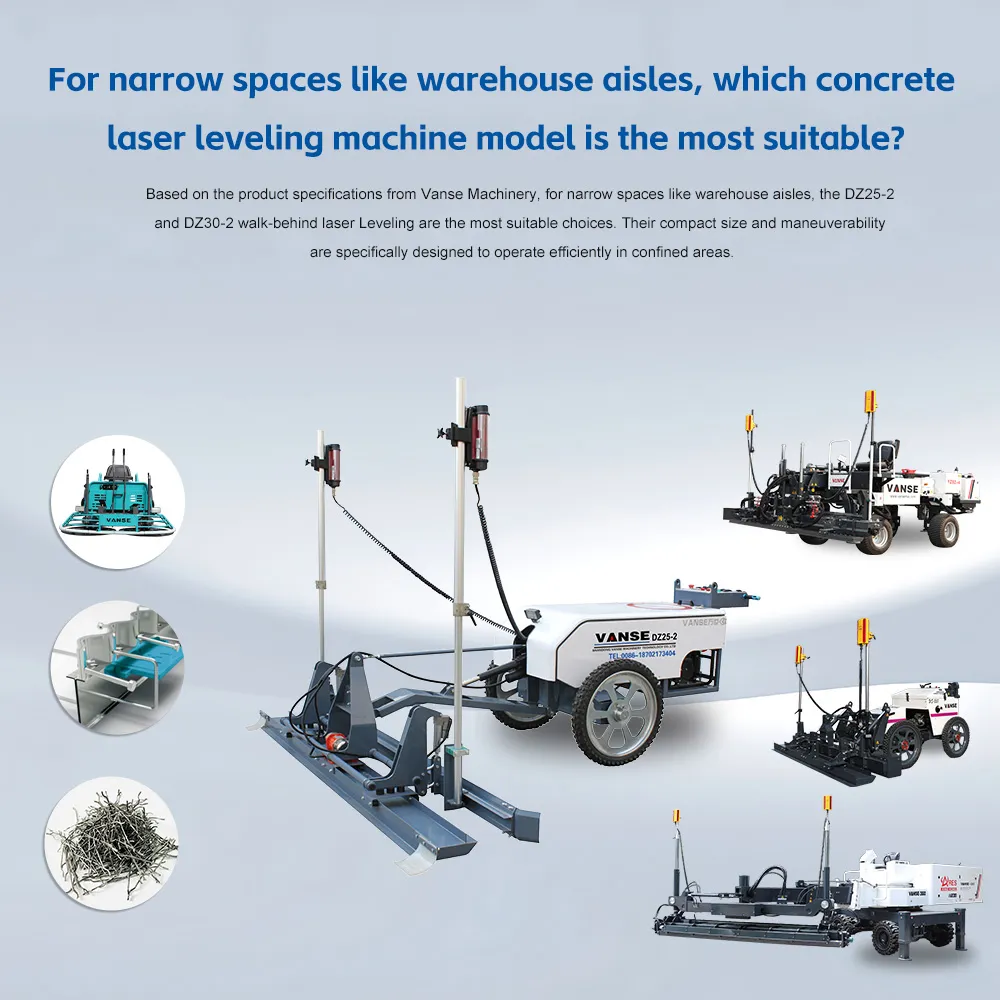
For narrow spaces like warehouse aisles, which concrete laser leveling machine model is the most suitable?
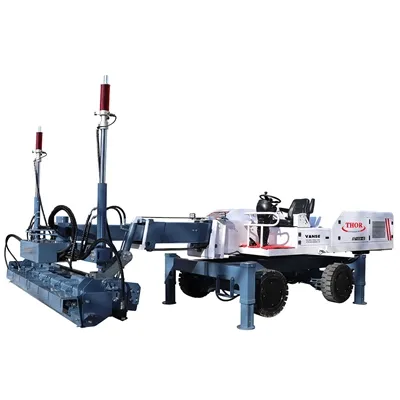
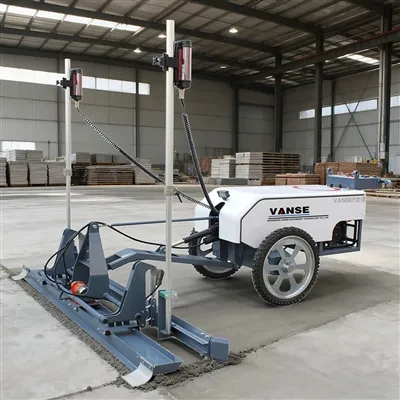
Based on the product specifications from Vanse Machinery, for narrow spaces like warehouse aisles, the DZ25-2 and DZ30-2 walk-behind laser Leveling are the most suitable choices. Their compact size and maneuverability are specifically designed to operate efficiently in confined areas. Model Why It's Suitable for Narrow Aisles Key Advantage Typical Application Efficiency DZ25-2 Light and flexible for performing high-precision leveling in narrow or complex sites. Compact size, ideal for very tight spaces. Small warehouses, indoor workshops, underground garages. Approx. 200㎡/h DZ30-2 Same core design as DZ25-2, with slightly higher power and efficiency. Light and flexible, with a bit more output. Small warehouses, industrial plants with compact space. Approx. 300㎡/h The DZ series are explicitly recommended on the site for "small warehouses" and "underground garages" where you need to maneuver between columns. Choose the DZ25-2 if your aisles are extremely tight (e.g., under 2 meters wide) and you prioritize maximum maneuverability above all else. Choose the DZ30-2 if your aisles offer a bit more space and you want a slightly faster leveling speed (300㎡/h vs. 200㎡/h) to complete the job more quickly. For wider aisles or large open areas within the warehouse, you might consider larger ride-on models like the WS550 or WS940 series, but the DZ25-2 and DZ30-2 are the clear picks for navigating narrow aisles effectively. If you can share the exact width of your warehouse aisles, I can help confirm if these models will fit perfectly. Contact us NOW Note: The parameters provided in this document are for reference only and are not mandatory. Due to differences in technical characteristics between different brands and models of laser levelers, please consult the manufacturer for a suitable solution before actual operation. This reference document assumes no responsibility for any issues arising from failure to follow the manufacturer's instructions.How does concrete laser leveling technology achieve precise leveling of concrete surfaces?
Concrete laser leveling technology is an efficient construction technology that uses laser beams as reference planes to accurately level the concrete surface through automated equipment to ensure the flatness and accuracy of the concrete floor. This technology has been widely used in the modern construction industry, especially in large industrial plants, warehouses, airport runways, large commercial facilities and other places where there are extremely high requirements for ground flatness. The following is a specific introduction and analysis of concrete laser leveling technology. Technical Overview The core of concrete laser leveling technology is to use laser as a reference. The laser beam emitted by the laser transmitter forms a horizontal plane in the construction area. The construction personnel or machines adjust the laying thickness and flatness of the concrete according to this horizontal plane. > Learn more about leveling machine >> Working Principle The laser leveling machine usually consists of the following parts: – **Laser transmitter**: emits a stable laser beam to form a horizontal reference plane. – **Receiver**: installed on the leveling machine, receives laser signals and converts them into electrical signals. – **Control system**: automatically adjusts the working state of the leveling machine according to the received electrical signal to ensure that the concrete surface is consistent with the laser plane. – **Leveling machine**: According to the instructions of the control system, the concrete surface is leveled through vibration and scraping functions. > Learn more about leveling machine >> Technical advantages – **High efficiency**: The laser leveling machine can quickly complete the leveling of large-area concrete, saving manpower and time. – **High precision**: Laser leveling technology can ensure that the flatness of the concrete surface reaches extremely high standards and reduce subsequent finishing work. – **Reduce material waste**: Reduce material waste by accurately controlling the laying thickness of concrete. – **Improve construction quality**: A flat concrete surface can improve the overall quality and service life of the building. > Learn more about leveling machine >> Construction process 1. **Site preparation**: Clean the construction site to ensure that the ground is clean and flat. 2. **Laser transmitter setting**: Set the position and angle of the laser transmitter according to construction requirements. 3. **Concrete pouring**: Concrete is poured with the assistance of the laser leveling machine. 4. **Leveling operation**: The laser leveling machine automatically adjusts the scraper height according to the laser signal for leveling. 5. **Surface treatment**: After leveling, the concrete surface is smoothed and calendered to improve the surface quality. 6. **Quality inspection**: Use professional equipment to inspect the flatness and levelness of the concrete surface. > Learn more about leveling machine >> Technical application Laser leveling technology is widely used in the following fields: – **Industrial plants**: Large, flat floors are required for mechanical operation and cargo storage. – **Commercial facilities**: Such as shopping malls, exhibition halls, etc., require flat floors to provide a good customer experience. – **Airport runways**: There are extremely high requirements for flatness and strength to ensure the safe takeoff and landing of aircraft. – **Roads and bridges**: Precise flatness is required to ensure the smoothness and safety of vehicle driving. > Learn more about leveling machine >> Technical challenges and solutions – **Environmental factors**: Such as wind force, temperature changes, etc. may affect the stability of the laser. The solution is to improve the stability of the laser transmitter through technical improvements. – **Equipment maintenance**: Laser leveling machines require regular maintenance to ensure their performance. The solution is to establish a complete maintenance system and train operators. – **Training of construction personnel**: Operating a laser leveling machine requires professional knowledge and skills. The solution is to provide professional training courses. > Learn more about leveling machine >> Future development With the advancement of science and technology, laser leveling technology is also developing. Future development directions may include: – **Intelligentization**: Improving the automation level of leveling machines by integrating more intelligent sensors and control systems. – **Multifunctionality**: Developing leveling machines that can complete multiple construction tasks at the same time. – **Environmentally friendly materials**: Researching and using more environmentally friendly concrete materials to reduce the impact of construction on the environment. > Learn more about leveling machine >> Conclusion Concrete laser leveling technology has become an indispensable part of modern construction with its advantages of high efficiency, high precision and construction quality. With the continuous advancement and innovation of technology, this technology will play a greater role in the future and bring more possibilities to the construction industry. This article provides a comprehensive introduction to concrete laser leveling technology, including its working principle, technical advantages, construction process, application areas, challenges faced, and future development directions. The article avoids the use of clichés and shows how this technology plays a role in the modern construction industry through specific technical details and practical application cases. I hope this article can provide readers with valuable information and in-depth understanding. > Learn more about leveling machine >>The determination of initial setting time of concrete and the grasp of the best time for the concrete laser leveling to enter the site for operation
The determination of the initial setting time of concrete and the entry timing of laser levelings are directly related to the quality, efficiency and cost of floor construction. Now I will provide you with a detailed analysis of these two core points. The "initial setting" of concrete is a physicochemical process, referring to a point in time when concrete begins to transform from a plastic state to a solid state, rather than a period of time. In terms of standards, the initial setting time refers to the period from the moment water is added and mixed until the concrete loses its fluidity and begins to set. Judgment methods and criteria This is the method stipulated in the national standard (GB/T 50080), which is usually carried out in the laboratory or at important construction sites. Method: Use a penetration resistance meter to penetrate the mortar screened out from the concrete mixture at a specified speed. When the penetration resistance reaches 3.5MPa, the corresponding time is the initial setting time. Advantages: The data is precise, objective and reliable. Disadvantages: It requires dedicated equipment, the operation is rather complicated, and it is not suitable for on-site rapid judgment. In actual construction, workers and technicians mainly rely on the following empirical methods to make judgments: Acupressure method (the most classic) : Apply a slight pressure to the concrete surface (usually with the thumb). The criterion for judgment: If, after pressing with a finger, a clear mark about 2-3 millimeters deep can be left on the surface, and the concrete is not sticky to the hand, with no obvious water marks or slurry overflow around, it is considered to have reached the initial setting state at this time. State analogy: It feels like moist clay or plasticine. Scratch method Make a mark on the concrete surface with a nail, a screwdriver or your finger. The criteria for judgment: The scratch marks are clear, the edges are neat, and the bottom of the scratch can maintain its shape and will not be quickly filled and healed by the slurry. Footprint method A person walks on the concrete and observes the footprints. Judgment criteria: The depth of the footprints should be around 5 to 10 millimeters, and there should be no obvious cracking or excessive bleeding around the footprints. Vibration rod insertion method Insert the small vibrator into the concrete and then pull it out. The criterion for judgment: The hole formed after being pulled out can basically remain in its original state and will not collapse and close rapidly. Important note: The on-site experience method requires construction personnel to have certain experience. The best practice is to make a comprehensive judgment by combining multiple methods and compare it with the estimated initial setting time provided by the laboratory. The entry timing of the laser leveling must be closely coordinated with the setting state of the concrete. Entering the market too early or too late can lead to serious problems. Question Sinking: The tracks or wheels of the leveling may get stuck in the concrete, causing deep ruts and disrupting the flatness. Bleeding: The equipment's rolling will force water and fine particles to float up, forming a surface slurry layer, which leads to dusting, sanding and insufficient strength in the later stage. The concrete cannot support the weight of the equipment, and the leveling head cannot be effectively leveled. Instead, it will disrupt the concrete. Condition description: The fingerprinting mark is very deep (>5mm), or the footprint is deeply sunken, and the scratch heals rapidly. Question Construction difficulties: The resistance of the leveling machine's movement is huge, the engine load is high, and it may even be unable to move. Poor surface quality: The flat head cannot effectively smooth out the already hardened surface, leaving marks of roughening and cracking, which damages the integrity of the surface. Poor joint: It cannot bond well with the subsequent poured concrete, resulting in cold joints. Ineffective compaction: The concrete has lost its plasticity, and the vibration of the leveled head cannot make it compact again. Condition description: There is almost no mark when pressed by finger, or a very strong force is needed to leave a shallow mark. The edge of the scratch will crack. The laser leveling should be put into operation when the concrete reaches the initial setting state, or slightly earlier than the initial setting (that is, close to the initial setting but not yet fully reached). Specific timing to grasp Core standard: When using the finger press method and the depth of the finger press impression is around 3-5mm, it is the best time for the leveling to enter the site. Operation process connection: The ideal construction process is: The preparatory processes: concrete spreading, initial vibration, and leveling with scraping bars have been completed. Wait for the right moment: Let the concrete stand naturally, bleed water and evaporate, gradually developing towards the initial setting state. During this period, workers can carry out manual operations such as edge and corner treatment. Judgment and entry: The construction supervisor continuously observes the condition of the concrete. Once it reaches the aforementioned "golden finger pressure standard", they immediately direct the laser leveling machine to enter the site. High-efficiency operation: The leveling, with its highly efficient functions of scraping, vibrating and leveling, can quickly complete large-scale operations when the concrete is still plastic but capable of supporting the weight of the equipment at its optimal state. Prediction is key: Before construction, it is necessary to understand the mix ratio of the concrete to be used and the estimated initial setting time measured in the laboratory (for example, at 20℃, the initial setting time of ordinary concrete is approximately 4 to 6 hours). This provides a time reference for on-site judgment. Environmental factors: Temperature, humidity and wind speed have a significant impact on the initial setting time. High temperature, strong wind and low humidity will shorten the initial setting time. It is necessary to prepare in advance to reduce the waiting time. Conversely, it will be extended. Personnel and Communication: A designated person (such as a foreman or technician) must be assigned to determine the initial setting time and maintain smooth communication with the equipment operator. It's better to arrive a little earlier than too late: When it's impossible to make an accurate judgment, entering the site a little earlier (the concrete is slightly softer) might just require dealing with the track indentations. However, if the entry is too late and the concrete becomes too hard, the quality problems caused are almost irreversible and the handling cost is extremely high. In short: When you "feel" the concrete with your hand and it feels like a moist and solid piece of clay, that's the best time for the laser leveling to shine. Accurately seizing this opportunity is the core technology for creating high-level and high-quality concrete floors. Note: The parameters provided in this document are for reference only and are not mandatory. Due to differences in technical characteristics between different brands and models of laser levelers, please consult the manufacturer for a suitable solution before actual operation. This reference document assumes no responsibility for any issues arising from failure to follow the manufacturer's instructions.