Technical Knowledge
Rotary VS ride-on power trowel—Which polishes super flat floors better
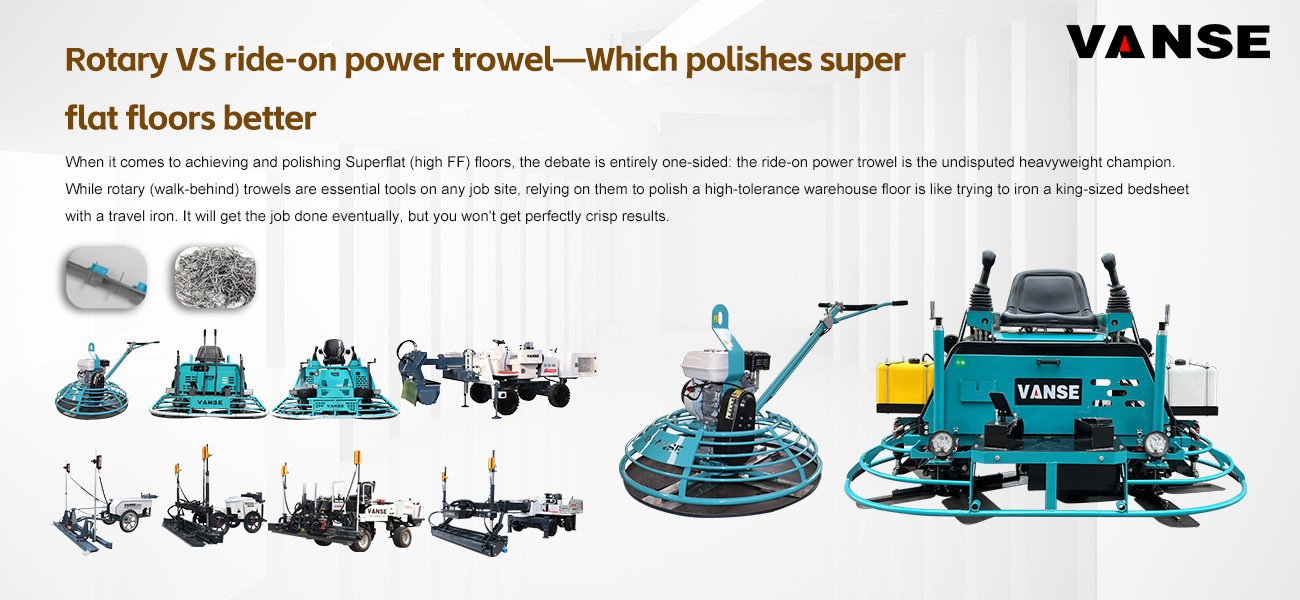
When it comes to achieving and polishing Superflat (high FF) floors, the debate is entirely one-sided: the ride-on power trowel is the undisputed heavyweight champion. While rotary (walk-behind) trowels are essential tools on any job site, relying on them to polish a high-tolerance warehouse floor is like trying to iron a king-sized bedsheet with a travel iron. It will get the job done eventually, but you won't get perfectly crisp results.
Here is the technical breakdown of why ride-on trowels dominate the Superflat and polishing arenas.
1. The "Bridging" Effect (Maximizing Flatness)
The primary goal of a Superflat floor is high FF (Flatness), which means eliminating the microscopic "waves" in the concrete.
Ride-On Trowels: Because they feature dual (or triple) overlapping rotors and a wide, rigid wheelbase, they act like a massive carpenter's plane. When equipped with float pans, a ride-on trowel "bridges" the low spots and violently shaves off the high peaks.
Walk-Behind Trowels: A walk-behind has a single, small rotor. Instead of bridging the waves, it tends to ride up and down them. If you aren't careful, a walk-behind can actually create dips and dishing, ruining your FF numbers.
2. Downward Pressure (The Secret to Polishing)
Polishing and densifying the surface (creating that hard, dark "burnished" look) requires extreme friction and pressure.
Ride-On Trowels: These machines weigh anywhere from 800 lbs to over 2,500 lbs. That massive downward force, combined with high-speed rotors and a steep blade pitch, generates the heat and friction necessary to melt the surface paste into a glass-like finish.
Walk-Behind Trowels: Weighing in at only 150 to 300 lbs, they simply do not have the mass to forcefully close the pores of the concrete to the same density as a ride-on.
3. The "Footprint" Problem
This is the most critical factor for Superflat floors.
Walk-Behind Trowels: The operator must physically walk backward on the curing concrete. Even when the concrete is firm enough to support a machine, work boots can still leave millimeter-deep micro-depressions. Every footprint is a localized failure in flatness.
Ride-On Trowels: The operator sits on the machine. The weight is entirely distributed across the massive surface area of the rotors or float pans, leaving zero footprints and maintaining the pristine levelness established by the laser Leveling.
4. Head-to-Head Comparison for High-Spec Floors
| Feature | Ride-On Power Trowel | Walk-Behind (Rotary) Trowel |
| Superflat Capability | Exceptional (Bridges waves) | Poor (Follows contours) |
| Burnishing/Polishing | Superior (High downward pressure) | Moderate (Lacks weight) |
| Surface Disruption | Zero (Operator rides) | High (Operator footprints) |
| Best Used For | The main floor (the "runway") | Edges, tight corners, around pipes |
5. The Perfect Partnership
It is worth noting that you still need both machines on a Superflat project. A massive ride-on trowel cannot get within a few inches of a wall or a structural column without risking damage to the concrete or the machine.
The standard Superflat workflow uses ride-on trowels for 95% of the floor area to establish the density and flatness, while a skilled operator uses a walk-behind trowel equipped with a rotating edge ring to manually polish the remaining 5% along the perimeter.
Would you like me to outline a specific overlapping pass pattern for a ride-on trowel to ensure you don't create ridges while pushing for maximum FF numbers? Contact us NOW
Note: The parameters provided in this document are for reference only and are not mandatory. Due to differences in technical characteristics between different brands and models of laser levelers, please consult the manufacturer for a suitable solution before actual operation. This reference document assumes no responsibility for any issues arising from failure to follow the manufacturer's instructions.
Thanks to All the Friends Who Support and Trust Shandong Vanse Machinery Technology Co., Ltd.
If you want to know more about Shandong Vanse Machinery Technology Co., Ltd. or have any questions, please feel free to contact us:
Our Factory
Shandong Vanse Machinery Technology Co., Ltd.








Share this article

About the Author: Shandong Vanse Machinery Technology Co., Ltd.
Shandong Vanse Machinery Technology Co., Ltd. is a high-tech manufacturer specializing in concrete construction machinery, including laser screeds and related equipment. The company integrates R&D, production, and global sales, with products exported to over 60 countries and widely used in infrastructure projects worldwide.
Previous Post
Next Post
Related Articles
You Might Also Like
Manual leveling VS laser leveling—Which is better for large concrete floors?
For large-scale concrete flooring (typically anything over 500 m²), Laser Leveling is the undisputed industry gold standard. While manual leveling still has a place in residential or highly complex, tight spaces, it cannot compete with the precision and speed of laser technology in an industrial or commercial setting. Here is a detailed breakdown of how they compare across critical performance metrics: Objective: To prevent problems before they occur and promptly identify potential issues through daily observation. Feature Manual Leveling (Traditional) Laser Leveling (Automated) Accuracy (FF / FL) Low to Moderate (FF 20-35) High to Ultra-High (FF 50-100+) Daily Output ~300–500 ㎡ 1,500–3,000+ ㎡ Labor Intensity Extremely high (8-12 people) Moderate (3-5 people) Joint Frequency Many construction joints (every 4-6m) Fewer joints (large pour strips) Consistency Highly dependent on worker fatigue Machine-consistent precision Laser Levelings receive a signal from a stationary transmitter 300 times per minute. This real-time hydraulic adjustment ensures the floor is leveled to within millimeters. Manual Downside: Humans using straightedges naturally create "waves" as they get tired, leading to poor FF (Flatness) scores. In large floors, joints are the "weakest link"-they are where cracks start and forklift tires wear out. Laser: Allows for large-area pours (e.g., 2,000 ㎡ in one go), significantly reducing the number of construction joints. Manual: Requires "form-to-form" pouring in narrow strips, creating a grid of joints that increases maintenance costs. Laser Levelings use high-frequency vibration (usually 3,000–4,000 rpm) integrated into the leveling head. This ensures the concrete is uniformly compacted from bottom to top. Manual tamping often leaves air pockets or inconsistent density, especially in thicker slabs. Despite the superiority of lasers, manual methods are preferred in these specific scenarios: Highly Congested Areas: Floors with hundreds of vertical penetrations (pipes, columns, or drains) where a machine cannot maneuver. Sloped Drainage: While 3D laser systems can handle slopes, simple manual Leveling is often more cost-effective for small wash-down areas with complex multi-directional falls. Low-Budget/Small Scale: For a small garage or a space under 200 ㎡, the mobilization cost of a laser Leveling is rarely justifiable. While a laser Leveling has a higher daily rental/operation cost, it is usually cheaper per square meter on large projects because: Reduced Labor: You need fewer skilled finishers. Faster Schedule: You can finish a 10,000 ㎡ warehouse in 4-5 days instead of 20 days. Lower Material Waste: Precision leveling prevents "over-pouring" (lowering concrete waste by 3-5%). For a warehouse, hangar, or factory floor, Laser Leveling is mandatory. Manual leveling in these environments is a liability that leads to poor floor performance and high long-term maintenance costs. Would you like me to help you calculate the estimated "Time vs. Cost" savings for a specific floor area you are planning? Contact us NOW Note: The parameters provided in this document are for reference only and are not mandatory. Due to differences in technical characteristics between different brands and models of laser levelers, please consult the manufacturer for a suitable solution before actual operation. This reference document assumes no responsibility for any issues arising from failure to follow the manufacturer's instructions.Concrete laser leveling machine winter maintenance tips
The strongest cold wave hits, Wanshi machinery warm reminder you now is the off-season construction, machine maintenance can not slack off oh, here is the winter maintenance of the machine super practical knowledge, the following winter maintenance measures are in the routine maintenance needs special attention to matters, must be completed under the premise of conventional maintenance: Before the onset of winter, replace the winter fuel in advance to avoid the wax accumulation of ordinary diesel in the filter element and pipeline due to low temperature, thus causing the engine to fail to start normally. Choose a standard engine oil. Open the anti-icing device of the compressed air system and check the ether level regularly. Many engines require additional additives in the coolant, known as SCA (Supplemental Coolant Additive). It is usually used in the process of contact between aluminum parts and coolant, so as to prevent metal corrosion, mineral precipitation, cylinder liner cavitation and foaming more effectively. Please refer to the machine's manual for details. Electrical system maintenance: Please start the engine once every half a month, charge the battery, and run all hydraulic actuators, such as rotating hydraulic motor, telescopic cylinder, etc. Do not remove the battery from the machine to prevent the failure of the internal software program of the controller due to the loss of the equipment for a long time. Hydraulic system maintenance: Start the machine regularly and open all hydraulic functions on the machine, so that the hydraulic drive components work regularly, in order to prevent the related seals due to long time parking damage, and cylinder rod and other metal components corrosion and other failures. As far as possible, all cylinder rods are shrunk into the hydraulic cylinder cavity to better protect the surface of the cylinder rod. Maintenance of mechanical parts: Before parking the machine for a long time in winter, lubrication and maintenance of each mechanical hinge point and bearing should be done well. Check the integrity of the dustproof cover of each mechanical component, and replace the damaged seals in time. Metal contact surfaces exposed to air should be treated against rust. Start the engine regularly and run all reduction gear boxes to prevent the shaft seals and rubber seals in the gear boxes from being damaged by long-term parking and bonding with gear oil.The laser leveling machine parts frequently fail. How much do you know about the correct avoidance methods?
If the laser leveling machine is used for too long or the method of use is incorrect, the various components will frequently fail. To prevent such a phenomenon from happening, it is necessary to check the wear of the equipment accessories in time. If the wear phenomenon is serious, the seriously worn accessories should be replaced in time to avoid affecting the normal use of the equipment. Let's take a detailed look at the methods to prevent frequent failures of laser leveling machine parts. 1. Check the connection and fastening of the various parts of the laser leveling machine, whether the connecting bolts are loose or broken, tighten or replace them if necessary, check whether there are leaks, and eliminate leaks in various parts in time. Pay attention to the amount of engine oil, fuel, coolant and hydraulic oil, and add new oil to the oil mark as required. Check whether the grease in the centralized lubrication device is appropriate. 2. Be careful not to work under a larger load than the machine can bear. Use the machine to the best of your ability. As a laser leveling machine manager, when designating an operator, you should give the laser leveling machine random information and operation manual to the operator so that he can master the mechanical performance and operating procedures normally, and should not arbitrarily withhold the relevant information. 3. Try to ensure the uniform addition and subtraction of mechanical load, so that the machine is in a relatively gentle load change. Specifically, it is necessary to add and subtract the throttle more evenly to prevent the engine and working device from fluctuating greatly. After the construction, there will be a lot of dust and mud on the equipment. First, wipe the dust on the laser leveler clean, and wipe the dirt and oil stains with thin paper or cotton cloth. 4. If the laser signal is lost during the construction of the laser leveler, the machine needs to be restarted. The interval time is more than ten seconds. If there are too many stains, you can soak it in water diluted with neutral detergent with a soft cloth, wring it out and wash it. Remember not to use volatile oil, thinner, gasoline and other chemicals to clean and wipe. The laser leveler uses several automatic control components to monitor the elevation of the leveling head in real time, and the monitoring frequency is relatively high, which can reach about 10 times per second. The above is a method to prevent the failure of laser leveler components. You can learn about it in detail. If you have any ideas and need to understand the intention of the product during the reading process, you can contact us in time, and we will have professional technicians to help you solve the problem.