Technical Knowledge
How to adjust power trowel settings for concrete floors with integrated heating systems
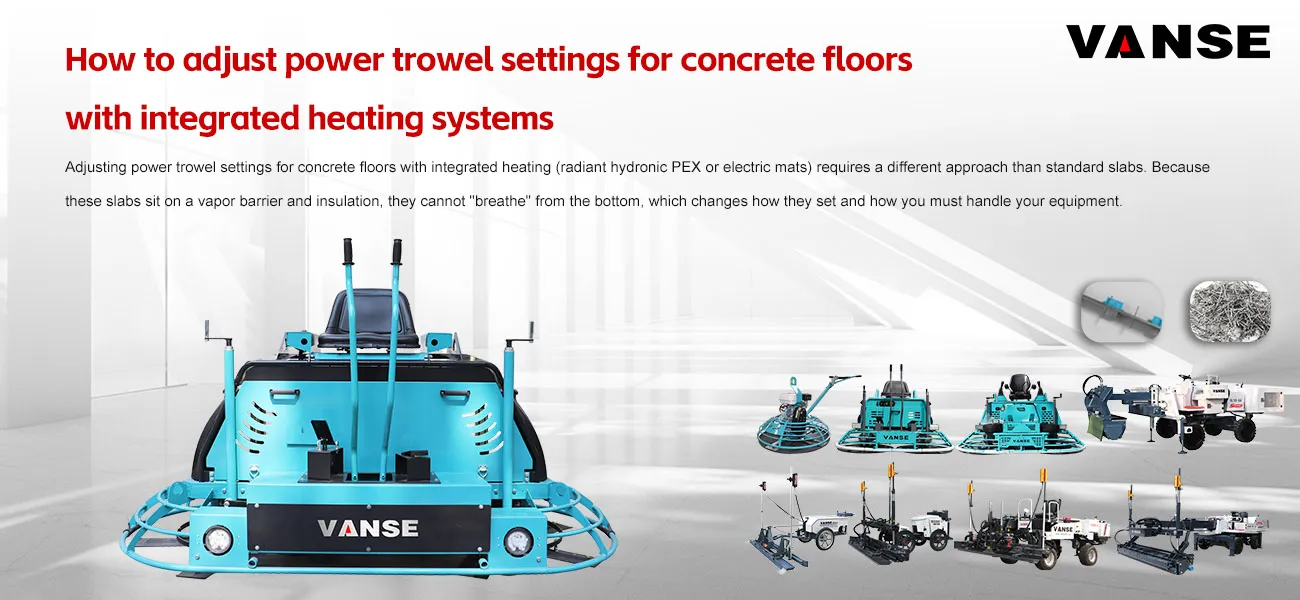
Adjusting power trowel settings for concrete floors with integrated heating (radiant hydronic PEX or electric mats) requires a different approach than standard slabs. Because these slabs sit on a vapor barrier and insulation, they cannot "breathe" from the bottom, which changes how they set and how you must handle your equipment.
The following guide outlines how to manage your pitch, speed, and timing to ensure a dense finish without causing delamination or "crusting."
1. Initial Floating (Stage 1)
The "floating" phase is about leveling and embedding aggregate. For radiant slabs, the presence of insulation below means all bleed water must travel to the top.
Timing: Wait for the "Footprint Test." The concrete should support the machine and an operator, leaving a depression no deeper than 3–6 mm (1/8" to 1/4").
Blade Pitch: Flat (0° to 2°). Use float pans or combination blades set completely flat.
Rotor Speed: Low (60–80 RPM).
Strategy: Keep the machine moving. Because the slab is "unbonded" (sitting on insulation), it is more prone to shifting or "curling" if you dwell in one spot too long.
2. Intermediate Finishing (Stage 2)
Once the surface sheen (bleed water) has disappeared, you move to the intermediate passes. This is where the risk of "crusting" is highest.
Blade Pitch: Slight Pitch (5° to 10°). Increase the angle by about two turns of the hand crank.
Rotor Speed: Medium (80–110 RPM).
The "Crust" Warning: Because the bottom of the slab stays wet (due to the vapor barrier) while the top dries, you may experience a "crust" where the top seals while the inside is still plastic.
Adjustment: If you see the surface peeling or "tearing," reduce your pitch and slow down. You need to let more moisture escape before sealing the surface.
3. Final Finishing/Burnishing (Stage 3)
This stage creates the hard, polished look typical of modern concrete floors.
Blade Pitch: Steep (15° to 25°). As the concrete gets harder, the blades should be tilted sharply to apply high pressure to a small surface area.
Rotor Speed: High (120–150+ RPM).
Blade Choice: If the floor is to remain as exposed polished concrete, consider plastic or composite blades for the final passes. Steel blades can leave "burnish marks" (dark streaks) which are more visible on heated slabs due to the way they cure.
Summary of Settings by Stage
| Pass Stage | Blade Pitch (Angle) | Rotor Speed (RPM) | Purpose |
| Float | Flat (0°–2°) | 60–80 (Low) | Leveling & Agg. Embedding |
| Intermediate | 5°–10° (Moderate) | 90–110 (Medium) | Closing the surface |
| Finish | 15°–25° (Steep) | 120–150 (High) | Polishing & Densifying |
Crucial Tips for Heated Slabs
Keep the Heat OFF: Never have the radiant heating system running during the pour or the finishing process. The heat will cause "flash setting" on the bottom of the slab while the top remains wet, leading to severe curling and cracks.
Monitor "Cover Depth": Ensure your heating elements are at least 40–50 mm (1.5" to 2") below the surface. If the PEX is too shallow, a heavy ride-on trowel or a high-pitch blade can "chatter" against the high spots, potentially damaging the tubes.
Weight Matters: For radiant slabs, walk-behind trowels are often preferred over heavy ride-ons for the first pass. The insulation layer (EPS/XPS) can compress slightly under extreme weight, causing the slab to deflect while it’s still green.
Pressure Test Throughout: Keep the heating system pressurized with air (typically 20–30 PSI) during the troweling. If a blade accidentally clips a shallow tube, you will hear the air escaping immediately, allowing for a repair before the concrete hardens.
Would you like me to find a specific concrete mix recommendation (slump or additives) that helps reduce the "crust" formation on radiant floors? Contact us NOW
Note: The parameters provided in this document are for reference only and are not mandatory. Due to differences in technical characteristics between different brands and models of laser levelers, please consult the manufacturer for a suitable solution before actual operation. This reference document assumes no responsibility for any issues arising from failure to follow the manufacturer's instructions.
Thanks to All the Friends Who Support and Trust Shandong Vanse Machinery Technology Co., Ltd.
If you want to know more about Shandong Vanse Machinery Technology Co., Ltd. or have any questions, please feel free to contact us:
Our Factory
Shandong Vanse Machinery Technology Co., Ltd.








Share this article

About the Author: Shandong Vanse Machinery Technology Co., Ltd.
Shandong Vanse Machinery Technology Co., Ltd. is a high-tech manufacturer specializing in concrete construction machinery, including laser screeds and related equipment. The company integrates R&D, production, and global sales, with products exported to over 60 countries and widely used in infrastructure projects worldwide.
Previous Post
Next Post
Related Articles
You Might Also Like
How Do The Laser Transmitter And Receiver Of A Concrete Laser leveling Work?
How the laser transmitter and receiver of a concrete laser leveling machine work Concrete laser leveling machine, as an important equipment in modern building construction, has been widely used in the construction industry with its efficient and accurate ground leveling capabilities. In this machine, the laser transmitter and receiver play a vital role, working together to ensure the flatness and accuracy of the concrete surface to predetermined standards. This article will discuss in detail the working principle of the laser transmitter and receiver of the concrete laser leveling, including its principle, signal transmission and processing, precise positioning and calibration, etc., and also discuss the impact of environmental factors on the equipment and the maintenance and upkeep of the equipment. Key points, and finally a summary and outlook on technology applications and development trends. 1. Principle of laser transmitter The laser transmitter is one of the core components of the concrete laser leveling. Its main function is to emit a stable, high-precision laser beam. These laser beams provide the leveling with a reliable reference, allowing the machine to precisely control the concrete paving and leveling process. The working principle of a laser transmitter is based on the physical process of laser generation. With specific optical components and excitation sources, laser transmitters are able to produce a high-quality laser beam. This laser beam has extremely high directivity and monochromaticity, allowing it to maintain stable characteristics during propagation. At the same time, laser transmitters are usually equipped with angle and height adjustment devices so that users can adjust the direction and projection range of the laser beam according to actual needs. In the application of concrete laser leveling machine, the laser transmitter is placed on a stable platform to ensure the stability of the laser beam. By adjusting the angle and height of the emitter, precise control of the laser beam can be achieved to meet different construction needs. 2. Working principle of the receiver The laser receiver is another key component of the concrete laser leveling machine. It is responsible for receiving the laser beam emitted by the laser transmitter and converting it into a processable electrical signal. These electrical signals are then used to control the operation of the leveling, ensuring a smooth surface on the concrete. The working principle of the laser receiver is based on the principle of photoelectric conversion. When the laser beam irradiates the photoelectric element on the receiver, the photoelectric element will generate a photocurrent. The size of this photocurrent is proportional to the intensity of the laser beam, so the photocurrent can be measured. size to determine the intensity of the laser beam. At the same time, the receiver can also focus and filter the laser light through the built-in optical system to improve the receiving sensitivity and anti-interference ability. During the operation of the concrete laser leveling, the laser receiver needs to be kept within the irradiation range of the laser beam at all times. When the receiver receives the laser beam, it converts the optical signals into electrical signals and transmits these signals to the leveler's control system. The control system calculates the actual height and position information of the concrete surface based on the received signals, and adjusts the working parameters of the leveling machine accordingly, such as the height and vibration frequency of the blade, to achieve accurate leveling effects. 3. Signal transmission and processing Signal transmission and processing between the laser transmitter and receiver are the key to achieving high-precision operation of the leveler. In concrete laser leveling machines, signal transmission mainly relies on transmission media such as electrical or optical fiber. These media transmit the electrical signals converted by the laser receiver to the leveler's control system. After the control system receives the signal, it processes and analyzes it. This process usually includes signal amplification, filtering, conversion and calculation steps. Through signal processing, the control system can accurately obtain the height and position information of the concrete surface and compare it with the preset leveling standards. Based on the comparison results, the control system will adjust the working parameters of the leveling machine to achieve the desired leveling effect. 4. Precise positioning and calibration The precise positioning and calibration of the laser leveler is an important part of ensuring construction quality. The leveler requires initial calibration before work to ensure precise alignment between the laser transmitter and receiver. Initial calibration involves adjusting parameters such as the height and angle of the transmitter, and the position and sensitivity of the receiver. During the construction process, the leveling machine also needs to be calibrated in real time to deal with possible errors and changes. Real-time calibration is usually achieved by comparing the difference between the received laser signal and a preset value. When the difference exceeds the allowable range, the leveler will automatically adjust the working parameters to eliminate the error. In addition, the laser leveling machine is equipped with high-precision sensors and control systems to achieve more accurate positioning and calibration. These sensors can monitor the position and status of the leveling machine in real time and provide accurate data support for the control system. 5. Impact of environmental factors on Environmental factors have a non-negligible impact on the performance of the laser transmitter and receiver of the concrete laser leveling. First, changes in temperature can cause changes in the performance of laser transmitters and receivers. Such as the stability of the laser beam, the sensitivity of the photoelectric components, etc. In a high-temperature environment, the equipment may overheat, affecting its normal operation; while in a low-temperature environment, the performance of some components may be degraded due to low temperatures. In addition, humidity and dust are also important factors affecting the performance of laser transmitters and receivers. A high-humidity environment may cause condensation inside the device, affecting the normal operation of electronic components; and the accumulation of dust may block the receiving surface of the photoelectric component and reduce the receiving sensitivity. Therefore, when using a concrete laser leveling, it is necessary to fully consider the impact of environmental factors on the performance of the equipment and take appropriate measures for protection and maintenance. For example, in high-temperature environments, heat dissipation measures can be taken, such as installing fans or radiators; in environments with high humidity, the equipment can be dehumidified regularly; at the same time, regular cleaning of the surface and interior of the equipment is also necessary. 6. Maintenance and Maintenance Points The maintenance and upkeep of the concrete laser leveling machine is the key to ensuring its long-term stable operation. For laser transmitters and receivers, the following are key maintenance and care points: First, regularly check the optical components of the laser transmitter and receiver to ensure that their surfaces are clean and dust-free. Any dirt or scratches may affect the transmission and reception quality of the laser beam. Special cleaning cloths and detergents should be used for cleaning, and harsh chemical solvents should be avoided. Secondly, keep the mechanical parts of the transmitter and receiver in good condition, regularly check whether the fasteners are loose, and lubricate the moving parts to ensure their normal operation and extend their service life. At the same time, pay attention to waterproofing and moisture-proofing to avoid using the device in humid or harsh environments to avoid damaging electronic components. In addition, regular calibration of the equipment is necessary. Since the equipment may be affected by various factors during use, resulting in changes in the signal shift of the laser beam or the receiving sensitivity, regular calibration can ensure the accuracy and stability of the equipment. Finally, equipment that is not used for a long time should be properly stored. The device should be placed in a dry, ventilated environment away from direct sunlight and high temperatures. At the same time, the equipment should be powered on regularly to ensure the normal operation of its circuits and components. 7. Technology Application and Development The application of warm concrete laser leveling machines in the construction industry has become more and more widespread, and its characteristics of high precision and high efficiency have been widely recognized. With the continuous development of science and technology, the performance of laser transmitters and receivers are also constantly improving, providing more reliable technical support for the work of the leveling machine. In the future, with the continuous advancement of laser technology and the improvement of intelligence level, concrete laser leveling machines are expected to achieve higher precision and wider applications. For example, by optimizing the design of the laser transmitter and receiver, the stability and anti-interference ability of the laser beam are improved; by introducing more advanced control systems and sensors, more precise positioning and calibration can be achieved; at the same time, the Internet of Things and Big data technology enables remote monitoring and intelligent maintenance of equipment, improving equipment efficiency and reliability. In addition, with the continuous improvement of environmental awareness, the application of concrete laser leveling machines in green construction will also receive more attention. By optimizing equipment design and construction technology, energy consumption and waste emissions are reduced to achieve green and environmentally friendly building construction. 8. Summary and Outlook The laser transmitter and receiver of the concrete laser leveler are key components to achieve high-precision leveling. They provide reliable reference and control signals for the leveling machine by emitting and receiving laser beams. During use, you need to pay attention to the impact of environmental factors on equipment performance, and take appropriate measures for protection and maintenance. Looking to the future, with the continuous advancement of science and technology and the continuous expansion of application fields, concrete laser levelings are expected to achieve higher precision, wider applications and more environmentally friendly construction methods. At the same time, we also need to continue to pay attention to the development of new technologies and new materials, promote technological innovation and industrial upgrading of concrete laser leveling machines, and make greater contributions to the sustainable development of the construction industry. In short, the laser transmitter and receiver of the concrete laser leveling are the key links to ensure construction accuracy and efficiency. By in-depth understanding of its working principle and maintenance points, we can better utilize this advanced technology, improve the quality and efficiency of construction, and promote the sustainable development of the construction industry.How maintainable is a concrete laser leveling machine?
Concrete laser leveling machine maintainability With the rapid development of the construction industry, concrete laser leveling machines, as an efficient and accurate concrete construction equipment, are widely used in various construction projects. However, in order to ensure the long-term stable operation of the equipment, reduce the failure rate, and improve production efficiency, research on the maintainability of concrete laser leveling machines is crucial. This article will take an in-depth look at concrete laser leveling serviceability and its impact on equipment performance. ◆Working principle and composition of concrete laser leveling machine Concrete laser leveling machines mainly work based on a combination of laser technology and scraping machinery. It generates a laser beam through a laser transmitter and receives and calibrates it through a receiver. The leveling head is responsible for reflecting the laser beam onto the work surface and smoothing the concrete surface. In addition, the equipment is equipped with support wheels and steering wheels to ensure operational stability and flexibility. ◆The importance of maintainability Maintainability refers to the nature of equipment that can be easily repaired and maintained during operation. Good maintainability can improve the operating efficiency of equipment, reduce failure rates, and reduce downtime, thereby saving costs for enterprises and improving production efficiency. In addition, for equipment that operates continuously for a long time, such as concrete laser levelings, good maintainability is the key to ensuring stable operation of the equipment. ◆Maintainability design of concrete laser leveling machine In order to improve the maintainability of concrete laser leveling machines, designers need to consider the following aspects: ★Modular design: The main components of the equipment are designed into modules, which can be easily replaced and repaired. For example, components such as the leveling head, support wheels and steering wheels can be designed as modules and can be quickly replaced in the event of failure. ★Easy disassembly design: Designers should consider the ease of disassembly and assembly of the equipment. For example, standardized connection methods should be used at the connections between the main components of the equipment to facilitate disassembly and assembly. ★Lubrication and maintenance design: The moving parts of the equipment should be lubricated and maintained regularly to reduce wear and tear. Designers should consider the lubrication and maintenance cycles of the equipment, as well as the methods and tools for lubrication and maintenance. ★Dust-proof and waterproof design: Concrete laser levelingers often face dust and water environments when working on construction sites. Designers should consider dustproof and waterproof designs for equipment to extend the service life of the equipment. ★Fault prompt design: The equipment should have a fault prompt function. When the equipment fails, the operator can detect it in time and take corresponding measures. ◆M aintenance practices and recommendations for concrete laser leveling machines In actual use, in order to improve the maintainability of the concrete laser leveling, operators need to comply with the following recommendations: ★Regular inspection: Operators should regularly check the wear and tear of various parts of the equipment, especially the moving parts. If parts are found to be severely worn or damaged, they should be replaced in time. ★Keep it clean: The concrete laser leveling machine should be kept clean to prevent dust and debris from entering the inside of the equipment. During operation, avoid dropping debris into the equipment. ★Regular lubrication: The moving parts of the equipment should be lubricated and maintained regularly. Operators should regularly add lubricating oil or grease to the equipment according to the equipment's lubrication and maintenance requirements. ★Moisture-proof and rust-proof: The concrete laser leveling machine should be placed in a dry environment to avoid moisture and rust. After working in a humid environment, water stains and rust on the surface of the equipment should be cleaned in time. ★Back up wearing parts: For some wearing parts, such as scrapers, bearings, etc., some spare parts should be backed up so that they can be replaced in time w hen needed. ★Train operators: Operators should undergo professional training and be familiar with the structure, performance and working principles of the equipment. During the operation, the operating procedures should be strictly followed to avoid damage to the equipment caused by misoperation. ★Establish maintenance files: For each concrete laser leveling machine, a complete maintenance file should be established to record equipment repair records, maintenance records and replacement parts records, etc. Through the establishment of maintenance files, we can better understand the operating status and maintenance status of the equipment, and provide a basis for equipment repair and maintenance. ★Introducing condition monitoring technology: By introducing condition monitoring technology such as vibration monitoring, temperature monitoring, etc., the operating status of the concrete laser leveling can be monitored in real time to detect abnormal situations in a timely manner and take corresponding measures to avoid the expansion of faults, thereby reducing maintenance costs and improving production efficiency. ★Reasonably arrange maintenance plans: Reasonably arrange maintenance plans based on the operating status and maintenance experience of the equipment to avoid excessive maintenance or insufficient maintenance, reduce equipment failure rates and repair costs, and improve equipment maintainability. ★Establish an expert support system: By establishing an expert support system, we provide technical support to operators and maintenance personnel to solve the problems they encounter at work, improve the efficiency and accuracy of problem solving, and thereby improve the maintainability of the equipment. In short, good maintainability is one of the key factors to ensure the long-term stable operation of the concrete laser leveling. Through reasonable design and scientific management, the maintainability of the equipment can be improved, maintenance costs can be reduced, production efficiency can be improved, and more value can be created for the enterprise.Leveling Head Maintenance on a Laser Guided Concrete Leveling
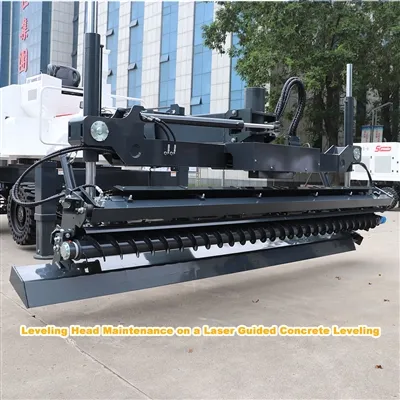
This is an excellent question and one of the most critical maintenance areas for a laser leveling machine. The leveling head is the component that determines your final floor quality, and it operates directly in the most corrosive environment (wet concrete). Here is the expert guide to maintaining the leveling head on a laser-guided concrete leveling. The bearings on the auger and the vibrator assembly are exposed to water, slurry, and abrasive concrete dust. Failure to service them daily is the fastest way to destroy them. When to Grease: You must grease the bearings every time the machine is used, immediately after cleaning. The "Purge" Principle: The goal of daily greasing is not just to add lubrication, but to force out any water, cement paste, or abrasive sand particles that may have entered the bearing seal during the pour or the wash-down. The Process: Use the manufacturer-specified grease (often NLGI-2 Lithium Base Grease). Continue pumping grease slowly until you see clean, fresh grease pushing out past the seals. This confirms the contamination has been expelled. Spares: Keep spare bearings on hand. They are wear parts and will eventually fail, and having a spare prevents downtime on a tight pour schedule. Hardened concrete on the head is the enemy of flatness and machine function. Immediate Cleaning: Power wash the entire leveling head immediately after the pour. Use a brush (stiff plastic or natural fiber, avoid steel unless scraping dry concrete) to remove all residue from the auger flights, the plow, the vibrator bar, and the finish blade. Why it Matters: Concrete build-up changes the weight and balance of the head, causing the machine's automatic leveling and counter-balance systems to work incorrectly, leading to inaccuracies in your floor. Check Head Geometry: The components (plow, auger, finish blade) must be in a specific geometric relationship for the machine to level correctly. Common Setting : The plow is often set approx 1/4 above the bottom of the auger. Wear Check: The finish blade and auger are high-wear items. If they are worn or bent, they change the geometry, and the head will no longer produce the required flatness. Check the flatness of the finish blade with a level and replace it if necessary. Vibration is essential for consolidation, but it also causes hardware to loosen. Fastener Check: Inspect and tighten every nut and bolt on the leveling head before and after a pour. Pay special attention to the bolts holding the vibrator motors and the auger to the main frame, as these are subject to constant, intense vibration. Structural Inspection: Look for small cracks around the mounting points and welds, especially where the head attaches to the boom. These must be addressed immediately by a certified welder to prevent catastrophic failure. Laser Receivers: Ensure the laser receivers (the "eyes") mounted on the masts are clean and secure. Dirt or buildup on the receiver glass can cause signal "jitter," which transfers to the head as slight, uncontrollable movement. Clean: Pressure wash the entire head until spotless. Purge: Grease all auger and vibrator bearings until clean grease is visible. Inspect: Check all nuts/bolts for tightness and verify the plow/auger/blade geometry. Note: The parameters provided in this document are for reference only and are not mandatory. Due to differences in technical characteristics between different brands and models of laser levelers, please consult the manufacturer for a suitable solution before actual operation. This reference document assumes no responsibility for any issues arising from failure to follow the manufacturer's instructions.