Technical Knowledge
Must-have accessories to boost power trowel functionality
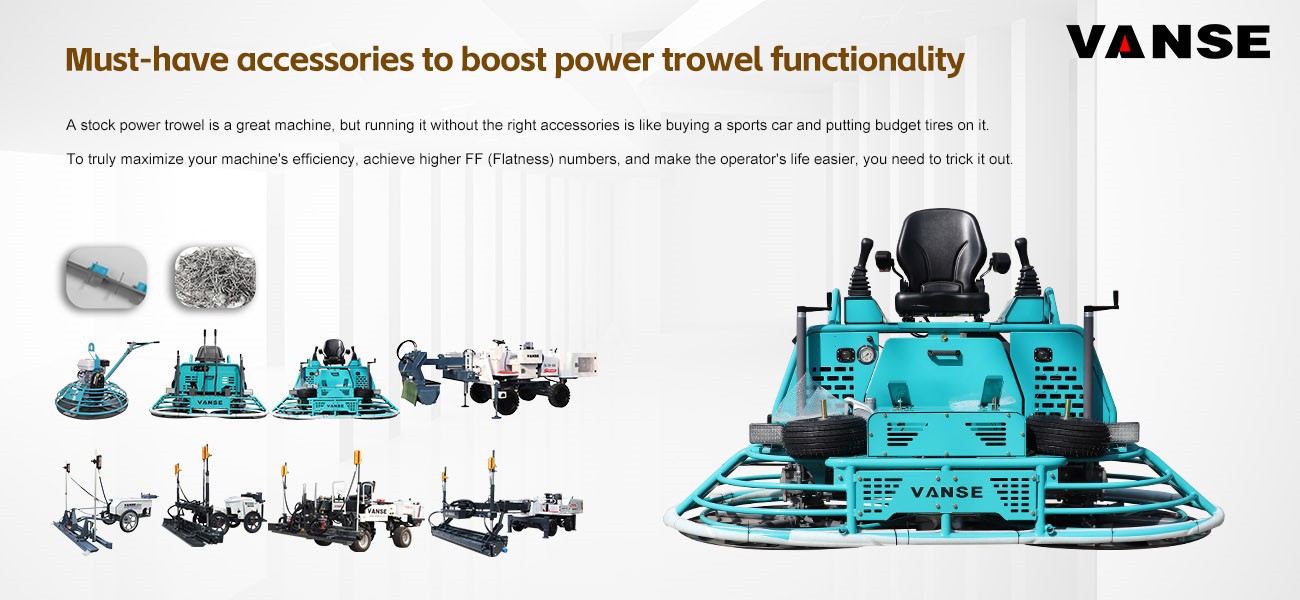
A stock power trowel is a great machine, but running it without the right accessories is like buying a sports car and putting budget tires on it. To truly maximize your machine's efficiency, achieve higher FF (Flatness) numbers, and make the operator's life easier, you need to trick it out.
Here are the must-have accessories to elevate your power trowel from a basic finishing tool to a precision instrument.
1. The Flatness Enhancers
If your goal is high-tolerance floors, these are non-negotiable.
Clip-On Float Pans:
You cannot achieve a Superflat floor with just blades. Float pans clip directly over the finishing blades. They increase the machine's footprint, allowing it to "bridge" low spots and shave off high spots during the critical early stages of curing.
Weight Kits:
As concrete cures and hardens, you need more downward pressure to effectively burnish and seal the surface. Bolt-on weight kits allow you to add calibrated mass to the trowel's frame. This is especially vital for ride-on trowels when you transition to the final finishing passes.
Edging Rings/Free-Wheeling Rotors:
For walk-behind trowels, a rotating outer ring allows the operator to run the machine directly against walls, columns, or forms without damaging the machine or the concrete. It practically eliminates the need for manual hand-troweling the perimeters.
2. Efficiency and Environmental Control
Concrete waits for no one, and you are constantly fighting the environment (sun, wind, and darkness).
On-Board Sprayer Systems: Wind and dry air can cause the surface of the slab to dry out faster than the bottom (crusting). An automated, push-button sprayer tank mounted on the steering column lets the operator hit dry spots with a fine mist of water or evaporation retarder without stopping the machine.High-Output LED Lighting Kits: Many commercial pours happen at night or in poorly lit, unfinished warehouses. Bolt-on LED light bars that run off the machine's alternator illuminate the immediate work area, ensuring the operator can actually see the "cream" and blade marks they are trying to fix.
3. Mobility and Maintenance
Moving a 1,000-pound ride-on trowel or even a 250-pound walk-behind off the slab without damaging the fresh concrete or the blades requires the right gear.
Trowel Dollies (Transport Wheels): Dragging a trowel by its guard ring bends the frame and ruins the rotor pitch. A heavy-duty set of transport wheels hooks under the guard ring, allowing one person to tilt and roll the machine effortlessly across rebar, dirt, or finished floors.
Lifting Bails/Slings: A certified, heavy-duty lifting bail allows a crane or forklift to safely hoist the trowel onto elevated decks or over high foundation walls without warping the machine's center of gravity.
4. Accessory Quick Reference
| Accessory | Best Used For | Walk-Behind or Ride-On? |
| Float Pans | Initial pass, flattening (FF), embedding aggregate | Both |
| Weight Kits | Late-stage finishing, burnishing hard concrete | Primarily Ride-On |
| Edging Rings | Getting tight to walls and columns | Walk-Behind |
| Sprayer System | Applying evaporation retarders, fixing dry spots | Ride-On |
| LED Lights | Early morning/night pours, dark warehouses | Both |
| Transport Dolly | Moving equipment safely off the slab | Both |
Pro Tip: If you invest in float pans, make sure you match the profile to your work. Flat pans are better for sheer flatness and cutting high spots, while Z-pans (beveled edge) are better for transitioning over slightly uneven joints without digging in.
Would you like me to detail the exact sequence of blade and pan changes required to achieve a highly densified, polished concrete finish? Contact us NOW
Note: The parameters provided in this document are for reference only and are not mandatory. Due to differences in technical characteristics between different brands and models of laser levelers, please consult the manufacturer for a suitable solution before actual operation. This reference document assumes no responsibility for any issues arising from failure to follow the manufacturer's instructions.
Thanks to All the Friends Who Support and Trust Shandong Vanse Machinery Technology Co., Ltd.
If you want to know more about Shandong Vanse Machinery Technology Co., Ltd. or have any questions, please feel free to contact us:
Our Factory
Shandong Vanse Machinery Technology Co., Ltd.








Share this article

About the Author: Shandong Vanse Machinery Technology Co., Ltd.
Shandong Vanse Machinery Technology Co., Ltd. is a high-tech manufacturer specializing in concrete construction machinery, including laser screeds and related equipment. The company integrates R&D, production, and global sales, with products exported to over 60 countries and widely used in infrastructure projects worldwide.
Previous Post
Next Post
Related Articles
You Might Also Like
How to deal with the existing cracks in the diamond wear-resistant floor?
How to deal with existing cracks in diamond wear-resistant flooring Diamond wear-resistant flooring has been widely used in industrial plants, warehouses, parking lots and other places due to its high wear resistance, high strength and beautiful appearance. However, during use, cracks may appear in the floor due to the influence of various factors such as materials, construction, and environment. Cracks not only affect the aesthetics of the floor, but also the durability and performance of the floor. Therefore, for cracks in diamond wear-resistant flooring that have already appeared, appropriate treatment methods must be adopted. This article will combine actual cases to explore how to deal with cracks in diamond wear-resistant flooring that have already appeared. 1. Crack type and cause analysis Before dealing with cracks in diamond wear-resistant flooring, it is necessary to first analyze the types and causes of cracks. Crack types mainly include transverse cracks, longitudinal cracks, mesh cracks and irregular cracks. The causes of these cracks are varied, and may involve various factors such as material quality, construction technology, temperature changes, humidity changes, foundation settlement, etc. Therefore, different treatment methods are needed for cracks of different types and causes. 2. Preparation before crack treatment Before treating the cracks in the diamond wear-resistant floor, a series of preparations need to be carried out. First, the cracks need to be inspected and recorded in detail, including the length, width, depth and distribution of the cracks. Secondly, it is necessary to clean up the debris and oil in the cracks to ensure that the surface of the cracks is clean and dry. Finally, according to the type and cause of the cracks, a suitable treatment plan is formulated. 3. Crack treatment method ☑ Filling method For cracks with smaller width and shallower depth, the filling method can be used for treatment. First, select the filling material suitable for the floor material, such as elastic caulking agent, polyurethane sealant, etc. Then, apply the filling material evenly on the crack surface to ensure that the filling material fully fills the crack. Finally, use a sharp plate to level the excess filling material so that it is flush with the floor surface. The filling method is simple to operate and low in cost, and is suitable for treating minor cracks. ☑ Expansion method For cracks with larger width and deeper depth, the filling method may not be effective. At this time, the expansion method can be used for treatment. First, use a cutting machine or a drilling machine to widen and deepen the profile joint so that the profile joint forms a V-shaped groove. Then, fill the special floor repair material into the V-shaped groove to ensure that the repair material fully fills the entire crack. Finally, use a scraper to scrape off the excess repair material and maintain it until the repair material is completely solidified. The crack expansion method can effectively improve the quality of crack repair, but the operation is relatively complicated and the cost is high. ☑ Pressure grouting method For cracks with larger width and deeper depth, the crack position is more special, and it is difficult to expand the crack, the pressure grouting method can be used. First, set a grouting hole at one end of the crack and an exhaust hole at the other end. Then, use a grouting machine to inject special grouting materials (such as epoxy resin, polyurethane, etc.) into the crack through the grouting hole. During the grouting process, the grouting pressure and grouting speed are controlled to make the grouting material fully fill the crack. Finally, after the grouting material is solidified, the crack surface is polished and processed. Pressure grouting can effectively improve the density and strength of crack repair, but the operation is difficult and requires professional equipment and personnel. 4. Maintenance and precautions after crack treatment ☑ Maintenance After the crack treatment is completed, the repaired part needs to be maintained. During the maintenance period, heavy objects should be avoided from rolling over and sharp objects should be avoided from scratching the repaired part to avoid affecting the repair effect. At the same time, the repaired part should be kept dry and clean to avoid water or other liquids from penetrating into the repaired part. The maintenance time is generally determined by the curing time of the repair material and environmental conditions. ☑ Precautions (1) When dealing with cracks, the appropriate treatment method should be selected according to the type and cause of the cracks. Avoid blind treatment or inappropriate treatment methods that may cause crack expansion or poor repair effect. (2) When selecting repair materials, ensure that the performance of the repair materials matches the original floor materials. Avoid using inferior or incompatible repair materials that may cause problems such as falling off and cracking at the repaired part. (3) When dealing with cracks, safety protection measures should be taken. Avoid dust and splashes generated during the treatment process that may cause harm to personnel and the environment. At the same time, relevant safety operating procedures must be followed to ensure the safety and stability of the construction process. 5. Case Analysis After a period of use, the diamond wear-resistant floor of a large industrial plant had multiple horizontal cracks and mesh cracks. After a detailed inspection and cause analysis of the cracks, it was found that the cracks were mainly caused by factors such as temperature changes, humidity changes and foundation settlement. In response to this situation, the expansion method was adopted for treatment. First, the cracks were widened and deepened to form a V-shaped groove. Then, a special floor repair material was used to fill the V-shaped groove to ensure that the repair material fully filled the entire crack. Finally, the repaired part was maintained and polished. After treatment, the cracks were effectively repaired, and the flatness and aesthetics of the floor were restored. 6. Summary and Outlook The treatment of diamond wear-resistant floor cracks is a complex and important task. By analyzing the types and causes of cracks and selecting appropriate treatment methods, the quality of crack repair and the performance of the floor can be effectively improved. At the same time, attention should be paid to safety protection and maintenance work during the crack treatment process to ensure the safety of the construction process and the durability of the repair effect. With the continuous advancement of science and technology and the emergence of new materials, the crack treatment technology of diamond wear-resistant floor will be more mature and perfect in the future. For example, advanced non-destructive testing technology can be used to accurately measure and locate cracks to improve the accuracy and efficiency of treatment: more excellent repair materials can be developed to improve the strength and durability of the repaired parts: more environmentally friendly and energy-saving crack treatment methods can be explored to reduce the impact on the environment during the treatment process. In addition, in addition to crack treatment, daily maintenance and care are also the key to keeping diamond wear-resistant floor in good condition. The floor should be cleaned and maintained regularly, and small cracks and damage should be discovered and treated in time to prevent them from expanding and deteriorating. At the same time, care should be taken to avoid collisions with heavy objects and scratches with sharp objects to avoid damage to the floor. In summary, the treatment of diamond wear-resistant floor cracks is a systematic project, which requires comprehensive consideration of the types, causes, treatment methods and daily maintenance of cracks. Only by scientific analysis, reasonable treatment and careful maintenance can the long-term use effect and aesthetics of diamond wear-resistant floor be ensured. In practical applications, we also need to constantly sum up experience and lessons, combine specific engineering practices, and explore crack treatment methods that are more suitable for different environments and needs. At the same time, strengthening the training and education of relevant personnel and improving their professional skills and operation level are also important measures to ensure the quality and effect of crack treatment. In the future, with the continuous advancement of science and technology and the continuous development of floor materials, we have reason to believe that the treatment of diamond wear-resistant floor cracks will become simpler, more efficient and more reliable. This will provide safer, more beautiful and more durable floor solutions for industrial plants, warehouses, parking lots and other places, and provide a more comfortable and convenient environment for people's production and life. In the process of crack treatment, in addition to the traditional methods such as the expansion method and pressure grouting method mentioned above, some new technical means can also be tried. For example, using drones or robots to automatically detect and identify cracks, accurately determine the location and size of cracks through image recognition technology, and improve processing efficiency and accuracy. In addition, it is possible to consider the use of new self-healing materials that can automatically fill and repair cracks when they occur, thereby extending the service life of the floor. At the same time, with the continuous improvement of environmental awareness, attention should also be paid to environmental protection and sustainable development in the process of crack treatment. Select repair materials with excellent environmental performance, reduce waste and pollutants generated during the treatment process, and ensure that the impact of the treatment process on the environment is minimized. In addition, energy-saving technologies should be actively promoted and applied to reduce energy consumption in the treatment process and improve resource utilization efficiency. In short, the treatment of cracks in diamond wear-resistant floor is a field that is constantly developing and improving. Through continuous exploration of new technical means, improving treatment efficiency and accuracy, and focusing on environmental protection and sustainable development, we are expected to provide more high-quality, efficient and environmentally friendly solutions for the treatment of cracks in diamond wear-resistant floor. This will bring a better experience to industrial production and people's daily life. Before ending this article, it should be emphasized that for the treatment of cracks in diamond wear-resistant floor, prevention is always better than treatment. Therefore, in the design and construction stages, factors such as material selection, construction technology, and foundation treatment should be fully considered to avoid the occurrence of cracks as much as possible. At the same time, during use, the maintenance and care of the floor should be strengthened, potential problems should be discovered and dealt with in a timely manner, and the long-term stable operation of the floor should be ensured. Looking to the future, with the advancement of science and technology and the development of floor materials, we look forward to seeing more innovative solutions applied to the treatment of cracks in diamond wear-resistant floor. This will bring a broader development prospect to the flooring industry and make greater contributions to the sustainable development of society. In summary, the treatment of diamond wear-resistant flooring is a complex process that requires comprehensive consideration of multiple factors. Through scientific analysis, reasonable treatment methods and careful maintenance, we can effectively solve this problem and ensure the long-term stable operation and aesthetics of the floor. At the same time, we should also pay attention to the application of new technologies and new materials to promote the continuous innovation and development of the flooring industry. This article discusses in detail the treatment methods, precautions, case analysis and future prospects of diamond wear-resistant floor cracks, and strives to provide readers with a comprehensive and in-depth understanding. It is hoped that this article can provide certain reference and reference value for practitioners and researchers in related fields, and jointly promote the continuous progress and development of diamond wear-resistant floor crack treatment technology.Does the concrete laser leveling machine have high requirements for the concrete/ cement floor?
Concrete laser levelinging machines have higher requirements for cement floors, which are mainly reflected in the following aspects: Cement strength and flatness: The concrete laser leveling requires the cement floor to have sufficient strength and flatness. Generally speaking, a new cement floor should have a strength grade no less than C15 and reach sufficient strength 3-5 days after pouring is completed to ensure that the concrete laser leveling can operate on a flat surface. At the same time, the flatness of the cement floor should also meet certain requirements to ensure that the concrete laser leveling can operate on a smooth ground, thereby improving work efficiency and construction results. Dryness of the cement floor: The concrete laser leveling machine requires the cement floor to be dry to avoid the impact of moisture on the construction effect. If the cement floor is too wet, it may cause the concrete laser leveling to be unable to level the ground, and may affect the strength and stability of the concrete. Therefore, the dryness of the cement floor should be ensured before construction. Cleanliness of the cement floor: The concrete laser leveling requires the cement floor to be clean to avoid the impact of impurities on the construction effect. If there are impurities such as dust, bricks, and waste materials on the cement floor, it may affect the smoothing effect of the concrete laser leveling and may leave impurity marks on the concrete surface. Therefore, the cleanliness of the cement floor should be ensured before construction. Smoothness and roughness of the cement floor: The concrete laser leveling requires good smoothness of the cement floor to avoid the impact of surface texture and structure on the construction effect. At the same time, the concrete laser leveling machine also has certain requirements for the roughness of the cement floor. Too high a roughness may cause the concrete laser leveling to be unable to level the ground, while too low a roughness may cause the concrete surface to be too smooth and not smooth. Conducive to later maintenance and upkeep. In short, the concrete laser leveling machine has high requirements for the cement floor and needs to meet certain strength, flatness, dryness, cleanliness and roughness requirements. The quality of the cement floor should be carefully checked before construction to ensure the smoothing effect and construction efficiency of the concrete laser leveling.In what scenarios is the concrete laser leveling not applicable?
Concrete laser levelings may not be suitable or have limitations in the following scenarios: 1. The principle of laser leveling machine in small spaces or irregular terrain or the operation of very irregular terrain may be limited. Because laser leveling machines require enough space to expand and move, conventional laser leveling machines may not be effective in very small spaces or in places with complex and varied terrain. 2. Short-time construction: For emergency situations where construction needs to be completed in a short time, a laser leveler may not be the best choice. Because the laser leveling machine takes a certain amount of time to measure and position the construction area, the leveling process may need to be repeated multiple times to obtain a high-precision leveling effect. 3. Large-scale projects or large-area construction: For large-scale projects or large-area construction areas, laser leveling machines may not be suitable. In this case, a larger or more powerful laser leveling equipment may be needed to meet the demand. 4. Complex shapes or specific requirements: For construction that requires complex shapes or special requirements, the laser leveler may not be able to meet the requirements. Because laser leveling machines are mainly used to level the ground, other professional equipment and processes may be required for specific shapes or special requirements. 5. Maintenance and repairs: For projects that have already been built or sites that require regular maintenance and repairs, a laser leveler may not be the best choice. Because laser levelings are primarily used for new project construction or large-scale levelinging projects, for small-scale repair or maintenance work, using traditional tools and methods may be more suitable. Although the above scenario may not be applicable to laser leveling machines, you can still consider whether to use laser leveling machines or other methods for construction based on actual conditions. In practical applications, the construction unit should comprehensively consider factors such as the specific requirements of the project, construction conditions, budget, and construction period to select the most suitable construction methods and equipment.