Technical Knowledge
Standard requirements for the flatness of concrete pavement

The standard requirements for the flatness of concrete pavement vary depending on the type of project, usage function and other factors. Here are some common standards:
General concrete pavement: According to the "Construction and Acceptance Specifications for Concrete Pavement of Highway Engineering" (JTG F40 – 2004), under normal circumstances, the allowable deviation of the flatness of concrete pavement should be controlled within ±3mm.
High-standard pavement such as highways: For highways and other roads with high requirements for driving comfort and safety, the allowable deviation of the flatness should be more stringent, generally controlled within ±2mm.
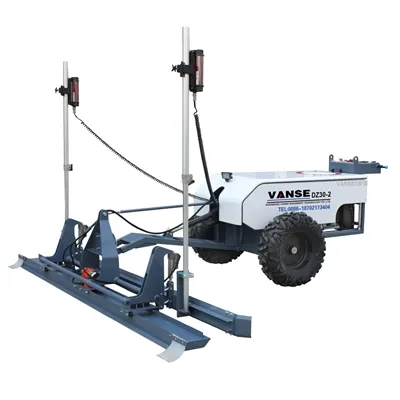
During the construction process, the use of concrete laser leveling machine (concrete laser leveling machine) can help improve the flatness of the concrete pavement. The concrete laser leveling machine uses the horizontal laser as the reference surface to control the ground elevation, which can effectively ensure the levelness and flatness of the ground. Its application advantages include:
Precise elevation control: The concrete laser leveling machine uses a laser measurement and control system to control the elevation in real time. There is no need to pull a control line for leveling, nor is there a need to support the side template to control the ground elevation, thus avoiding elevation errors caused by template vibration or manual block support during construction.
Extremely small flatness error: When applied to large-area floor construction, the ground elevation is easy to control. The entire floor only requires 1-2 reference point elevations, which can reduce the error caused by multiple reference points. As long as the laser transmitter is not disturbed, no matter where the leveling machine moves, it can ensure that the overall elevation of the paved ground is not affected, and the flatness error is extremely small.
Better ground integrity: Using a concrete laser leveling machine for floor construction, it is easy to achieve one-time overall paving of a large area of floor. It can be divided into blocks as needed, and the construction can be continued until the entire floor is completed, making the ground integrity better.
The ground is more compact and uniform: When the concrete laser leveling machine is leveling the concrete, it is always in a uniform speed construction state. Through the high-frequency vibrator of 4000 times per minute, the vibration plate of the leveling head produces uniform high-frequency vibration, making the concrete ground more compact and uniform.
—- Click the below to jump immediately!!! —-


LASER LEVELING MACHINE


SLIPFORM MACHINE


TOPPING SPREADER

TRACKED MINI DUMPER
Thanks to All the Friends Who Support and Trust Shandong Vanse Machinery Technology Co., Ltd.
If you want to know more about Shandong Vanse Machinery Technology Co., Ltd. or have any questions, please feel free to contact us:
Our Factory
Shandong Vanse Machinery Technology Co., Ltd.








Share this article

About the Author: Shandong Vanse Machinery Technology Co., Ltd.
Shandong Vanse Machinery Technology Co., Ltd. is a high-tech manufacturer specializing in concrete construction machinery, including laser screeds and related equipment. The company integrates R&D, production, and global sales, with products exported to over 60 countries and widely used in infrastructure projects worldwide.
Previous Post
Next Post
Related Articles
You Might Also Like
Troubleshooting Multiple Possible Causes of Unexplained Power Trowel Machine Shutdown
Unexplained stalling of a power trowel is a common but headache-inducing problem. To conduct a systematic investigation, one can follow the principle of "from simple to complex and from outside to inside". The following is a detailed investigation of multiple possibilities. You can start checking from the simplest and most likely cause: Possibility: The fuel has expired and deteriorated (gelatinized), water has been mixed in, the fuel grade is incorrect or the fuel quality is too poor. Investigation and resolution: Check the color and smell of the fuel. Fresh gasoline is transparent, while spoiled gasoline will turn yellow or have a pungent smell. Immediately empty the old fuel tank completely and then refill it with clean, fresh unleaded gasoline of grade 92 or above. It is recommended that the fuel tank not be filled with oil for a long time. Possibility: The vent hole of the fuel tank cap is blocked, causing a vacuum to form inside the fuel tank and preventing the fuel from flowing down. Troubleshooting and resolution: When the engine is turned off, immediately open the fuel tank cap to listen for a "sizzling" sound of air intake. Or next time when the engine is turned off, try loosening the fuel tank cap to see if it returns to normal. Clean the vent of the fuel tank cap or replace the fuel tank cap. Possibility: The main fuel gauge hole, idle fuel gauge hole and other parts inside the carburetor are blocked by impurities and gum, resulting in poor fuel supply. Troubleshooting and resolution: Check if the fuel filter (if any) is dirty. Try repeatedly pressing the "oil bubble" on the carburetor (if any). Cleaning the carburetor is the most efficient solution. The carburetor needs to be removed and all oil lines and measuring holes thoroughly rinsed with carburetor cleaner. For old machines, the cost of directly replacing a new carburetor is not high either. Possibility: The air filter was severely clogged with dust and cement powder, causing the engine to "suffocate", resulting in insufficient air intake and stalling. Troubleshooting and resolution: Remove the air filter and observe if it is so dirty that the original color cannot be seen clearly. Clean or replace the air filter. On construction sites with a lot of dust, air filters should be cleaned more frequently (after each shift). When cleaning, use compressed air to blow from the inside out. Possibilities: Severe carbon deposits on the spark plugs, improper electrode gap, cracked porcelain body or mismatched model. Troubleshooting and resolution: Remove the spark plug and check the condition of its top. The normal one should be brown or light gray. If there is black carbon deposit, it indicates incomplete combustion. Clean the carbon deposits, adjust the gap with a feeler gauge to the requirements of the manual (usually 0.6-0.7mm), or directly replace it with a new spark plug of the same model. Possibility: The flameout wire (usually a thin wire) connected to the spark plug has poor contact, short circuit or open circuit, causing the spark plug to accidentally shut off. Troubleshooting and resolution: Check whether the connection of the flameout wire is loose and whether the insulation is damaged. You can try temporarily disconnecting the flameout wire (to keep the switch in operation), and then pull the rope to start it (pay attention to safety and ensure the machine is stable). If it doesn't flameout, the problem lies in the flameout switch or the circuit. Reconnect or replace the flameout wire/switch. Possibility: It is relatively rare, but the ignition coil malfunctions internally after the engine heats up, causing the spark to weaken or disappear. Troubleshooting and resolution: Usually, the machine starts up normally when cold, but suddenly shuts down after working for a period of time due to overheating, and it is difficult to restart immediately. The machine can be started again after it has cooled down. Professional maintenance personnel are required to test the resistance of the ignition coil. After confirmation, it should be replaced. Possibility: The radiator is clogged with cement or oil stains, resulting in poor engine cooling. High temperatures can cause expansion, cylinder seizure or trigger thermal protection, leading to engine stalling. Troubleshooting and resolution: Check whether the heat sinks around the cylinder are clean. Thoroughly clean the blockages on the heat sink. At the same time, check the oil level and quality to ensure normal lubrication. Possibility: After long-term use, the valve clearance changes (usually becomes smaller), causing the valves to not close tightly when the engine is hot, resulting in a decrease in the compression ratio and stalling. Troubleshooting and resolution: The cold start and low-speed operation are normal, but the engine stalls as soon as the accelerator is increased or after working for a period of time. Professional maintenance workers need to use a feeler gauge to check and adjust the intake and exhaust valve clearances to the specified values. Step 1: Check the fuel -> Change to new oil! Step 2: Check the air filter -> Clean or replace! Step 3: Check the spark plugs -> Clean/Adjust/replace! Step 4: Check the fuel tank cap -> Try loosening it! Step 5: Clean the carburetor -> This is the most likely cause! If none of the above steps can solve the problem, then the issue might be more difficult to handle (such as ignition coil or valve problems). It is recommended to contact professional maintenance services. Note: The parameters provided in this document are for reference only and are not mandatory. Due to differences in technical characteristics between different brands and models of laser levelers, please consult the manufacturer for a suitable solution before actual operation. This reference document assumes no responsibility for any issues arising from failure to follow the manufacturer's instructions.Which concrete cutting machines are suitable for making joint cuts on ultra-flat floors without damaging the flatness?
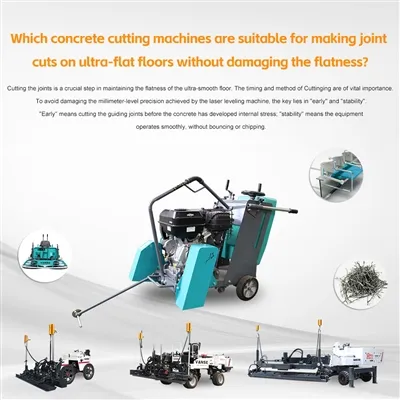
Cutting the joints is a crucial step in maintaining the flatness of the ultra-smooth floor. The timing and method of Cuttinging are of vital importance. To avoid damaging the millimeter-level precision achieved by the laser leveling machine, the key lies in "early" and "stability". "Early" means cutting the guiding joints before the concrete has developed internal stress; "stability" means the equipment operates smoothly, without bouncing or chipping. Based on this principle, there are mainly two types of equipment available on the market that are suitable for cutting joints in ultra-smooth floors. The core difference between them lies in the time window for cutting. To make it easier for you to compare, I have listed their features as follows: Comparison dimension Early-Entry Cutting Conventional Cutting The timing of the cut Within 1-4 hours after the concrete has been polished (commonly known as the "initial setting" stage) After 6-12 hours or longer of concrete curing (usually overnight waiting) Core Strengths Prevent cracks from forming at their source: Cut the joints before the concrete begins to contract, guiding the cracks to develop in a regular pattern. This is the best way to protect the flatness of the super-level floor. High flexibility: Suitable for all types of concrete, including hardened floors. Smooth cuts: Special blades and patented sliding plates are used, resulting in almost no chipping during cutting, and the joints are aesthetically pleasing. Adjustable depth and width: Capable of cutting deeper and wider joints. Potential risks The time window is narrow, and high requirements are placed on construction organization. Special cutting blades must be equipped. May cause random cracks: If the cutting is done too late, the internal stress of the concrete may have already caused micro-cracks or warping on the floor before the joint is made, thus damaging the flatness. The key to the decision lies in your ultimate pursuit of flatness and the scheduling of the project. Preferred solution: Early Cutting If your project aims for a super-flat floor with FF/FL 35 or above, or if the floor will be used in high-shelf warehouses or precision instrument workshops, then the early Cutting is the only recommended option. It actively guides the cracks before stress is formed, maximizing the protection of the perfect foundation created by the laser leveling machine. Alternative solution: Traditional precision joint Cutting If your project requires a slightly lower level of flatness (such as for ordinary commercial floors), or if you missed the early Cutting window due to construction schedule reasons, then choosing a high-precision, smooth-running traditional joint Cutting is necessary. The key lies in the stability of the equipment. No matter which equipment you choose, there are two points to keep in mind: Special blades: For the initial cutting, you must use the blades specifically designed for this purpose. The blade head connection and formula are specially tailored for un-hardened concrete, which can prevent the blade head from falling off and ensure the cutting quality. Smooth operation: The weight balance of the equipment and the design of the blade guard (such as whether it has a stabilizing slide) will directly affect the stability during cutting, and thereby influence the final flatness. I hope the above information can help you make a clearer choice. If you want to know more about how to select the appropriate blade type based on the specific concrete mix ratio (such as whether fibers are added), I can help you organize more detailed information for you. Contact us NOW Note: The parameters provided in this document are for reference only and are not mandatory. Due to differences in technical characteristics between different brands and models of laser levelers, please consult the manufacturer for a suitable solution before actual operation. This reference document assumes no responsibility for any issues arising from failure to follow the manufacturer's instructions.Concrete laser levelling machine VS manual construction, where is the difference?
In recent years, with the continuous development of the economy and society, the construction demand of large areas such as parking lots, large squares, industrial plants is also increasing, because these sites mainly use concrete to pour the foundation, and then cover the floor tile or floor paint, so higher requirements are put forward for the flatness of the base layer. In order to ensure that the ground flatness after construction reaches an ideal level, it is necessary to use a concrete laser levelling machine. So, what is the difference between the construction of concrete laser levelling machine and manual construction? What are the significant construction advantages of the concrete laser leveling machine itself? █ Traditional construction method The common concrete floor construction method is to manually level, and then use a polishing machine to wipe. This method requires a lot of labor, the quality of the construction process is not controlled, the need for manual correction many times, repeated measurement and adjustment of the ground under construction, and the efficiency is not high. A large area of concrete floor construction needs to use a large number of wood or metal plates to form the side formwork in advance, and measure the height of the side formwork by the level to control the height of the concrete after laying. Due to the need to use the level for multi-point measurement, the side template must be retested after laying to ensure accuracy. Therefore, the process is prone to human error. In addition, the removal of the side template also requires a lot of labor. █ Intelligent construction method 1. Operation principle The Topcon laser transmitter is set up in advance on the construction site to provide the reference surface of the working elevation. The Topcon receiver LS-B110 fixed on the laser leveler receives the laser elevation position signal and transmits the real-time elevation position signal to the controller, which automatically controls the electric push rod or hydraulic system of the concrete laser leveler. Ensure that the receiver's elevation is at the same level as the reference plane, and the leveling machine mechanism can be spread according to the set height. 2. Construction advantages The advantages of using concrete laser leveling machine for concrete leveling are highlighted in the following aspects: (1) It is easy to lay high-strength concrete, low-slump concrete and fiber mud condensate; (2) The construction quality is high, the leveling quality of the laser leveling machine is more than 3 times higher than that of the traditional manual construction method, and the ground is super flat; (3) Improve work efficiency and save about labor. The use of concrete laser levelling machine construction, shorten the construction time, improve work efficiency, and can save labor; (4) The heavy manual labor is changed into mechanical paving, vibrating, leveling, pulp lifting, and plastering, so that the operator is reduced, and the labor intensity is reduced to create high-quality ground; (5) The application of concrete laser levelling machine, not only than the traditional manual process to save costs, and less ground joint, later maintenance costs are greatly reduced, so that the economic benefits are significantly improved; (6) The use of concrete laser levelling machine can achieve large area construction, reduce a large number of construction joints, concrete collapse can be reduced, concrete strength is guaranteed, so that the ground integrity is good, not easy to crack. Summary of this chapter: Although the concrete laser levelling machine is an emerging new equipment with excellent technology in recent years, it is widely used in airport runways, high-speed rail platforms, large workshop pavements and other projects with high requirements for ground smoothness. If it can be widely popularized and promoted, it will bring very considerable construction benefits.