Technical Knowledge
How to clean the leveling head of concrete laser leveling machine
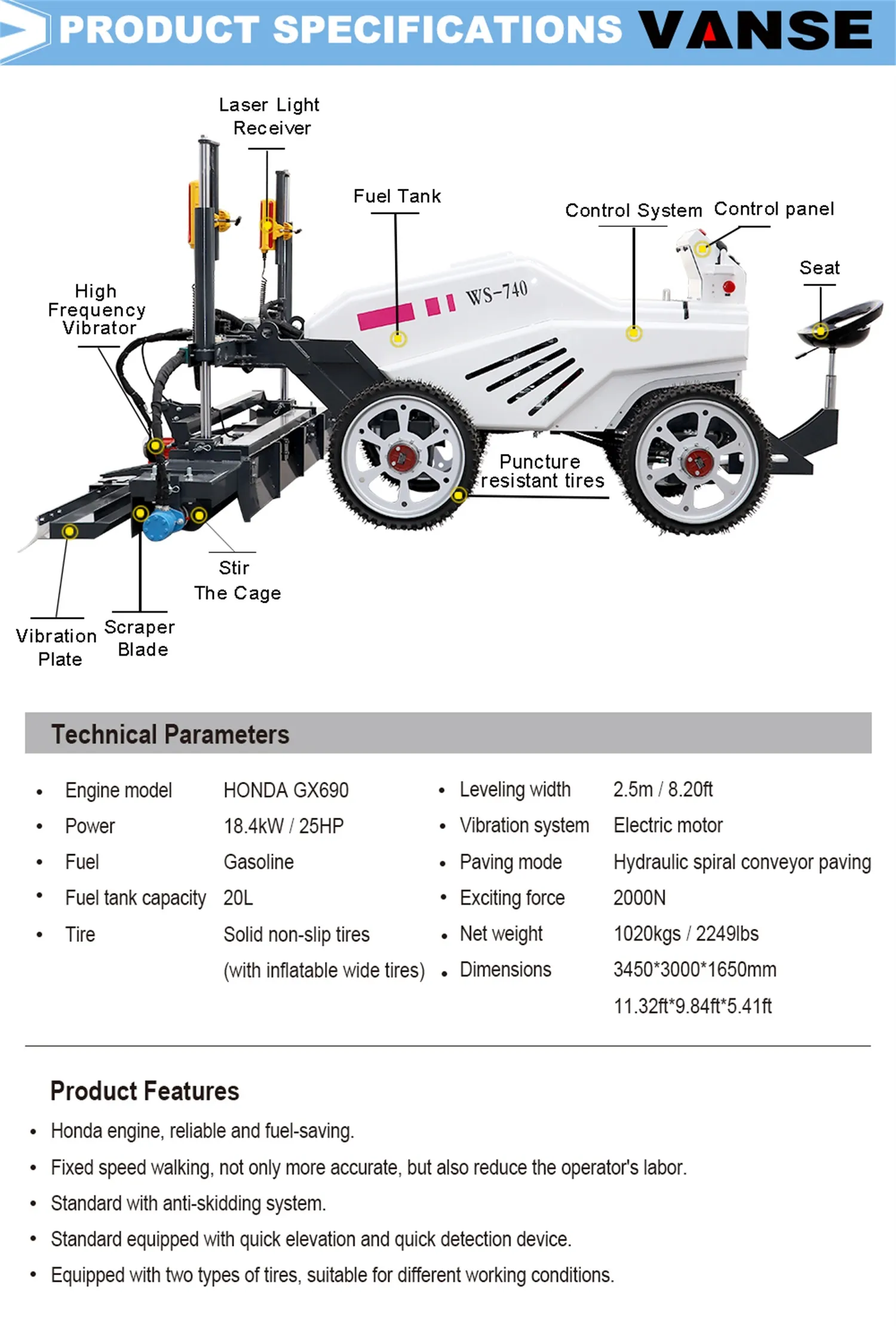
The concrete laser leveling machine is mainly used for leveling the concrete surface. The leveling head is one of its main working parts. Therefore, cleaning the leveling head is an important step to maintain the machine's working efficiency and extend its service life. Here are the steps on how to clean the leveling head of your concrete laser leveling:
Shut down and disconnect power: Before cleaning the leveling head, you must shut down and disconnect power to avoid any electric shock or accidental injury.
Remove the leveling head: Remove the leveling head from the machine, taking care not to use force or damage any parts.
Clean the leveling head: Wipe the surface of the leveling head with a damp cloth to remove dust and debris. If there is dirt on the leveling head that is difficult to remove, you can use an appropriate amount of detergent to clean it, and then rinse it with clean water.
Inspect the leveling head: Check the surface of the leveling head for any damage or wear, paying particular attention to critical components such as the blades and bearings. If any abnormalities are found, they should be replaced or repaired immediately.
Reinstall the leveling head: Reinstall the cleaned leveling head to the machine, making sure it is installed securely and that nothing is loose or falling off.
Test run: Restart the machine and test run to make sure the leveling head is working properly and there are no unusual noises or vibrations.
Cleaning the leveling head of a concrete laser leveling is a basic maintenance job that maintains the efficiency and accuracy of the machine while also extending its service life. Please note that if you are not familiar with how to clean or repair your concrete laser leveling, please contact a professional for maintenance and repairs.
Thanks to All the Friends Who Support and Trust Shandong Vanse Machinery Technology Co., Ltd.
If you want to know more about Shandong Vanse Machinery Technology Co., Ltd. or have any questions, please feel free to contact us:
Our Factory
Shandong Vanse Machinery Technology Co., Ltd.








Share this article

About the Author: Shandong Vanse Machinery Technology Co., Ltd.
Shandong Vanse Machinery Technology Co., Ltd. is a high-tech manufacturer specializing in concrete construction machinery, including laser screeds and related equipment. The company integrates R&D, production, and global sales, with products exported to over 60 countries and widely used in infrastructure projects worldwide.
Previous Post
Next Post
Related Articles
You Might Also Like
What materials are suitable for concrete laser leveling machines?
Concrete laser leveling: suitable materials and applications ★1★ Introduction to compact soil laser leveling machine The concrete laser leveling is a high-efficiency, high-precision concrete construction equipment that is widely used in the construction of floors, roads, bridges and other fields. This equipment achieves high-precision positioning and leveling through laser technology, which can greatly improve the quality and efficiency of concrete construction. ★2★ Concrete material properties Concrete is a composite material widely used in construction projects. It is mainly composed of aggregates, cement, water and other additives. The hardening process of concrete involves factors such as hydration reaction and temperature changes, and it requires a certain amount of time and appropriate maintenance to reach the design strength. Due to the diversity of concrete materials, different types and proportions of mixers have different characteristics and application ranges. ★3★ Working principle of concrete laser leveling machine The working principle of the compacted soil laser leveling machine mainly uses laser technology for high-precision positioning and measurement. By installing a laser transmitter and receiver on the equipment, the concrete laser leveling can form a laser beam in the construction area, and monitor and control the height and level of the laser beam in real time through sensors and control systems. During the leveling process, the equipment will automatically adjust the walking track and concrete paving thickness to ensure the flatness and compactness of the floor. ★4★ Applicable material range of concrete laser leveling machine Concrete laser leveling machines are suitable for many types of concrete materials, including but not limited to the following: 1. Ordinary concrete: suitable for concrete construction in general construction projects, such as floors, roads, etc. 2. High-strength concrete: suitable for structures with high strength requirements, such as bridges, high-rise buildings, etc. 3. Durable concrete: Suitable for projects with high durability requirements, such as nuclear power plants, tunnels, etc. 4. Special function concrete: such as thermal insulation concrete, refractory concrete, etc., suitable for projects with specific functions. It should be noted that for different types of concrete materials, appropriate mix design and construction process adjustments need to be carried out according to their characteristics and requirements to ensure Construction Quality. ★5★ Application of concrete laser leveling machine in different scenarios The application of concrete laser leveling machines in different scenarios includes the following aspects: 1. Floor construction: Suitable for floor construction in industrial plants, warehouses, parking lots, shopping malls, etc., which can improve the flatness and durability of the floor. 2. Road construction: It is suitable for the construction of urban roads, highway bridges and other road projects. It can improve the smoothness and durability of the road and reduce maintenance costs. 3. Bridge construction: It is suitable for construction on the surface of bridges, which can improve the flatness and durability of the bridge and extend the service life of the bridge. 4. Airport runway construction: Suitable for the construction of airport runways, it can improve the flatness and durability of the runway and ensure flight safety. 5. Special projects: Suitable for the construction of special projects with extremely high safety requirements such as nuclear power plants, tunnels, and oil depots. ★6★ Advantages and limitations of concrete laser leveling machine The advantages of the compacted soil laser leveler mainly include high precision, high efficiency, and high degree of automation, which can greatly improve construction quality and efficiency, and reduce labor costs and material waste. However, there are also some limitations to the compacted soil laser leveling, such as the higher skill level requirements for operators, additional processing and adjustments that may be required for construction with complex shapes and special requirements, and in addition, the purchase and maintenance costs of the equipment. It also requires reasonable economic considerations. ★7★ Operation and maintenance of concrete laser leveling machine Operating a concrete laser leveling requires professional training and practical experience. Operators need to master the performance and working principles of the equipment and strictly abide by operating procedures and safety regulations. During use, the equipment must be inspected and maintained regularly to ensure the normal operation and service life of the equipment. At the same time, for different types of concrete materials and construction scenarios, corresponding adjustments and treatments are required to ensure construction quality. ★8★ Market Prospects and Investment Value Analysis With the continuous expansion of the scale of construction projects and the continuous improvement of construction requirements, the market demand for concrete laser leveling machines is also gradually increasing. In the next few years, with the continuous advancement of technology and the expansion of application fields, there is still a lot of room for improvement in the accuracy, efficiency and service life of concrete laser levelings. Therefore, for investors with a long-term perspective, concrete laser leveling machines are a potential investment area. However, it should be noted that the investment cost of equipment is relatively high, and adequate preparation and planning are required economically. At the same time, market competition is becoming increasingly fierce, and it is necessary to strengthen technological innovation and service quality improvement to maintain competitive advantages.Collection Of Basic Knowledge Of Laser Leveling Machine
First, the characteristics of laser leveling machine: 1. The leveling principle of the leveling machine is the use of laser precision technology, closed-loop implementation and a highly precise hydraulic system. In the automatic control of the computer and the highly precise hydraulic system, it has technical characteristics that are different from other laser ground construction processes. specialty. 2. The leveling principle of the precision leveling machine is to use the hydraulically driven leveling head, cooperate with the laser and computer control system to complete the leveling work while automatically leveling, and the laser on the leveling head is equipped with an integrated design system scraper, vibration And leveling, all leveling, leveling, tamping work is integrated into one automatic, and produced. The computer system controls the target 10 times, high real-time, and the average designed vibration frequency of the vibrator is 3000 times/minute. 3 The laser transmitter that controls the ground elevation is its own, so that the ground elevation is not controlled by the template and does not produce accuracy. 4. The laser leveling machine can also automatically control the longitudinal and transverse slopes, which is also completed by the laser system, computer system, hydraulic system and mechanical system. For complex-shaped grounds with high requirements such as drainage, a three-dimensional special-shaped ground treatment system can also be selected. Second, the debugging method of the laser flat machine: 1. When starting the continuous laser leveling machine, it is necessary to rotate the screw clockwise to adjust the speed of the feed, and the slider will move slowly so that the slider can be seen during the reciprocating motion. 2. Before connecting the power test, please check whether the direction is correct. 3. If the construction speed of the machine is stable, the laser system can operate normally at this speed. First, the characteristics of laser leveling machine: 1. The leveling principle of the leveling machine is the use of laser precision technology, closed-loop implementation and a highly precise hydraulic system. In the automatic control of the computer and the highly precise hydraulic system, it has technical characteristics that are different from other laser ground construction processes. specialty. 2. The leveling principle of the precision leveling machine is to use the hydraulically driven leveling head, cooperate with the laser and computer control system to complete the leveling work while automatically leveling, and the laser on the leveling head is equipped with an integrated design system scraper, vibration And leveling, all leveling, leveling, tamping work is integrated into one automatic, and produced. The computer system controls the target 10 times, high real-time, and the average designed vibration frequency of the vibrator is 3000 times/minute. 3 The laser transmitter that controls the ground elevation is its own, so that the ground elevation is not controlled by the template and does not produce accuracy. 4. The laser leveling machine can also automatically control the longitudinal and transverse slopes, which is also completed by the laser system, computer system, hydraulic system and mechanical system. For complex-shaped grounds with high requirements such as drainage, a three-dimensional special-shaped ground treatment system can also be selected. Second, the debugging method of the laser flat machine: 1. When starting the continuous laser leveling machine, it is necessary to rotate the screw clockwise to adjust the speed of the feed, and the slider will move slowly so that the slider can be seen during the reciprocating motion. 2. Before connecting the power test, please check whether the direction is correct. 3. If the construction speed of the machine is stable, the laser system can operate normally at this speed.How to deal with the possible faults and problems during the leveling process of concrete laser leveling machine?
The concrete laser leveling machine may encounter various faults and problems during the leveling process, but through reasonable prevention and response measures, these problems can be effectively dealt with to ensure the smooth progress of the construction. The following are some common faults and problems and their corresponding solutions: Trouble and problem 1: Equipment operation problems *Problem description: The operator may not be familiar with the operation of the equipment or may not be proficient in the operation, causing the equipment to fail to operate normally or produce errors. *Coping method: Conduct systematic training for operators to ensure that they are familiar with the various functions and operating procedures of the equipment. Conduct regular operational assessments to ensure operators' skills are up to standard Fault and problem 2: Sensor failure *Problem description: The sensor is a key part of the laser leveling machine. If the sensor fails, it will affect the leveling accuracy. *Countermeasures: Regularly check the operating status of the sensor, and repair or replace it in time if there is any abnormality. Use high-quality sensors and pay attention to sensor maintenance. Failure and Problem 3: Equipment Mechanical Failure *Problem description: Mechanical parts may be worn, loose or broken. *Countermeasures: Regularly inspect and maintain mechanical parts maintenance to ensure its normal operation. If there is any problem, repair or replace it in time. Trouble and problem 4: Concrete material problem *Problem description: If the ratio of concrete materials, slump and other parameters do not meet the requirements, the smoothing effect will be affected. *Countermeasures: Strictly control the proportion and quality of concrete materials to ensure that they meet construction requirements. Test the various properties of the concrete, and promptly adjust the faults and problems if there are any problems 5: Impact of environmental factors *Problem description: Environmental factors at the construction site, such as temperature, humidity, dust, etc., may affect the normal operation and smoothing effect of the equipment. *Countermeasures: Try to choose an appropriate construction time and avoid construction under extreme temperature and humidity conditions. Keep the construction site clean and tidy to reduce the impact of dust. When dealing with possible faults and problems that may occur during the leveling process of the laser leveling machine, multiple factors such as personnel, equipment, materials, and the environment need to be comprehensively considered. Developing an effective set of preventive and response measures can greatly reduce the occurrence of failures and problems and improve construction efficiency and quality.