Technical Knowledge
Laser leveling machine manufacturers talk about: New technology of large-area floor leveling construction
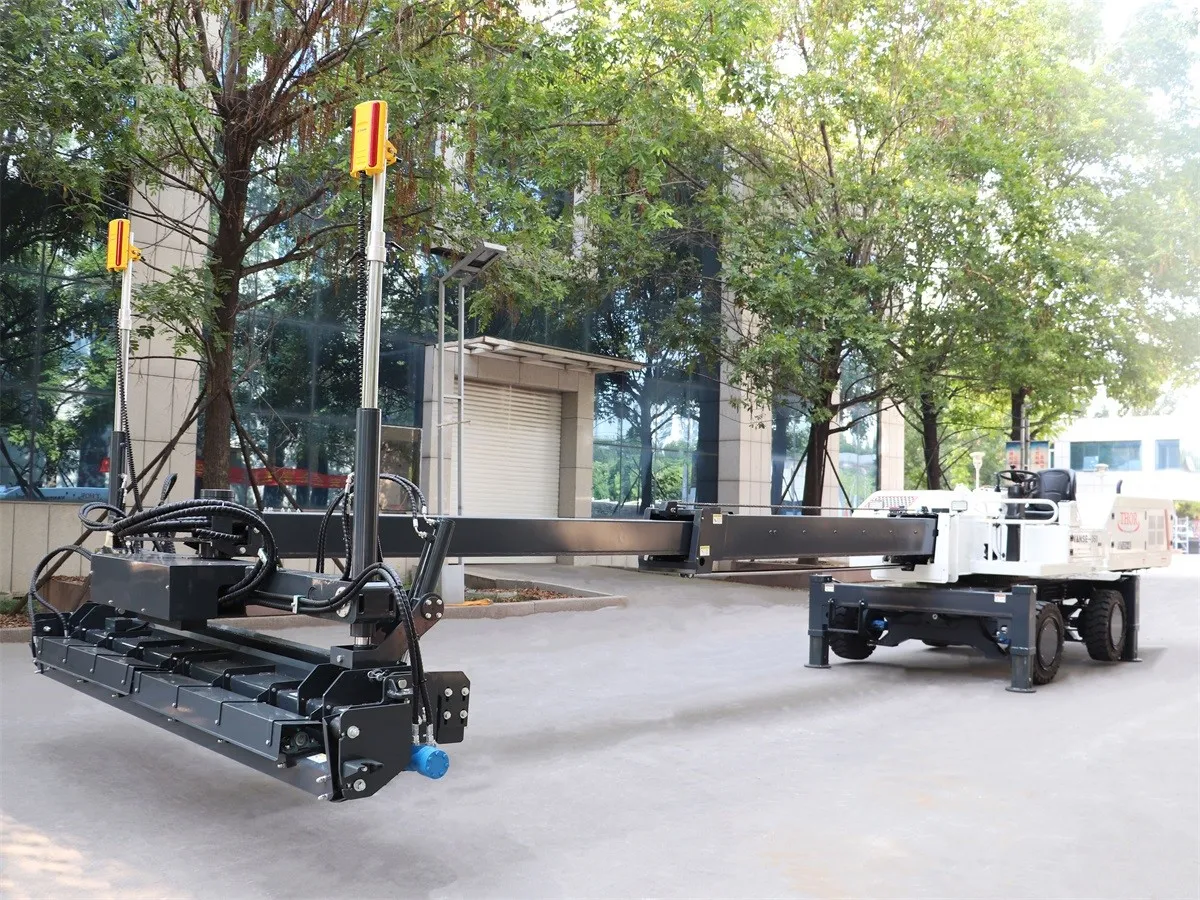
| with the continuous improvement of the requirements of modern industrial plants for concrete floor flatness, Traditional Floor Leveling Construction Methods Can Not Fully Meet The Requirements Of Quality, Construction Period And Other Aspects, Therefore, The Introduction Of High-tech Laser Leveling Machine For Large-scale Floor Paving, Compaction, Leveling Is The Inevitable Trend Of The Present. Compared With The Traditional Construction Method Of Guideway Leveling Beam, The Application Of Laser Leveling Machine Can Not Only Effectively Solve The Problems Of Ground Hollow Drum And Cracking, But Also Help To Reduce Costs And Speed Up The Construction Progress. The Following Laser Leveling Machine Manufacturers On A Large Area Of Floor Construction Technology To Make A Simple Discussion. | |
|
☾ Construction site arrangement and management ☽ :
1. Remove obstacles at the construction site.
In the actual construction process, it is necessary to remove all obstacles in the construction area, such as ditches, garbage, communication lines, etc., and migrate high-voltage lines or communication lines after being allowed by relevant departments. If obstacles that cannot be moved or removed are encountered, they need to be adjusted or avoided in time.
|
|
|
☾ Large area floor treatment work ☽ :
When the formwork is fixed, it is necessary to use steel bars to fix it, and set the cement mortar pad to ensure that the formwork does not shift during the concrete pouring process and the thickness of the protective layer meets the requirements. Before large-scale floor concrete pouring, the concrete surface on both sides should be chiseled, the steel bar should be removed and the position should be corrected, and the garbage should be cleaned. Under normal circumstances, the floor and the casting belt adopt an independent support system that is supported separately from the bottom formwork, which can effectively control the floor compared with the whole formwork, because the deflection caused by mold removal increases, and because no secondary formwork is required, manual use is reduced, which has good economic benefits. The pouring time of the expansion post pouring belt is generally carried out 60d after the completion of the concrete pouring in the adjacent parts, and watering and wetting treatment should be done 24h in advance before construction. The concrete used is micro-expansive concrete with a strength grade higher than the corresponding structural position to prevent cracks. In the process of construction, the laser leveler manufacturer recommends the use of C35 concrete mixed with 12%SY-G. After the completion of concrete pouring, the construction site should be covered with moisturizing curing treatment within 12h, and the curing time should not be less than 28d. Watering net is strictly prohibited when the average temperature of the day is below 5℃. |
|
|
☾ Concrete paving work ☽ :
When the large-scale floor concrete paving work, many factors such as the position of the formwork and the supporting condition should be strictly checked. When the concrete is dumped after the inspection, it should be carried out according to the guidance of the professional of the laser leveling machine manufacturer to ensure that the concrete is dumped to the specified position. If there is any fault in the large-area floor paving, it is necessary to immediately suspend the construction for more than 1 hour. For example, when the mixing material cannot be vibrated, it is necessary to install construction joints on the floor after the completion of the floor paving, and discard the mixing material that cannot be vibrated. When the plug-in vibrator vibrates the mixture, it is necessary to lift the pulp and scrape it with a laser leveler. Two vibrators should be installed on the vibrator in a large area of the floor, so as to form a transverse vibratory group on the ground and carry out continuous vibratory work along the cross section. In the vibration work, it is necessary to pay attention to the position of the bottom of the board on the ground, and the problem of under-vibration or missing vibration must not occur in the position of the interior and corners. The vibration time is about 30 seconds, and the relevant personnel should supplement the material beside the vibration real-time, and strictly supervise and manage the tension rod and effect of the template transmission rod of the vibration. When deformation, leakage displacement and loosening occur, it should be corrected immediately. |
|
| The above three aspects of the construction site management, floor treatment, paving of large area floor leveling construction technology are discussed in detail. In order to effectively improve the quality and efficiency of floor construction, laser leveling machine manufacturers suggest that: in the actual construction process, the operator also needs to fully grasp the characteristics of the leveling machine, and combine it with the construction, so as to achieve a more ideal construction standard. |
Thanks to All the Friends Who Support and Trust Shandong Vanse Machinery Technology Co., Ltd.
If you want to know more about Shandong Vanse Machinery Technology Co., Ltd. or have any questions, please feel free to contact us:
Our Factory
Shandong Vanse Machinery Technology Co., Ltd.








Share this article

About the Author: Shandong Vanse Machinery Technology Co., Ltd.
Shandong Vanse Machinery Technology Co., Ltd. is a high-tech manufacturer specializing in concrete construction machinery, including laser screeds and related equipment. The company integrates R&D, production, and global sales, with products exported to over 60 countries and widely used in infrastructure projects worldwide.
Previous Post
Next Post
Related Articles
You Might Also Like
How Is The Frequency Of Maintenance Of Concrete Laser Leveling Machine Determined?
How is the frequency of maintenance of concrete laser leveling machine determined? As an important equipment in modern building construction, the frequency of maintenance of concrete laser leveling machine is of great significance to ensure the normal operation of the equipment, extend its service life and ensure the quality of construction. Determining a reasonable maintenance frequency is a complex process that requires consideration of the combined effects of multiple factors. This article will delve into how to determine the maintenance frequency of concrete laser levelings, and cover frequency of use and working environment, equipment performance evaluation, manufacturer recommendations and maintenance manuals, regular inspections and preventive maintenance, fault and exception handling, maintenance records and tracking and professional technical support and services. 1. Frequency of use and working environment The frequency of use and working environment of the concrete laser leveling are the basic factors that determine the frequency of maintenance. Generally speaking, equipment that is heavily used is more prone to wear and failure and therefore requires more frequent maintenance. At the same time, the complexity of the working environment will also affect the frequency of maintenance. If the equipment often operates in harsh environments, such as dusty, watery, high or low temperatures, the frequency of maintenance will also need to increase accordingly. When determining the frequency of maintenance, a preliminary assessment can be made based on the actual use of the equipment and the working environment. For example, if the equipment needs to work for a long time every day and the working environment is harsh, then it is recommended to perform comprehensive maintenance once a week or every two weeks. 2. Equipment performance evaluation Equipment performance evaluation is an important basis for determining maintenance frequency. By evaluating the performance of the equipment, you can understand the operating status and wear of the equipment and determine when maintenance is needed. Performance evaluation includes but is not limited to the flatness, flatness deviation, compactness, operational flexibility and stability of the equipment. During the evaluation process, if it is found that the performance of the equipment has declined or an abnormality occurs, maintenance should be carried out in a timely manner. At the same time, based on the results of equipment performance evaluation, the frequency of maintenance can be adjusted to ensure that the equipment is always maintained in optimal condition. 3. Manufacturer's recommendations and maintenance manual Manufacturer's recommendations and maintenance manuals are important references for determining the frequency of maintenance on concrete laser levelings. Manufacturers usually provide a detailed set of maintenance recommendations based on equipment design, manufacturing and testing experience. These recommendations usually include specific requirements and cycles for equipment cleaning, lubrication, tightening, inspection, and replacement of wear parts. The maintenance manual is a detailed guide for equipment maintenance, which contains maintenance requirements and specific operating steps for each component of the equipment. . By reading and maintaining the manual, we can have a more comprehensive understanding of the structure, performance and maintenance methods of the equipment, thereby more accurately determining the frequency of maintenance. Therefore, when determining the maintenance frequency of the concrete laser leveling, we should carefully read the recommendations and maintenance manuals provided by the manufacturer, and comprehensively consider the actual situation of the equipment. 4.Regular inspection and preventive maintenance Regular inspection and preventive maintenance are important measures to ensure the stable operation of the concrete laser leveling. Through regular inspections, potential problems and hidden dangers of the equipment can be discovered in time to prevent the occurrence or expansion of faults. Preventive maintenance is to delay the wear and aging process of equipment through a series of maintenance measures before equipment failure occurs. Regular inspections usually include visual inspection, electrical system inspection, hydraulic system inspection and transmission component inspection. During the inspection process, attention should be paid to the wear and tear of the equipment, the lubrication condition, the tightening of fasteners, and the contact of electrical components. Preventive maintenance includes regularly changing lubricants, cleaning filters, adjusting transmission component clearances, and tightening loose components. These measures can effectively extend the service life of the equipment and improve the stability of the equipment. The frequency of regular inspections and preventive maintenance should be determined based on the actual use of the equipment and the working environment. For equipment with high frequency of use or harsh working environment, the frequency of inspection and maintenance should be appropriately increased. 5. Fault and exception handling Fault and exception handling are important links in the maintenance process. When equipment fails or an abnormal situation occurs, it should be dealt with in time to prevent the failure from expanding or affecting the construction progress. When dealing with a fault, you should first determine the cause and location of the fault. Through observation, testing and analysis, the root cause of the fault is found, and then appropriate measures are taken to repair or replace it. At the same time, faults should be summarized and recorded to avoid the recurrence of similar problems during subsequent maintenance. In addition to handling faults, attention should also be paid to abnormal conditions of the equipment. For example, abnormal sounds, vibrations or temperature increases during the operation of the equipment may be symptoms of potential problems with the equipment. When these abnormalities are discovered, timely inspection and repair should be carried out to ensure the normal operation of the equipment. Therefore, when determining the maintenance frequency of concrete laser levelings, the need for fault and abnormal handling should also be taken into consideration. If your equipment frequently malfunctions or behaves abnormally, it may require more frequent maintenance. 6. Maintenance records and tracking Maintenance records and tracking are important means to ensure that maintenance work is carried out in an orderly manner. By recording the maintenance status of the equipment, the maintenance history and status of the equipment can be understood in a timely manner, providing reference for subsequent maintenance work. Maintenance records should include information such as the time, content, and methods of each maintenance, as well as problems found and treatment results. At the same time, records should be organized and analyzed regularly to evaluate the maintenance effect of the equipment and determine the next maintenance plan. Through the tracking and analysis of maintenance records, the actual operation status and maintenance needs of the equipment can be more accurately understood, thereby providing a more reliable basis for determining the frequency of maintenance. 7. Professional technical support and services Professional technical support and services are important guarantees to ensure the smooth progress of concrete laser leveling maintenance work. Manufacturers or professional maintenance teams usually have rich technical experience and professional knowledge and can provide timely and accurate technical support and services. During the maintenance process, if you encounter problems that are difficult to solve or need professional technical support, you can seek help from the manufacturer or a professional maintenance team. They can provide targeted solutions and technical guidance based on the actual situation and specific needs of the equipment. At the same time, professional technical support and services can also provide equipment upgrades and improvement suggestions to help users make better use of the equipment and improve its performance and efficiency. Through cooperation with the professional technical team, we can have a more comprehensive understanding of the characteristics and maintenance of the equipment. Maintenance requirements to more accurately determine the frequency of maintenance. To sum up, determining the frequency of concrete laser leveling maintenance is a process that takes multiple factors into consideration. Through comprehensive consideration of frequency of use and working environment, equipment performance evaluation, manufacturer recommendations and maintenance manuals, regular inspections and preventive maintenance, fault and exception handling, maintenance records and tracking, and professional technical support and services, we can provide equipment with Develop a scientific and reasonable maintenance plan. In actual operations, we need to flexibly adjust the frequency and content of maintenance based on the specific conditions and actual needs of the equipment. At the same time, we will strengthen the training and technical improvement of maintenance personnel to ensure that they are proficient in equipment maintenance skills and provide a strong guarantee for the stable operation of the equipment. In addition, with the continuous advancement of science and technology and the upgrading of equipment, we also need to pay attention to new maintenance technologies and methods and apply them to actual work in a timely manner to improve the effectiveness and efficiency of maintenance. During the maintenance process, we should also pay attention to the following points: First, we must strengthen the daily cleaning and maintenance of the equipment, regularly clean up dust and debris on the surface of the equipment, and keep the equipment clean and hygienic. This can not only extend the service life of the equipment, but also improve the construction efficiency of the equipment. Secondly, pay attention to the lubrication of the equipment, regularly replace the lubricating oil and clean the filter to ensure that the lubrication system of the equipment is smooth. Good lubrication conditions can reduce equipment wear and failure and improve equipment stability and reliability. In addition, attention should be paid to the inspection and maintenance of the equipment's electrical system and hydraulic system. Regularly check the contact of electrical components and the connection of the lines to ensure the normal operation of the electrical system: Regularly check the cleanliness of the wave pressure oil and the stability of the oil level to ensure the stable operation of the hydraulic system. Finally, it is necessary to establish a sound maintenance record and file management system, and conduct detailed records and analysis of each maintenance situation to provide reference and basis for subsequent maintenance work. At the same time, through the management of maintenance records and files, potential problems and hidden dangers of the equipment can be discovered in time, providing a basis for preventive maintenance. In short, determining the frequency of concrete laser leveling maintenance is a comprehensive and complex process that requires comprehensive consideration of multiple factors. Through the implementation of scientific and reasonable maintenance plans and measures, we can ensure the stable operation of the equipment and extend its service life, and provide efficient and high-quality services for concrete construction. However, it is worth noting that although we have discussed multiple factors to determine the frequency of maintenance, each specific concrete laser leveling may vary depending on its model, specifications, usage conditions and other factors. different. Therefore, in actual operation, we also need to flexibly adjust the frequency and method of maintenance according to specific conditions. At the same time, with the advancement of science and technology and the upgrading of equipment, new maintenance concepts and technologies will continue to emerge. We should actively pay attention to the latest developments and technological developments in the industry, and promptly apply new maintenance concepts and technologies to actual work to improve the maintenance level and efficiency of equipment. In addition, it is also very important to strengthen communication and cooperation with other peers and professional and technical personnel. By sharing experiences, exchanging ideas and jointly discussing ways to solve problems, we can continuously improve our professional skills and levels and provide better support and services for the maintenance of concrete laser leveling machines. Finally, we need to emphasize the continuity and stability of maintenance work. Maintenance work should not be just an occasional temporary task, but should become a long-term, stable job. Only consistent maintenance can ensure the stable operation of the equipment and extend its service life. To sum up, determining the frequency of concrete laser leveling maintenance is a complex and important process. We need to comprehensively consider multiple factors, formulate a scientific and reasonable maintenance plan, and strengthen the continuity and stability of maintenance work. Only in this way can we ensure the stable operation and efficient construction of the equipment and contribute to the development of the concrete industry. The above content is only a relatively comprehensive overview of the maintenance frequency of concrete laser leveling machines. In actual operation, we still need to conduct more in-depth research and discussion based on specific circumstances. I hope this article can provide some reference and inspiration for readers, and inspire more thinking and research on the maintenance of concrete laser leveling machines.Take precautionary measures and say goodbye to the troubles of operating the laser leveler in rainy season!
Any road construction machinery will inevitably be affected by external environmental factors, and this is no exception for laser levelers, especially in the hot and rainy summer. Once the laser leveler is exposed to too much rain, it is very likely to cause a series of problems such as rust on the leveler body and damage to parts. In order to avoid unnecessary maintenance costs and extend the service life of the leveler, it is particularly necessary to do a good job of laser leveling maintenance in the rainy season. Below, our company will combine its own years of work experience to make several suggestions on how to do a good job of protecting the leveler in the rainy season. First, before parking the laser leveler, you should use your naked eyes to observe and judge whether the surrounding geographical environment is safe, stay away from rivers or hillsides that may cause landslides. Under a big tree is not a good parking place. It is easy to be struck by lightning in thunderstorms, and if a big tree is blown down on the laser leveler in windy weather, it will also cause great losses. Choose a place with a solid road surface to park. It is good to be able to park on cement or asphalt, but our leveling machine usually rarely has cement roads. Most of them are operated in the field. In this case, you should choose to park on a stable ground for a long time, and try to avoid parking on the fill ground. Second, if necessary, you need to install anti-skid chains on the laser leveler to increase the safety factor. The installation of anti-skid chains should be carried out in advance. Do not start installing them in an emergency environment. Such hasty installation is unsafe and troublesome. If it is a special case, safety warning signs must be placed before and after the laser leveler. Do not install anti-skid chains when the tire pressure is insufficient. Also pay attention to the different sizes of anti-skid chains. Choose anti-skid chains that match the size of the wheel hub and wheel width. After installing the anti-skid chain, pay attention to the driving speed of the roller should not be too fast, and also pay attention to avoid sudden acceleration or deceleration to cause damage to the anti-skid chain. Third, if conditions permit, you can park in the garage, and try to avoid parking in an overly humid environment and choose indoor storage. The rust prevention of laser leveling machines is very important. If the machine is parked for a long time, it should be started and driven once a month to charge the battery. After the machine is stored for a long time, the grease on the piston rod should be wiped dry and all parts should be filled with grease. When the machine is parked, the working device should be kept dry and clean, and water should not be put in to avoid rust and make the machine inconvenient to operate. In fact, in addition to the above aspects, there are many details that need to be paid attention to during the construction of the laser leveling machine in the rainy season. This site will continue to pay attention to, organize and share related content. Interested users can directly visit the official website of this site to inquire and obtain it. I believe it will be helpful for your future use.How Does The Concrete Laser Leveling Machine Ensure The Flatness And Smoothness Of The Concrete During The Construction Process?
With the continuous advancement of modern construction technology, concrete laser levelings have become an efficient tool to ensure the flatness and smoothness of the ground. During the construction process, how to make full use of this technology to ensure the quality of concrete is the key that every construction worker needs to study and master in depth. This article will cover an overview of laser leveling machine technology, pre-construction preparation and material selection, laser leveling machine operation points, flatness control technical measures, smoothness improvement methods, construction quality inspection and evaluation, common problems and preventive measures, and construction safety and Environmental protection and other aspects, discuss how to ensure the flatness and smoothness of concrete during the construction process. ✔ Laser Leveling Machine Technology Overview The concrete laser leveling machine uses laser technology to perform precision leveling, which has the advantages of high efficiency, high precision and high stability. During the construction process, the laser leveling machine can adjust the height and position of the leveling tool in real time through the laser beam emitted by the laser transmitter to ensure that the flatness of the ground meets the design requirements. ✔ Pre-construction preparation and material selection Before construction, adequate preparations need to be made, including cleaning the construction site, ensuring the ground is solid and flat, and selecting appropriate concrete materials. The selection of concrete materials has a direct impact on flatness and smoothness. Concrete materials with stable quality and excellent performance should be selected, and the mix ratio of concrete should be adjusted according to the construction environment and requirements. ✔ Key points for laser leveling machine operation When operating the laser leveling machine, you need to pay attention to the following points: 1. Strictly follow the equipment instructions to ensure normal operation of the equipment. 2. Adjust the parameters of the laser leveler according to the construction requirements, such as leveling speed, leveling height, etc. 3. During the leveling process, keep driving at a constant speed and avoid sudden acceleration or braking. 4. Regularly check the wear of leveling tools and replace seriously worn tools in a timely manner. ✔ Technical measures for flatness control To ensure the flatness of concrete, the following technical measures can be taken: 1. Use a laser leveling machine for multiple levels to ensure that the flatness of the ground gradually improves. 2. During the leveling process, debris and accumulated water on the ground should be cleaned up in time to avoid affecting the leveling effect. 3. For areas with uneven ground, local leveling can be used. ✔ How to improve smoothness To improve the smoothness of concrete, you can do the following: 1. Before the initial setting of the concrete, use a professional trowel to perform troweling treatment to make the ground smoother. 2. During the troweling process, pay attention to controlling the speed and angle of the troweling machine to avoid excessive scratches. 3. For floors with special requirements, an appropriate amount of lubricant can be added to the concrete to improve the smoothness of the ground. ✔ Construction quality inspection and evaluation During the construction process, the construction quality should be regularly tested and evaluated. Specific contents include: 1. Use a spirit level, laser rangefinder and other equipment to check the flatness of the ground to ensure it meets the design requirements. 2. Observe the smoothness of the ground and check whether there are obvious scratches or pitting. 3. Record and analyze the test results, discover problems in a timely manner and take measures to improve them. ✔ Frequently asked questions and preventive measures During the construction process, some common problems may occur, such as sanding and cracking on the ground. To address these issues, the following preventive measures can be taken: 1. Control the concrete mix ratio and water-cement ratio to prevent the concrete from being too dry or too wet. 2. During the leveling process, avoid excessive vibration or impact on the ground to avoid cracking the ground. 3. For areas prone to sanding, you can increase the number of times of troweling or use professional sand control agents. ✔ Construction safety and environmental protection During the construction process, attention should be paid to construction safety and environmental protection. Specific measures include 1. Construction workers should wear safety protective equipment, such as hard hats, protective glasses, etc. 2. Obvious safety warning signs should be set up at the construction site to remind personnel to pay attention to safety. 3. To avoid noise, dust and other pollution during the construction process, noise reduction, dust reduction and other measures can be taken to reduce the impact on the surrounding environment. To sum up, ensuring the flatness and smoothness of concrete requires many aspects, including selecting appropriate materials, correct equipment, taking technical measures, conducting quality inspection and evaluation, and doing a good job in construction safety and environmental protection. Only by comprehensively considering and strictly implementing these measures can we ensure that the construction quality meets the expected requirements. At the same time, with the continuous advancement of technology and the accumulation of experience, we have reason to believe that concrete laser levelings will play a greater role in future construction. , providing a more reliable guarantee for improving the flatness and smoothness of the ground.