Technical Knowledge
For narrow spaces like warehouse aisles, which concrete laser leveling machine model is the most suitable?
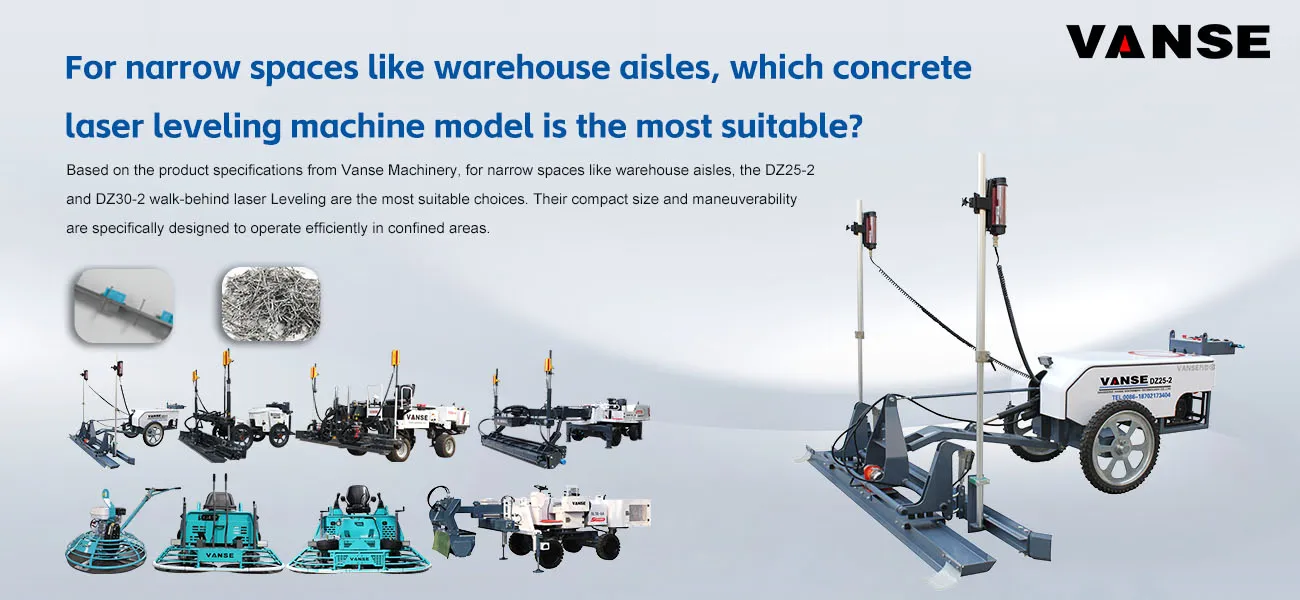
Based on the product specifications from Vanse Machinery, for narrow spaces like warehouse aisles, the DZ25-2 and DZ30-2 walk-behind laser Leveling are the most suitable choices. Their compact size and maneuverability are specifically designed to operate efficiently in confined areas.
Here is a quick comparison of the recommended models from the information you provided:
| Model | Why It's Suitable for Narrow Aisles | Key Advantage | Typical Application | Efficiency |
| DZ25-2 | Light and flexible for performing high-precision leveling in narrow or complex sites. | Compact size, ideal for very tight spaces. | Small warehouses, indoor workshops, underground garages. | Approx. 200㎡/h |
| DZ30-2 | Same core design as DZ25-2, with slightly higher power and efficiency. | Light and flexible, with a bit more output. | Small warehouses, industrial plants with compact space. | Approx. 300㎡/h |
💡 How to Choose Between Them
The DZ series are explicitly recommended on the site for "small warehouses" and "underground garages" where you need to maneuver between columns.
Choose the DZ25-2 if your aisles are extremely tight (e.g., under 2 meters wide) and you prioritize maximum maneuverability above all else.
Choose the DZ30-2 if your aisles offer a bit more space and you want a slightly faster leveling speed (300㎡/h vs. 200㎡/h) to complete the job more quickly.
For wider aisles or large open areas within the warehouse, you might consider larger ride-on models like the WS550 or WS940 series, but the DZ25-2 and DZ30-2 are the clear picks for navigating narrow aisles effectively.
If you can share the exact width of your warehouse aisles, I can help confirm if these models will fit perfectly. Contact us NOW
Note: The parameters provided in this document are for reference only and are not mandatory. Due to differences in technical characteristics between different brands and models of laser levelers, please consult the manufacturer for a suitable solution before actual operation. This reference document assumes no responsibility for any issues arising from failure to follow the manufacturer's instructions.
Thanks to All the Friends Who Support and Trust Shandong Vanse Machinery Technology Co., Ltd.
If you want to know more about Shandong Vanse Machinery Technology Co., Ltd. or have any questions, please feel free to contact us:
Our Factory
Shandong Vanse Machinery Technology Co., Ltd.








Share this article

About the Author: Shandong Vanse Machinery Technology Co., Ltd.
Shandong Vanse Machinery Technology Co., Ltd. is a high-tech manufacturer specializing in concrete construction machinery, including laser screeds and related equipment. The company integrates R&D, production, and global sales, with products exported to over 60 countries and widely used in infrastructure projects worldwide.
Previous Post
Next Post
Related Articles
You Might Also Like
How to choose the power trowel with appropriate power according to the construction scenario?
– The construction area of this type of scene is usually small, generally between tens of square meters and hundreds of square meters. For example, the floor area of the living room and bedroom of an ordinary residence may be around 20-50 square meters. The space is relatively narrow and there are many corners. – For this situation, a hand-held trowel with lower power is more suitable, with a power range of about 1-3kW. Because the low-power trowel has a small body and flexible operation, it can be easily moved in a limited space to perform trowel operations on narrow areas such as corners and walls. – Common indoor floor materials include cement mortar floors, fine stone concrete floors, etc. The thickness of these floor materials is relatively thin, generally within a few centimeters. – The precision requirements are high, and the trowel machine needs to be able to finely process the floor to achieve a high degree of flatness and glossiness. The speed and trowel force of the low-power trowel machine are relatively moderate, which can just meet this demand and avoid damaging the surface structure of the floor material due to excessive power. – The construction area is between a few hundred square meters and thousands of square meters, and the space is relatively open. For example, the area of a medium-sized warehouse may be 500-2000 square meters. – You can choose a moderately powered walk-behind or ride-on trowel. The power of a walk-behind trowel is generally 3-5kW, and the power of a ride-on trowel is 4-7kW. Ride-on trowels are more efficient when constructing large areas, and can quickly smooth the ground, saving time. Walk-behind trowels can be used in some corners that are difficult for ride-on trowels to reach. – The ground material may be thick concrete, about 10-20 cm thick. In this case, the trowel needs to have enough power to compact and smooth the ground. – Although the precision requirements are not as high as those for small indoor scenes, it is still necessary to ensure that the ground has a certain degree of flatness and smoothness to meet the needs of cargo storage or equipment installation. Medium-power trowels can complete the troweling task well while ensuring efficiency. – The construction area is very large, often exceeding thousands of square meters, or even tens of thousands of square meters. For example, a large city square may be 10,000 to 50,000 square meters in area, and an airport runway is even larger. – For this scenario, a high-power driving trowel should be selected, with a power of usually 7 to 15kW. Because large outdoor projects require a large amount of ground troweling work to be completed in a short period of time, a high-power trowel can provide sufficient power and high work efficiency to quickly cover a large area of the ground. – The ground material is generally a thick layer of high-strength concrete, which may be about 20 to 50 cm thick. The trowel needs to have strong power to handle this thick and hard ground material. – For precision requirements, large squares require good flatness and drainage slope of the ground, while airport runways have strict specifications for indicators such as flatness and roughness of the ground. High-power trowel machines can precisely control the trowel effect by adjusting components such as the trowel blade to meet these high standards.How to deal with surface bubbles after concrete pavement construction?
– Mechanical surface treatment: Use a trowel to smooth the surface before the concrete is initially set. The rotation and extrusion of the trowel make the concrete surface more compact, squeeze out some bubbles from the surface, and make the surface smoother. The speed and pressure of the trowel should be controlled during operation to avoid excessive pressure causing water seepage or segregation on the concrete surface. – Manual surface treatment: For corners that are difficult to reach with mechanical surface treatment or areas with many local bubbles, manual surface treatment with a trowel is required. Manual surface treatment can trim the concrete surface more carefully, gently crush the bubbles and evenly cover the bubble marks with surface mortar. During the surface treatment process, pay attention to the angle and strength of the trowel, and try to make the surface treatment smooth and uniform. – After the concrete is poured, when a small amount of water seeps out of the concrete surface and it has not yet set, perform secondary vibration. Use a vibrating rod to vibrate the concrete surface. The vibration time should not be too long. Generally, it is appropriate to stop bubbles from appearing on the concrete surface and to seep out cement slurry. Secondary vibration can further expel the bubbles inside the concrete, while enhancing the compactness of the concrete and improving the quality of the concrete surface. However, be careful to avoid inserting the vibrating rod too deep to damage the formed concrete structure. – For larger bubbles, you can use a steel needle or other sharp tools to puncture the bubbles before the concrete sets to expel the gas. Then use a trowel to gently compact the punctured bubble area so that the surrounding concrete mortar fills the gaps left by the bubbles. Needle puncture exhaust should be performed in time to avoid bubbles from forming obvious holes or defects after the concrete hardens. – If bubbles on the concrete surface still leave obvious marks or small potholes after finishing, you can repair the surface after the concrete has finally set. First, clean the surface of the repaired area to remove dust, debris, etc. Then, according to the color and mix ratio of the concrete, mix an appropriate amount of repair material, such as cement mortar or a special concrete repair agent. Apply the repair material to the bubble marks and smooth it with a trowel to make it smooth and consistent with the surrounding concrete surface. After repair, pay attention to the maintenance of the repaired area to avoid the repair material from losing water and drying too quickly and causing cracks. – Reasonable maintenance is also important to reduce the impact of bubbles on the concrete surface. After the concrete is poured, it should be covered with moisturizing materials such as plastic film and geotextile to prevent the water on the concrete surface from evaporating too quickly. At the same time, according to the ambient temperature and humidity, watering maintenance should be carried out in time to keep the concrete surface moist. The maintenance time is generally not less than 7 days. For important concrete pavements or large-volume concrete, the maintenance time should be appropriately extended. Good maintenance can fully hydrate the concrete, improve the strength and density of the concrete, and reduce surface defects caused by water evaporation and concrete shrinkage, including bubble-related problems.How durable is a concrete laser leveling machine?
The durability of a concrete laser leveling depends largely on its design and build quality. Generally speaking, a high-quality concrete laser leveling should have the following characteristics: ▶Strong and durable: The concrete laser leveling machine should be made of high-strength materials, such as high-quality steel and alloy materials, to ensure that the machine is not easily damaged during use. In addition, the leveling should have protection against wear and damage, such as wear-resistant coatings and anti-collision designs. ▶Reliable performance: Concrete laser leveling machines should have reliable laser transmitters and receivers to ensure that the machine can accurately measure and level the concrete surface. In addition, the leveling machine should have a reliable drive system and control system to ensure that the machine can operate stably and provide accurate leveling results. ▶Good maintenance: Maintenance of your concrete laser leveling is crucial to its durability. Check regularly whether all parts of the machine are working properly, including laser transmitters and receivers, drive systems, control systems, etc. In addition, machines should be cleaned and maintained regularly to prevent dust and other impurities from causing damage to machine parts. ▶Wide range of applications: Concrete laser leveling machine should be suitable for various types of concrete surface leveling operations, such as floors, ceilings and walls, etc. This means that machines should have flexible design and functionality that can adapt to different working environments and needs. ▶Long-lasting service life: The service life of a concrete laser leveling should be evaluated based on its design and manufacturing quality. Generally speaking, the service life of a high-quality concrete laser leveling machine should be more than 10 years, which requires the machine to maintain good performance and reliability during long-term use. Overall, the durability of a concrete laser leveling depends on the quality of its design and build, as well as its use and maintenance. Therefore, when choosing a concrete laser leveling machine, you should choose a well-known brand and reliable manufacturer to ensure the quality and service life of the machine. At the same time, operation and maintenance should be carried out in accordance with the operation and maintenance guidelines provided by the manufacturer during use to ensure that the machine maintains good performance and reliability.