Technical Knowledge
What are the specific safe operation and maintenance procedures for concrete laser leveling machines?
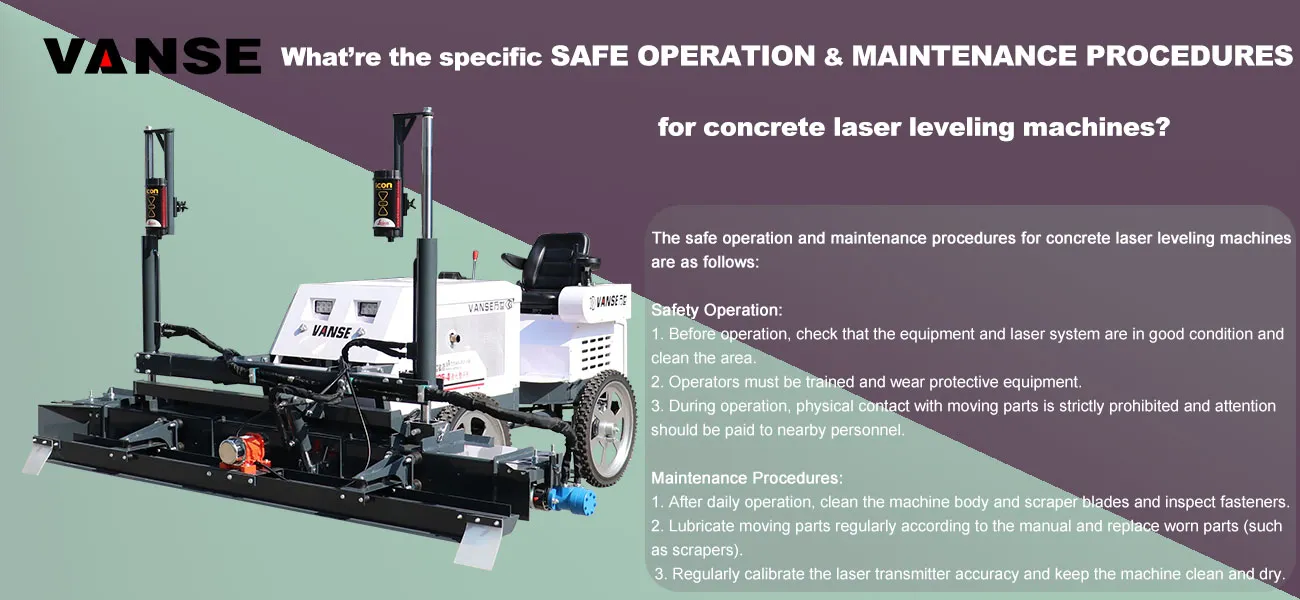
Concrete Laser Leveling Machine Safety Operation and Maintenance Procedures
1. Safety Operating Procedures
(1) Pre-Operation Preparation
Performance Requirements: Operators must undergo rigorous training and be familiar with the equipment's performance, operating methods, and safety regulations. Unlicensed operators are strictly prohibited.
Dress Code: Wear personal protective equipment (PPE), including a hard hat, reflective clothing, puncture-resistant shoes, and protective gloves.
On-site Inspection:
Survey the construction site, clear any obstructions, and confirm the site's sufficient bearing capacity to prevent equipment from sinking.
Set up clear construction cordons and prohibit unauthorized personnel from entering the work area.
Equipment Inspection (mandatory before daily startup):
Walk around the machine: Check all machine components for damage or cracks, especially the scraper, vibrator, and track.
Fastener Inspection: Check for loose bolts and nuts in key areas (such as scraper attachment bolts and vibrator mounting bolts).
Leak Check: Check the engine, hydraulic system, and fuel system for oil or water leaks.
Lubrication Inspection: Check the lubricating and hydraulic oil levels to ensure they are within normal ranges.
Power System: Check the coolant level and engine air filter for cleanliness.
Laser System: Check the laser transmitter battery level to ensure the signal is stable; clean the laser receiver sensor lens.
(2) Precautions during operation
Start up:
Ensure all control levers are in the neutral or park position.
Sound the horn or sound an alarm to alert nearby personnel that the equipment is about to start.
Start the engine smoothly and let it idle for 3-5 minutes to warm up, especially in cold weather.
Moving and Traveling:
Before moving, check your surroundings to ensure there are no people or obstacles.
When working in potholes, on slopes, or near edges, exercise extreme caution and maintain a low speed to prevent tipping.
When turning, pay attention to the position of accessories such as scrapers to avoid collisions with others or objects.
Operation Process:
Laser Setup: Properly set up the laser transmitter, ensuring it remains stable and stationary. Regularly check the reference surface for accuracy throughout the application process.
Focused Operation: Pay close attention to the front and rear of the machine, as well as the feedback from the laser control system, and keep your hands on the joystick.
Keep Out of the Way: While the machine is operating, no one is allowed to stand in the danger zone directly in front of or behind the machine.
Abnormal Handling: If the machine experiences unusual noises, vibrations, alarms, or a sudden drop in performance, immediately shut it down for inspection. Operations can only resume after the problem has been corrected.
Emergency:
Familiarize yourself with the location of the emergency stop button and press it immediately in any emergency.
If a fire occurs, immediately use the provided fire extinguisher to extinguish the fire.
(3) Cleaning Up After Operation
Shutting Down the Machine: Park the machine on a flat, solid, and safe area. Lower the scraper and ensure it rests flat on the ground.
Shutting Down the Engine: Turn off the engine and remove the key for safekeeping.
Cleaning:
Do this immediately! Before the concrete sets, thoroughly clean any concrete slurry from the equipment, especially any buildup on the scraper, vibrator, and travel mechanism. Never use a sledgehammer to strike precision components.
When flushing, avoid splashing the engine exhaust, bearing housing, laser electrical components, and other areas.
Handover: Complete the equipment operation log, recording the operating hours, any abnormalities detected, and any maintenance performed during the shift.
2. Maintenance Procedures
Maintenance is implemented through a system that combines daily maintenance, scheduled maintenance, and seasonal maintenance.
(1) Daily Maintenance (8-10 working hours per shift)
Cleaning: Thoroughly clean the entire machine.
Inspection and Tightening: Inspect and tighten all connecting bolts.
Lubrication: Fill all lubrication points (such as the cutter head support, lift screw, travel bearings, etc.) with the specified grease according to the instructions in the manual. (Especially important: the scraper lift screw must be lubricated after each use!)
Leak Check: Inspect the hydraulic system and engine for leaks.
Oil Level Check: Check the engine oil, coolant, and hydraulic oil levels.
(2) Regular maintenance
| Cycle Maintenance Details | Maintenance Details |
| Every 50 hours | 1. Complete all daily maintenance items. |
| 2. Inspect the scraper and vibrator for wear and adjust or replace if necessary. | |
| 3. Check the engine belt tension. | |
| Every 250 hours | 1. Complete all 50-hour maintenance items. |
| 2. Change the engine oil and oil filter. | |
| 3. Clean or replace the engine air filter element (requires shorter intervals in dusty environments). | |
| 4. Inspect the equipment structure for cracks or deformation. | |
| Every 500 hours | 1. Complete all 250-hour maintenance items. |
| 2. Replace the hydraulic oil suction and return filters. | |
| 3. Inspect the track and tires for wear and tension. | |
| 4. Check all electrical connections for tightness and deterioration. | |
| Every 1000-2000 hours | 1. Complete all 500-hour maintenance items. |
| 2. Completely replace all hydraulic oil. | |
| 3. Clean the hydraulic oil tank and breather. | |
| 4. Professional service engineers will fully calibrate the laser system accuracy and conduct a comprehensive overhaul of the equipment. |
(3) Long-term Storage and Maintenance (Season Change or Project Ending)
Clean the equipment according to regulations.
Apply grease to all exposed metal parts (such as scrapers and screws) to prevent rust.
Fill the fuel tank with fuel to prevent rust on the inside.
Disconnect the negative battery cable.
Store the equipment in a dry, flat indoor environment.
Key Points:
Safety First, Prevention First: All operations and maintenance must be conducted with safety in mind.
Cleanliness is Key: Concrete is extremely difficult to clean after setting, which can severely damage equipment. Immediate cleaning after each shift is paramount.
Lubrication Ensures Longevity: Use the specified brand of lubricant/grease strictly in accordance with the manual and refill on schedule.
Follow the Manual: This procedure is a general guideline only. For specific operations, be sure to follow the official manual for your equipment.
Implementing this procedure in daily operations will greatly ensure personnel safety, extend equipment life, and ensure construction quality.
Note:
The parameters provided in this document are for reference only and are not mandatory. Due to differences in technical characteristics between different brands and models of laser levelers, please consult the manufacturer for a suitable solution before actual operation. This reference document assumes no responsibility for any issues arising from failure to follow the manufacturer's instructions.
Thanks to All the Friends Who Support and Trust Shandong Vanse Machinery Technology Co., Ltd.
If you want to know more about Shandong Vanse Machinery Technology Co., Ltd. or have any questions, please feel free to contact us:
Our Factory
Shandong Vanse Machinery Technology Co., Ltd.








Share this article

About the Author: Shandong Vanse Machinery Technology Co., Ltd.
Shandong Vanse Machinery Technology Co., Ltd. is a high-tech manufacturer specializing in concrete construction machinery, including laser screeds and related equipment. The company integrates R&D, production, and global sales, with products exported to over 60 countries and widely used in infrastructure projects worldwide.
Previous Post
Next Post
Related Articles
You Might Also Like
The reason why the laser leveling machine is efficient and fast
With the gradual improvement of the requirements of modern industrial floors, more and more floor construction equipment began to show their own power, and the laser leveling machine has been loved by the majority of users since it was launched, so it can be used in the leveling machine occupy a place in the market. Laser leveling machine manufacturers have always insisted on providing users with standardized equipment, and are committed to bringing more efficient construction to road construction. Laser leveling machine manufacturers will introduce some performance advantages of the leveling machine from the following, I hope you can understand. The laser leveling machine laser measurement and control system produced by the laser leveling machine manufacturer automatically controls the elevation. The design elevation of the top surface of the floor with the laser system imported from the United States is automatically controlled by the laser machine computer, which can ensure a very high leveling of the ground, and can directly achieve leveling on the concrete layer. The leveling of the ground is not affected by the vibration of the construction formwork, and no formwork is needed in the middle , Reduce artificial material input, reduce construction procedures, and speed up construction progress. The laser leveling machine is super flat and super economical. Since the 1990s, since the continuous promotion of "clear water concrete" (building) floor and colored wear-resistant (building) floor, after more than ten years of exploration and continuous improvement, through the upgrading of laser leveling machine equipment, the process flow The integration is perfect, so that the "three super" floors in the current "flat" product series have reached the domestic level. The laser leveling machine produced by the laser leveling machine manufacturer replaces the traditional manual leveling of concrete. The ground elevation can reach laser-level accuracy. Lasers are used to control the levelness and flatness of the ground, so as to achieve a super-flat floor in the sense. So how much is a laser leveling machine, you first understand the performance and then look at the price. The integral floor abandons the traditional method of separate construction of the concrete base and surface, thus eliminating the common quality problems of cracks and hollows caused by poor combination of the base and the surface, and is widely used in factories, warehouses, runways, docks and other projects more and more widely used. Using special leveling and polishing technology to process concrete into high-density and high-gloss floor, and naturally form a 3~5mm thick wear-resistant layer on the surface, without other chemical surface materials, meeting environmental protection requirements. The laser leveling machine is developed according to the increasing demand for ground quality such as strength, compactness, flatness, levelness, etc. of modern industrial plants, large shopping malls, warehouses and other large-area cement concrete floors. Laser leveling machine manufacturers specialize in the production of various types of leveling machines. The equipment produced is exquisite in craftsmanship, mature in technology, and stable in performance. We will provide customers with good after-sales service, allowing you to enjoy a relaxed and happy purchase process. Customers will use it later Problems encountered can be resolved in time to ensure the normal operation of the production line.Technical key points on how to ensure the overall flatness in the construction of large-span floor slabs with a concrete laser leveling machine.
In the construction of large-span floor slabs, using a concrete laser leveling machine to ensure overall flatness is far more than just "starting the machine and scraping it flat". It is a systematic project involving the comprehensive application of equipment, measurement, materials, processes and management. The following are the core technical points to ensure the overall flatness of large-span floor slabs: This is the most crucial step. If the benchmark is wrong, all subsequent work will be in vain. When choosing a 360° rotating laser emitter, it is essential to ensure that its horizontal accuracy is ±1.0mm/100m or higher (such as ±0.5mm/100m). This is the "absolute benchmark" for the entire construction process. The optimal installation location: The transmitter should be set up in the center of the site or at a stable position that can cover the entire construction area. For extremely large spans, it may be necessary to set up multiple transmitters and use the same reference elevation, or to use equipment with multiple receivers for seamless switching. Firmness and protection: The transmitter must be set up on an extremely stable tripod, far away from equipment passageways and areas with frequent personnel movement, and clearly marked to prevent it from being touched. Any tiny movement can lead to a disastrous elevation error. Laser leveling machines cannot correct the macroscopic undulations of the base layer (such as formwork and foundation). Before pouring, an optical level or total station must be used to conduct a comprehensive recheck of all formwork top elevations and support systems based on the reference plane set by the laser emitter. Ensure the rigidity and stability of the entire support system to prevent settlement during the pouring process. Select large ride-on leveling machine: For large-span construction, equipment with sufficient self-weight and powerful performance is required to ensure adequate vibration force and leveling force on the concrete, avoiding the formation of wavy surfaces due to the lightness of the equipment. Pre-construction calibration: Before starting work every day and during construction, it is necessary to regularly check whether the laser receiver, control system and hydraulic actuator of the leveling machine are sensitive and accurate. Ensure that the flat head can respond immediately and accurately to changes in the laser signal. For large-span floor slabs, it is necessary to plan the traveling path of the leveling machine and the placement position of the concrete pump truck. The "backlaying method" is usually adopted, that is, the leveling machine starts from one end, spreading the material while leveling it, and gradually proceeds backward for construction. The principle of path planning is to minimize the repeated movement of equipment on the unset concrete, avoiding the formation of ruts and damage to the leveled surface layer. There should be sufficient overlapping area (usually 100-200mm) between two adjacent leveling zones. Consistency is key: The pouring time for large-span floor slabs is long, and it is essential to ensure that the mix proportion and slump of all batches of concrete are highly consistent. The slump is recommended to be controlled at 140mm±20mm. Slump fluctuations can lead to different local drying shrinkage rates, affecting the final flatness. Optimize the ratio of aggregates to slurry: A good mix ratio can ensure that the concrete has sufficient slurry to coat the aggregates and float up after vibration, forming a smooth and flat surface. The height of the fabric should be slightly higher than the designed elevation (taking into account the amount of vibration and settlement). The leveling machine should closely follow the placing machine and level the concrete in a timely manner within the time when it maintains the best workability. Avoid laying a large area of material first and then starting to level it, as this may cause the concrete laid earlier to have already begun to set, affecting the overall integrity. This is a key measure to prevent large-scale concrete cracking and thus affect the flatness. After the concrete is leveled and its strength reaches approximately 5-10 mpa (usually when a person can walk on it but without leaving deep footprints), a professional jointing machine should be immediately used for early jointing to release the shrinkage stress. The depth of the cut seam is generally 1/3 to 1/4 of the slab thickness, and the seam spacing is determined based on the slab thickness and reinforcement conditions. Once the leveling work is completed, maintenance should be carried out immediately. By spraying curing agents or fully covering with plastic film, ensure that the moisture on the concrete surface does not evaporate too quickly. Uneven water loss is the enemy of flatness, which can cause surface cracking and warping deformation, thereby destroying the flatness that has been achieved. Process inspection: During construction, workers should use a 2-meter straightedge to conduct random checks on the just-leveled area at any time. If any deviation is found, the equipment or process should be fine-tuned immediately. Final inspection: After the concrete has hardened, use a level or total station for grid-based measurement to check the overall elevation. Use a 2-meter straightedge and a feeler gauge to conduct a comprehensive inspection of the flatness (whether it meets ±3mm/2m or higher standards). For extremely demanding sites, even floor flatness testers (Dipstick) or F-meters can be used to obtain more scientific dynamic flatness (FF/FL) data. Stage Key points Purpose Preparatory work 1. High-precision laser emitter Establish an unshakable absolute elevation benchmark 2. Precise calibration of the base layer/template Equipment and Technology 1. Large vehicle-type equipment Ensure that the accuracy, efficiency of the actuator matches the material 2. Equipment calibration 3. Scientific path planning 4. Concrete consistency Process operation 1. Synchronize the fabric and leveling Ensure the continuity of construction and control shrinkage cracks 2. Make timely soft cuts to the seams Later maintenance Immediate seamless maintenance Prevent uneven water loss from causing deformation and cracking In the construction of large-span floor slabs, the concrete laser leveling machine is the core tool for achieving high flatness, but its performance depends on a complete technical system. Starting from establishing an absolutely precise and stable laser reference, to the supply of qualified concrete, scientific construction organization, meticulous operation and timely maintenance, every link is of vital importance. Only by systematically integrating these key points can the outstanding overall flatness of large-span floor slabs be ultimately guaranteed. Note: The parameters provided in this document are for reference only and are not mandatory. Due to differences in technical characteristics between different brands and models of laser levelers, please consult the manufacturer for a suitable solution before actual operation. This reference document assumes no responsibility for any issues arising from failure to follow the manufacturer's instructions.In commercial facilities, how can laser leveling machines ensure floor flatness to provide a better customer experience?
A laser leveling is a piece of equipment used in concrete construction that uses laser technology to measure and adjust the flatness of concrete floors. Here are some of the ways a laser leveling ensures floor flatness: Laser transmitter: The laser leveling is equipped with a laser transmitter that emits a horizontal laser beam. This laser beam is used as a reference line to determine if the concrete floor is flat. Receiver: The laser leveling is also equipped with a receiver that detects the position of the laser beam and compares it to the actual floor. If the floor is not flat, the receiver sends a signal to the operator indicating that adjustments need to be made. Automatic adjustment: Some advanced laser levelings have an automatic adjustment function that automatically adjusts the height and angle of the machine based on the information received to ensure the flatness of the concrete floor. High-precision sensors: Laser levelings are usually equipped with high-precision sensors that can accurately measure the flatness of the concrete floor and transmit data to the control unit for necessary adjustments. Through the above methods, laser levelings can ensure the flatness of concrete floors in commercial facilities, providing customers with a better experience. For example, in places such as shopping malls and hotels, a flat floor is essential for walking comfort and safety. In addition, a flat floor can improve space utilization and make commercial facilities look neater and more professional.