Technical Knowledge
Optimizing strategies for managing maintenance cycles and frequency for concrete laser leveling machines
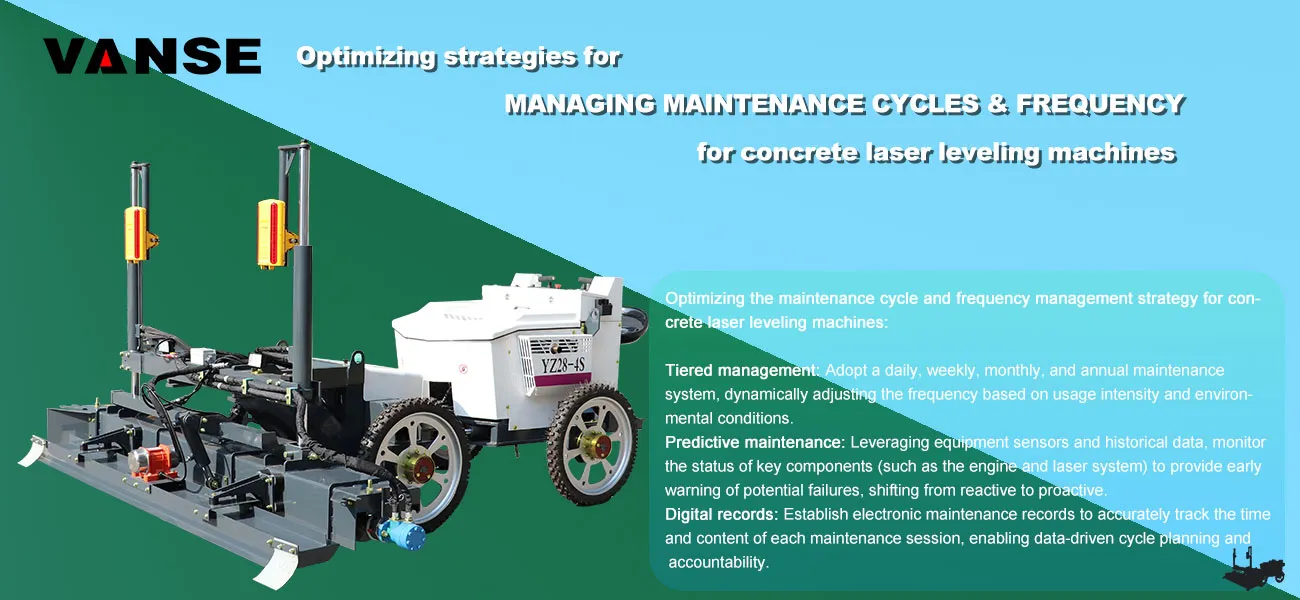
Optimizing Maintenance Cycles and Frequency Management for Concrete Laser Leveling Machines
1. Dynamic Cycle Adjustment Based on Equipment Operation Data
Establish a data collection system: Using built-in sensors or IoT modules, real-time data collection is performed on working hours, work intensity (e.g., concrete hardness, construction area), and core component temperature/vibration values, replacing the traditional "fixed cycle" model.
Setting grading thresholds:
Normal operating conditions (average daily operating hours ≤ 8 hours, concrete strength below C30): Core components (laser transmitter, hydraulic system) are maintained every 50 hours, and the entire machine is maintained every 200 hours.
Heavy operating conditions (average daily operating hours > 8 hours, concrete strength above C40): Core components are maintained every 30 hours, and the entire machine is maintained every 150 hours.
Data exceeding thresholds (e.g., abnormal vibration values) triggers an emergency maintenance alert, requiring inspection within 24 hours.
2. Differentiated Management Based on Use Cases
Environmental Adaptation and Adjustment:
In high-temperature/high-dust areas (such as open-air construction sites):
Increase maintenance frequency of air and hydraulic oil filters by 50% to once every 10 days.
In humid areas:
Inspect electrical systems (such as laser receivers and control panels) for moisture every 20 days to prevent short circuits.
Intermittent Utilization:
After a single day's work (within 1-2 hours of equipment downtime), simple maintenance (such as cleaning the machine body and checking tire/track wear) can be completed, reducing dedicated downtime for maintenance and improving equipment utilization.
3. Efficiency Improvements through Technology Upgrades
Application of an Intelligent Early Warning System:
Introducing a maintenance management system with fault warning capabilities. This uses data analysis to predict component lifespans (e.g., remaining life of laser tubes, wear levels of hydraulic pumps) in advance, avoiding over- or under-maintenance.
Standardized Maintenance Processes:
Developing tiered maintenance manuals (basic maintenance/deep maintenance) clearly defines the time required for each step, as well as the tools and consumables required. This ensures efficient execution by maintenance personnel and reduces disruptions to the maintenance cycle caused by human error.
4. Regular Review and Continuous Optimization
Evaluate equipment failure types, maintenance costs, and downtime quarterly to analyze the rationality of the current cycle and frequency.
If a component's failure rate remains high, shorten its maintenance interval (e.g., from 50 hours to 40 hours).
If a maintenance step is too costly and ineffective, optimize the process (e.g., replacing disassembly maintenance with maintenance-free cleaning) to achieve a cost-effective balance.
Note: The parameters provided in this document are for reference only and are not mandatory. Due to differences in technical characteristics between different brands and models of laser levelers, please consult the manufacturer for a suitable solution before actual operation. This reference document assumes no responsibility for any issues arising from failure to follow the manufacturer's instructions.
Thanks to All the Friends Who Support and Trust Shandong Vanse Machinery Technology Co., Ltd.
If you want to know more about Shandong Vanse Machinery Technology Co., Ltd. or have any questions, please feel free to contact us:
Our Factory
Shandong Vanse Machinery Technology Co., Ltd.








Share this article

About the Author: Shandong Vanse Machinery Technology Co., Ltd.
Shandong Vanse Machinery Technology Co., Ltd. is a high-tech manufacturer specializing in concrete construction machinery, including laser screeds and related equipment. The company integrates R&D, production, and global sales, with products exported to over 60 countries and widely used in infrastructure projects worldwide.
Previous Post
Next Post
Related Articles
You Might Also Like
The Concrete Laser Leveling Equipment Maintenance: Failure Rate Analysis and Maintenance Frequency Determination
Concrete Laser Leveling Equipment Maintenance: Failure Rate Analysis and Maintenance Frequency Determination Laser System (25%-30%): Construction dust and vibration can easily cause laser transmitter calibration deviation, or prolonged high temperature environments can cause poor circuit contact, resulting in leveling accuracy deviation and frequent alarms. Hydraulic System (20%-25%): Hydraulic oil contamination (impurities/water) and seal aging can lead to cylinder leakage and lag. Prolonged oil shortages can cause hydraulic pump wear, a major cause of downtime and maintenance. Travel and Transmission Components (15%-20%): Tire/Track wear (from friction on gravel roads), chain slack (from long-term load operation), and drive motor carbon brush wear can easily lead to equipment deviation and power loss. Electrical System (10%-15%): Oxidation of wiring terminals (from humid environments), wear of control switch contacts, and impact damage to sensors (such as elevation sensors) can easily cause equipment start/stop failures and false data reports. Structural parts and wearing parts (10%-15%): wear of the leveling scraper (concrete friction), damage to the vibrator bearing (high-frequency vibration), loose connection bolts (equipment vibration transmission). Although the cost of a single repair is low, it can easily affect construction efficiency. Environmental Factors: High temperatures (>35°C) accelerate hydraulic oil deterioration and circuit aging; humid/rainy environments increase the risk of electrical short circuits; dusty construction sites (such as those near gravel pits) shorten the lifespan of laser systems and heat dissipation components, increasing the failure rate by 20%-30%. Usage Habits: Overloading (e.g., exceeding the rated leveling thickness of the equipment), running at full load immediately after startup (without preheating), and failing to clean the machine promptly after shutdown (due to residual concrete buildup) can increase the failure rate by over 30%. Maintenance Level Maintenance Details Maintenance frequency (normal operating conditions) Adjustments for harsh operating conditions (high temperature, high dust, and humidity) Daily Maintenance 1. Clean dust from the laser transmitter and receiver; Daily before and after work Add one laser system cleaning during operation 2. Check the hydraulic oil level and quality; 3. Tighten the machine body connecting bolts; 4. Clean any remaining concrete from the leveling blades; Weekly Maintenance 1. Lubricate the travel chain and bearings (add grease); Every 50-80 work hours (or once a week) Reduced to every 30-50 operating hours 2. Check tire/track wear and tire pressure; 3. Test the laser system accuracy (check with a calibration ruler); 4. Check for loose electrical terminals; Monthly Maintenance 1. Replace the hydraulic oil filter; Every 200-300 work hours (or once a month) Reduced to every 150-200 operating hours 2. Check the hydraulic seals for leaks; 3. Calibrate the elevation sensor and travel deviation correction; 4. Check the drive motor operating temperature and noise Laser System: Professionally calibrate every 6 months (or 800 operating hours) and replace the laser transmitter dust cover (if worn). If accuracy deviation exceeds 0.5mm/2m, immediately shut down the machine for calibration. Hydraulic System: Replace hydraulic oil (and oil tank filter) every 12 months (or 2000 operating hours). Completely inspect and replace seals every 18 months (or 3000 operating hours). Electrical System: Replace control switch contacts and motor carbon brushes (if worn more than 1/2) every 8 months (or 1500 operating hours). Waterproof and seal the electrical cabinet before the rainy season. Consumable Parts: Leveling scraper (wear exceeds 5mm), vibrator bearings (noise during operation), tires (tread depth <3mm). Replace as needed (generally every 1000-1500 operating hours). Long-term shutdown (>15 days): Before shutdown, bleed residual hydraulic system pressure, clean the equipment inside and out, and store in a dry, ventilated area. Before restarting, perform a comprehensive inspection (hydraulic oil, electrical circuits, and precision calibration). Do not restart operations immediately. High-intensity operation (average daily operation time >8 hours): Reduce all maintenance frequency by 30%, and increase daily hydraulic system and motor temperature monitoring (if the temperature exceeds 60°C, shut down the machine for cooling). Note: The parameters provided in this document are for reference only and are not mandatory. Due to differences in technical characteristics between different brands and models of laser levelers, please consult the manufacturer for a suitable solution before actual operation. This reference document assumes no responsibility for any issues arising from failure to follow the manufacturer's instructions.A must-read for beginners–a collection of judgment skills for concrete laser leveling machines
As construction units continue to increase their requirements for the color, appearance, and flatness of large-area concrete floors, the problems of traditional construction processes in terms of construction progress and quality are becoming increasingly prominent. The use of concrete laser leveling machines for one-time floor forming construction has far greater advantages in terms of process, technology, and cost than the former. In order to effectively improve the operating efficiency of concrete laser leveling machines, this article briefly summarizes some methods and techniques from the perspective of purchase and maintenance, hoping to help everyone's future use. ✪ How to judge whether the quality of a laser leveling machine is good? 1. Look at the effect. High-quality laser leveling machines have more stable effects. 2. Look at the speed. High-quality laser leveling machines have faster leveling speeds. 3. Look at the accuracy. High-quality concrete laser leveling machines have higher leveling accuracy. 4. Look at the model. The selection of a suitable laser leveling machine is mainly based on the construction site and area. 5. Look at the manufacturer. The technical strength of the manufacturer of concrete laser leveling machines directly affects the quality of the equipment. 6. Look at safety. When selecting a laser leveling machine, the braking performance and operational safety of the concrete laser leveling machine must also be fully considered. ✪✪How to judge whether the laser leveling machine is a new equipment? 1. Check whether there is noise during operation. Hold the inner sleeve of the bearing body of the concrete laser leveling machine with your left hand, and turn the outer sleeve with your right hand to make it rotate, and listen to whether there is noise during the operation of the bearing. Since most counterfeit products are produced under backward conditions and are completely operated in a manual workshop, it is inevitable that impurities such as dust and sand will be mixed into the bearing body during the production process, so there will be noise or unsmooth operation when the bearing rotates. 2. Check whether there is oil stain on the surface. This should be paid special attention to when purchasing. Since the current anti-rust technology is still a little behind that of foreign manufacturers, many manufacturers are prone to leave thick oil stains when anti-rusting concrete laser leveling machines, and there will always be a sticky touch when directly touching them with your hands. 3. Check whether the printing on the parts is clear. The bearing products of each laser leveling machine are usually printed with their words, numbers, etc. The counterfeit fonts are not only blurred, but also float on the surface due to the rough printing technology. Some can even be easily wiped off by hand or have serious manual traces. 4. Check whether the outer packaging is clear. Generally speaking, the concrete laser leveling machines produced by regular manufacturers have their own dedicated designers to design the outer packaging, so the whole machine packaging should be very clear from lines to color blocks. ✪✪✪How to judge whether the laser leveling machine needs overhaul? Due to the great differences in the operating conditions and maintenance levels of different concrete laser leveling machines, it is difficult to determine the reasonable overhaul time based on the service life and working time alone. According to many practical results, we recommend that the laser leveling machine generally needs an overhaul after working for 4000-6000 hours. Machinery that needs overhaul usually has the following symptoms: 1. The pipelines and sealing components of the hydraulic system are aging and the oil leakage is serious. 2. The circuits of the electronic control system are aging, the control accuracy is reduced, and the failure rate is high. 3. The engine power is significantly reduced, and symptoms such as blowby, burning oil, and difficulty in starting appear. 4. The concrete laser leveling machine has been working for about 5000 hours, but its transfer case, transmission, and reducer have never been repaired; 5. The hydraulic power of the leveling machine has decreased, which is generally manifested as insufficient walking power or material distribution power. Specifically, it is basically normal for small load operations, barely able to operate with medium loads, but unable to operate with large loads. Warm reminder: Choosing the right model and ensuring the performance of the machine are important prerequisites for the safe use of the concrete laser leveling machine, and learning maintenance skills is a necessary requirement to maintain the good operation of the laser leveling machine and extend the service life of the machine, so both aspects need to be given enough attention.How should maintenance standards for equipment used in concrete construction be established?
When developing maintenance standards for concrete construction equipment, it's necessary to consider the technical characteristics of each equipment type (such as mixing equipment, conveying equipment, pouring equipment, and vibrating equipment), construction scenario requirements, and industry standards. This approach aims to create a systematic standard that covers the entire lifecycle, is quantifiable and implementable, and assigns specific responsibilities. The following is the specific framework and core content: Before developing standards, it's important to first clarify the underlying foundations to ensure they are legally compliant, practical, and avoid being divorced from equipment characteristics or industry requirements. Equipment Technical Documentation Based on the manufacturer's operating and maintenance manuals, key parameters (such as lubrication cycles, replacement thresholds for wearing parts, and maintenance tool models) are extracted. For example, for a mixer, "mixing blades should be replaced if wear is ≤3mm" and "gear oil should be changed every 500 hours for the reducer" are standard "technical baselines." Industry and national standards Reference mandatory or recommended specifications, such as: Technical Regulations for Safety in the Use of Construction Machinery (JGJ33-2012): Clarifies safety requirements for equipment maintenance (such as powering off before maintenance and posting warning signs); Technical Specifications for Concrete Mixing Plants (Buildings) (GB/T 10171-2021): Specifies maintenance cycles and performance testing indicators for mixing equipment; Technical Specifications for Concrete Pumps (GB/T 13333-2014): Clarifies maintenance requirements for the hydraulic system and piping of concrete pumps. Construction scenarios and equipment load Based on project specific adjustments (e.g., high temperature, high humidity, or high-frequency construction scenarios require shortened maintenance intervals): For example, for concrete mixer trucks in tropical regions, the hydraulic oil filter replacement interval needs to be shortened from the standard 1,000 hours to 800 hours. For example, when continuously pouring large volumes of concrete, the insulation layer of the vibrator needs to be inspected every 8 hours instead of every 8-hour shift. Concrete construction equipment varies greatly. Based on the principle of "classification and standardization," the standard should be broken down into "equipment classification modules." Each module covers four dimensions: daily maintenance, scheduled maintenance, fault prevention, and safety requirements, ensuring coverage of the entire equipment lifecycle. Using the four most critical types of equipment in concrete construction as examples, this standard specifies specific maintenance content, cycles, standards, and responsible individuals: Device Type Maintenance Dimension Maintenance cycle Core maintenance content (quantifiable standards) 1. Mixing equipment (mixing machine, batching machine, cement silo) Daily Maintenance Daily before/after construction 1. Mixer: Clean any remaining concrete in the drum (no lumps or adhesion), and check the blade/liner fastening bolts (no looseness, torque ≥ 80 N·m). 2. Batching machine: Clean any debris from the hopper, and check the conveyor belt for deviation (≤ 50 mm/10 m). 3. Cement silo: Check the sensitivity of the level gauge (analog signal response time ≤ 2 seconds), and the safety valve for leaks. Periodic Maintenance (Medium Repair) Every 300-500 man-hours 1. Replace the mixer liner (if wear ≥ 5 mm). 2. Change the gear oil in the reducer (oil quality test: viscosity ≥ 220 cSt, no metal debris). 3. Adjust the tension of the batching machine conveyor belt (deflection ≤ 15 mm/1 m span). Periodic Maintenance (Major Repair) Every 2000-3000 man-hours 1. Disassemble the mixer shaft and check the bearing clearance (≤ 0.05 mm). 2. Calibrate the batching scale for accuracy (error ≤ ±1%). 3. Repair the anti-corrosion coating on the cement silo interior (no rust on ≥ 0.1 m2). 2. Conveying equipment (concrete pump trucks, trailer pumps, mixer trucks) Daily Maintenance Daily after construction 1. Pump Truck: Flush the delivery pipeline (no concrete residue, smooth water flow), check the outrigger cylinder seals (no oil leakage, no scratches on the piston rod); 2. Mixer Truck: Clean the tank (no hardening on the tank wall), check the tire pressure (±0.2 bar). Periodic Maintenance Every 1000 km / 500 man-hours 1. Pump Truck: Replace the hydraulic oil filter (pressure differential ≥ 0.3 MPa), inspect the boom welds (no cracks, weld height ≥ 8 mm); 2. Mixer Truck: Replace the tank liner (wear ≥ 10 mm), and maintain the drive system (bearing temperature ≤ 60°C). 3. Vibrating equipment (insertion vibrator, flat plate vibrator) Daily Maintenance Every 8-hour shift 1. Check the cable insulation (no damage, ground resistance ≤ 4Ω); 2. Vibrator: Test run (amplitude ≥ 0.8 mm, no abnormal noise), and check the connectors for looseness. Periodic Maintenance Every 50 shifts 1. Replace the vibrator bearing (clearance ≥ 0.1 mm); 2. Clean the motor cooling vents (no dust blockage, temperature rise ≤ 40°C). 4. Measuring equipment (sand and gravel scales, cement scales, admixture scales) Daily Maintenance Daily 1. Clear the scale hopper of any accumulated material (no material hanging, no skew); 2. Calibrate the zero point (error ≤ ±0.5kg) and check the sensor wiring (no looseness). Periodic Maintenance Every 30 days 1. Perform dynamic calibration (load 100% of the rated weight, error ≤ ±1%); 2. Check the sensor protection (no moisture, no deformation due to impact). Lubrication Management Standards Follow the "Equipment Lubrication Chart" (specify the lubricant type, filling point, cycle, and amount). For example, use 3# lithium-based grease for the mixer bearings, refilling every 100 working hours at a rate of 50g each time. After lubrication, record the "lubrication time, person performing the lubrication, and oil quality" to avoid over-lubrication or under-lubrication. Consumable Parts Management Standards Maintain a "consumable parts ledger" (including model, inventory threshold, and replacement cycle), such as for agitator blades, conveyor belts, vibrators, and cables, with a minimum inventory of three sets. When replacing consumable parts, "model matching" is required. Substitution with non-genuine parts is prohibited (exceptional circumstances require approval from the technical director). After replacement, a test run is required to confirm compliance. Safety Maintenance Standards Before maintenance, power and gas must be turned off, and a warning sign must be posted (e.g., "Equipment under maintenance, do not start"). Safety belts must be worn and a warning area must be set up for overhead work (e.g., pump truck boom maintenance). Electrical equipment maintenance requires a "certified operator" (electrician's license). Hydraulic system maintenance must be depressurized (reduced to 0 MPa) to prevent hydraulic fluid spray and injury. Record and traceability standards Establish an "Equipment Maintenance Record Form" (electronic or paper) that includes: equipment number, maintenance date, maintenance items, test data, abnormalities, person responsible, and inspector. Record retention period should be ≥ the equipment's service life to facilitate tracing the cause of a malfunction (e.g., if a mixer blade breaks, the record can be used to verify whether it has not been replaced beyond the specified time limit). Clarify the responsibility system Responsibilities are divided into different levels: Operators are responsible for "daily maintenance" (cleaning, inspection, and simple tightening); repair workers are responsible for "regular maintenance" (disassembly, replacement, and calibration); technical leaders are responsible for "standard review and exception handling"; and project managers are responsible for "resource support (spare parts, tools, and funding)." A "Equipment Maintenance Responsibility Letter" is signed, linking maintenance effectiveness to performance appraisals (e.g., if equipment failure occurs due to inadequate maintenance, the responsible individual's performance will be deducted). Supervision and Inspection Mechanism Daily Inspections: Technicians will spot-check the Maintenance Record Form daily and verify maintenance effectiveness on-site (e.g., randomly checking the wear of the mixer blades to see if it matches the records). Regular Assessments: Monthly "Equipment Maintenance Evaluations" are conducted, rewarding teams/individuals with a maintenance compliance rate ≥95%. Those failing to meet the standards will be given a deadline to rectify the situation. Fault Review: After equipment failure, analysis will be conducted to determine whether the cause was maintenance failure, and standards will be updated (e.g., if a crack on a pump truck boom was caused by untimely weld inspection, the weld inspection cycle will be shortened). Personnel Training Standards New employees must pass "equipment maintenance training + practical assessment" (e.g., identifying wearing parts of the mixing unit and completing maintenance records) before they can begin work. Maintenance skills training is organized quarterly (manufacturer technicians are invited to explain key maintenance points and common troubleshooting for new equipment) to ensure personnel skills meet standard requirements. Concrete construction equipment technology evolves rapidly (e.g., new intelligent mixing plants and electric pump trucks), necessitating regular standard updates: Update Cycle: A comprehensive review is conducted annually. Revisions are required immediately if equipment upgrades, construction scenarios change, or industry standards are updated. Update Process: The technical department collects equipment failure data, maintenance feedback, and new regulatory requirements. Discussions are held with maintenance workers, operators, and manufacturer representatives. After revisions are made public, training sessions are held to ensure full awareness. The standards established through the above framework can not only cover the technical requirements of equipment, but also be implemented in specific positions and operations, avoiding "empty" concepts and ultimately achieving the goal of "reducing equipment failures, extending service life, and ensuring construction continuity." Note: The parameters provided in this document are for reference only and are not mandatory. Due to differences in technical characteristics between different brands and models of laser levelers, please consult the manufacturer for a suitable solution before actual operation. This reference document assumes no responsibility for any issues arising from failure to follow the manufacturer's instructions.