Technical Knowledge
The Purpose and Significance of Management and Maintenance of Concrete Laser Leveling Equipment
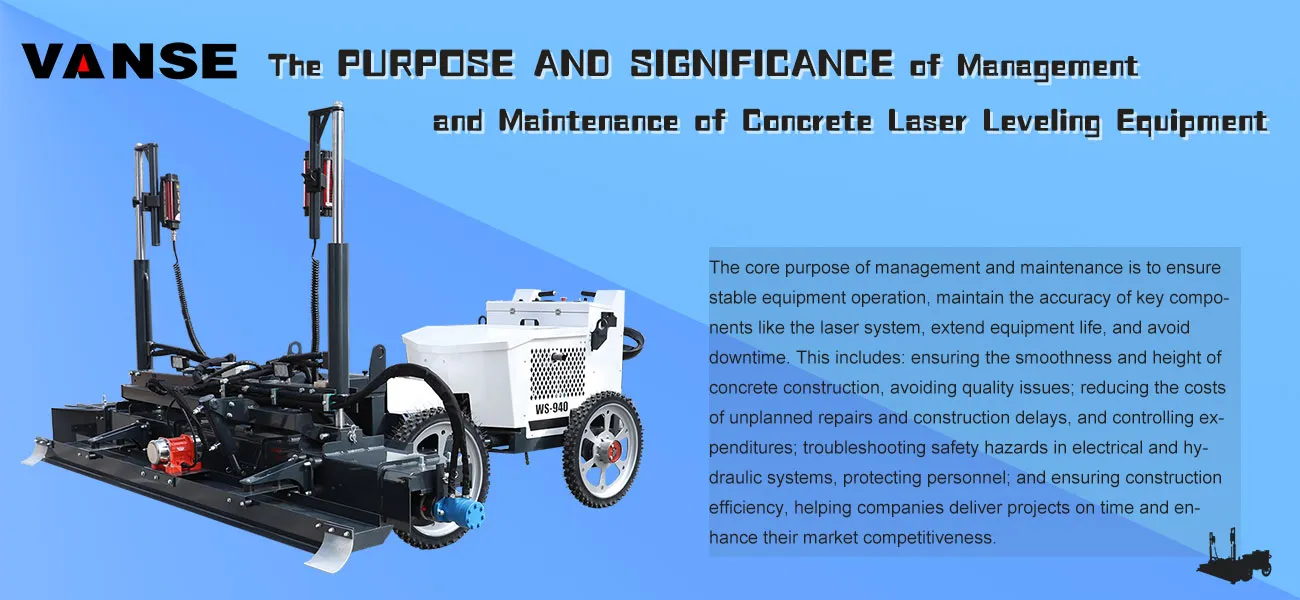
As core equipment for high-precision, high-efficiency floor leveling in modern construction, the management and maintenance of Concrete Laser Levelings not only impacts the stable performance of the equipment but also directly impacts project quality, construction costs, and enterprise competitiveness. The following analysis examines the purpose and significance of Concrete Laser Leveling management and maintenance:
Ⅰ. The Purpose of Concrete Laser Leveling Management and Maintenance
1. Ensure stable equipment performance and construction quality.
Laser Leveling machines achieve millimeter-level precision control through their laser transmitters and receivers. Issues such as calibration deviations, sensor failure, or mechanical wear can directly result in substandard floor flatness, leading to rework and quality disputes. Regular maintenance ensures that key components, such as the laser system, vibration motor, and travel mechanism, are in optimal condition, ensuring that construction accuracy meets design requirements.
2. Extend equipment lifespan and reduce overall lifecycle costs.
Concrete construction is a harsh environment, and equipment is susceptible to cement corrosion, mechanical vibration, and dust abrasion. Through scientific management (such as standardized operating procedures and maintenance records) and preventive maintenance (such as regular cleaning, lubrication, and replacement of wearing parts), unplanned downtime can be reduced, equipment degradation can be delayed, and repair costs and the frequency of replacements can be significantly reduced.
3. Improve construction efficiency and shorten project cycle times.
Equipment failure or performance degradation can lead to construction interruptions and reduced efficiency. For example, loss of laser system signal may require recalibration, which is time-consuming and impacts progress. Routine inspections and rapid maintenance can minimize downtime, ensure continuous and efficient equipment operation, and contribute to on-time project delivery.
4. Ensure operational safety and avoid accident risks.
Laser Leveling machines involve high-speed rotating parts, hydraulic systems, and overhead work (such as telescopic boom models). Improper maintenance can lead to mechanical failure, hydraulic leaks, or even casualties. Regularly inspecting safety devices (such as emergency stop buttons and protective covers), hydraulic lines, and electrical systems can eliminate potential safety hazards and protect both operators and equipment.
II. The Significance of Concrete Laser Leveling Management and Maintenance
1. Direct Contribution to Project Quality
Surface flatness is a core indicator of concrete construction quality, directly impacting subsequent floor laying, equipment installation, and building aesthetics. Precise maintenance of the laser transmitter, receiver, and screed head ensures surface flatness within ±2mm, meeting the requirements of high-standard industrial plants, logistics warehouses, and other scenarios, while avoiding customer complaints or claims due to quality issues.
2. Far-reaching Impact on Enterprise Economic Performance
Reduce direct costs: Preventive maintenance costs are far lower than repair costs. For example, regularly changing hydraulic oil can prevent system downtime caused by oil line blockage, saving tens of thousands of yuan in repair costs.
Improve equipment utilization: By optimizing maintenance plans, equipment idle time can be reduced, increasing output per unit time and indirectly increasing company revenue.
Enhance market competitiveness: Stable and reliable equipment performance is key to earning customer trust, helping companies establish a professional image and expand into the high-end market.
3. Promote industry technology upgrades and standardization
Standardized equipment management (such as establishing a maintenance database and applying IoT monitoring technology) can accumulate extensive operational data, providing a basis for optimized equipment design, fault prediction, and intelligent maintenance, driving the industry's development towards digitalization and refinement. Furthermore, a comprehensive maintenance system helps standardize construction standards and elevate the industry's overall technical capabilities.
4. Complying with the concept of sustainable development
Extending equipment lifespan and reducing resource waste are key aspects of green construction. Reducing equipment scrap rates through scientific maintenance can reduce the consumption of raw materials such as metals and plastics, lower carbon emissions, and help the construction industry achieve its "dual carbon" goals.
Conclusion
The management and maintenance of Concrete Laser Leveling machines is crucial for ensuring construction quality, controlling costs, improving efficiency, and ensuring safety. Companies should establish a full lifecycle management system that prioritizes prevention and prioritizes maintenance. Incorporating intelligent monitoring technologies, these systems enable real-time monitoring of equipment status and optimal allocation of maintenance resources. This will help companies gain an advantage in the fiercely competitive market and promote high-quality development in the industry.
Note:
The parameters provided in this document are for reference only and are not mandatory. Due to differences in technical characteristics between different brands and models of laser levelers, please consult the manufacturer for a suitable solution before actual operation. This reference document assumes no responsibility for any issues arising from failure to follow the manufacturer's instructions.
Thanks to All the Friends Who Support and Trust Shandong Vanse Machinery Technology Co., Ltd.
If you want to know more about Shandong Vanse Machinery Technology Co., Ltd. or have any questions, please feel free to contact us:
Our Factory
Shandong Vanse Machinery Technology Co., Ltd.








Share this article

About the Author: Shandong Vanse Machinery Technology Co., Ltd.
Shandong Vanse Machinery Technology Co., Ltd. is a high-tech manufacturer specializing in concrete construction machinery, including laser screeds and related equipment. The company integrates R&D, production, and global sales, with products exported to over 60 countries and widely used in infrastructure projects worldwide.
Previous Post
Next Post
Related Articles
You Might Also Like
Tell you how effective the concrete laser leveling machine is!
Tell you how effective the concrete laser leveling machine is! Many consumers are still hesitating whether they should buy a concrete laser leveling machine, because they have no concept of the construction effect of the equipment. Today we will introduce the use effect of the equipment. First of all, the biggest feature of this equipment is that it is fast, and the time-consuming is 1/10 of manual work, which is enough to make many construction teams excited; secondly, it is flat, and the ground level error after paving is small , is almost negligible. 1. Requirements for concrete and formwork ① Concrete: Concrete must be produced, conveyed or pumped to the flooring site by a commercial concrete production plant. ② Concrete specifications: C25~C30 concrete, the strength of which is not less than 25MPa in 28 days, according to the design requirements. ③ Water-cement ratio: N o more than 0.5, no water can be added during the feeding process. ④ Cement: Use ordinary Portland cement with a grade of not less than 42.5. ⑤ Aggregate: Well-graded aggregate should be used. Crushed granite or pebbles are used as coarse aggregate, and the maximum diameter is not more than 25mm. The fine aggregate is clean river sand with a fineness modulus of 2.4-2.7. ⑥ Concrete mix ratio: The amount of cement is not less than 350Kg/m3. In order to avoid surface quality problems, the sand rate should be controlled at 35% to 40%. ⑦ Concrete slump: 14±2cm, maximum 16cm. ⑧ Setting time: The initial setting time should be controlled within 3-5 hours. In order to avoid the excessive deviation of the surface elevation affecting the joints, the formwork should be steel formwork. The height of the formwork should be controlled within +0 and -2mm, and the steel formwork should be within 1-1.2 meters from the surrounding walls. 2. Construction cooperation requirements ① The concrete feeding speed should be determined according to the ground thickness and pouring area to determine the minimum hourly feeding speed. For a floor with a thickness of 200 mm, if the width of one-time pouring reaches 40 meters, the minimum feeding speed should reach 40 cubic meters per hour, otherwise there will be cold joint problems, which will affect the quality of ground construction. ② Manually coordinate the concrete sent to the platform, and workers need to remove it as soon as possible and roughly level it. In addition, the areas around the formwork, walls, columns, trenches, equipment foundations, floor drains or around pipelines that cannot be leveled require manual cooperation for local leveling. Generally, 3-4 workers are required to cooperate with the construction (provided by Party A). ③ Other precautions In order to ensure the flatness of the ground, attention should be paid to: 1) The slump of concrete sent to the platform must be consistent each time. 2) Ensure that the concrete feeding speed reaches 40 cubic meters per hour or above, and the initial setting time of each batch of concrete must be consistent. 3) Ensure that the formwork elevation is accurate and cannot be disturbed during construction. 4) Environmental cooperation. The concrete floor that has just been constructed cannot be exposed to sunlight, wind, rain, etc. that are unfavorable to concrete health. ④ Other requirements: A. In order to avoid random cracks in the floor, the cutting time of shrinkage joints should be carried out as early as possible (within 24 hours). B. At the same time as the construction of the laser leveling machine, there should be no electric welding machines on site, and no reflective objects (such as glass windows). C. The foundation must reach a certain hardness to ensure that the laser leveling machine does not collapse when working on the ground. D. The height of the ground in the factory building shall be calibrated by Party A, and the points must be evenly distributed, and there must be no error in the levelness. E. Pouring concrete must be operated according to the requirements of Party B's technicians.What factors should be considered when purchasing a concrete power trowel?
– Site size – For large-scale concrete construction sites, such as large industrial plants, warehouses, parking lots, etc., it is recommended to choose a ride-on trowel. The ride-on trowel has high working efficiency and can complete large-scale troweling work in a short time. For example, for the floor construction of a logistics warehouse with an area of more than 1,000 square meters, a ride-on trowel can quickly perform rough and fine grinding, effectively saving time and manpower. – For small-area indoor floors or local repair work, a walk-behind or handheld trowel is more suitable. For scenes such as home indoor floor decoration and small store floor repair, the walk-behind trowel is flexible to operate and can easily operate in narrow spaces and corners. – Ground flatness requirements – If the flatness and finish of the ground are extremely high, such as the floor of a high-end shopping mall, the clean workshop of an electronics factory, etc., a double-disc trowel needs to be considered. The double-disc trowel can better ensure the flatness of the ground. Its two trowel discs work at the same time, which can reduce the height difference of the ground and make the ground achieve a mirror-like effect. – For general ground, such as outdoor roads in ordinary houses, simple activity venues, etc., a single-disc trowel can meet basic troweling needs. – Electric trowel – Advantages: The electric trowel has the characteristics of low noise and no pollution, which is suitable for use indoors or in places with high requirements for environmental noise. Moreover, the operation of the electric trowel is relatively simple, and it is convenient to start and stop. You only need to turn on or off the power. – Disadvantages: The working range of the electric trowel is limited by the length of the power cord. If the construction site is large, the socket position may need to be changed frequently. In addition, the power of the electric trowel is relatively weak. When facing thicker or harder concrete, it may be insufficient. – Gasoline trowel – Advantages: The gasoline trowel has strong power, is suitable for various types of concrete, is not limited by the site power supply, and has good maneuverability. It can be freely moved and operated in remote construction sites or large open-air sites without power supply. – Disadvantages: Gasoline trowels are noisy and produce exhaust emissions, which have a certain impact on the environment and the health of operators. In addition, its maintenance cost is relatively high, and parts such as engine oil and spark plugs need to be replaced regularly. – Size of trowel disc – The larger the size of the trowel disc, the larger the coverage area of a single trowel and the higher the work efficiency. Generally, the diameter of the trowel disc of a hand-held trowel is between 600 and 1000 mm, and the diameter of the trowel disc of a ride-on trowel may reach more than 1000 mm. When choosing, determine the appropriate trowel disc size based on the size of the construction site and actual needs. – Speed range – The appropriate speed is one of the key factors to ensure the quality of troweling. Too high a speed may cause the trowel disc to wear too quickly and cause defects such as wavy lines on the ground; too low a speed will affect the troweling efficiency. The speed of a general trowel is between 70 and 150 rpm. The speed range of trowels of different brands and models may vary, and needs to be selected according to specific construction requirements. – Power – The power determines the working capacity of the trowel. For large trowels or when thicker and harder concrete needs to be processed, higher power is required. For example, the power of a ride-on trowel is generally between 5 and 10 horsepower, the power of a walk-behind trowel is usually between 3 and 5 horsepower, and the power of a handheld trowel is relatively low, generally between 1 and 3 horsepower. – The consumable parts of a trowel mainly include trowel blades, bearings, drive belts, etc. When purchasing a trowel, consider whether these consumable parts are in sufficient supply and whether they are easy to purchase. For example, some niche brands of trowels may have consumable parts that are difficult to find, making repair and replacement inconvenient. At the same time, you should also compare the prices of consumable parts of different brands and models of trowel machines, and try to choose a trowel machine with lower consumable parts costs, so as to reduce the cost of later use and maintenance. – Brand reputation: Choosing a trowel machine from a well-known brand can usually guarantee the quality and performance of the product. Well-known brands have stricter standards in product research and development, production processes, quality control, etc., and their products are more reliable. For example, some brands with many years of production experience in the field of construction machinery have had long-term inspections on the market and received good user feedback. – After-sales service: Good after-sales service is an important factor in ensuring the normal use of the trowel machine. After-sales service includes product warranty period, timeliness and professionalism of maintenance services, technical support, etc. When purchasing, you should understand whether the manufacturer provides door-to-door maintenance services, the speed of supply of maintenance parts, and whether there is a professional customer service team to answer questions encountered by users during use.Large-area ultra-flat wear-resistant floor concrete laser leveling machine one-time forming construction method
At the moment when the construction field is constantly innovating, the pursuit of flatness, strength and construction efficiency in large-area floor construction has reached a new height. Traditional construction methods are difficult to accurately control flatness when dealing with large-scale ground operations, and the construction period is long. The use of concrete laser leveling machine Beton – Laser – Nivelliermaschine to implement one-time forming construction has become an effective solution to break through these bottlenecks and provide strong guarantees for creating high-quality ultra-flat wear-resistant floors. Excellent precision: With the help of advanced laser systems, Macchina livellatrice laser per calcestruzzo has extremely high control accuracy for ground elevation, and can control flatness deviation within a very small range, far exceeding traditional construction methods, and meeting the stringent requirements of high-standard ultra-flat floors. Efficient operation: The equipment has a leading degree of automation, and a large area of ground leveling can be completed in a single operation. Compared with traditional manual leveling, the construction period is greatly shortened and the construction efficiency is greatly improved. Material optimization: With precise elevation control, it can effectively avoid the situation of too much or too little concrete laying, reduce material waste and construction costs. Performance enhancement: Uniform vibration during the leveling process makes the internal structure of the concrete more compact and uniform, significantly enhances the strength and wear resistance of the ground, and extends the service life of the ground. This method is widely used in various large-area places with high requirements for ground flatness and wear resistance, such as industrial plants that need to withstand the operation of heavy equipment; logistics warehouses, where frequent cargo handling causes great damage to the ground; large shopping malls, where there is a large flow of people and the ground needs to be beautiful; parking lots, where vehicles frequently enter and exit and test the durability of the ground, etc. The core of Extendedoras de hormigón lies in the collaborative work of high-precision laser transmitters and receivers. The laser transmitter emits a stable horizontal laser beam, just like building a precise reference plane in the air. The laser receiver is installed on the leveling machine frame to capture the laser signal in real time and quickly transmit it to the control system. The control system automatically and accurately adjusts the height of the screed blade according to the received signal to ensure accurate leveling of the concrete surface during the process. At the same time, the vibrating device equipped with the screed works synchronously to fully vibrate the concrete, ensure its density, and lay the foundation for high-quality ground. Base treatment → measurement and layout → installation of formwork → concrete pouring → laser leveling machine leveling → surface treatment (smoothing, spreading wear-resistant materials, etc.) → maintenance Base treatment Thoroughly remove debris, dust, oil and other pollutants on the surface of the base to ensure that the surface of the base is clean and flat, providing a good foundation for subsequent construction. Use compaction machinery to compact the base. For weak foundations, effective measures such as replacement and reinforcement piles are required to improve the bearing capacity of the base and prevent later ground settlement. Measurement and layout Use precision measuring instruments such as total stations to accurately measure and lay out the elevation control lines and construction boundaries of the floor according to the requirements of the design drawings. Set firm control points at a certain distance (usually 3-5 meters) on the base. These control points serve as key references for the initial positioning and calibration of the laser leveling machine to ensure the accuracy of the equipment's running trajectory and elevation control. Install the formwork Install the formwork strictly according to the measured layout position. The formwork should be made of materials with high strength and good rigidity, such as high-quality steel formwork or reinforced wooden formwork. Use a level to accurately adjust the elevation of the top surface of the formwork so that it is completely consistent with the design elevation. The joints of the formwork should be tight, and sealing strips or tapes can be used to seal to prevent leakage during concrete pouring and affect the quality of the ground. Preferably use commercial concrete, and its mix ratio needs to be professionally optimized according to factors such as engineering design strength, durability, and construction environment to ensure that the concrete performance meets the construction requirements. Concrete is efficiently transported to the construction area through equipment such as concrete pump trucks or mixer trucks. Pour in layers and sections from one end to the other. The pouring thickness should be 2-3 cm higher than the design elevation, and space for leveling should be reserved. During the pouring process, use an inserted vibrator or a flat vibrator to vibrate the concrete in time. The vibration points should be evenly distributed to avoid leakage or over-vibration and ensure the density of the concrete. Laser leveling machine leveling After the concrete pouring is completed, the laser leveling machine should be driven into the construction area as soon as possible to avoid the initial setting of the concrete affecting the leveling effect. Start the laser transmitter and laser leveling machine in turn, calibrate and debug the equipment comprehensively, and check whether the laser signal reception, scraper lifting control, and vibration device operation are normal. The operator sets a reasonable leveling machine route and speed according to the shape and area of the construction site. The general speed is controlled at 1-3 meters per minute. During the leveling machine's movement, pay close attention to the equipment's operating status and the concrete surface. If local unevenness, depressions or convexities are found, stop the machine immediately and use manual filling or shoveling to repair. Surface treatment For ordinary floors, use a trowel machine for mechanical troweling after the initial setting of the concrete and before the final setting. The trowel machine operates in a horizontal and vertical cross-pattern, and generally needs to be troweled 3-5 times until the ground surface is flat, smooth, and free of smear marks. For wear-resistant floors, when the concrete is initially set, the wear-resistant materials (such as metal aggregates and non-metallic aggregate wear-resistant materials) selected according to the design requirements will be evenly spread on the concrete surface, and the spreading amount will be determined according to the material description and design requirements. After spreading, use a trowel to smooth the surface so that the wear-resistant materials and concrete are fully integrated to form a solid and wear-resistant floor surface. Maintenance After the ground construction is completed, maintenance work should be carried out immediately. Sprinkling maintenance can be used. The number of sprinkling times per day is determined according to the temperature and humidity, generally not less than 3-5 times, to keep the ground moist; plastic film can also be covered to prevent water evaporation and maintain the internal humidity of the concrete; curing agent can also be sprayed to form a protective film on the ground to achieve the maintenance effect. The curing time is usually not less than 7-14 days, and the specific duration is determined according to the concrete strength growth and relevant specifications. During the maintenance period, it is strictly forbidden for people and vehicles to walk or roll on the ground to prevent damage to the ground strength growth process and ensure that the final strength of the ground meets the design requirements. Concrete: must strictly meet the design strength grade requirements, have good workability, fluidity and durability, and ensure easy pouring and vibration during construction. Wear-resistant materials: accurately select wear-resistant materials according to the actual needs of the project and design standards. Metal aggregate wear-resistant materials have the characteristics of high hardness and high strength; non-metal aggregate wear-resistant materials have excellent performance in impact resistance and anti-static, and can be selected as needed. Formwork materials: steel formwork has the advantages of high strength and high turnover; wooden formwork has certain advantages in shape adaptability and splicing flexibility. Appropriate formwork materials can be selected according to construction conditions and cost considerations, but their strength and rigidity must meet construction requirements. Extendedoras de hormigón: According to the size of the construction site, the complexity of the shape and the ground design requirements, reasonably select equipment models with power, leveling width and accuracy. Laser transmitter and receiver: Closely matched with laser leveling machine, laser transmitter emits stable and accurate laser beam, receiver accurately captures signal, the two work together to ensure high precision of elevation control, and their performance directly affects the quality of ground leveling. Concrete delivery equipment: Concrete pump truck has strong mobility and is suitable for concrete delivery in different site conditions; mixer truck can ensure the uniformity and working performance of concrete during transportation, and can be reasonably used according to the construction site conditions. Trowel machine: Divided into hand-held type and driving type, selected according to the ground area and construction efficiency requirements. Its high-speed rotating trowel compacts and smoothes the ground to make the ground flat and smooth. Measuring instruments: Total station is used for large-area high-precision measurement and layout; level can accurately measure elevation; theodolite assists in determining angles and verticality. These measuring instruments jointly provide accurate data support for positioning and elevation control during construction. Quality management system construction: Set up a professional quality management team to clarify the specific responsibilities of each member in the stages of construction preparation, construction process and quality acceptance. Formulate a detailed quality management system and set clear and quantifiable quality goals, such as controlling the ground flatness deviation within ±2 mm. Raw material quality control: Each batch of raw materials such as concrete and wear-resistant materials entering the site shall be inspected and tested strictly in accordance with relevant standards. Concrete needs to be tested for slump, compressive strength and other indicators; wear-resistant materials need to be tested for their wear resistance, hardness and other properties to ensure that the quality of raw materials fully meets the design and specification requirements and ensure the quality of the project from the source. Construction process quality supervision: Arrange professional quality management personnel to supervise the entire construction process and strictly follow the established construction process and operation points. Focus on monitoring whether the laser operation is standardized, including equipment calibration, travel speed and route control; whether the concrete pouring and vibration meet the requirements, such as pouring sequence, vibration time and depth, etc.; the timing of polishing in the surface treatment process, the uniformity of wear-resistant material spreading, etc., and timely rectification when problems are found. Quality acceptance: After the construction is completed, the ground is comprehensively inspected in accordance with the current relevant national specifications and standards. Use professional measuring tools to detect the flatness and elevation deviation of the ground; use equipment such as rebound testers to detect the ground strength; and use wear resistance testers to test the wear resistance of wear-resistant floors. Only after all indicators meet the requirements after testing can the project quality be determined to be qualified. Building a safety management system: Develop a complete safety management system covering all aspects such as construction site safety protection, equipment operation specifications, and personnel safety training. Clarify the safety responsibilities of personnel in various positions, and implement safety responsibilities at all levels from project managers to front-line construction personnel. Safety education and training: Regularly organize construction personnel to participate in safety education and training, including safety regulations, safety operating procedures, accident case analysis, etc. New employees must undergo three-level safety education and training and pass the assessment before they can take up their posts. Special types of work (such as electricians, welders, machine operators, etc.) must be certified to work, and continuously improve the safety awareness and operating skills of construction personnel. Safety protection at the construction site: Set up obvious safety warning signs at the entrance of the construction site and dangerous areas (such as deep foundation pits, high-altitude working areas, etc.). Set up protective railings and safety nets for high-altitude working surfaces; equip construction workers with qualified personal protective equipment such as safety helmets, safety belts, safety shoes, and supervise their correct wearing and use. Equipment safety management: Establish a regular inspection and maintenance system for construction equipment such as laser levelers and concrete conveying equipment, conduct equipment appearance inspections and performance tests before and after each use, and conduct regular comprehensive maintenance and repairs. During the operation of the equipment, operators must strictly abide by the operating procedures, and illegal operations are strictly prohibited to prevent safety accidents caused by equipment failures or improper operations. Construction dust control: Harden the main roads in the construction site, and arrange special personnel to sprinkle water to reduce dust regularly. Sand, stone and other materials that are prone to dust are stored in closed silos, or covered with dustproof nets to reduce dust pollution. Construction noise control: Plan construction time reasonably to avoid high-noise operations during residents' rest time (such as 22:00 to 6:00 the next day). Take noise reduction measures for high-noise equipment such as concrete pumps and vibrators, such as installing silencers and setting up soundproof covers, to reduce the impact of construction noise on the surrounding environment. Waste treatment: Set up classified trash cans and waste storage sites at the construction site to classify and collect construction waste and domestic waste generated during the construction process. Recyclable waste (such as scrap steel, waste wood, etc.) is recycled and reused; non-recyclable waste is transported to designated locations for proper disposal in accordance with the requirements of local environmental protection departments to prevent environmental pollution. Economic benefits: The one-time forming construction method of the laser leveling machine has greatly improved construction efficiency, shortened the construction period, and correspondingly reduced labor costs and equipment rental costs. Accurate leveling effectively reduces concrete waste and saves material costs. Comprehensive calculations can significantly improve the economic benefits of the project. Social benefits: The high-quality, ultra-flat, wear-resistant floor created by this method can effectively improve the performance and durability of the building, reduce the cost of later maintenance and renovation, provide the society with better building space, and create good social benefits. Environmental benefits: By implementing a series of environmental protection measures, such as dust control, noise control, and reasonable disposal of waste, the pollution of the surrounding environment during the construction process is reduced, which conforms to the concept of green environmental protection and sustainable development, and produces positive environmental benefits.