Technical Knowledge
Technical key points on how to ensure the overall flatness in the construction of large-span floor slabs with a concrete laser leveling machine.
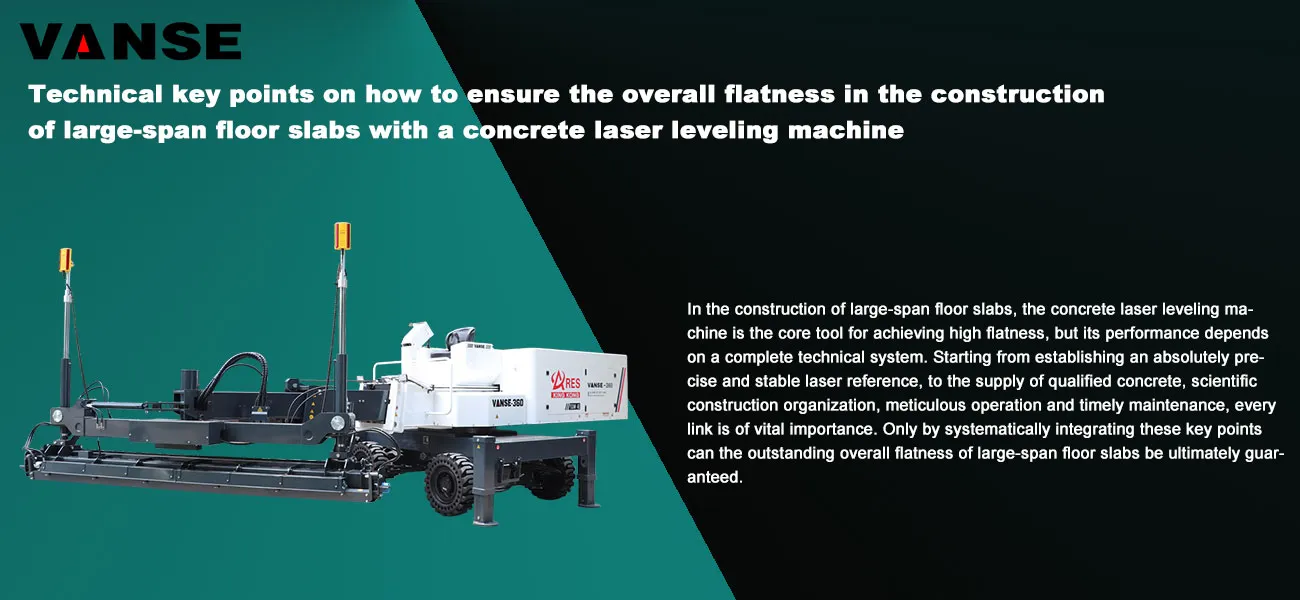
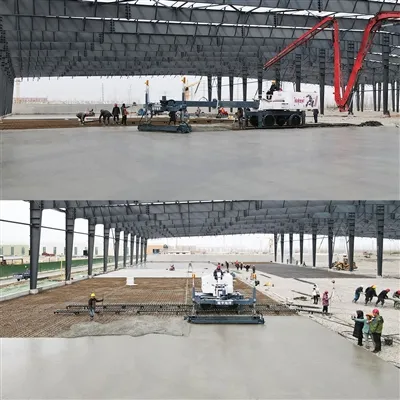
In the construction of large-span floor slabs, using a concrete laser leveling machine to ensure overall flatness is far more than just "starting the machine and scraping it flat". It is a systematic project involving the comprehensive application of equipment, measurement, materials, processes and management.
The following are the core technical points to ensure the overall flatness of large-span floor slabs:
I. Preparatory Work and Benchmark Establishment: The Foundation of Success or Failure
This is the most crucial step. If the benchmark is wrong, all subsequent work will be in vain.
Selection and installation of High-precision laser emitters
When choosing a 360° rotating laser emitter, it is essential to ensure that its horizontal accuracy is ±1.0mm/100m or higher (such as ±0.5mm/100m). This is the "absolute benchmark" for the entire construction process.
The optimal installation location: The transmitter should be set up in the center of the site or at a stable position that can cover the entire construction area. For extremely large spans, it may be necessary to set up multiple transmitters and use the same reference elevation, or to use equipment with multiple receivers for seamless switching.
Firmness and protection: The transmitter must be set up on an extremely stable tripod, far away from equipment passageways and areas with frequent personnel movement, and clearly marked to prevent it from being touched. Any tiny movement can lead to a disastrous elevation error.
Precise calibration of the base layer and the template
Laser leveling machines cannot correct the macroscopic undulations of the base layer (such as formwork and foundation). Before pouring, an optical level or total station must be used to conduct a comprehensive recheck of all formwork top elevations and support systems based on the reference plane set by the laser emitter.
Ensure the rigidity and stability of the entire support system to prevent settlement during the pouring process.
Ⅱ. Equipment and Process Control: Core Execution Link
Equipment selection and commissioning
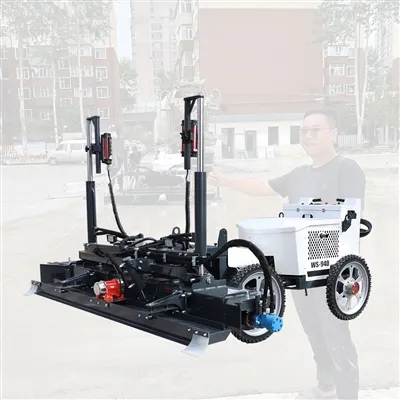
Select large ride-on leveling machine: For large-span construction, equipment with sufficient self-weight and powerful performance is required to ensure adequate vibration force and leveling force on the concrete, avoiding the formation of wavy surfaces due to the lightness of the equipment.
Pre-construction calibration: Before starting work every day and during construction, it is necessary to regularly check whether the laser receiver, control system and hydraulic actuator of the leveling machine are sensitive and accurate. Ensure that the flat head can respond immediately and accurately to changes in the laser signal.
Scientific construction route planning
For large-span floor slabs, it is necessary to plan the traveling path of the leveling machine and the placement position of the concrete pump truck. The "backlaying method" is usually adopted, that is, the leveling machine starts from one end, spreading the material while leveling it, and gradually proceeds backward for construction.
The principle of path planning is to minimize the repeated movement of equipment on the unset concrete, avoiding the formation of ruts and damage to the leveled surface layer. There should be sufficient overlapping area (usually 100-200mm) between two adjacent leveling zones.
Concrete mix proportion and slump management
Consistency is key: The pouring time for large-span floor slabs is long, and it is essential to ensure that the mix proportion and slump of all batches of concrete are highly consistent. The slump is recommended to be controlled at 140mm±20mm. Slump fluctuations can lead to different local drying shrinkage rates, affecting the final flatness.
Optimize the ratio of aggregates to slurry: A good mix ratio can ensure that the concrete has sufficient slurry to coat the aggregates and float up after vibration, forming a smooth and flat surface.
Ⅲ. Process Refinement Operation: Determining the final outcome
Orderly and synchronous fabric and leveling
The height of the fabric should be slightly higher than the designed elevation (taking into account the amount of vibration and settlement).
The leveling machine should closely follow the placing machine and level the concrete in a timely manner within the time when it maintains the best workability. Avoid laying a large area of material first and then starting to level it, as this may cause the concrete laid earlier to have already begun to set, affecting the overall integrity.
The timely application of "soft cutting seam" technology
This is a key measure to prevent large-scale concrete cracking and thus affect the flatness. After the concrete is leveled and its strength reaches approximately 5-10 mpa (usually when a person can walk on it but without leaving deep footprints), a professional jointing machine should be immediately used for early jointing to release the shrinkage stress.
The depth of the cut seam is generally 1/3 to 1/4 of the slab thickness, and the seam spacing is determined based on the slab thickness and reinforcement conditions.
Ⅳ. Post-maintenance and Quality Inspection
Immediate and seamless maintenance
Once the leveling work is completed, maintenance should be carried out immediately. By spraying curing agents or fully covering with plastic film, ensure that the moisture on the concrete surface does not evaporate too quickly.
Uneven water loss is the enemy of flatness, which can cause surface cracking and warping deformation, thereby destroying the flatness that has been achieved.
Full-process and multi-dimensional inspection
Process inspection: During construction, workers should use a 2-meter straightedge to conduct random checks on the just-leveled area at any time. If any deviation is found, the equipment or process should be fine-tuned immediately.
Final inspection: After the concrete has hardened, use a level or total station for grid-based measurement to check the overall elevation. Use a 2-meter straightedge and a feeler gauge to conduct a comprehensive inspection of the flatness (whether it meets ±3mm/2m or higher standards). For extremely demanding sites, even floor flatness testers (Dipstick) or F-meters can be used to obtain more scientific dynamic flatness (FF/FL) data.
Summary table of Technical Key points
| Stage | Key points | Purpose |
| Preparatory work | 1. High-precision laser emitter | Establish an unshakable absolute elevation benchmark |
| 2. Precise calibration of the base layer/template | ||
| Equipment and Technology | 1. Large vehicle-type equipment | Ensure that the accuracy, efficiency of the actuator matches the material |
| 2. Equipment calibration | ||
| 3. Scientific path planning | ||
| 4. Concrete consistency | ||
| Process operation | 1. Synchronize the fabric and leveling | Ensure the continuity of construction and control shrinkage cracks |
| 2. Make timely soft cuts to the seams | ||
| Later maintenance | Immediate seamless maintenance | Prevent uneven water loss from causing deformation and cracking |
Conclusion
In the construction of large-span floor slabs, the concrete laser leveling machine is the core tool for achieving high flatness, but its performance depends on a complete technical system. Starting from establishing an absolutely precise and stable laser reference, to the supply of qualified concrete, scientific construction organization, meticulous operation and timely maintenance, every link is of vital importance. Only by systematically integrating these key points can the outstanding overall flatness of large-span floor slabs be ultimately guaranteed.
Note: The parameters provided in this document are for reference only and are not mandatory. Due to differences in technical characteristics between different brands and models of laser levelers, please consult the manufacturer for a suitable solution before actual operation. This reference document assumes no responsibility for any issues arising from failure to follow the manufacturer's instructions.
Thanks to All the Friends Who Support and Trust Shandong Vanse Machinery Technology Co., Ltd.
If you want to know more about Shandong Vanse Machinery Technology Co., Ltd. or have any questions, please feel free to contact us:
Our Factory
Shandong Vanse Machinery Technology Co., Ltd.








Share this article

About the Author: Shandong Vanse Machinery Technology Co., Ltd.
Shandong Vanse Machinery Technology Co., Ltd. is a high-tech manufacturer specializing in concrete construction machinery, including laser screeds and related equipment. The company integrates R&D, production, and global sales, with products exported to over 60 countries and widely used in infrastructure projects worldwide.
Previous Post
Next Post
Related Articles
You Might Also Like
What are the quality concrete acceptance criteria for building ground projects?
Acceptance standards for quality concrete in building floor projects 1. General principles 1.1 Purpose This standard clarifies the specifications and standards for quality concrete acceptance of building ground projects to ensure that the project quality meets the design requirements and is safe to use. 1.2 Scope of application This standard applies to the acceptance of concrete materials in building ground projects, including requirements for raw materials, construction technology, quality inspection and acceptance, and safe and civilized construction. 2. Material acceptance standards 2.1 Cement When using cement, cement with product quality certificate and on-site inspection report should be selected, and on-site acceptance should be carried out in accordance with regulations. After the cement enters the site, it should be stored separately according to different varieties, labels, and factory dates, and signs should be set up. It is strictly prohibited to use expired, damp, or agglomerated cement. 2.2 Sand and stone Sand and stone should meet the design requirements, be free of impurities such as silt and stone powder, and have particle size and gradation that meet specification requirements. For projects with special requirements, special sand and stone should be used. 2.3 Water When using tap water or well water, make sure the water is clean and free of impurities such as oil, acid, and alkali. The chloride ion content in water should not exceed specification requirements. 2.4 Admixtures Admixtures should meet the design requirements, have product quality certificates and on-site inspection reports, and undergo on-site acceptance in accordance with regulations. The type and dosage of admixtures should comply with the design and specification requirements and should not contain ingredients harmful to the human body. 3. Construction process acceptance standards 3.1 Template installation Design calculations should be carried out before the formwork is installed, and the formwork should be made and installed in accordance with the design requirements. The strength and stiffness of the formwork should meet the construction requirements, and the joints should be tight, smooth, and free of slurry leakage. The formwork support system should be firm and stable and must not tilt or shake. After the formwork is removed, the surface should be kept clean and free of residue. 3.2 Steel bar binding Rust removal treatment should be carried out before the steel bars are bound. The specifications, models, quantities and spacing of the steel bars should meet the design requirements. The steel bars should be tied firmly and not loose. The joints of the steel bars should comply with the specification requirements, and the welding quality should comply with the design and specification requirements. The thickness of the protective layer of steel bars should meet the design requirements. When cement mortar pads are used, the number of pads should not be less than 4/m2. 3.3 Concrete pouring Before pouring the compacted soil, the formwork, steel bars, etc. should be inspected to ensure that they meet the construction requirements. The slump of concrete should comply with the design and specification requirements, and no water or additives should be added to the mixer at will. When pouring the compacted soil, it should be carried out in layers. The thickness of each layer should not be too large, and it should be vibrated densely without vibration leakage. After the concrete pouring is completed, the surface should be polished and compacted in time to prevent cracks. 3.4 Maintenance After the concrete pouring is completed, curing should be carried out in time, and the curing time should not be less than 7 days. During the curing period, the concrete surface should be kept moist to prevent shrinkage cracks. When using cover watering for curing, the frequency of watering should be enough to keep the concrete in a moist state. When using plastic film for curing, the plastic film should remain completely sealed and water-tight. After the curing is completed, the formwork should be removed promptly and the finished product should be protected in accordance with regulations. 4. Quality inspection and acceptance standards 4.1 Essentials The quality of building ground engineering should comply with the design requirements and relevant specifications, and the surface should be smooth, smooth, and free of cracks, pitting and other defects. The dividing joints should be neat and straight, and there should be no staggered joints. There should be no leakage at the junction between the floor and the wall. Ground engineering with functional requirements should meet the requirements of relevant functional functions.How can the performance and operation of a concrete laser leveling machine be optimized
Regarding the performance and operation optimization of concrete laser leveling machines, this is a systematic project that integrates equipment maintenance, advanced technology, and precise operation. Optimization can be approached from two perspectives: equipment performance optimization and operating method optimization. Equipment performance is the foundation for ensuring construction quality and efficiency. Optimization aims to ensure that the equipment is always in optimal working condition. Laser Transmitter: This is the "eyes" and "brains" of the equipment. Calibration: Perform a calibration check daily before starting work. Secure the receiver to a pole and verify that the elevation set by the laser transmitter matches the actual measurement. Even the slightest deviation can lead to extensive construction failure. Cleaning and Protection: Keep the laser transmitter lens clean to prevent dust and moisture from affecting the laser beam's accuracy. Store properly to prevent collisions. Leveling Head (Scraper and Vibrator): Check for wear: Regularly inspect the scraper for wear. Excessive wear can lead to reduced leveling accuracy and material waste. Replace or adjust promptly. Vibration Frequency Uniformity: Check that the vibrating rod is functioning properly to ensure uniform concrete compaction density across the entire leveling head to avoid localized honeycombing. Chassis and Travel System: Cleaning: After each construction phase, thoroughly clean any solidified concrete debris from the chassis, as this will significantly affect the smoothness of the next construction phase. Check Fasteners: Check all connecting components and bolts for looseness to ensure the structural stability of the equipment. Tires/Tracks: Check tire pressure and track wear to ensure stable ground contact. Multiple Laser Receivers: Equipping the leveling head with multiple laser receivers allows for more comprehensive monitoring of the head's real-time posture. This is particularly important for levelinging over large spans, effectively preventing errors caused by leveling head deformation. Intelligent Control System Upgrade: Monitor control system updates provided by equipment manufacturers. Newer systems may feature more advanced algorithms, enabling smoother control, fault diagnosis, and even grade control. High-Strength Components: For components subject to severe wear, such as scrapers, consider using more wear-resistant high-strength alloys or polyurethane materials to extend their service life. Advanced equipment requires scientific operating methods to maximize its effectiveness. Precise benchmark setting: This is the foundation of all work. A professional surveyor must use a high-precision level or total station to determine the position and elevation of the laser transmitter according to the design drawings. Ensure that the transmitter is set up in a stable, interference-free area. Formwork (steel formwork) installation: The top elevation of the formwork must be precisely aligned with the designed elevation of the laser leveling and securely fixed. The flatness of the formwork directly affects the construction quality of the edge areas. Base preparation and reinforcement mesh laying: The base layer (usually a crushed stone base) must be compacted and leveled; otherwise, uneven concrete thickness may occur, leading to cracking due to settlement. The steel mesh should be laid flat and supported with blocks to ensure its correct position in the concrete and prevent it from scraping against the rebar and shifting during equipment movement. Concrete material control: Slump: This is the key to success! The slump of concrete used for laser leveling must be strictly controlled, typically between 140-160mm. Excessive slump results in high concrete flow, causing backflow on both sides of the leveling as the leveling moves, forming waves. Excessive slump results in poor flow, high resistance to the leveling, prone to cracking, and difficulty maintaining density. Aggregate Size: Avoid using coarse aggregate with excessively large particle sizes to prevent it from clogging the leveling blade or vibrator. Unloading and Initial Spreading: Concrete should be evenly distributed during unloading to avoid piles. Initial spreading can be performed using a small excavator or manually, with a thickness slightly above the design elevation to reduce the load on the leveling. Equipment Path Planning: The operator should plan the leveling's path, typically adopting an S-shaped or spiral path, to avoid sharp turns on unset concrete, which can cause surface disturbance and elevation deviation. Matching Travel Speed and Vibration Frequency: The equipment should maintain a constant and slow speed. Excessive speed will result in incomplete vibration and surface ripples. Adjust the vibration frequency in real time based on the concrete slump. For high slumps, reduce the frequency appropriately; for low slumps, increase the frequency to ensure adequate vibration. Overlap Treatment: There should be a sufficient overlap between the two leveling paths (typically 10-20cm) to ensure a smooth transition at the joint with no height differences. Operator Skills: The operator must not only be able to operate the machine but also understand the characteristics of concrete. They should be able to observe the concrete's response (such as slurry seepage and surface gloss) to determine whether the vibration is sufficient and the speed is appropriate, allowing for immediate adjustments. Timely Curing: After initial setting, laser-leveled concrete floors should be immediately sprayed with a curing agent or covered with a film to retain moisture and prevent plastic shrinkage cracks caused by rapid water loss. The optimized leveled floor is denser, so early curing is particularly important. Connecting with Subsequent Processes: Time the joint cutting process appropriately (usually within 6-24 hours after construction, depending on the temperature and concrete strength development) to prevent random cracking. Optimize Category Specific Measures Purpose Equipment performance Daily laser system calibration Ensures absolutely precise elevation control Inspect and replace the leveling scraper Ensures levelinging results and smoothness Thoroughly clean the chassis of concrete debris Prevents elevation errors and equipment damage Operation Strictly control the concrete slump (140-160mm) Ensures proper fluidity, easy leveling, and no backflow Precisely set the formwork and laser reference Provides a foundation for high-quality construction Drive at a constant and slow speed, matching the vibration frequency Ensures adequate vibration and compaction of concrete Operator experience and fine-tuning Addresses unexpected on-site situations and enables dynamic optimization Timely water conservation and maintenance Prevents surface cracking and ensures overall quality By combining strict equipment maintenance, scientific construction preparation and refined operating procedures, the performance of the concrete laser leveling machine can be maximized, ultimately achieving ultra-high flatness, high density and high efficiency construction results. Note: The parameters provided in this document are for reference only and are not mandatory. Due to differences in technical characteristics between different brands and models of laser levelers, please consult the manufacturer for a suitable solution before actual operation. This reference document assumes no responsibility for any issues arising from failure to follow the manufacturer's instructions.Can a push power trowel be used in small indoor scenes?
– Hand-push trowels are suitable for indoor scenes with relatively small areas. If the indoor space is relatively open and regular in shape, such as warehouses, large exhibition halls, etc., hand-push trowels can play a good role. It can be easily pushed on the flat ground to smooth the concrete and other floor materials. – However, if the indoor space is narrow and there are many obstacles or corners, the use of hand-push trowels may be restricted. Because its size and operation method determine that it is difficult to turn and operate in a small space. – For common indoor concrete, cement mortar and other floor materials, hand-push trowels can effectively smooth and compact the surface to make the floor smoother and smoother. It can handle newly poured floors and help remove surface defects such as bubbles and protruding pebbles. – However, if the floor material is special, such as wooden floors, epoxy floors, etc., which are relatively fragile or require extremely high surface accuracy, the hand-push trowel may not be suitable. Because its working principle is to operate through a rotating trowel blade, it may cause damage to these special floors. – The hand-push trowel is relatively simple to operate, and general operators can get started after simple training. It is pushed forward by manpower, and the direction and speed can be adjusted at any time according to the ground conditions during operation. For example, near the wall or pillar, you can slow down and operate carefully to avoid collision. – However, long-term use of the hand-push trowel requires certain arm and waist strength, and the operator may be more tired. – The hand-push trowel is small in size and is easier to move in indoor scenes. In indoor areas without large equipment access channels, it can be transported to the work site through small doorways or elevators. – However, compared with large driving trowels, its movement speed is slower, and work efficiency will be affected to a certain extent. – The hand-push trowel has a high speed. If the operator is not careful during operation, clothing, hair, etc. may be drawn into the machine, causing safety accidents. Therefore, the operator needs to wear appropriate work clothes and protective equipment, such as safety helmets, gloves, etc. – In addition, since the operation is indoors, the ground may be slippery, so be careful to prevent slipping when pushing the trowel. – The hand-push trowel will generate certain noise and dust when working. In small indoor scenes, the noise may interfere with the surrounding environment, so try to choose the right time to operate to avoid affecting others. – For dust problems, you can reduce its impact on indoor air quality by equipping a dust collection device or strengthening ventilation.