Technical Knowledge
How to operate concrete topping spreaders on uneven base layers without affecting material distribution accurac
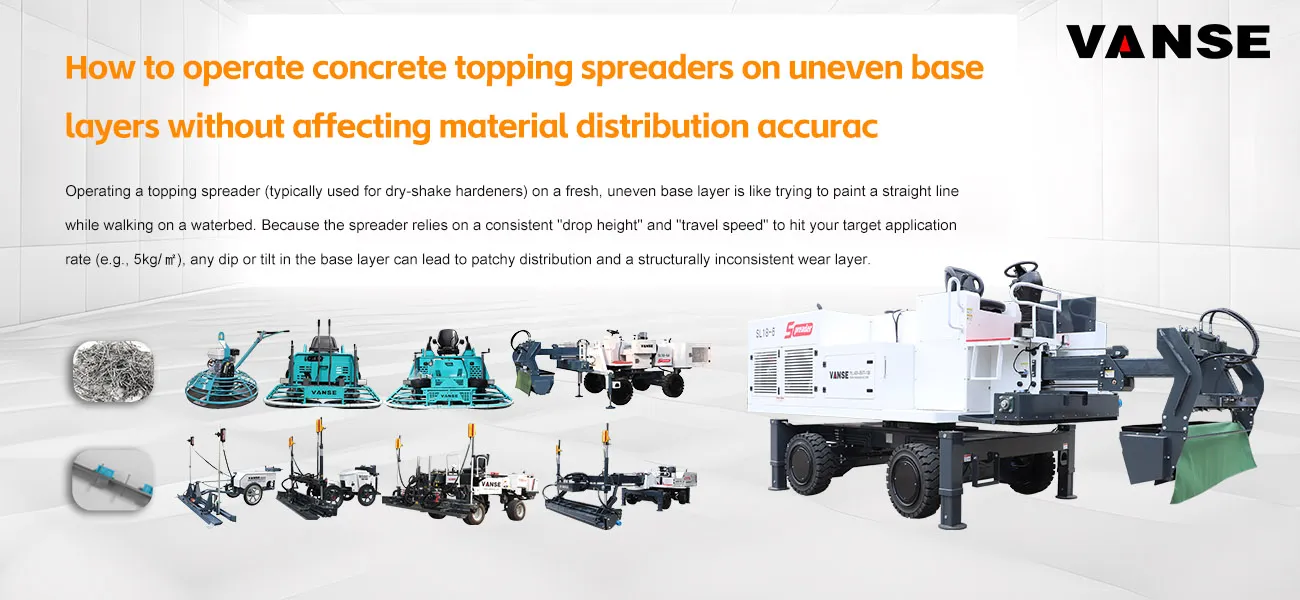
Operating a topping spreader (typically used for dry-shake hardeners) on a fresh, uneven base layer is like trying to paint a straight line while walking on a waterbed. Because the spreader relies on a consistent "drop height" and "travel speed" to hit your target application rate (e.g., 5kg/㎡), any dip or tilt in the base layer can lead to patchy distribution and a structurally inconsistent wear layer.
Here is how to maintain precision when the ground beneath you isn't cooperating.
1. Use a Telescopic Boom Spreader (The "Off-Slab" Solution)
The most effective way to handle an uneven base is to avoid driving on it entirely. * How it works: Large-scale spreaders use a telescopic boom that extends over the fresh concrete.
The Advantage: Since the machine’s tracks or wheels stay on the stable, leveled subgrade or the previously poured (and hardened) lane, the "head" of the spreader remains perfectly level regardless of the "hills and valleys" in the wet concrete.
Accuracy: This setup allows for a computer-controlled discharge rate that is decoupled from the unevenness of the wet slab.
2. Speed-to-Discharge Synchronization
If you are using a spreader that must travel on the fresh concrete (like a walk-behind or a ride-on), your accuracy depends on Variable Rate Control.
The Problem: When a spreader hits a "low spot" or soft patch, the wheels often slip or the operator slows down. If the hopper continues to drop material at a fixed rate, you end up with a "heavy" pile in the low spot.
The Fix: Modern spreaders use encoders on the wheels. If the machine slows down due to the uneven terrain, the computer automatically slows the discharge rotor.
Pro Tip: If your machine isn't automated, the operator must consciously "feather" the discharge trigger as they navigate difficult patches to avoid material "slugs."
3. The "Two-Pass" Distribution Method
On high-tolerance projects with uneven bases, never try to drop the full amount of topping in a single pass.
The 50/50 Rule: Apply 50% of the material in one direction (e.g., North-South) and the remaining 50% in the perpendicular direction (East-West).
The Benefit: This cross-hatching pattern naturally "averages out" any distribution errors caused by the spreader tilting or surging over uneven spots. It ensures that even if one pass was slightly "light" due to a bump, the second pass will likely compensate for it.
4. Interaction with the Laser Leveling
Accuracy starts before the spreader arrives. The laser Leveling must be used to create a "flat-enough" surface for the spreader to navigate.
| Strategy | Action | Result |
| Initial Strike-off | Laser Leveling makes a fast, leveling pass. | Provides a consistent "bed" for the topping. |
| Wait Time | Allow the "bleed water" to disappear. | Firms up the base so the spreader doesn't sink/bog down. |
| Mechanical Integration | Attach the spreader head to the laser Leveling (if compatible). | Uses the laser’s elevation accuracy to drop material at a precise height. |
5. Avoiding "Wheel-Track" Segregation
The Solution: Use low-pressure flotation tires or wide tracks to spread the weight of the machine.
Immediate Follow-up: A bull float or a "highway straightedge" must follow the spreader immediately to "knit" the topping into the base and erase the tracks before the material begins to hydrate.
Technical Warning: If you are using metallic dry-shakes, distribution accuracy is even more critical. "Clumps" of metallic topping caused by uneven spreading can lead to localized delamination because the topping won't have enough moisture from the base slab to hydrate properly.
Would you like me to detail the "Wash-out" test used to verify if your spreader is actually hitting the kg/㎡ target across the entire floor?
Slump Consistency: If the concrete slump varies by even 1 inch (e.g., from a 5-inch slump to a 6-inch slump), the vibratory Leveling will "sink" differently. For Superflat results, the concrete must be identical truck-to-truck.
Head-to-Head Overlap: When using a handheld vibratory Leveling, ensure each pass overlaps the previous one by 20–30%. This "erases" the line between passes.
Would you like a list of the specific F-number tolerances required for "Category 1" VNA (Very Narrow Aisle) floors versus standard warehouse floors?. Contact us NOW
Note: The parameters provided in this document are for reference only and are not mandatory. Due to differences in technical characteristics between different brands and models of laser levelers, please consult the manufacturer for a suitable solution before actual operation. This reference document assumes no responsibility for any issues arising from failure to follow the manufacturer's instructions.
Thanks to All the Friends Who Support and Trust Shandong Vanse Machinery Technology Co., Ltd.
If you want to know more about Shandong Vanse Machinery Technology Co., Ltd. or have any questions, please feel free to contact us:
Our Factory
Shandong Vanse Machinery Technology Co., Ltd.








Share this article

About the Author: Shandong Vanse Machinery Technology Co., Ltd.
Shandong Vanse Machinery Technology Co., Ltd. is a high-tech manufacturer specializing in concrete construction machinery, including laser screeds and related equipment. The company integrates R&D, production, and global sales, with products exported to over 60 countries and widely used in infrastructure projects worldwide.
Previous Post
Next Post
Related Articles
You Might Also Like
How to determine the maintenance cycle of concrete laser leveling machine?
As an important equipment in modern construction, the efficient and precise leveling performance of concrete laser leveling machine greatly improves the quality and efficiency of the project. However, the long-term stable operation of any equipment is inseparable from scientific and reasonable maintenance. Therefore, determining the maintenance cycle of concrete laser leveling machine is a vital task. This article will discuss in depth how to determine the maintenance cycle of concrete laser leveling machine from the aspects of equipment use frequency analysis, working environment investigation, manufacturer recommended cycle, component wear inspection, maintenance record, maintenance cost analysis, and safety and performance evaluation. 1. Equipment use frequency analysis + – The use frequency of concrete laser leveling machine is one of the important factors affecting its maintenance cycle. The higher the frequency of equipment use, the faster the wear and aging of its internal mechanical parts, so more frequent maintenance is required. For equipment with high frequency use, the maintenance cycle should be shortened to ensure that the equipment is always in good working condition. On the contrary, for equipment with low frequency of use, the maintenance cycle can be appropriately extended Avoid unnecessary waste of resources. When conducting a frequency analysis, we need to carefully record each use of the equipment, including information such as usage time, workload, and working environment. Through the statistics and analysis of these data, we can derive the average frequency and characteristics of the equipment, which provides an important basis for determining the maintenance cycle. 2. Working environment inspection + – The working environment of the temperature-soluble soil laser leveling machine also has an important impact on its maintenance cycle. The equipment works in a harsh environment, such as dust, high temperature, etc., which will accelerate the corrosion and wear of its components. Therefore, when determining the maintenance cycle, the impact of the working environment must be fully considered. We should conduct on-site inspections of the working environment of the equipment to understand factors such as humidity, temperature, and dust concentration in the environment. At the same time, it is also necessary to pay attention to whether the equipment is often exposed to corrosive substances or subjected to strong mechanical shock during work. Based on this information, we can make appropriate adjustments to the maintenance cycle of the equipment to adapt to different working environments. 3. Manufacturer recommended cycle + – Equipment manufacturers usually give recommended maintenance cycles based on the design and manufacturing process of the equipment. These recommended cycles are usually based on the normal service life and expected wear of the equipment, and have certain reference value. When determining the maintenance cycle of the concrete laser leveling machine, we should refer to the recommended cycle provided by the manufacturer and make comprehensive considerations based on the actual use of the equipment and the working environment. If the equipment does not have any abnormal situation during use and the working environment is good, then maintenance can be carried out according to the cycle recommended by the manufacturer. However, if the equipment fails frequently or the working environment is bad, the maintenance cycle may need to be shortened. 4. Component wear inspection + – The various components of the concrete laser leveling machine will wear during use, and the different degrees of wear will directly affect the performance and life of the equipment. Therefore, regular wear inspection of the components of the equipment is an important basis for determining the maintenance cycle. When inspecting component wear, we should focus on the vulnerable parts and key components of the equipment, such as blades, bearings, seals, etc. By checking the wear of these components, we can understand the overall operating status of the equipment and then determine whether maintenance is needed. At the same time, according to the wear law of the components, the future wear trend can be predicted to provide a basis for formulating maintenance plans. 5. Maintenance records + – Maintenance records are important data reflecting the maintenance of equipment. By analyzing the maintenance records, we can understand the historical maintenance of the equipment and the operating status after each maintenance. This information is of great significance for determining the maintenance cycle. We should establish a complete maintenance record system to record the time, content, personnel and other information of each maintenance in detail. At the same time, we should also track and record the operation of the equipment after maintenance. Through the statistics and analysis of these records, we can find potential problems in the operation of the equipment, so as to carry out preventive maintenance in advance. 6. Maintenance cost analysis + – Maintenance cost is one of the important factors to be considered when determining the maintenance cycle of wet concrete laser leveling machine. Too frequent maintenance will increase maintenance costs, while too long maintenance cycle may lead to more equipment failures and increase the cost of overhaul or replacement of parts. Therefore, we need to conduct a comprehensive analysis of the maintenance cost of the equipment. This includes counting the cost of each maintenance and repair, and analyzing the relationship between the cost and the maintenance cycle. By finding the best balance point, we can reduce maintenance costs while ensuring the normal operation of the equipment. When conducting maintenance cost analysis, it is also necessary to consider the purchase cost and expected service life of the equipment. If the purchase cost of the equipment is high and the expected service life is long, then when determining the maintenance cycle, more attention should be paid to the long-term stable operation of the equipment and the reduction of long-term costs. 7. Safety and performance evaluation + – Safety and performance are key indicators for the operation of concrete laser leveling machines, and are also important bases for determining maintenance cycles. The safety of equipment includes the safety of operators and the safety of the equipment itself, while performance is directly related to construction quality and efficiency. Therefore, we need to regularly evaluate the safety and performance of the equipment. This includes checking whether the safety protection devices of the equipment are intact, whether the operation is convenient, and whether the operation is smooth. At the same time, it is also necessary to test and evaluate the performance indicators of the equipment, such as leveling accuracy and work efficiency. Based on the evaluation results of safety and performance, we can adjust the maintenance cycle. If the safety and performance of the equipment decline or fluctuate, the maintenance cycle should be shortened, and the problem should be checked and solved in time. On the contrary, if the safety and performance of the equipment are stable and good, the maintenance cycle can be appropriately extended. In summary, determining the maintenance cycle of the concrete laser leveling machine requires comprehensive consideration of equipment use frequency, working environment, manufacturer recommended cycle, component wear inspection, maintenance records, maintenance costs, safety and performance evaluation, and other aspects. Only by comprehensively considering these factors can we formulate a scientific and reasonable maintenance plan to ensure the long-term stable operation and efficient construction of the equipment. 8. Specific implementation of safety and performance evaluation + – When implementing safety and performance evaluation, it is necessary to first provide professional training to operators to ensure that they are familiar with the various safety operating procedures of the equipment and can correctly identify and deal with potential safety hazards. At the same time, the equipment manager or maintenance engineer also needs to conduct regular equipment inspections, focusing on whether the safety protection devices and warning signs of the equipment are complete and clear to ensure the safety of the operators. In terms of performance evaluation, professional testing equipment and methods can be used to quantitatively evaluate the various performance indicators of the concrete laser leveling machine. For example, by measuring the leveling accuracy and efficiency of the equipment, the performance status of the equipment can be intuitively understood. At the same time, the performance of the equipment can also be comprehensively evaluated in combination with the actual needs of the construction to determine whether it is necessary to adjust the maintenance cycle or take other improvement measures. In addition, with the continuous advancement of technology and the upgrading of equipment, we also need to pay attention to the safety performance and performance characteristics of the new concrete laser leveling machine. By comparing and analyzing the differences between new equipment and existing equipment, we can provide a reference for formulating a more scientific and reasonable maintenance cycle. 9. Dynamic adjustment of maintenance cycle + – It should be noted that the maintenance cycle of the concrete laser leveling machine is not static. With the increase of equipment use time, changes in working environment and technological progress, the maintenance cycle may need to be adjusted dynamically. Therefore, we should establish a dynamic maintenance cycle adjustment mechanism. This includes regular evaluation and analysis of the equipment's operating conditions, component wear, maintenance costs, etc., and timely adjustment of the maintenance cycle based on the evaluation results. At the same time, it is also necessary to pay attention to changes in industry standards and best practices, and promptly apply new experiences and practices to the maintenance of equipment. 10. Conclusion + – In summary, determining the maintenance cycle of concrete laser leveling machines is a complex and meticulous process that requires comprehensive consideration of multiple factors. Through scientific analysis, reasonable evaluation and dynamic adjustment, we can formulate a maintenance plan that meets the actual needs of the equipment, ensure the safe and stable operation of the equipment and efficient construction, and at the same time, this will also help reduce the maintenance cost of the equipment, extend its service life, and provide strong guarantees for the sustainable development of the enterprise. In future work, we should continue to deepen the research and practice of the maintenance cycle of warm concrete laser leveling machines, constantly explore new methods and means, improve the maintenance level and management efficiency of equipment, and at the same time strengthen exchanges and cooperation within the industry, share experience and resources, and jointly promote the progress and development of maintenance technology for concrete laser leveling machines.What are the tips for using a concrete power trowel?
Concrete can be said to be one of the most commonly used materials in construction. In order to make the ground smoother and more beautiful, many people also use a trowel, so you must understand some skills and matters before using it. The editor below will introduce to you the tips for using a concrete trowel. What are the tips for using concrete trowel The troweling machine can only be started by holding it steady by hand. In order to balance the machine body, adjust the screw. When starting work, be sure to hold it steady. If you are operating on the floor, adjust the direction to prevent the machine from losing control. Remember to first Grind coarsely, then finely grind later. When selecting, you must choose a suitable blade material based on the construction conditions. If it is too soft, it will deform during use, which may cause unevenness. You must choose a blade with high rigidity and strength. What are the precautions for operating the trowel machine? 1. Before use, you need to check the switch of the motor, check whether the cables and wiring are normal and comply with regulations, and check whether a leakage protector is installed. 2. Before use, you need to check whether there are any debris on the wiper plate to prevent the whole machine from jumping during use. 3. Start the trial operation after the power is turned on. The blades are generally in a clockwise direction and must not be reversed. 4. Operators must remember to wear insulating shoes and gloves. Assistant personnel must also wear these things to avoid damage to the insulation layer and electric shock accidents. 5. When a fault occurs, the power must be cut off before maintenance can be carried out. 6. The trowel should be placed in a dry place, free of corrosive gases and dirt, and its handle should also be placed in the specified position. When moving it, no rough handling can be carried out. Summary: This is the introduction to the tips for using concrete trowels. When choosing, you must first look at the material of the blade. If it is too soft, it will deform during use, which may cause unevenness. phenomenon, it is appropriate to choose a material with high rigidity and strength. If you want to know more related knowledge, you can follow us for consultation.What Are The Construction Steps Concrete Laser Leveling Machine ?
Main Construction Process: Civil engineering formwork support (bottom formwork)→rebar tying→concrete pouring and laser leveling device elevation control→"VANSE" laser leveling machine for concrete leveling→professional technicians use a 3-meter scraper for precise leveling→single-disc troweling Machine pulping and smoothing→Professionals use a 3-meter scraper for precise leveling→Professional operation of double-disc driving troweling machine→Surface finishing→Product protection. 1. Civil engineering formwork (bottom formwork): Civil engineering formwork support (bottom formwork) is strictly controlled in elevation as in normal drawing design and construction specification acceptance standards, and the scaffolding is firmly supported. It should be noted that the "clear water concrete" building (ground) Surface and concrete pouring shall be constructed at the same time. In order to facilitate mechanical construction, there shall be no formwork or supporting elements higher than the building (ground) level, except for the reserved and pre-embedded levels. 2. Reinforcement tie-up: Because the surface layer is a building (ground) surface formed at one time by using the protective layer of reinforced concrete, the reinforcement must ensure that the concrete protective layer is sufficient, and the reinforcement, stirrup or weldment is not allowed to be placed in the wrong place. The concrete pouring surface layer is exposed, causing the machine to hit the steel bar, which not only destroys the machine but also destroys the surface layer of the building (ground). 3. Laser leveling instrument controls concrete pouring: set the elevation on the column reinforcement before concrete pouring, and lead the accurate elevation to the laser leveling instrument control system, and the concrete pouring personnel will control the elevation to be 5 times higher than the design elevation when scraping – Within the range of 10mm, lay a solid foundation for the leveling of the next laser leveling machine. 4. "VANSE" laser leveling machine leveling: In the case of accurate elevation setting by professional technicians, mechanical operators will precisely level the concrete surface under the control of the laser leveling instrument, and the leveling machine will automatically to calibrate and control the leveling machine to ensure the accuracy of leveling. 5. Leveling by professionals: This process is to re-measure the puddles with a laser sweeper when the bleeding of the concrete pouring surface is completed, fill the puddles with concrete, and use a 3-meter scraper to level the surface layer with a 360° rotation. To fully control the flatness and smooth the edge details of the column root formwork, use a laser sweeper to repeatedly detect until the requirements are met. 6. Single-disk troweling machine for smoothing and lifting slurry: while the concrete is poured in an orderly manner according to the specifications, the concrete poured earlier will reach the initial setting earlier by using the time difference of the concrete construction. 2-3mm footprint), it is convenient to use the "VANSE" single-disc troweling machine and troweling disc to carry out cross-breaking troweling to ensure the smooth control of the mechanical operation process.