Technical Knowledge
Can concrete polishing machines replace power trowels for achieving mirror-finish super flat floors?
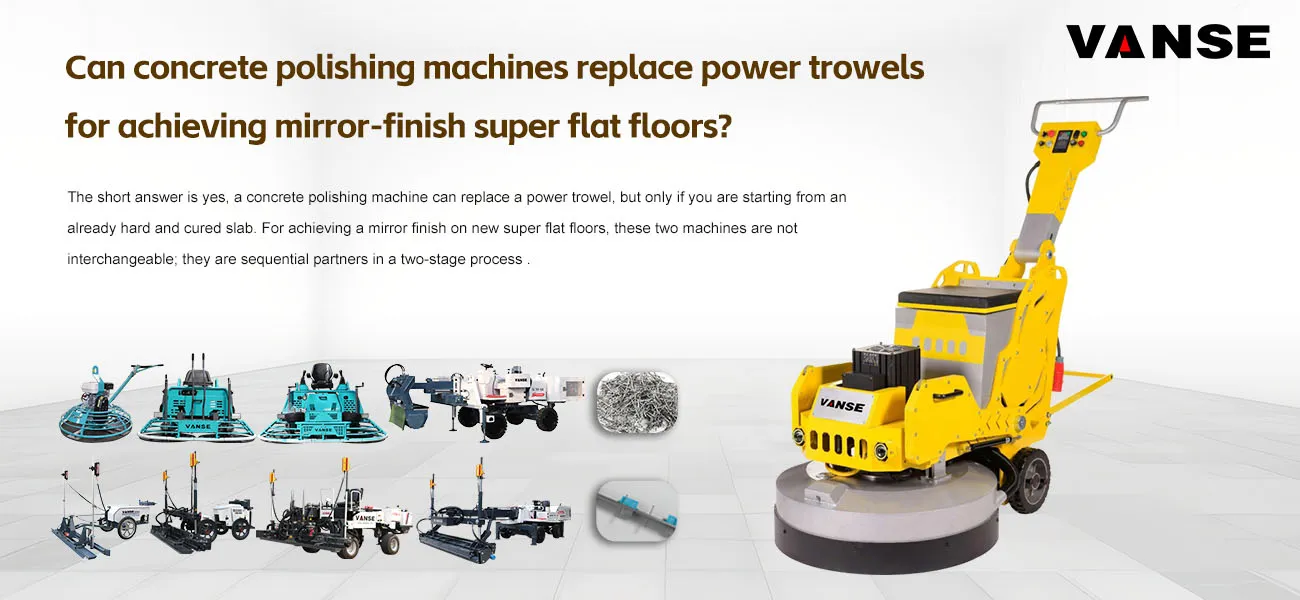
The short answer is yes, a concrete polishing machine can replace a power trowel, but only if you are starting from an already hard and cured slab. For achieving a mirror finish on new super flat floors, these two machines are not interchangeable; they are sequential partners in a two-stage process .
To understand why, you have to look at when in the concrete's life cycle each machine operates. A power trowel works on wet, setting concrete, while a polishing machine works on hard, cured concrete.
🆚 The Core Difference: Timing and Technique
| Feature | Power Trowel (Finishing Stage) | Concrete Polisher (Hardening Stage) |
| When to Use | During the concrete's initial set (while still plastic/hardening) . | After the concrete has fully cured (typically 28+ days) . |
| How it Works | Uses steel blades to float, compact, and "burnish" the surface paste, creating a temporary mechanical shine . | Uses abrasive diamond pads to physically grind down the surface, exposing the aggregate and creating a permanent structural shine . |
| Result | Creates the initial dense, smooth surface required before any polishing can happen. This is the foundation. | Removes the top layer to achieve the final desired gloss level (from satin to mirror). This is the final art. |
| Goal | Densification & Profile Creation. To prepare a flat, cured slab ready for polishing. | Aesthetics & Durability. To reveal the aggregate and create a long-lasting, high-gloss finish . |
🛠️ Why You Need Both for a Mirror Finish
Think of it like building a piece of fine furniture. You cannot start with a rough log and immediately apply varnish. You need a plane to make it flat first.
Phase 1: The Power Trowel (Creating the Canvas)
The power trowel's job is to create a perfectly flat and dense foundation. As we discussed in your previous question about operation time, the trowel burnishes the surface. If you try to use a polishing machine on a floor that hasn't been properly power-troweled, the slab will be too rough and uneven. The polisher would have to remove far too much material to achieve flatness, which is inefficient and costly .
Phase 2: The Polisher (Painting the Masterpiece)
Once the concrete is cured, the polishing machine takes over. You attach diamond abrasive pads (starting coarse and moving to very fine, like 3,000 grit) . This process physically cuts the surface, revealing the inner beauty of the stone and creating a shine that is part of the material itself, not just a surface effect .
💡 Can One Machine Do Both?
Technically, yes, a power trowel can be converted into a high-speed polishing machine, but this is for the polishing phase only.
The Conversion: You can buy a conversion kit (planetary grinding heads) that attaches to the bottom of a power trowel, allowing it to hold diamond polishing pads .
The Advantage: This is incredibly fast. A converted ride-on power trowel can polish over 10,000 square feet a day, making it ideal for massive warehouses .
The Trade-off: A converted trowel is less precise than a dedicated planetary grinder and cannot get close to walls or into corners. You would still need a smaller, walk-behind grinder for the edges .
⚙️ The Critical Step: Densifier
Regardless of which machine you use for polishing, you must apply a chemical hardener called a densifier (usually lithium silicate) after the initial grinding passes . This chemical reacts with the concrete to make it rock-hard, allowing it to accept a high-gloss polish. Without it, the surface will remain chalky and dull.
In short: Use the power trowel to build the perfect canvas. Then, bring in the polisher to create the artwork.
If you are planning a project, knowing the desired final gloss level (e.g., matte, satin, or high-gloss mirror) will help determine exactly which grit progression you need for the polishing phase. Let me know if you'd like more details on that. Contact us NOW
Note: The parameters provided in this document are for reference only and are not mandatory. Due to differences in technical characteristics between different brands and models of laser levelers, please consult the manufacturer for a suitable solution before actual operation. This reference document assumes no responsibility for any issues arising from failure to follow the manufacturer's instructions.
Thanks to All the Friends Who Support and Trust Shandong Vanse Machinery Technology Co., Ltd.
If you want to know more about Shandong Vanse Machinery Technology Co., Ltd. or have any questions, please feel free to contact us:
Our Factory
Shandong Vanse Machinery Technology Co., Ltd.








Share this article

About the Author: Shandong Vanse Machinery Technology Co., Ltd.
Shandong Vanse Machinery Technology Co., Ltd. is a high-tech manufacturer specializing in concrete construction machinery, including laser screeds and related equipment. The company integrates R&D, production, and global sales, with products exported to over 60 countries and widely used in infrastructure projects worldwide.
Previous Post
Next Post
Related Articles
You Might Also Like
Construction Technology And Construction Process Of Concrete Laser Leveling Machine
Construction technology and construction process of concrete laser leveling machine ★Introduction to laser leveling machine☆ The concrete laser leveling machine is an advanced ground leveling equipment that uses a laser control system to accurately level the concrete surface. Laser leveling machine combines modern laser technology, mechanical technology and electronic control technology, which can greatly improve the flatness of concrete floors, reduce construction time, and ensure construction quality. ★Preparation work before construction☆ 1. On-site survey: Before construction, a detailed survey of the construction site should be conducted to understand the ground foundation conditions, drainage facilities, surrounding environment, etc., to ensure that the laser leveler can operate smoothly. 2. Material preparation: Prepare sufficient concrete materials and select appropriate concrete proportions according to design requirements. 3. Equipment inspection: Ensure that the laser leveler and other auxiliary equipment (such as concrete pumps, mixer trucks, etc.) are in good condition, and have necessary wearing parts and maintenance tools. 4. Safety protection: Set up construction areas and set up warning signs to ensure the safety of the construction site. ★Key points for concrete laying☆ 1. Foundation treatment: Ensure that the foundation ground is solid, flat, free of oil and water, and lay an isolation layer or moisture-proof layer as needed 2. Concrete pouring: Concrete pouring should be continuous and even to avoid quality problems such as hollows and cracks. 3. Control the water-cement ratio: Strictly control the water-cement ratio of concrete according to design requirements to ensure the strength and durability of concrete. ★Laser leveling machine operation☆ 1. Laser transmitter setting: Set up the laser transmitter in the construction area, and adjust the position and height of the laser transmitter according to the design requirements 2. Equipment positioning: Position the laser leveler within the construction area, and ensure that the laser receiver of the laser leveler can accurately receive the signal from the laser transmitter. 3. Concrete leveling: Start the laser leveling machine and adjust the driving speed and leveling depth of the equipment to make the concrete surface achieve the flatness required by the design. 4. Corner treatment: For corner areas that cannot be covered by the laser leveling machine, hand tools should be used for supplementary leveling. ★Construction quality monitoring☆ 1. Flatness testing: During and after construction, professional flatness testing tools should be used to test the flatness of the concrete floor to ensure that the construction quality meets the design requirements. 2. Strength testing: After the construction is completed, the strength testing of the concrete floor should be carried out at specified intervals to ensure that the concrete reaches the design strength. 3. Quality control records: Keep detailed records of key parameters and quality control measures during the construction process to facilitate subsequent quality tracing and problem handling. ★Later maintenance and care☆ 1. Equipment cleaning: After the construction is completed, the laser leveling machine should be thoroughly cleaned to remove concrete residue and dust on the equipment. 2. Lubrication and maintenance: Regularly lubricate and maintain the key components of the laser leveling machine to ensure smooth operation of the equipment. 3. Equipment inspection: Conduct comprehensive inspections of the laser leveling machine regularly to discover and deal with potential problems in a timely manner. 4. Storage protection: During the storage period of the equipment, necessary protective measures should be taken to prevent the equipment from getting damp, rusty or other damage. ★Safe construction measures☆ 1. Personnel training: Ensure t hat operators have received professional training and have corresponding operating qualifications, and can operate the laser leveling machine skillfully and accurately. 2. Safety protection facilities: Set up necessary safety protection facilities at the construction site, such as guardrails, warning signs, etc., to ensure safety during the construction process 3. Emergency plan: Develop an emergency plan to clarify response measures and rescue procedures in the event of emergencies (such as equipment failure, casualties, etc.). 4. Safety inspection: Conduct regular safety inspections on the construction site to discover and deal with potential safety hazards in a timely manner ★Environmental protection and energy saving considerations☆ 1. Reduce noise pollution: Choose a low-noise laser leveling machine model, and reasonably arrange the operating time during the construction process to reduce the impact on surrounding residents. 2. Reduce waste production: Strictly control the amount of concrete used during the construction process to avoid excessive waste production. The waste materials generated should be classified and processed, and the recyclable materials should be recycled and the non-recyclable materials should be properly disposed of. 3. Energy-saving measures: Optimize the construction process, reasonably arrange operation time, and reduce unnecessary equipment idling and energy consumption. At the same time, the equipment is regularly maintained and maintained to ensure that the equipment is in optimal working condition and improve energy utilization efficiency. 4. Environmental awareness education: Strengthen the environmental awareness education of construction workers and improve their understanding and attention to environmental protection work. Through training and education, construction personnel can understand environmental protection regulations and policies, master environmental protection knowledge and skills, and actively participate in environmental protection work. To sum up, the construction technology and construction process of concrete laser leveling machine need to comprehensively consider many factors, including equipment performance, construction quality, safe construction, environmental protection and energy saving, etc. During the construction process, operations and management should be carried out in strict accordance with relevant standards and requirements to ensure construction quality and safety. At the same time, environmental protection and energy-saving measures should be actively adopted to promote green construction and sustainable development.How to repair the cracking problem of emery floor caused by long-term wear?
How to repair the cracking problem of emery floor caused by long-term wear? Emery floor is widely used in industrial plants, warehouses, parking lots and other places because of its wear resistance, pressure resistance and anti-slip properties. However, as time goes by, the surface of the floor will inevitably be worn, especially in high-traffic areas, where cracking problems often occur. This not only affects the aesthetics of the floor, but may also cause safety hazards and affect the use effect. Therefore, it is very important to repair the cracking problem of emery floor. ★ Problem Analysis and Causes ★ There are many reasons for the cracking of emery floor, among which long-term wear is one of the main factors. During the use of the floor, due to the frequent exchanges of vehicles, personnel, goods, etc., the surface of the floor is constantly rubbed and hit, causing the surface material to gradually wear and thin. When the wear reaches a certain extent, the structural strength and stability of the floor will be affected, resulting in cracking. In addition, factors such as floor construction quality, material quality, and use environment may also affect the wear resistance and cracking of the floor. For example, poor construction quality may lead to uneven floor surface, prone to wear and cracking; harsh use environment, such as frequent contact with chemicals or high temperature, will also accelerate the damage and aging of the floor. ★ Preparation before repair ★ Before repairing the cracking problem of diamond sand floor, you need to make adequate preparations. This includes the following aspects: 1. On-site investigation and evaluation: Conduct a comprehensive investigation and evaluation of the cracking of the floor to determine the scope, degree and cause of the cracking. At the same time, understand the use and environment of the floor to provide a basis for subsequent repair work. 2. Material preparation: According to the results of the on-site investigation and the repair plan, prepare the required repair materials, such as repair agents, curing agents, coatings, etc. Ensure that the quality of the materials meets the requirements and has good wear resistance and pressure resistance. 3. Tool and equipment preparation: Prepare the tools and equipment required during the repair process, such as grinders, vacuum cleaners, roller brushes, etc. Ensure that these tools and equipment can be used normally to improve the efficiency of repair. ★ Crack Repair Plan ★ For the cracking problem of diamond sand floor, the following repair plan can be adopted: 1. Cleaning and grinding: First, use a vacuum cleaner to clean the debris and dust in the cracked area to ensure that the surface is clean. Then, use a grinder to grind the cracked area to remove the loose layer and uneven parts of the surface to improve the adhesion of the repair material. 2. Filling the profile joint: For larger profile joints, special repair agents can be used to fill them. The choice of repair agent should be determined according to the material and use environment of the floor to ensure that it has good adhesion and good abrasiveness. When filling, apply the repair agent evenly in the crack to ensure that the filling is complete and flat. 3. Overall coating reinforcement: In order to enhance the overall strength and flatness of the floor, a layer of reinforcement coating can be applied to the entire floor surface. The choice of reinforcement coating should be determined according to the material and use requirements of the floor. You can choose a coating with wear-resistant, anti-slip and other functions. When applying, ensure that the coating is uniform and without omissions, and pay attention to avoid bubbling, cracking and other phenomena. ★ Curing and strengthening treatment ★ In order to improve the wear resistance and stability of the repaired floor, the floor can be cured and strengthened. Curing agent is a substance that can react chemically with the floor material to improve the hardness and wear resistance of the floor. After the repair work is completed, a layer of curing agent can be applied to form a hard and wear-resistant protective layer on the floor surface. Curing and strengthening treatment can further enhance the bearing capacity and service life of the floor. ★ Subsequent care and maintenance ★ After the repair work is completed, subsequent care and maintenance are equally important. Here are some suggestions: 1. Regular cleaning: Regularly use a vacuum cleaner or mop to clean the floor surface to avoid the accumulation of debris and dust. For stains that are difficult to clean, such as oil stains, professional cleaning agents can be used for treatment 2. Avoid heavy impact: When using the floor, avoid heavy objects directly hitting or scratching the floor surface to avoid damage to the floor. For high-traffic areas, protective pads can be set up or protective facilities can be installed to reduce wear. 3. Regular inspection and repair: Regularly check the cracking and wear of the floor, and deal with problems in a timely manner once they are found. For minor wear and cracking, you can use repair materials to repair; for larger problems, you can contact a professional team for repair. ★ Preventive measures ★ In order to avoid the problem of cracking of diamond sand floor again, the following are some preventive measures: 1. Improve the construction quality: During the construction process, strictly follow the construction specifications to ensure the flatness and construction quality of the floor. Pay special attention to the control of key links such as base treatment, material mixing ratio, and construction thickness) 2. Select high-quality materials: When selecting floor materials, you should pay attention to its performance in terms of wear resistance, pressure resistance, and stability. Give priority to brand products with reliable quality and stable performance, and avoid using inferior materials. 3. Reasonably plan the use environment: Reasonably plan the use environment according to the use needs and environmental characteristics of the floor. For example, set up a buffer zone in a high-traffic area or take other measures to reduce wear; take protective measures in areas susceptible to chemical invasion, etc. 4. Strengthen daily maintenance: Clean and maintain the floor regularly, and deal with minor wear and cracking problems in a timely manner. At the same time, strengthen daily inspections and maintenance work to ensure that the floor is in good use. In summary, repairing the cracking problem of diamond sand floor caused by long-term wear needs to start from multiple aspects. First, analyze and evaluate the problem to find out the cause and scope of the cracking; then, make preparations before repair, including the preparation of materials, tools and equipment; then, use appropriate repair solutions to treat the cracked area; finally, perform curing and strengthening treatment to improve the wear resistance and stability of the floor. After the repair is completed, it is also necessary to pay attention to subsequent maintenance and maintenance work, as well as take preventive measures to avoid similar problems from happening again. In the process of repairing the cracking problem of diamond sand floor, we also need to pay attention to the following points: First, safety is always the primary consideration. Before the repair work begins, ensure that the safety warning signs in the work area are in place to prevent unrelated personnel from entering the construction area. At the same time, construction personnel should wear appropriate safety protection equipment, such as gloves, masks, safety shoes, etc., to ensure safety during the construction process. Secondly, pay attention to the control of the construction environment. During the repair work, the construction area should be kept dry and clean as much as possible to avoid the influence of moisture and debris on the repair effect. At the same time, it is also crucial to control the construction temperature and humidity. Appropriate construction conditions should be selected according to the requirements of the floor material and curing agent. In addition, after the repair work is completed, a comprehensive inspection should be carried out to ensure that the repair area is consistent with the flatness and color of the surrounding floor. For the slight differences that exist, appropriate grinding and adjustment can be carried out to achieve an overall beautiful effect. Finally, the implementation of preventive measures is also crucial. In addition to improving the construction quality and selecting high-quality materials, the daily maintenance and management of the floor should be strengthened. Clean and maintain the floor regularly, and deal with the wear and cracking problems that occur in a timely manner. At the same time, for high-traffic areas or areas susceptible to chemical erosion, enhanced measures can be taken to improve the wear resistance and stability of the floor. In short, repairing the cracking problem of the diamond floor caused by long-term wear is a complex and meticulous task. Only by starting from multiple aspects such as problem analysis, pre-repair preparation, repair plan, curing and strengthening treatment, subsequent care and maintenance, and preventive measures can the quality and effect of the repair work be ensured. At the same time, paying attention to safe construction and environmental protection are also important aspects that cannot be ignored. Through scientific repair methods and effective preventive measures, we can extend the service life of emery floors, improve the use effect, and provide strong protection for the safety and beauty of various places. However, for non-professionals, it may be difficult and risky to repair emery floors. Therefore, in actual operation, it is recommended to seek the help of a professional floor repair service team. They have rich experience and professional skills, can formulate appropriate repair plans according to specific circumstances, and ensure the quality and safety of construction. At the same time, they can also provide follow-up maintenance and maintenance suggestions to help users better manage and maintain the floor. In summary, the repair of emery floors requires comprehensive consideration of multiple aspects, from problem analysis to the implementation of preventive measures. Through scientific methods and professional team support, we can effectively solve the problem of cracking of emery floors and improve the performance and life of the floor. At the same time, strengthening daily maintenance and maintenance work is also the key to ensure the long-term and stable operation of the floor. Through continuous efforts and attention, we can let the emery floor continue to play its important role in various places and provide a safe and comfortable environment for people's life and work. The above is a comprehensive analysis and solution on how to repair the cracking problem of emery floors caused by long-term wear. I hope that these contents can provide you with useful references and inspirations, helping you to better solve the problem of floor cracking and improve the use effect and service life of the floor. At the same time, it is also recommended that you pay attention to safety, environmental protection and efficiency in actual operation to ensure the smooth progress of the repair work and achieve good results.Use the concrete laser leveling machine to control the temperature!
When the concrete laser leveling machine performs operations on the road surface, some parts of the equipment may overheat due to the increase in temperature, which will affect the correct leveling effect of the equipment. So, how should the temperature of the leveling machine be controlled during work? Next, let's take a look at how our company's technicians teach you how to control the temperature of the leveling during operation! How to control the temperature during leveling operation? First of all, controlling the temperature of the leveling machine is one of the keys to ensure the quality of leveling. When the equipment is being leveled, it should meet the requirements of relevant standards according to the type of asphalt, label, consistency, ambient temperature, and leveling thickness. Secondly, when the construction temperature of expressways and first-class roads is lower than 10°C, and the construction temperature of other grades of roads is lower than 5°C, leveling is not suitable. If it is necessary to carry out leveling work, the temperature of the road leveling machine should be increased, and there are also low-temperature leveling requirements that meet the regulations. After the plate is heated and leveled, it is pressed immediately to shorten the length of the press. Finally, remember that during leveling, the requirements of relevant standards should be met according to the type of asphalt, label, consistency, ambient temperature, leveling thickness, etc. In this case, it is relatively simple and easy to control the temperature. Precautions for leveling machine: 1. After finishing the leveling operation, carry out the routine maintenance work according to the content of the routine maintenance procedure. 2. The working devices and moving mechanisms of the leveling machine that are in direct contact with the asphalt mixture during operation, after the operation, spray with diesel oil and then run for a period of time to remove the residual asphalt on it, so that it can run freely and rotate flexibly. It is forbidden to spray diesel oil on the electric control system and helix to prevent fire and combustion when electrified. 3. After leveling the two-ash soil, wash it with water to wash off the white material. After washing, use waste hydraulic oil to lubricate the moving parts of the scraper conveyor chain, and apply anti-rust oil to the piston rod. Be careful not to allow water to wash into the electrical appliances and bearings to prevent short circuits and foreign objects entering the bearings. 4. Clean and check the elevation adjustment device of the slope gauge, and lubricate the lead screw with grease. Apply grease to the slide rails of the floating arm. Grease each oil filling point until the seam overflows. For levelers with oil filling cups, observe the consumption and fill them up at any time. Have you learned all the above? If you want to know more about concrete laser leveling machine, please continue to pay attention to this website!