Technical Knowledge
Concrete laser leveling machine VS. traditional manual leveling, how much has the efficiency increased?
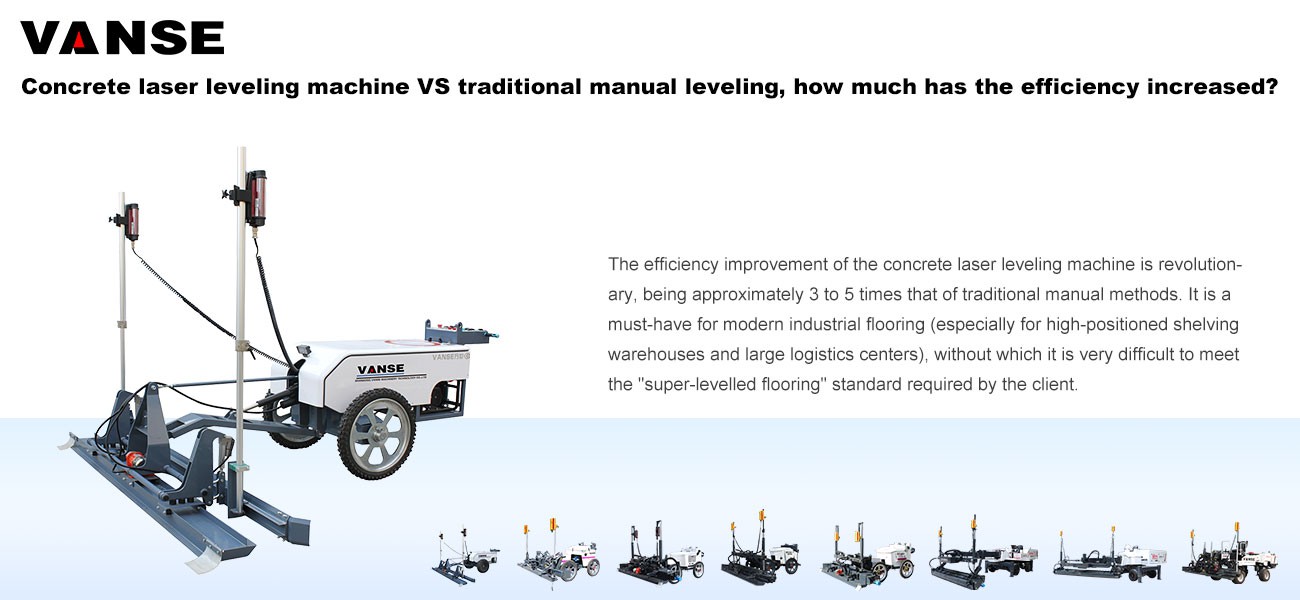
The comprehensive construction efficiency of the concrete laser leveling machine is typically 3 to 5 times that of the traditional manual method (that is, an increase of 300% to 500%).
It is not merely about "doing it quickly"; its advantages in terms of labor saving and uniformity are even more revolutionary than just the speed.
The following is a detailed data comparison and analysis of laser leveling versus manual leveling:
Core Data Comparison Table (Efficiency and Quality)
To make it clear for you, we will compare the key indicators of the two types of work methods side by side:
| Core indicators | Traditional manual leveling | Laser Leveling Machine (Laser leveling) | Improvement percentage/difference |
| Daily construction area | Approximately 500 – 800 m² per day | Approximately 2,500 – 4,500 m² per day | Efficiency increased by 300% – 500% |
| Required manpower | 15 – 20 people (high-intensity physical labor) | 4 – 6 people (mainly for assistance and operation) | Labor reduced by approximately 60% |
| Leveling error | 5mm – 10mm (even larger) | ≤ 2mm (measured with a 2-meter level) | Precision reaches the standard of a perfectly flat floor |
| Concrete slump | Requires a larger slump (120-140mm) for dragging | Suitable for low slump (80-100mm) | Concrete strength and density are higher |
| Construction joint | Must be poured in sections, with many construction joints | Capable of continuous large-area laying | Reduced construction joints, resulting in a more integrated floor surface |
2. Specific dimensions of efficiency improvement
A. Qualitative change in speed: From "piece-by-piece construction" to "large-scale paving"
Traditional method: First, formwork (channel steel) needs to be erected, then points need to be marked and lines drawn.Workers have to bend over and repeatedly level the surface using a trowel. This requires a lot of physical effort. As time goes by, workers become more fatigued, and their efficiency and quality in the afternoon usually decline significantly.
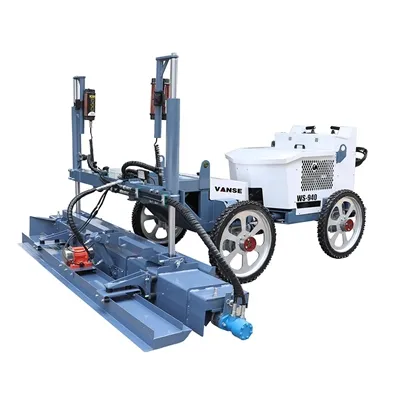
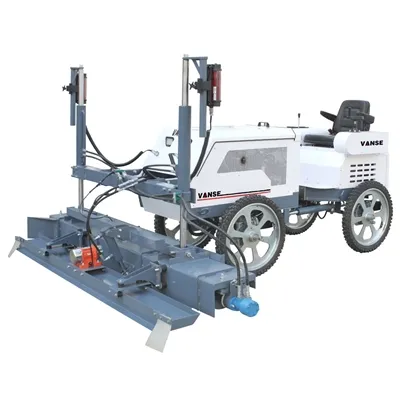
Laser leveling: The machine is equipped with a high-frequency vibrator (about 4,000 times per minute). While moving, it automatically levels, vibrates, and stirs the mixture.It doesn't require side formwork and can achieve large-area, continuous laying. The machine is tireless and maintains consistent quality day and night.
B. Liberation of Human Resources: From "Human Sea Strategy" to "Elite Forces"
Traditional approach: To meet the deadline, the only solution is to hire more workers. However, having too many workers can lead to chaos at the site, and skilled plasterers (foremen) currently have very high daily wages.
Laser leveling: Only one operator is needed, along with 2-3 assistants (responsible for pulling the concrete pipes and providing simple materials). This not only reduces the daily wage expenses, but also lowers the management difficulty and the risk of workplace injuries.
C. The "invisible efficiency" brought about by quality
This is the point that is most easily overlooked.
No need for rework: Manual leveling is prone to "ripple patterns" or hollowing out. If the storage and logistics center has strict requirements for leveling accuracy, after manual leveling, it may still require a significant amount of time for self-leveling repair or sanding, which are all hidden costs.
High-strength concrete: The laser leveling machine can handle more dry and harder concrete (with lower slump), which means that the risks of sanding and cracking after the floor dries completely are significantly reduced, thereby lowering the maintenance costs in the later stage.
3. Financial Report: Is It Worth It?
Although the laser leveling machine is highly efficient, the cost of purchasing the machine is high (ranging from several hundred thousand to even over a million). Let's do a simple calculation:
Applicable scenario (the critical point where profits turn into losses):
If your project is a small basement less than 1000 square meters or a small room divided by walls: traditional manual methods are more cost-effective, as it is troublesome to bring in and set up the machinery, as well as to transport it.
If your project involves a factory building, warehouse or parking lot with an area of over 3,000 square meters: The laser leveling machine is the undisputed champion.
Example: 10,000 square meters of factory floor area
The manual team: It might take 10 to 12 days to complete the task, and we will pay the wages of 15 people every day.
Machine team: The job can be completed within 3 to 4 days. We will pay the wages of 5 workers plus the depreciation of the machines and the cost of fuel.
Result: The construction period was shortened by 70%. The client (the owner) was more satisfied, and you could receive the project payment more quickly to take on the next job.
Conclusions and Recommendations
The efficiency improvement of the concrete laser leveling machine is revolutionary, being approximately 3 to 5 times that of traditional manual methods. It is a must-have for modern industrial flooring (especially for high-positioned shelving warehouses and large logistics centers), without which it is very difficult to meet the "super-levelled flooring" standard required by the client.
Note: The parameters provided in this document are for reference only and are not mandatory. Due to differences in technical characteristics between different brands and models of laser levelers, please consult the manufacturer for a suitable solution before actual operation. This reference document assumes no responsibility for any issues arising from failure to follow the manufacturer's instructions.
Thanks to All the Friends Who Support and Trust Shandong Vanse Machinery Technology Co., Ltd.
If you want to know more about Shandong Vanse Machinery Technology Co., Ltd. or have any questions, please feel free to contact us:
Our Factory
Shandong Vanse Machinery Technology Co., Ltd.








Share this article

About the Author: Shandong Vanse Machinery Technology Co., Ltd.
Shandong Vanse Machinery Technology Co., Ltd. is a high-tech manufacturer specializing in concrete construction machinery, including laser screeds and related equipment. The company integrates R&D, production, and global sales, with products exported to over 60 countries and widely used in infrastructure projects worldwide.
Previous Post
Next Post
Related Articles
You Might Also Like
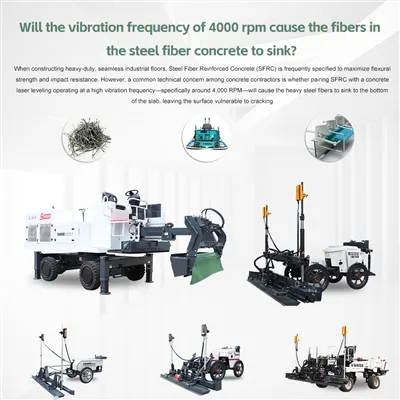
Will the vibration frequency of 4000 rpm cause the fibers in the steel fiber concrete to sink?
When constructing heavy-duty, seamless industrial floors, Steel Fiber Reinforced Concrete (SFRC) is frequently specified to maximize flexural strength and impact resistance. However, a common technical concern among concrete contractors is whether pairing SFRC with a concrete laser leveling operating at a high vibration frequency-specifically around 4,000 RPM-will cause the heavy steel fibers to sink to the bottom of the slab, leaving the surface vulnerable to cracking. The short answer is no. When a laser leveling is operated correctly, a 4,000 RPM vibration frequency does not cause steel fibers to sink. In fact, it provides the optimal consolidation needed to align the fibers perfectly within the concrete matrix. Here is a comprehensive, technical breakdown of how high-frequency laser leveling interact with steel fiber concrete, ensuring top-tier Floor Flatness (FF) and Floor Levelness (FL) without compromising structural integrity. To understand why the fibers do not sink, it is crucial to distinguish between the type of vibration used by a laser leveling and traditional manual vibrators. Deep Poker Vibrators (Low Frequency/High Amplitude): Traditional internal vibrators create violent, high-amplitude waves deep within the slab. If left in one place too long, this aggressive action will force heavy aggregates and steel fibers to the bottom while driving excess water and weak cement paste to the top. Laser leveling Vibrating Plates (High Frequency/Low Amplitude): The vibrating plate on a modern laser leveling operates at roughly 4,000 RPM. This is a high-frequency, low-amplitude surface vibration. It is designed to temporarily fluidize only the top layer (typically the top 50mm to 75mm) of the concrete. This gentle, rapid liquefaction allows the leveling to close the surface and bring up just enough cream (cement paste) for power troweling, without disturbing the homogenous suspension of steel fibers in the deeper matrix. Far from causing the fibers to sink, the 4,000 RPM vibration actually improves the mechanical performance of the SFRC. As the leveling head of the laser leveling passes over the concrete, the high-frequency vibration and the physical strike-off action force the steel fibers near the surface to lie down horizontally. This parallel alignment is exactly what engineers want. Fibers that are aligned horizontally across the surface provide maximum resistance against surface micro-cracking, shrinkage, and dynamic loads from heavy warehouse equipment like forklifts. If steel fibers are sinking to the bottom of a slab, the equipment is rarely the root cause. The primary culprit is almost always a poorly designed concrete mix with an excessively high slump (too much water or chemical plasticizer). Proper SFRC Mix: In a well-proportioned SFRC mix, the mortar holds the fibers in suspension. Over-Wet Mix: If the concrete is too fluid (a high slump), the matrix lacks the viscosity to support the heavy steel fibers. In this scenario, gravity-accelerated by any form of vibration-will cause the fibers to settle. Maintaining strict control over the batching process and ensuring a cohesive mix design is essential for seamless floor construction. Achieving perfect E-E-A-T (Experience, Expertise, Authoritativeness, and Trustworthiness) in industrial flooring requires equipment that guarantees consistency. This is where advanced machinery from Shandong Vanse Machinery Technology Co., Ltd. excels. As detailed on www.vansemac.com, Vanse's equipment ecosystem is specifically engineered to handle complex materials like steel fiber concrete: Constant Travel Speed: Models like the YZ30-4E and YZ40-4E telescopic boom laser leveling utilize intelligent control systems that maintain a smooth, continuous retraction speed. Because the machine never stalls or pauses over one spot, there is zero risk of localized over-vibration that could cause aggregate or fibers to segregate. Optimized Leveling Heads: The heavy-duty vibrating plates on Vanse equipment are calibrated to deliver exactly the 4,000 RPM surface energy required to consolidate stiff, low-slump SFRC mixes efficiently. Electric Drive Precision: For smaller commercial decks, walk-behind units like the all-electric DZ25-2 provide fixed-speed walking. This steady pace ensures the vibration exposure is mathematically uniform across every square meter of the slab. Pairing a high-performance concrete laser leveling with steel fiber concrete is not a risk; it is the industry standard for delivering super-flat, ultra-durable logistics and manufacturing facilities. The 4,000 RPM high-frequency surface vibration ensures rapid surface closure and optimal horizontal fiber alignment, locking in the structural strength of the floor. Note: The parameters provided in this document are for reference only and are not mandatory. Due to differences in technical characteristics between different brands and models of laser levelers, please consult the manufacturer for a suitable solution before actual operation. This reference document assumes no responsibility for any issues arising from failure to follow the manufacturer's instructions.Maintenance points for special parts of concrete laser leveling machine
Every piece of equipment needs to be maintained after use, and the concrete laser leveling is no exception. The maintenance work seems simple, but in fact it also hides a big mystery. If the maintenance method is suitable for this equipment, it will It is effective, but if it is not suitable, such maintenance will be in vain and will not play a big role at all. Let's take a detailed look at the main points to master in the maintenance of the equipment. Maintenance points for "special" parts of concrete laser levelings 1. The connection between the supercharger of the concrete laser leveling machine and the inlet and exhaust pipes must be tight without air leakage. If there is air leakage between the exhaust pipe and the exhaust gas turbine, the efficiency of the supercharger will be greatly reduced and the exhaust temperature of the diesel engine will be reduced. The valves and supercharger will be damaged due to sudden increase. Before starting the new engine, the supercharger and supercharger oil filter must be filled with clean oil to ensure that the supercharger bearings can be lubricated as soon as the diesel engine is started. After the car has traveled 8,000 to 10,000km, the supercharger oil filter element must be replaced. 2. Before shutting down the diesel engine of the concrete laser leveling machine, it should be run at idle speed for 3 to 5 minutes to reduce the supercharger speed and temperature, and listen to the sound of the supercharger running. If any abnormality is found, the machine should be stopped for inspection, such as If the supercharger rotor rotates sluggishly and makes sounds of sticking or wear, it must be sent to a qualified repair station for repair. 3. After every 500 hours or 30,000km of concrete laser levelinging, the gap on the supercharger rotor shaft should be checked, and the dust and carbon deposits on the compressor turbine casing and rotor blades should be cleaned. At this time, the turbocharger should be Remove it from the diesel engine and replace the metal gasket between the supercharger exhaust pipe. It is not allowed to use mechanical methods to remove the scale on the rotor parts. Instead, use gasoline or other cleaning fluids for cleaning aluminum parts. 4. The locking nut of the supercharger compressor of the concrete laser leveling machine cannot be disassembled, otherwise the dynamic balance of the supercharger rotor will be destroyed and the supercharger will be damaged. 5. Do not damage or deform the rotating parts of any removed turbocharger, otherwise it will affect the balance of the concrete laser leveling machine turbine, and do not damage any rubber seals.The Laser leveling machine manufacturers: Quality and quantity are guaranteed because the equipment has these advantages
As the requirements for modern industrial floors gradually increase, more and more floor construction equipment has begun to show its power. Since its launch, laser leveling machines have been loved by the majority of users, so they can occupy a place in the leveling machine market. Laser leveling machine manufacturers have always insisted on providing users with standardized equipment and are committed to bringing more efficient construction to road construction. Laser leveling machine manufacturers will introduce some performance advantages of leveling machines to you below, I hope you can understand. The laser leveling machine laser measurement and control system produced by laser leveling machine manufacturers automatically controls the elevation. The design elevation of the top surface of the laser system floor imported from the United States is automatically controlled by the laser machine computer, which can ensure a very high ground flatness and can be directly leveled on the concrete layer. The ground flatness is not affected by the vibration of the construction template, and no formwork is needed in the middle, which reduces the input of labor and materials, reduces the construction procedures, and speeds up the construction progress. The laser leveling machine is super flat and super economical. Since the 1990s, the practice of "clear water concrete" (floor) floor and colored wear-resistant (floor) floor has been continuously promoted. After more than ten years of exploration and continuous improvement, through the upgrade of laser leveling machine equipment and the integration and improvement of process flow, the "three super" floor in the current "leveling" product series has reached the domestic level. The laser leveling machine produced by the laser leveling machine manufacturer replaces the traditional manual leveling concrete. The ground elevation can reach laser-level accuracy. The laser is used to control the horizontality and flatness of the ground, so as to achieve a super-flat floor in the sense. So how much does a laser leveling machine cost? You should first understand the performance and then look at the price. The integral floor abandons the traditional practice of separate construction of the concrete base and surface layer, thereby eliminating the quality problems of cracks and hollows caused by poor bonding between the base and surface layers, and is increasingly widely used in factories, warehouses, runways, docks and other projects. Special leveling and polishing technology is used to process concrete into a high-density and high-gloss floor, and a 3~5mm thick wear-resistant layer is naturally formed on the surface. No other chemical surface materials are required to meet environmental protection requirements. Laser leveling machines are developed based on the increasing demand for floor quality such as strength, density, flatness, and levelness in modern industrial plants, large shopping malls, warehouses, and other large-area cement concrete floors. Laser leveling machine manufacturers specialize in the production of various types of leveling machines. The equipment they produce has exquisite craftsmanship, mature technology, and stable performance. We will provide customers with good after-sales service, allowing you to enjoy a relaxed and pleasant purchase process. Customers can solve problems encountered in the later use in a timely manner to ensure the normal operation of the production line