Technical Knowledge
Common sources of errors & solutions in the construction of concrete laser leveling machines
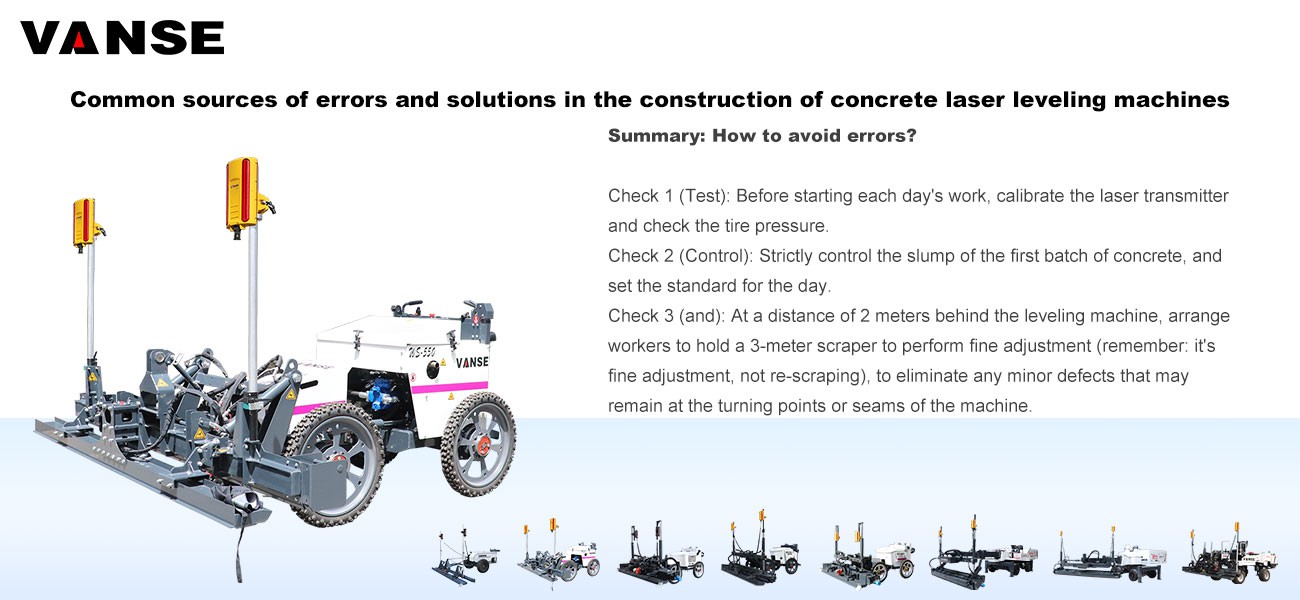
Although the concrete laser leveling machine is a highly precise device, it is not a "fully automatic wonder". The final leveling accuracy (FF/FL value) of it is highly dependent on the perfect coordination of "human-machine-material-method".
Often, the machine itself is not faulty, but the ground it produces has unevenness or wave patterns. Here are the four main sources of common errors and their specific solutions. This is a "guide to avoiding pitfalls" derived from countless construction sites.
Signals and System Errors (The "Eyes" & "Brain")
This is the most common but also the most easily overlooked source of error. The laser system serves as the benchmark for the leveling machine. If the benchmark is incorrect, everything will be ruined.
| Source of error | Description of the phenomenon | Solution |
| Reference drift of the transmitter | Over time, the overall elevation of the entire area has shifted or there has been a large-scale inclination. | Root control: The launcher tripod must be set up on a completely stationary base (strictly prohibited from being placed on soil prone to subsidence or on vibrating floor slabs). |
| Root control: The launcher tripod must be set up on a completely stationary base (strictly prohibited from being placed on soil prone to subsidence or on vibrating floor slabs). | ||
| Laser signal dead zone / interference | The machine suddenly started to move erratically, or the leveling head began to shake up and down. | Clean up the site: Ensure there is no obstruction (workers moving, pillars) between the transmitter and the receiver. |
| Light shielding reflection: Remove large areas of glass and stainless steel plates at the scene to prevent multi-path laser reflection that could cause false signals. | ||
| Adjusting the Dead Band: Based on the requirements for flatness, appropriately set the sensitivity (width of the dead band) of the receiver. | ||
| Strong wind vibration | During outdoor construction, strong winds blew the transmitter, causing the base surface to shake up and down. | Physical Wind Protection: Build a wind shield around the transmitter, or use a heavy tripod with added weights. |
💡 Expert tip: Never allow the power cords of the concrete pump pipe or the vibration rod to come into contact with the frame of the laser emitter! This is the most embarrassing error that can occur on-site.
2. Mechanical and Calibration Errors (The "Body")
The mechanical condition of the machine directly determines whether it can accurately execute the instructions of the laser system.
Inconsistent tire pressure:
Question: If there is a significant difference in tire pressure between the left and right wheels, the machine will shake while moving, causing the leveling head to sway left and right and resulting in wave patterns.
Solution: Before construction, the tire pressure of all four wheels must be measured to ensure they are exactly the same.
Hydraulic system lag:
Question: The laser caused the scraper to rise, but the hydraulic cylinder responded half a second later, resulting in a "pit" on the ground.
Solution: Check if the hydraulic oil temperature is too high and if the solenoid valve is clogged.
Scraping plate and fabric spiral wear:
Problem: The bottom of the scraper is worn unevenly, resulting in scratches or stripes on the polished surface.
Solution: Daily inspect the wear plate at the bottom of the scraper. Replace it immediately if it is severely worn.
3. Concrete material error (The "Medium")
This is the factor that the machine "cannot control" but is the most affected one. The inconsistency in slump (cohesion) is the number one killer of flatness.
The slump value fluctuates frequently.
Too dry (<100mm): The machine cannot scrape, or the leveling head is "pushed up" by the counterforce, resulting in an overly high ground elevation.
Too dry (<100mm): The machine cannot scrape, or the leveling head is "pushed up" by the counterforce, resulting in an overly high ground elevation.
Solution: Strict control must be exercised over the material distribution at the concrete mixing station! Designate a dedicated person to test the slump before the tanker unloads the material. Those with Unqualified slumps must be immediately withdrawn or adjusted on-site. The optimal slump for the laser leveling machine is typically 140mm ± 20mm (depending on the model).
Initial setting time difference:
Question: The interval between the first batch of materials and the second batch is too long, resulting in "cold joints" or hardness differences at the junction. The machine will vibrate when passing through.
Solution: Ensure continuous supply of materials and avoid any interruptions.
4. Operational Error (The "Driver")
A good machine requires a good operator. The operator's experience determines 30% of the final outcome.
Improper control of the amount of fabric accumulation (Head of Concrete):
Error principle: If the concrete in front of the scraper is piled up too high (for example, more than half the height of the feeding screw), the machine resistance becomes too large, the tires slip or the machine head is lifted. If it is piled up too little, it will result in the pit not being filled.
Solution: The operator needs to work in coordination with the general workers to ensure that there is always only 2-3 cm of excess concrete remaining on the scraper during the rolling process. Make more corrections when necessary and avoid excessive adjustments.
Improper overlap:
Solution: The recommended standard overlap width is usually between 15cm and 30cm, and the marking lines should be used to assist with walking.
Solution: The recommended standard overlap width is usually between 15cm and 30cm, and the marking lines should be used to assist with walking.
Moving too fast:
Question: It's like driving over a speed bump. If you go too fast, the suspension system doesn't have enough time to react.
Solution: Maintain a constant speed. It is generally recommended to keep the speed within the range of 3 – 5 meters per minute, allowing sufficient reaction time for the hydraulic system.
Summary: How to avoid errors?
Check 1 (Test): Before starting each day's work, calibrate the laser transmitter and check the tire pressure.
Check 2 (Control): Strictly control the slump of the first batch of concrete, and set the standard for the day.
Check 3 (and): At a distance of 2 meters behind the leveling machine, arrange workers to hold a 3-meter scraper to perform fine adjustment (remember: it's fine adjustment, not re-scraping), to eliminate any minor defects that may remain at the turning points or seams of the machine.
Note: The parameters provided in this document are for reference only and are not mandatory. Due to differences in technical characteristics between different brands and models of laser levelers, please consult the manufacturer for a suitable solution before actual operation. This reference document assumes no responsibility for any issues arising from failure to follow the manufacturer's instructions.
Thanks to All the Friends Who Support and Trust Shandong Vanse Machinery Technology Co., Ltd.
If you want to know more about Shandong Vanse Machinery Technology Co., Ltd. or have any questions, please feel free to contact us:
Our Factory
Shandong Vanse Machinery Technology Co., Ltd.








Share this article

About the Author: Shandong Vanse Machinery Technology Co., Ltd.
Shandong Vanse Machinery Technology Co., Ltd. is a high-tech manufacturer specializing in concrete construction machinery, including laser screeds and related equipment. The company integrates R&D, production, and global sales, with products exported to over 60 countries and widely used in infrastructure projects worldwide.
Previous Post
Next Post
Related Articles
You Might Also Like
Concrete laser leveling machine construction efficiency
Concrete laser leveling machine construction efficiency ♦1♦ Introduction As an advanced construction equipment, the concrete laser leveling has significant advantages in improving construction efficiency. This article will discuss the construction efficiency of concrete laser leveling machines from aspects such as equipment performance, operator skills, and construction environment. ♦2♦ Equipment performance 1. The efficient construction Concrete laser leveling machine uses advanced laser measurement and control technology to accurately measure and control the flatness and elevation of the concrete surface. At the same time, the equipment is equipped with a high-efficiency scraper mechanism and vibrator, which can quickly level the concrete surface and improve construction efficiency. 2. High degree of automation The concrete laser leveling machine adopts an intelligent control system and can realize automated operation. The operator only needs to set relevant parameters and the equipment can automatically complete the leveling operation. This highly automated equipment greatly reduces manual operation time and labor costs. ♦3♦ Operator skills 1. Train qualified operators In order to ensure the construction efficiency of the concrete laser leveling machine, operators need to undergo professional training and master the operation methods and maintenance knowledge of the equipment. Only trained and qualified operators can skillfully operate the equipment and improve construction efficiency. 2. Experienced operators Operators with extensive experience can better cope with various construction environments and conditions. They can adjust the parameters and operating methods of the equipment according to the actual situation to ensure the stability and reliability of the equipment, thereby improving construction efficiency. ♦4♦ Construction environment 1. Good construction environment The concrete laser leveling needs to operate in a good construction environment. If there are severe weather conditions such as sand, rain and snow at the construction site, it will affect the construction efficiency of the equipment. Therefore, when selecting the construction time and location, weather factors need to be fully considered to ensure that the equipment can operate in a good environment. 2. Reasonable construction organization Reasonable construction organization is one of the key factors to improve the construction efficiency of concrete laser leveling machine. During the construction process, it is necessary to formulate reasonable construction plans and organizational plans based on the actual situation. Ensure that the equipment can complete various tasks efficiently. At the same time, on-site management also needs to be strengthened to ensure the safe and stable operation of the equipment. ♦5♦ Conclusion To sum up, the construction efficiency of concrete laser leveling machine is affected by many factors. In order to improve construction efficiency, factors such as equipment performance, operator skills, and construction environment need to be comprehensively considered. Only by giving full play to the performance of the equipment, improving the skills of the operators and choosing a good construction environment can the construction efficiency of the compacted soil laser leveling machine be truly improved.Three common misunderstandings about maintenance of concrete laser levelers. Have you fallen into any of these misunderstandings?
Concrete laser leveling machines can meet the construction requirements of large areas with high requirements for flatness and levelness. They play a very important role in the construction process. After the equipment is used, I believe everyone knows the maintenance of the leveling machine, but it is very likely that wrong operations will occur during the maintenance process, which will only have a counterproductive effect. In this article, our staff will explain the three major maintenance misunderstandings of concrete laser leveling machines. There are many fasteners of bolts and nuts in the concrete laser leveling machine. In order to make the connection reliable, it should be ensured that there is sufficient preload. However, it is not wrong to think that the tighter the bolts are tightened, the better. Blindly increasing the torque of the bolts will not only cause the fasteners to be permanently deformed by excessive external force, but also the screw will cause thread stripping or screw breakage due to excessive tension. The tire inflation pressure of the concrete laser leveling machine is the main factor that determines its service life and work quality. When the air pressure is too low, the deformation of the tire body increases, which will cause the internal stress to increase, and accelerate the aging of rubber and the fatigue of the cord; at the same time, the rolling resistance increases, so the tire shoulder wear is aggravated. However, when the inflation pressure is too high, the tire cord will produce a lot of tension, the resistance to impact will be weakened, and the rock edges will easily damage the tire; at the same time, the tire tread will be aggravated, causing the tire to slip, which will reduce the operating efficiency of the concrete laser leveler. The concrete laser leveler has many hydraulic components and requires sufficient hydraulic oil. Whenever the hydraulic oil deteriorates due to long-term use and needs to be replaced, there will always be people who mistakenly think that they only need to drain the oil in the hydraulic oil tank and fill it with new hydraulic oil. In fact, the correct oil change procedure should first drain the hydraulic oil in the hydraulic oil tank, then clean the tank and add new hydraulic oil; then remove the circuit main pipe, start the engine and run it at a low speed, which will cause the oil pump truck operator to operate manually. If each mechanism is operated separately, the old oil in the circuit will be discharged one by one by relying on hydraulic oil until new oil flows out of the return oil main pipe; then connect the return oil main pipe to the oil tank, and then add new hydraulic oil to the concrete laser leveler tank to the specified position. If you make the mistakes mentioned in the above article when maintaining the concrete laser leveler, we hope you can correct them in time and use the correct maintenance method to avoid machine failure due to improper maintenance. We will continue to organize and publish relevant information about the leveler, and you are welcome to follow our website.How to optimize the construction process through real-time monitoring data of laser leveling machine?
Real-time monitoring data from laser leveling machines can greatly help optimize the construction process and improve construction efficiency and quality. Here are a few key points on how to use this data to optimize the construction process: The laser leveling machine can monitor the flatness of the ground in real time, continuously scanning and adjusting through laser sensors to ensure that the concrete surface is consistent with the preset laser plane. The construction team can use this data to instantly adjust the parameters of the leveling machine, such as adjusting the vibration frequency, the pressure or angle of the leveling plate, to achieve a better flatness effect. By monitoring the working speed and coverage area of the leveling machine, the construction plan can be adjusted to ensure that the construction progress matches the concrete setting time. If it is found that the construction speed is too fast and the concrete surface is not fully prepared, the speed can be slowed down appropriately, and vice versa. Real-time data can help the construction team quickly identify and correct any potential quality problems, such as uneven concrete density, surface defects or flatness errors. This helps avoid subsequent rework, saving time and cost. By monitoring the operating status of the leveler, such as motor temperature, hydraulic system pressure, sensor readings, etc., potential equipment failures or wear can be discovered in time, preventive maintenance can be performed, downtime can be avoided, and the equipment can be kept in optimal operating condition. The collected real-time data can be deeply analyzed to identify bottlenecks and inefficient links in the construction process. The long-term accumulated data can also be used to improve construction strategies, such as optimizing concrete mix ratios, adjusting construction sequences, or improving equipment configuration. Real-time data and historical records can be used as resources for training new employees to help them master operating skills faster. At the same time, data can provide a basis for decision makers to make more scientific construction decisions. In different construction environments, such as those with large changes in temperature and humidity, real-time monitoring data can help adjust construction parameters, such as concrete setting time, leveler operation mode, etc., to adapt to environmental changes. Real-time monitoring also includes safety monitoring of the construction site, such as noise level, dust concentration, etc., to ensure that the construction environment meets safety standards and protect workers' health. By making full use of the real-time monitoring data of the laser leveling machine, the construction team can achieve more refined construction management, improve construction efficiency, reduce costs, and ensure that the construction quality meets or even exceeds the expected standards.