Technical Knowledge
Adjustment Strategies for Concrete Laser leveling Machines Under Different Concrete Slumps
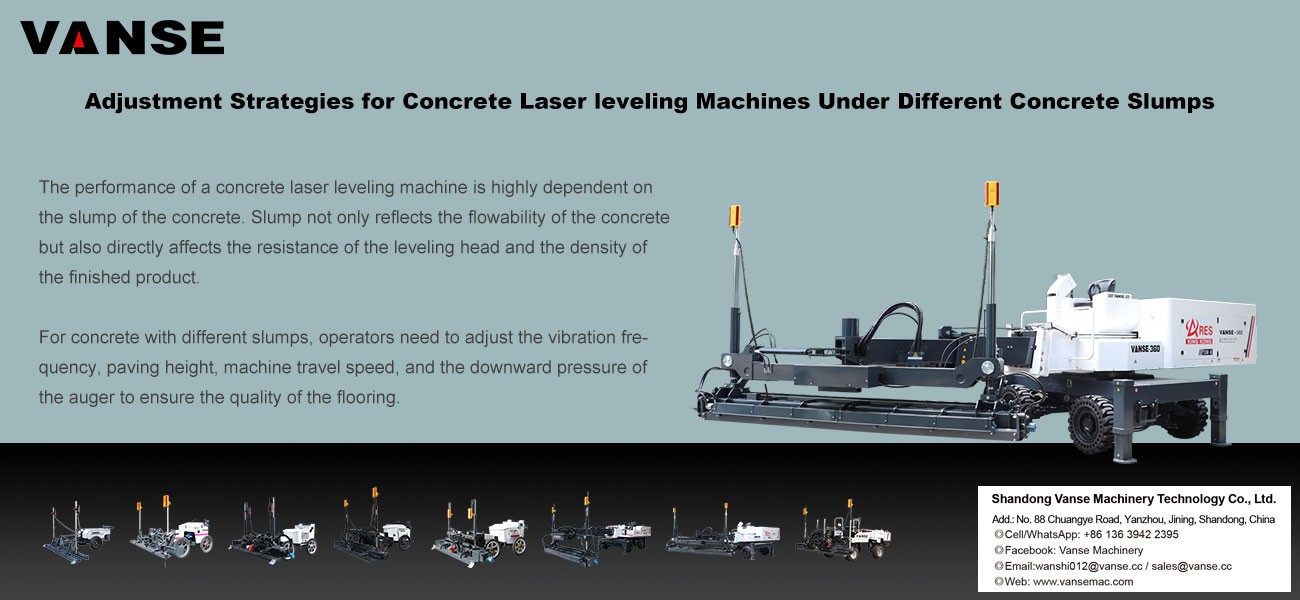
The performance of a concrete laser leveling machine is highly dependent on the slump of the concrete. Slump not only reflects the flowability of the concrete but also directly affects the resistance of the leveling head and the density of the finished product.
For concrete with different slumps, operators need to adjust the vibration frequency, paving height, machine travel speed, and the downward pressure of the auger to ensure the quality of the flooring.
I. Low-slump concrete (100mm–140mm)
This mix is typically used for heavy-duty industrial floors or areas requiring high strength. The concrete is relatively "dry" and has poor flowability.
Vibration frequency: Requires adjustment to a higher frequency (usually increasing by 10%–20%). Dry, stiff concrete requires stronger vibration to remove air bubbles and allow the slurry to float.
Travel speed: Slow. A slow travel speed allows sufficient compaction time for the leveling head, preventing surface "tearing" or honeycomb pitting caused by excessively rapid movement.
Auger adjustment: Increase downforce to allow the auger to cut deeper into the concrete, ensuring large aggregate particles are effectively leveled.
Plow height: Slightly lower the slow height. Because dry concrete has less rebound after leveling, the initial leveling needs to be closer to the design elevation.
II. Standard Slump Concrete (140mm–180mm)
This is the ideal working range for laser leveling, balancing pumpability and structural stability.
Vibration Frequency: Maintain a medium standard frequency.
Travel Speed: Medium speed. Observe the slurry thickness behind the leveling head to ensure a uniform "skin" (slurry layer) on the surface.
Overlap: Maintain a standard 200mm–300mm overlap to eliminate seam marks between adjacent passes.
III. High Slump/High Flowability Concrete (>180mm)
Common in projects using high-efficiency water-reducing agents or with high pumping heights. The concrete is extremely fluid and may even exhibit segregation.
Vibration Frequency: Adjust to a low frequency or reduce it appropriately. Excessive vibration can cause mortar and aggregate separation (segregation), resulting in a large amount of laitance and potential sandiness on the surface.
Travel Speed: Can be appropriately increased. Prevent the machine from remaining stationary in one spot for extended periods, which could lead to excessive subsidence in that area.
Auger Adjustment: Reduce the auger pressure or raise its position. High slump concrete is very mobile; the auger only needs to guide the flow slightly. Excessive agitation will disrupt the levelness.
Scraper Height: Set the scraper height slightly above the design elevation (approximately 3mm–5mm) to compensate for the slight settling of the high-flowability concrete after compaction.
IV. Key Parameter Adjustment Reference Table
| Adjustment items | Low slump (dry) | High slump (thin) |
| Vibration frequency | ↑ High frequency (strong vibration compaction) | ↓ Low frequency (prevents segregation) |
| Travel speed | ↓ Slow speed (fine grinding) | ↑ Relatively fast speed (uniform spreading) |
| Auger depth | Deeper (forced material discharge) | Relatively shallow (slight guidance) |
| Elevation allowance | Less (low rebound) | More (significant settlement) |
| Risk points | Surface cracking, poor flatness | Excessive slurry thickness, later peeling, slope loss |
💡 Operator Practical Skills:
On construction sites, the slump of concrete often fluctuates as the mixer trucks arrive. A skilled observer will closely follow the machine, monitoring the cream thickness behind the leveling head.
If the cream thickness exceeds 5mm, the concrete is too thin; the speed should be increased or the vibration reduced.
If the surface is dry and the aggregate is exposed, it is too dry; the walking speed should be immediately reduced and the vibration increased.
Note: The parameters provided in this document are for reference only and are not mandatory. Due to differences in technical characteristics between different brands and models of laser levelers, please consult the manufacturer for a suitable solution before actual operation. This reference document assumes no responsibility for any issues arising from failure to follow the manufacturer's instructions.
Thanks to All the Friends Who Support and Trust Shandong Vanse Machinery Technology Co., Ltd.
If you want to know more about Shandong Vanse Machinery Technology Co., Ltd. or have any questions, please feel free to contact us:
Our Factory
Shandong Vanse Machinery Technology Co., Ltd.








Share this article

About the Author: Shandong Vanse Machinery Technology Co., Ltd.
Shandong Vanse Machinery Technology Co., Ltd. is a high-tech manufacturer specializing in concrete construction machinery, including laser screeds and related equipment. The company integrates R&D, production, and global sales, with products exported to over 60 countries and widely used in infrastructure projects worldwide.
Previous Post
Next Post
Related Articles
You Might Also Like
What are the maintenance methods for laser concrete leveling machines?
The maintenance method of concrete laser leveling machine is crucial to the normal operation and service life of the equipment. The following will introduce the maintenance methods of concrete laser leveling machine. 1. Daily maintenance After daily use, routine maintenance should be performed to ensure the normal operation of the equipment and extend its service life. Routine maintenance mainly includes the following aspects: ▼Clean the dust and debris on the surface of the equipment and keep the surface of the equipment clean. ▼Check whether the various connection parts of the equipment are loose or falling off, and tighten them in time. ▼Check whether the running parts of each part are flexible and reliable, and apply grease regularly to prevent parts from wearing out. ▼Check whether the photoelectric sensor is clean and sensitive, and remove dust and debris in time to prevent photoelectric sensor failure. ▼Check whether the power supply, control circuit and other components are normal, and repair them in time if there are any abnormalities. 2. Regular inspection and maintenance Regular inspection and maintenance are important measures to ensure the long-term normal operation of the concrete laser leveling machine. Regular inspection and maintenance mainly include the following aspects: ▼Regularly check whether the power cords, control lines and other lines are damaged or aged, and repair or replace them in time if necessary. ▼Regularly check the wear of various components, such as bearings, gears and other components, and replace seriously worn components in a timely manner. ▼Regularly check the accuracy and stability of equipment, such as laser heads, sensors and other components, and adjust or replace components in a timely manner. ▼Regularly check whether the electrical components of the equipment are working properly, such as electrical control boxes, motors and other electrical components, and replace damaged electrical components in a timely manner. ▼Perform regular comprehensive inspections and maintenance of equipment to ensure normal operation and extend service life of the equipment. 3.Special maintenance Special maintenance is a deeper maintenance based on daily maintenance and regular inspection and maintenance. Special maintenance mainly includes the following aspects: ▼Carry out comprehensive cleaning and maintenance of the equipment to remove dirt and debris on the surface of the equipment to ensure the normal operation of the equipment. ▼Disassemble and clean the equipment, remove debris and dust inside the equipment, and ensure the normal operation of the equipment. ▼Carry out comprehensive inspection and maintenance of the electrical components of the equipment, remove dust and debris on the surface of the electrical components to ensure the normal operation of the electrical components. ▼Inspect and maintain the hydraulic system of the equipment, remove debris and dust inside the hydraulic system to ensure the normal operation of the hydraulic system. ▼Inspect and maintain the laser head of the equipment, remove dirt and debris on the surface of the laser head, and ensure the normal operation of the laser head. To sum up, the maintenance methods of concrete laser leveling mainly include daily maintenance, regular inspection and maintenance and special maintenance. In order to ensure the normal operation of the equipment and extend its service life, operators should be proficient in maintenance methods and perform maintenance in strict accordance with the requirements. At the same time, the daily use and storage of equipment should be strengthened to avoid unnecessary damage and waste.How to evaluate performance indicators of concrete laser leveling machine?
•••★••• Introduction Concrete laser leveling machine is an indispensable and important equipment in modern construction. The evaluation of its performance indicators is of great significance to ensure construction quality, improve work efficiency and reduce operating costs. This article will discuss how to comprehensively evaluate the performance of concrete laser leveling machines from aspects such as leveling efficiency, flatness accuracy, equipment stability, laser control system, energy consumption and environmental protection, ease of operation, maintenance and upkeep, and durability and lifespan. Performance. •••★••• Leveling efficiency Leveling efficiency is one of the important indicators to measure the performance of concrete laser leveling machine. When evaluating leveling efficiency, the following aspects are mainly considered: 1. Working speed: The working speed of the equipment directly affects the leveling efficiency. Generally speaking, the faster the working speed, the higher the leveling efficiency. However, it should be noted that working too fast may lead to a decrease in flatness accuracy. 2. Leveling area: The leveling area reflects the concrete surface area that the equipment can process per unit time. A larger leveling area means higher leveling efficiency. 3. Leveling thickness range: The wider the concrete thickness range that the equipment can handle, the stronger its applicability and the leveling efficiency will increase accordingly. •••★••• Flatness accuracy Flatness accuracy is an important indicator for measuring the construction quality of concrete laser leveling machines. When evaluating flatness accuracy, the following aspects are mainly considered: 1. Flatness error: The smaller the flatness error, the higher the flatness accuracy of the equipment. Generally speaking, high-precision concrete laser leveling machines can achieve lower flatness errors. 2. Flatness uniformity: Evaluating the uniformity of flatness in different areas and at different times helps to judge the stability and consistency of the equipment. •••★••• Equipment stability Equipment stability is a key factor in ensuring the continuous and efficient operation of concrete laser leveling machines. When evaluating equipment stability, the following aspects are mainly considered: 1. Equipment structure: Reasonable equipment structure can improve the stability and durability of the equipment. When evaluating equipment construction, focus on its resistance to vibration, impact, and wear. 2. Control system: A stable control system is the key to ensuring the normal operation of the equipment. When evaluating a control system, pay attention to its anti-interference ability, response speed, and fault self-diagnosis capabilities. •••★••• Laser control system The laser control system is the core part of the concrete laser leveling machine. Its performance directly affects the levelinging quality and efficiency. When evaluating the laser control system, the following aspects should be mainly considered: 1. Laser ranging accuracy: Laser ranging accuracy determines the device's ability to perceive ground height. The high-precision laser distance measurement system can achieve more accurate leveling results. 2. Laser tracking stabilizer: The laser tracks the stabilizer to maintain the accuracy of the equipment during continuous operation. The stable laser and hydrazone system can ensure that the equipment maintains high leveling accuracy during long-term operation. •••★••• Energy consumption and environmental protection With the advent of the concept of energy conservation and environmental protection, the energy consumption and environmental protection of equipment have attracted more and more attention. When evaluating the energy consumption and environmental protection of concrete laser leveling machines, the following aspects should be mainly considered: 1. Energy consumption level: Lower energy consumption level means lower costs incurred by the equipment during operation, and also helps reduce energy waste. 2. Noise level: The lower the noise generated during the operation of the equipment, the smaller the impact on the surrounding environment and operators, and the more it meets environmental protection requirements. 3. Emissions: For concrete laser leveling machines that use fuel or gas, it is also an important consideration to evaluate whether their emissions comply with relevant environmental standards. •••★••• Operation convenience Operation convenience is of great significance to improving construction efficiency and reducing labor costs. When evaluating the ease of operation of a concrete laser leveling, the following aspects should be considered: 1. Control system interface: The concise and clear control system interface helps operators quickly master equipment operation skills. 2. Operating steps: Reasonable operating steps can reduce the tediousness and mistakes during the operation and improve work efficiency. 3. Degree of automation: A higher degree of automation can reduce the skill requirements for operators and reduce the impact of human factors on construction quality. •••★••• Maintenance and maintenance Equipment maintenance and upkeep are crucial to extending equipment life and maintaining stable performance. When evaluating the maintenance and upkeep needs of a concrete laser leveling, the following aspects should be considered: 1. Maintenance cycle: A reasonable maintenance cycle can ensure that the equipment is always in good condition during operation. 2. Maintenance content: Detailed maintenance content guidance can help operators correctly maintain equipment and prevent potential failures. 3. Replacement of wearing parts: Evaluating the replacement cycle and cost of equipment wearing parts can help predict long-term operation and maintenance costs. •••★••• Durability and lifespan Durability and lifespan are important indicators for measuring the long-term performance of concrete laser leveling machines. When evaluating the durability and life of equipment, the following aspects are mainly considered: 1. Material selection: High-quality materials can improve the wear resistance and corrosion resistance of the equipment, thereby extending the service life of the equipment. 2. Manufacturing process: Exquisite manufacturing process can ensure that potential defects and hidden dangers are reduced during the manufacturing process of the equipment, and the durability of the equipment is improved. 3. Maintenance records: Understanding the equipment's maintenance records and historical faults will help evaluate the overall performance and remaining life of the equipment. •••★••• Summary To sum up, evaluating the performance indicators of concrete laser leveling requires comprehensive consideration from many aspects. By evaluating indicators such as leveling efficiency, flatness accuracy, equipment stability, laser control system, energy consumption and environmental protection, ease of operation, maintenance and upkeep, durability and lifespan, we can fully understand the performance of the equipment. Provide scientific basis for choosing a suitable concrete laser leveler. At the same time, regular maintenance and upkeep are also key measures to ensure stable equipment performance and extend service life.Collaborative Use Techniques of Concrete Laser Leveling Machines and High-frequency Vibrators
To achieve world-class Floor Flatness (FF) and Floor Levelness (FL) in industrial flooring, surface precision must be paired with deep structural integrity. While concrete laser leveling machines deliver millimeter-accurate surface grades, they rely on high-frequency vibrators to properly prepare the concrete mass ahead of the leveling head. Understanding the collaborative techniques between these two systems is the secret to eliminating air voids, preventing honeycombing, and delivering a flawless, ultra-flat slab. Before diving into techniques, it is essential to understand how these tools interact within the concrete matrix: High-Frequency Vibrators: Operating typically between 10,000 to 12,000 vibrations per minute (VPM), these tools fluidize the concrete. They break the friction between aggregates, forcing entrapped air to the surface and ensuring the concrete tightly wraps around rebar and armor joints. Concrete Laser Leveling Machines: Following immediately behind, the laser leveling utilizes its automated auger to cut the concrete to the exact elevation, while its vibrating leveling board seals and smooths the freshly consolidated surface. For optimal results, the operation of the vibrators and the laser leveling must be perfectly synchronized in a continuous, flowing rhythm. The "Lead and Follow" Pacing: Vibrator operators must maintain a consistent distance just ahead of the laser leveling's plow or auger. If the vibrators are too far ahead, the fluidized concrete may begin to stiffen before the leveling arrives. If they are too close, they risk bumping the leveling head, disrupting the laser receivers and altering the floor's precision. A standard buffer zone of 1 to 2 meters is highly recommended. Managing Specialized Mixes: When pouring heavy-duty slabs reinforced with steel fibers, this collaboration becomes critical. The high-frequency vibrator ensures the steel fibers are evenly distributed throughout the slab rather than clumping. Crucially, the vibration helps drive the rigid fibers slightly below the surface, allowing the trailing laser leveling to glide over the top, leaving a smooth, fiber-free "cream" finish that is safe for equipment tires. Grid Pattern Insertion: Operators using poker (internal) vibrators should insert the head vertically at regular intervals (typically 12 to 18 inches apart), holding it in place for 5 to 15 seconds until the surface takes on a sheen and large air bubbles stop surfacing. Dragging the vibrator horizontally can cause aggregate segregation and should be strictly avoided. Edge and Obstacle Consolidation: Laser leveling excel in open areas, but edges, corners, and areas around structural columns require special attention. Vibrator operators must thoroughly consolidate the concrete against formwork and armor joints before the laser leveling makes its pass, ensuring there are no weak spots or voids at the most vulnerable points of the floor. When contractors master the combined use of these tools, the structural and aesthetic results are undeniable: Maximum Compressive Strength: Removing entrapped air increases the density of the concrete, directly boosting its load-bearing capacity for VNA forklifts and automated logistics. Reduced Shrinkage Cracking: A uniformly consolidated slab dries and cures more evenly, minimizing the internal tensile stresses that lead to unpredictable surface cracks. Flawless Surface Integrity: Proper vibration prevents aggregate shadowing and surface blistering, allowing the laser leveling to achieve pristine FF/FL metrics on the first pass. The construction of a premium ultra-flat floor is a highly choreographed process. By training your crew to seamlessly integrate the deep consolidation power of high-frequency vibrators with the unmatched surface accuracy of concrete laser leveling machines, you guarantee a durable, high-performance slab that meets the strictest international standards. Note: The parameters provided in this document are for reference only and are not mandatory. Due to differences in technical characteristics between different brands and models of laser levelers, please consult the manufacturer for a suitable solution before actual operation. This reference document assumes no responsibility for any issues arising from failure to follow the manufacturer's instructions.