Technical Knowledge
On-site Remediation Plan for Color Difference or Strength Variation Caused by Uneven Broadcasting
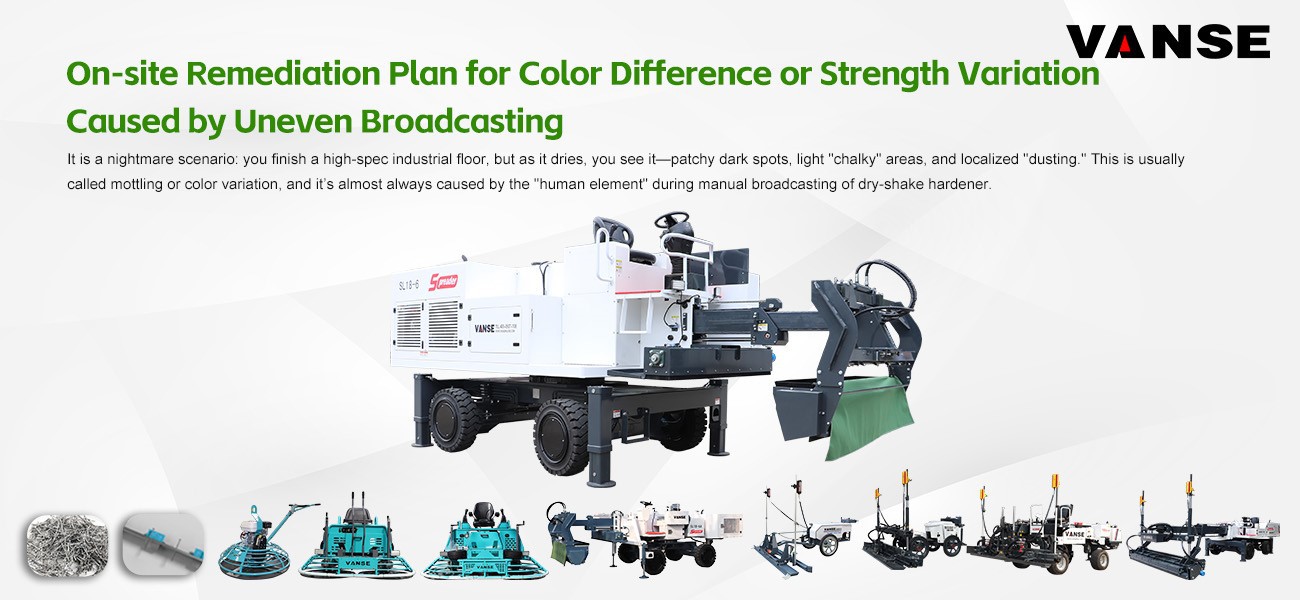
It is a nightmare scenario: you finish a high-spec industrial floor, but as it dries, you see it-patchy dark spots, light "chalky" areas, and localized "dusting." This is usually called mottling or color variation, and it’s almost always caused by the "human element" during manual broadcasting of dry-shake hardener.
If you are facing a "leopard-print" floor or inconsistent surface strength, here is the professional On-site Remediation Plan, along with the Vanse technical workflow to ensure it never happens again.
Step 1: The Diagnosis (Why did it happen?)
Before you fix it, you need to know why it failed.
Uneven Broadcasting: Manual throwing from a bucket creates "thick" and "thin" zones.
Timing Issues: Some areas were "over-troweled" while still wet, while others were finished too late.
The Vanse Prevention Tip: The best remediation is prevention. Using the Vanse Automatic Topping Spreader instead of manual labor ensures a 100% uniform grams-per-square-meter application. By linking the spreader's output to the machine's speed, you eliminate the "human error" that causes color shifts and weak spots.
Step 2: The Remediation Plan (The "Cure")
1. Mechanical Leveling & Grinding
If the strength variation is severe (the surface is "powdering"), you have to remove the weak layer.
The Process: Use a planetary floor grinder with 30/40 grit metal-bond diamonds to strip away the inconsistent "skin."
The Vanse Tool for the Job: In cases where deep remediation is needed, use a Vanse Concrete Cutting Machine (Floor Saw) to create clean, straight boundaries around the affected area if a partial re-pour is required. This ensures the "patch" doesn't spall or crack at the edges.
2. Chemical Densification
Once the surface is opened up, you need to fix the strength variation.
The Process: Apply a high-quality Lithium or Sodium Silicate Densifier. This penetrates the concrete, reacts with the free lime, and creates a uniform, hard-shell finish across both the "weak" and "strong" zones.
Blending the Color: Use a tinted sealer or a "color-matched" penetrant during the densification process to mask the mottling and create a visually consistent finish.
3. Re-Burnishing for a Mirror Finish
After densifying, you need to "seal" the surface mechanically.
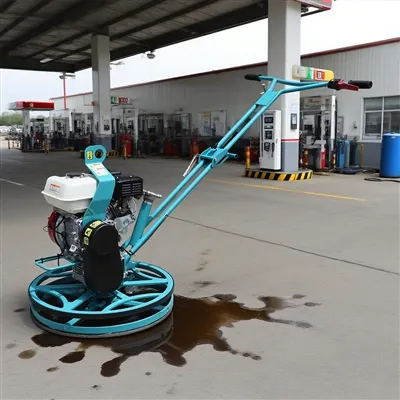
The Process: Transition to a Vanse Ride-on Power Trowel. With its high-torque engine and precision pitch control, you can "burnish" the densified surface. The heavy compaction of the Vanse rotors helps to blend the color and close the pores, resulting in a dense, dust-free, and uniform finish.
Step 3: Proactive Prevention (The Vanse Workflow)
Global buyers are moving away from manual methods because the cost of remediation is 3x higher than the cost of doing it right the first time. Here is the Vanse "Gold Standard" Workflow to avoid color and strength issues:
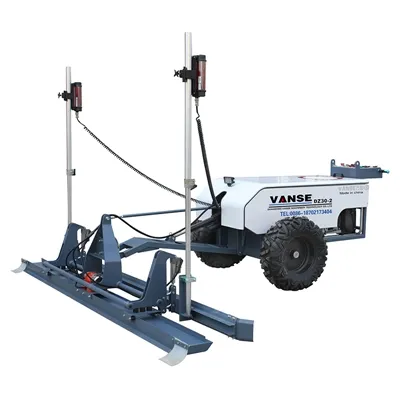
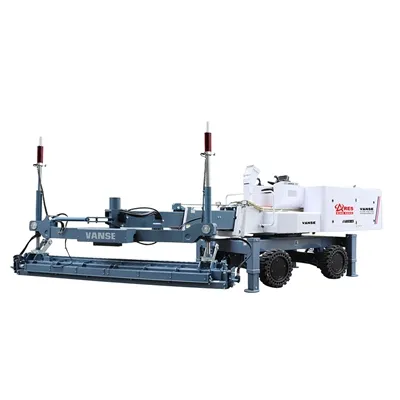
Uniform Placement: Use a Vanse Concrete Distributor or a Mini Dumper to place the base slab. This ensures the water-cement ratio is consistent across the entire bay, preventing "wet spots" that cause color variation.Consolidated Leveling: Use a Vanse Concrete Laser Leveling Machine . Its high-frequency vibration consolidates the slab from the bottom up, ensuring a uniform "paste" is available to bond with the hardener.
Mechanical Spreading: The Vanse Automatic Topping Spreader is your insurance policy. It applies the hardener in a single, even pass immediately behind the laser leveling, guaranteeing uniform strength and color.
Precision Finishing: The Vanse Power Trowel provides the final compaction, "locking in" the color and density.
Final Thought
Look, we’ve all been there-trying to "save money" by using manual labor for broadcasting, only to spend three times that amount on grinding and densifiers later. If you want to bid on FM1/FM2 high-spec projects, you need the precision of a Vanse fleet (www.vansemac.com).
Stop fixing floors and start finishing them. Visit Vanse Machinery today to see how our Topping Spreaders and Laser leveling can guarantee your color and strength consistency on every pour.
Note: The parameters provided in this document are for reference only and are not mandatory. Due to differences in technical characteristics between different brands and models of laser levelers, please consult the manufacturer for a suitable solution before actual operation. This reference document assumes no responsibility for any issues arising from failure to follow the manufacturer's instructions.
Thanks to All the Friends Who Support and Trust Shandong Vanse Machinery Technology Co., Ltd.
If you want to know more about Shandong Vanse Machinery Technology Co., Ltd. or have any questions, please feel free to contact us:
Our Factory
Shandong Vanse Machinery Technology Co., Ltd.








Share this article

About the Author: Shandong Vanse Machinery Technology Co., Ltd.
Shandong Vanse Machinery Technology Co., Ltd. is a high-tech manufacturer specializing in concrete construction machinery, including laser screeds and related equipment. The company integrates R&D, production, and global sales, with products exported to over 60 countries and widely used in infrastructure projects worldwide.
Previous Post
Next Post
Related Articles
You Might Also Like
In order to ensure the quality of construction, the following points should be observed when using the laser leveling machine:
Laser leveling machine is an advanced equipment used for ground leveling in construction. It uses laser technology to achieve high-precision plane leveling. In order to ensure the quality of construction, the following points should be followed when using laser leveling machine: 1. **Accurately set the laser transmitter**: – The laser transmitter must be accurately installed and adjusted to ensure that the laser beam it emits is perpendicular to the ground and remains horizontal throughout the working area. 2. **Calibrate the leveling machine**: – Before starting the operation, the laser leveling machine needs to be calibrated to ensure that its receiver can correctly read the laser signal and accurately control the leveling height. 3. **Check the ground conditions**: – Before construction, the ground should be pre-treated, including cleaning up debris, treating weak foundations, etc., to ensure that the ground foundation is solid and stable. 4. **Set reference points**: – According to the design requirements, set reference points at the construction site, which will serve as standard references for leveling operations. 5. **Continuous monitoring**: – When using a laser leveling machine, the intensity of the laser signal and the working status of the leveling machine should be continuously monitored to ensure that the machine is always operating on the correct plane. 6. **Operator training**: – Operators should receive professional training to understand the working principle and operating specifications of the laser leveler to avoid quality problems caused by misoperation. 7. **Regular maintenance**: – Regularly maintain and service the laser leveler, check the accuracy of the laser transmitter and receiver, and ensure the normal operation of the mechanical part. 8. **Quality control**: – During the construction process, periodic quality inspections should be carried out, and the leveling effect should be verified using a level or other measuring tools, and the construction parameters should be adjusted in time. 9. **Records and reports**: – Detailed records of various data and parameters during the construction process, including the setting values of the laser leveler, terrain changes in the construction area, etc., are required to facilitate later analysis and quality traceability. Through the above measures, the laser leveler can be effectively used to improve construction efficiency and quality, reduce manual errors, and ensure that the ground flatness meets the design requirements.Technical tips for leveling the power trowel chassis and calibrating the blade height consistency
The construction quality of a power trowel (also known as a finishing machine) is 70% about leveling and 30% about operation. The flatness of the chassis and the blade is the key to determining whether the concrete surface ultimately achieves a mirror-like smoothness, without ripples or flaws. The following are detailed technical tips for leveling the base of a power trowel and calibrating the consistency of the blade height, combining the experience of experienced masters with scientific methods. One benchmark: Take the chassis as the sole benchmark. All blade adjustments must be based on a already leveled chassis. Three unifications: uniform blade height, uniform inclination Angle, and uniform wear degree. The chassis serves as the installation platform for the blade. If the chassis itself is uneven, the consistency of the blade is out of the question. First choice: A large and flat platform (such as a calibrated granite platform, a thick tempered glass tabletop or a new thick steel plate). Second choice: On a very flat ground, use a known uniform thickness pad (such as a feeler gauge). Essential items: feeler gauge, tape measure, marker pen. Cleaning and preparation Thoroughly clean the chassis and remove all cement slurry and hard lumps. Check the chassis for any obvious deformation caused by the collision. If there is severe deformation, it needs to be corrected or replaced first. Place the power trowel on the platform and ensure that the contact surface between the chassis and the platform is clean and free of debris. Preliminary "Four-point measurement Method" Consider the chassis as a clock face and measure the gap between the edge of the chassis and the surface of the platform at the four positions of 12 o 'clock, 3 o 'clock, 6 o 'clock and 9 o 'clock. Use a feeler gauge to measure and record the gap values at four points. Preliminary judgment: If the gap values at the four points differ by more than 1-2 millimeters, it indicates that the chassis is uneven and needs to be adjusted. The chassis of most power trowels is connected to the main unit through three or four adjustable pull rods. Identify the high and low points: Based on the measurement data, determine which corner has the smallest clearance (the highest point of the chassis) and which has the largest clearance (the lowest point of the chassis). To raise a certain Angle, loosen (counterclockwise) the lock nut of the pull rod corresponding to that Angle, then shorten the length of the pull rod (turn the pull rod body clockwise), and finally tighten the lock nut. To lower a certain Angle, loosen the lock nut, then extend the length of the pull rod (turn it counterclockwise), and finally lock it. The mnemonic: "High pines are short, low pines are long." (For the angles that need to be adjusted After each adjustment, gently rotate the chassis (to prevent scratching the platform) and conduct the four-point measurement again. Repeat steps 3 and 4 until the difference in gap values among the four points is controlled within 1 millimeter. At this point, it can be considered that the chassis has been leveled. The calibration of the blade can only be carried out on the basis of ensuring that the chassis is absolutely flat. A ruler (preferably a high-precision steel ruler) or a dedicated blade height gauge. Tape measure, marker pen, wrench. Installation and cleaning Install a set of blades of consistent newness and oldness onto the blade seat. It is strictly prohibited to mix new and old blades! Make sure that all the blade fixing bolts and blade seats are clean, the threads are undamaged and can be tightened in place. Place the power trowel with the chassis adjusted on a flat ground. Place a fixed reference point (such as a thin gasket or directly using the joints of floor tiles) on the ground beneath the chassis and within the rotation trajectory of the blade. Stand a ruler vertically beside the reference point and measure the distance from one of the knife tips to the ground, recording it as the reference height H. It is extremely important: Manually and slowly rotate the base of the trotter so that the same position of the next blade (for example, the outermost end of both blades) rotates directly above the reference point. Measure the distance from the tip of the knife to the ground again with a ruler. Compare it with the reference height H and record the difference. For example: Blade 1 is H, blade 2 is H-1.5mm, and Blade 3 is H+1.0mm. Measure all the blades in sequence. The height of the blade is adjusted by the regulating bolt on the blade seat to change its inclination Angle. Adjustment principle If the measured value of a certain blade is low, it needs to be raised. The method is: tighten the adjusting bolt below the blade seat, or loosen the adjusting bolt above to lift the leading edge of the blade (the side close to the rotation direction). If the measured value of a certain blade is too high, it needs to be reduced. The method is: Loosen the adjusting bolt below the blade seat or tighten the adjusting bolt above it to lower the leading edge of the blade. Mnemonic: "High tight, low loose, the leading edge as the standard." (For the leading edge of the blade that needs to be adjusted After adjusting each blade, it is necessary to rotate and measure once again, as adjusting one blade may slightly affect the height of adjacent blades. Repeat steps 3 and 4 until the difference between the measured height of all blades at the reference point and the reference height H is controlled within ±1 millimeter. Final inspection: Rotate the chassis quickly and listen to the sound with your ears. When the highly uniform blades are idling, the wind sound is a uniform "buzz". Inconsistent ones will have a periodic noise of "puff puff". The sequence is crucial: the chassis must be leveled first, and then the blades calibrated. Reversing the order is in vain. Tools are the guarantee: Having an absolutely flat calibration platform is half the battle. Data-driven operation: Trust feeler gauges and rulers, not rely on the naked eye. Each adjustment should be measured and recorded. Complete set replacement: The blades must be replaced as a complete set to maintain the same wear condition. Regular inspection: A quick inspection should be carried out before starting work every day and after replacing the blade. A full set of calibration should be carried out every 50 to 100 hours of operation or after a collision. Safety first: All operations must be carried out when the machine is completely powered off and the engine is turned off. Through the above strict and meticulous process, your power trowel machine will be in the best working condition, capable of easily creating a mirror-like smooth and high-quality concrete surface, effectively avoiding problems such as ripples, scratches and excessive cutting, thereby enhancing construction efficiency and professional image. Note: The parameters provided in this document are for reference only and are not mandatory. Due to differences in technical characteristics between different brands and models of laser levelers, please consult the manufacturer for a suitable solution before actual operation. This reference document assumes no responsibility for any issues arising from failure to follow the manufacturer's instructions.How does concrete laser leveling technology improve construction efficiency?
Concrete laser leveling technology is an innovative technology in the field of modern construction. It uses laser as a reference to achieve fast and precise leveling of concrete surfaces. This technology not only improves the efficiency of construction, but also ensures the stability and consistency of construction quality. The following is an in-depth analysis of how concrete laser leveling technology improves construction efficiency. Introduction In traditional concrete construction, ground leveling work usually relies on manual operation, which is not only labor-intensive and inefficient, but also difficult to ensure flatness and accuracy. With the improvement of the construction industry's requirements for construction quality and efficiency, concrete laser leveling technology has emerged, bringing revolutionary changes to construction. 1. Technical Overview Concrete laser leveling technology is a technology that uses laser as a reference to accurately level the concrete surface through automated equipment. The core of this technology lies in the effective coordination of laser transmitters, receivers, control systems and leveling equipment. > Learn more about customlzatlon >> 2. Working Principle The working principle of concrete laser leveling technology mainly includes the following steps: – **Laser transmitter**: emits a stable laser beam to form a horizontal reference plane. – **Receiver**: installed on the leveling machine, receives laser signals and converts them into electrical signals. – **Control system**: According to the received electrical signal, the working state of the leveler is automatically adjusted to ensure that the concrete surface is consistent with the laser plane. – **Leveling equipment**: According to the instructions of the control system, the concrete surface is leveled through vibration and scraping functions. > Learn more about customlzatlon >> 3. Key factors to improve construction efficiency The key factors for improving construction efficiency of concrete laser leveling technology include: – **High degree of automation**: Reduces manual intervention and improves construction speed. – **High construction accuracy**: Ensures the flatness and accuracy of the concrete surface. – **Stable construction quality**: Reduces rework caused by uneven construction quality. – **High material utilization rate**: Reduces material waste by accurately controlling the laying thickness of concrete. > Learn more about customlzatlon >> 4. Construction process optimization The application of laser leveling technology optimizes the construction process, including: – **Site preparation**: Quickly complete site cleaning and leveling. – **Laser transmitter setting**: Quickly and accurately set the laser transmitter. – **Concrete pouring**: With the assistance of the laser leveling machine, the concrete pouring is quickly completed. – **Leveling operation**: The laser leveler automatically completes the leveling of concrete according to the laser signal. – **Surface treatment**: Quickly complete the leveling and calendering of the concrete surface. – **Quality inspection**: Use professional equipment to quickly complete the flatness and levelness inspection of the concrete surface. > Learn more about customlzatlon >> 5. Technical advantages and practical applications Laser leveling technology has shown obvious advantages in practical applications: – **Industrial plant**: Quickly complete the leveling of large areas of ground and improve construction efficiency. – **Commercial facilities**: Ensure the flatness of the ground and improve customer experience. – **Airport runway**: Ensure the flatness and strength of the runway to ensure the safe takeoff and landing of aircraft. – **Roads and bridges**: Improve the flatness and bearing capacity of the road surface and extend its service life. > Learn more about customlzatlon >> 6. Technical challenges and coping strategies Although laser leveling technology has obvious advantages, it also faces some challenges in practical applications: – **Environmental factors**: Wind, temperature changes, etc. may affect the stability of the laser. – **Equipment maintenance**: The laser leveler needs regular maintenance to ensure its performance. – **Training of construction personnel**: Professional knowledge and skills are required to operate the laser leveling machine. Countermeasures include: – Improve the stability of the laser transmitter through technical improvements. – Establish a complete maintenance system and train operators. – Provide professional training courses to improve the operating skills of construction personnel. > Learn more about customlzatlon >> 7. Technological innovation and development trends With the continuous advancement of science and technology, laser leveling technology is also constantly innovating and developing: – **Intelligentization**: Integrate more intelligent sensors and control systems to improve the automation level of the leveling machine. – **Multifunctionality**: Develop a leveling machine that can complete multiple construction tasks at the same time. – **Environmentally friendly materials**: Research and use more environmentally friendly concrete materials to reduce the impact of construction on the environment. > Learn more about customlzatlon >> 8. Conclusion Concrete laser leveling technology has become an indispensable part of modern construction with its advantages of high efficiency, high precision and construction quality. By optimizing the construction process, improving material utilization and reducing rework rate, this technology has significantly improved construction efficiency. With the continuous development and innovation of technology, concrete laser leveling technology will play a greater role in the future and bring more possibilities to the construction industry. > Learn more about customlzatlon >>