Technical Knowledge
Jointing Process between Manual Trowel and Mechanical Troweling in Edge Areas
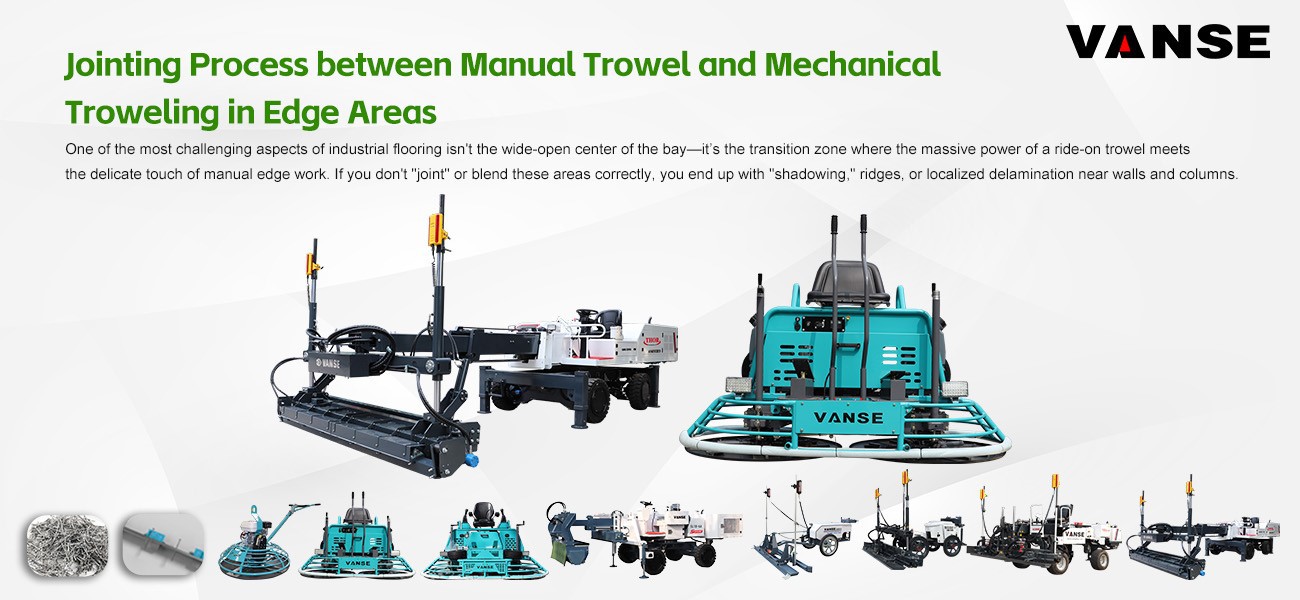
One of the most challenging aspects of industrial flooring isn't the wide-open center of the bay-it’s the transition zone where the massive power of a ride-on trowel meets the delicate touch of manual edge work. If you don't "joint" or blend these areas correctly, you end up with "shadowing," ridges, or localized delamination near walls and columns.
To achieve a seamless, professional finish that passes high-spec inspections, you need a workflow that bridges the gap between manual precision and mechanical force. Here is the pro’s guide to mastering the edge transition using the Vanse professional fleet.
1. Precision Placement: The "Zero-Spill" Edge
The transition starts before the concrete is even poured. If you have "mounds" of concrete near the formwork, the manual crew has to work twice as hard to get it flat.
The Vanse Workflow: Use a Vanse Concrete Distributor to place an even ribbon of material along the edges. For tight corners or indoor pillars where a truck can't reach, the Vanse Mini Dumper is the perfect "last-mile" tool. It allows you to dump concrete with surgical precision right up to the edge, reducing the manual labor needed to "pull" the concrete into place.
2. The Leveling Baseline: Getting Close to the Form
If the edge isn't level, the power trowel will "hop" when it hits the transition, creating a visible ridge.
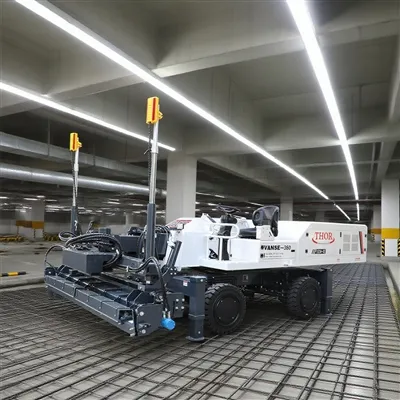
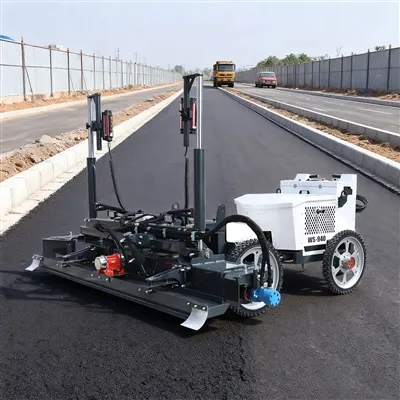
The Vanse Workflow: A Vanse Concrete Laser Leveling Machine (like the agile YZ25-4) is designed to get incredibly close to the formwork. The high-frequency vibration consolidates the edges just as effectively as the center. This creates a uniform "baseline" flatness, so the manual crew only has to focus on the final 15cm of finish rather than trying to fix the level.
3. Integrated Hardening: Don't Forget the Boundaries
A common failure point is the "soft edge"-where the center of the floor is hard as iron but the edges are dusty because the dry-shake wasn't applied correctly.
The Vanse Workflow: The Vanse Automatic Topping Spreader ensures that your wear-resistant hardener is applied uniformly right up to the boundary lines. This means the manual troweling in the edge area will have the same material density as the mechanically troweled center.
4. The "Seamless Blend" Troweling Technique
This is the critical "jointing" phase. The goal is to make it impossible to tell where the manual work ends and the machine work begins.
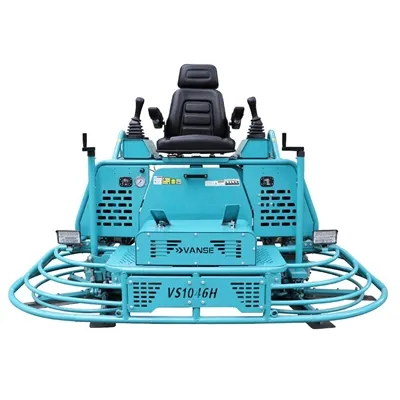
The Strategy: As the manual crew finishes the edges with hand floats, the Power Trowel operator (using a machine like the Vanse VS836 walk-behind or the VS1046H ride-on) must overlap the manual work by at least 15-20cm.
Vanse Edge-Friendly Tech: Vanse power trowels feature precision pitch control and balanced rotor designs. This allows the operator to "feather" the edge of the trowel pass, slowly decreasing the blade angle as they approach the manual work to create a perfectly flat, blended transition without "digging" into the fresh edge.
5. Final Stress Relief: The Clean Cut
Once the transition is blended, the edge area is under a lot of stress during the drying phase.
The Vanse Workflow: Use a Vanse Concrete Cutting Machine (Floor Saw) to execute the contraction joints near walls and columns. A stable, high-speed cut ensures that any shrinkage stress is relieved exactly where you want it, preventing "random cracks" from ruining your beautiful edge work.
Comparison: Manual vs. Mechanical Transition
| Stage | Manual Edge Focus | Vanse Mechanical Support |
| Placement | Pulling concrete by hand. | Mini Dumper / Distributor precision. |
| Leveling | Manual leveling (variable). | Laser Leveling Machine (±1mm accuracy). |
| Hardening | Hand-throwing (uneven). | Automatic Topping Spreader (uniform). |
| Finishing | Hand troweling (lower density). | High-Torque Power Trowel (dense/burnished). |
| Jointing | Hand-tooling joints. | Concrete Cutting Machine (clean/straight). |
Final Word
The quality of a floor is judged by its weakest point-which is usually the edges. By utilizing a complete "system" from Vanse Machinery (www.vansemac.com), you ensure that your edges aren't just an afterthought. They become a seamless extension of the superflat floor you’ve worked so hard to create.
Tired of "shadowed" edges? Visit Vanse today to see how our fleet can perfect your next project from center to boundary.
Note: The parameters provided in this document are for reference only and are not mandatory. Due to differences in technical characteristics between different brands and models of laser levelers, please consult the manufacturer for a suitable solution before actual operation. This reference document assumes no responsibility for any issues arising from failure to follow the manufacturer's instructions.
Thanks to All the Friends Who Support and Trust Shandong Vanse Machinery Technology Co., Ltd.
If you want to know more about Shandong Vanse Machinery Technology Co., Ltd. or have any questions, please feel free to contact us:
Our Factory
Shandong Vanse Machinery Technology Co., Ltd.








Share this article

About the Author: Shandong Vanse Machinery Technology Co., Ltd.
Shandong Vanse Machinery Technology Co., Ltd. is a high-tech manufacturer specializing in concrete construction machinery, including laser screeds and related equipment. The company integrates R&D, production, and global sales, with products exported to over 60 countries and widely used in infrastructure projects worldwide.
Previous Post
Next Post
Related Articles
You Might Also Like
Safety and environmental protection measures for concrete engineering construction
Concrete engineering construction needs to take into account both safety control and environmental protection governance, and both should run through the entire process of "construction preparation – process implementation – post-construction closure". Safety measures focus on preventing accidents such as collapses, falls from heights, and mechanical injuries, while environmental protection measures target pollution issues such as noise, dust, wastewater, and solid waste. The specific plans are as follows: Safety measures should revolve around the five elements of "people, machinery, materials, methods, and environment", and formulate control plans for high-risk points in key operation links (mixing, transportation, pouring, and curing). The core contents are as follows: The main risks of collapse come from formwork supports, deep foundation pits, and instability of concrete structures. It is necessary to control the entire chain from "design – erection – monitoring". Preliminary design: For high formwork (height ≥8m) and deep foundation pits (depth ≥5m), a specialized plan must be provided by a professional unit. The bearing capacity of the vertical rods, the spacing of the horizontal rods, and the strength of the support structure should be calculated. The plan can only be implemented after being approved by experts. Installation and control: Wooden pads or steel sections should be placed at the bottom of the support poles (to prevent foundation settlement). The ground clearance poles should be no more than 20cm from the ground, and the verticality deviation of the poles should be no more than 1/1000. The slope of the foundation pit should be laid out according to the plan (in soft soil areas, steel sheet piles and soil nail walls should be used for support). Over-digging or overloading is strictly prohibited (no materials should be piled up within 1.2 meters from the edge of the pit). Pouring and dismantling: Concrete pouring should follow the principle of "layering and symmetry", with the thickness of each layer not exceeding 30cm (for pumped concrete). It is strictly prohibited to pour on one side in a concentrated manner to prevent the support from being biased. Before the formwork is removed, the concrete strength needs to be tested (with test blocks under the same conditions). The beams and slabs can be removed only when they reach 75% of the designed strength and the cantilever components reach 100%. The removal sequence follows the principle of "remove the later supports first and then the later supports". Deformation monitoring: For high formwork and deep foundation pits, daily monitoring of settlement and displacement (using a total station or level) is conducted. The warning values are set as settlement ≥10mm and displacement ≥5mm. Work should be immediately halted for rectification once the warning is exceeded. Standardization of protective facilities: For high-altitude pouring platforms (such as floor slabs and beams), a 1.2-meter-high guardrail (with a crossbar spacing of no more than 60cm) is set up, an 18-cm-high toe board is installed at the bottom, and a close-mesh safety net (flame-retardant type, mesh density ≥2000 mesh / 100cm²) is hung on the outside. Elevator shafts and reserved openings shall be sealed with "tool type" (steel mesh + steel plate cover plate), and it is strictly prohibited to temporarily block them. Personnel operation norms: Workers engaged in high-altitude operations must wear "double-hook safety belts" and use them "high and low" (the hanging point should be higher than the working surface). It is strictly prohibited to walk on the edges of unprotected beams and slabs. The scaffold boards on the working layer should be fully laid, and the probe boards (extending more than 15cm beyond the crossbars) need to be fixed or removed. When performing cross-operation, a horizontal safety protection layer (such as a safety flat net) should be set in the middle, with a spacing of no more than 10 meters. Material management: The stacking volume of materials on the aerial platform should not exceed the load limit (controlled at 50% of the design value). Tools should be placed in dedicated tool bags, and it is strictly prohibited to throw waste materials. When a tower crane is transporting concrete hoppers, the hoppers need to be covered and a warning area (isolated by warning tape) should be set up below. Unrelated personnel are prohibited from entering. Mechanical safety control: Fixed protective covers should be installed on the transmission parts (gears, belts) of concrete mixers and vibration rods. The strength of the protective covers must be impact-resistant. Steel plates (with an area of ≥0.5 square meters) should be placed under the outriggers of the pump truck. Before operation, make sure the outriggers are stable. No one is allowed to stand within the rotation radius of the fabric rod. Equipment operators must hold special operation certificates to work. It is strictly prohibited to operate without a certificate or after drinking alcohol. When cleaning the mixer, it must be "powered off and locked" (with a warning sign), and supervised by a designated person. Temporary power safety: The construction site adopts the "three-phase five-wire system", and follows the principle Concrete construction is prone to generating four types of pollution: noise, dust, wastewater and solid waste. It is necessary to achieve environmental protection compliance through "source reduction, process control and end-of-pipe treatment". The specific measures are as follows: Noise reduction for equipment: The mixing plant is equipped with a sound insulation shed (using color steel plates + sound insulation cotton, with a thickness of ≥10cm), and low-noise vibration rods (noise ≤85dB) are selected. Mufflers are installed on the engines of pump trucks and tank trucks. Construction is prohibited at night (22:00-6:00). If construction is necessary, a night construction permit must be obtained and the surrounding residents must be informed in advance. Operation control: Concrete pouring should be concentrated during the day as much as possible, and vibration operations at night should be reduced. Sound insulation barriers (with a height of ≥2.5m, built with bricks or color steel sandwich panels) are set up at the boundary of the construction site, and the bottom of the barriers is sealed (to prevent noise leakage). After entering the site, the speed limit for transport vehicles should be no more than 5km/h and honking is prohibited (only in emergency situations). Dust prevention in mixing plants: Powder materials such as cement and fly ash are stored in closed tanks, and dust removal devices (such as pulse bag filters) are installed on the top of the tanks. The aggregate storage yard is equipped with a closed material shed (the shed roof is made of steel structure + color steel plate), and a sprinkler system is installed inside the shed (spray once every two hours, each time for 30 minutes) to prevent the aggregates from generating dust. Transportation and pouring dust prevention: When concrete is transported by tank trucks, dust covers should be added to the tank mouth (to prevent slurry from spilling), and the vehicle body should be regularly washed (tires and the vehicle body should be washed before leaving the factory to avoid driving with mud). The main roads at the construction site are hardened (using C20 concrete with a thickness of ≥15cm), and sprinklers or fog cannons are set up on both sides of the roads (spraying once per hour to suppress dust). When pouring concrete, lay colored tarpaulin under the pump truck's material rod to prevent the cement slurry from dripping and polluting the ground. Clean it up in time after the operation. Wastewater collection: The mixing plant is equipped with a sedimentation tank (three-stage sedimentation, with a total volume of ≥50m³). The wastewater used for rinsing the mixer and tank trucks is treated in the sedimentation tank and reused (for aggregate spraying and road watering). Direct discharge is strictly prohibited. Drainage ditches (with a slope of ≥3‰) are set up at the construction site to direct rainwater and pouring wastewater into sedimentation tanks, preventing sewage from overflowing. Treatment and reuse: The sedimentation tank is regularly dredged (once a month), and the dried sludge is disposed of together with construction waste. The water used for concrete curing is treated by spray curing (to avoid water accumulation), and the curing wastewater is recycled to the sedimentation tank through the drainage ditch, achieving "zero discharge". It is strictly prohibited to mix oil stains (such as waste oil from equipment maintenance) into wastewater. Oil stains must be collected separately and handed over to qualified units for treatment. Solid waste classification: Concrete waste residues (such as leftover concrete from pouring and waste from formwork cleaning) are collected separately. The usable parts (such as intact concrete blocks) can be crushed and used as roadbed fillers. The packaging bags (cement bags, admixture bags) are collected centrally and handed over to the waste recycling station for processing. Classified garbage bins (recyclable and non-recyclable) are set up for domestic waste, which are regularly removed by the sanitation department. Reduction measures: Accurately calculate the dosage before concrete mixing and reduce the remaining amount according to the principle of "mixing as needed". The formwork adopts recyclable steel formwork (replacing wooden formwork), reducing wood waste. During construction, optimize the pouring plan to avoid rework due to missed vibration and misalignment of platforms, and reduce the generation of waste residue. Education and training: Personnel entering the site must undergo dual training on "safety and environmental protection", and can only take up their posts after passing the assessment. Special operation personnel (mixers, scaffolders, electricians) need regular refresher training to master the latest safety regulations and environmental protection requirements. On-site inspection: Safety officers and environmental protection officers conduct joint daily inspections, focusing on checking the stability of supports, the integrity of protective facilities, noise and dust monitoring data, and the reuse of wastewater. Any issues found are immediately addressed with rectification notices and followed up for a closed loop. Emergency management: Develop special emergency plans for safety and environmental protection (such as collapse rescue and handling of excessive dust), equip with emergency supplies (such as first aid kits, fog cannons, sandbags), and organize drills every quarter to ensure rapid response to emergencies. Through the above measures, it is possible to achieve "zero safety accidents and zero environmental over-limit" in concrete engineering construction, taking into account both project quality and ecological protection. Note: The parameters provided in this document are for reference only and are not mandatory. Due to differences in technical characteristics between different brands and models of laser levelers, please consult the manufacturer for a suitable solution before actual operation. This reference document assumes no responsibility for any issues arising from failure to follow the manufacturer's instructions.What are the main differences in operation processes among different types of concrete laser leveling?
The four types of concrete laser leveling machines you mentioned represent typical models with different levels of automation and functionality. The main differences in their operation processes lie in several core links such as equipment positioning, elevation control, travel mode and construction scope. Now let's break down the unique operation process of each model one by one. To understand more intuitively, we can compare their differences in key operation links through the following table: Operation link Walk-behind type Four-wheel drive Four-wheel telescopic arm type Remote-controlled four-wheel telescopic arm type 1. Equipment positioning and movement Manual traction consumes a lot of physical effort from the operator and the movement is not precise. Cab operation, like driving a car, requires moving on a leveled or solid ground. The cab operates the movement, but the flat head is precisely positioned at a distance through the telescopic boom. The remote control operates the movement, allowing the operator to stand at the best observation point. 2. Control of a flat hairstyle The flat head is integrated with the main unit and moves along with it. The flat head is usually fixed at the front or bottom of the fuselage and moves along with the body. The flat head is separated from the main unit and controlled independently by a multi-section telescopic arm. The flat head is separated from the main unit and controlled independently by a multi-section telescopic arm. 3. Elevation and slope control It relies on manual adjustment by the operator and requires extremely high levels of experience and a sense of touch. The laser system automatically controls the elevation of the leveling head and can preset single or double slopes. The laser system automatically controls the elevation and slope of the leveling head, unaffected by the posture of the fuselage. The laser system automatically controls the elevation and slope of the leveling head, unaffected by the posture of the fuselage. 4. Construction scope and flexibility Small-scale construction, low flexibility, prone to leaving footprints that need to be repaired. Large-scale construction is carried out, but there are blind spots near walls and columns, and manual material replenishment is required. It has a wide coverage range, with an arm span of up to 6 to 12 meters, and can handle some blind spots. It has the highest flexibility and can be installed closely against walls and column bases with almost no blind spots. 5. Requirements for operators High skills and high physical strength Driving skills and system operation Driving skills, spatial sense and boom operation techniques Advanced remote control skills and spatial sense, with the lowest physical requirements. Core features: Human-machine integration, with humans serving as the power source and main control system. Typical operation process Installation reference: Set up a rotating laser emitter outside the construction area. Positioning and startup: Place the machine at the starting point of the concrete, install the laser receiver, and turn on the vibration motor. Manual traction and leveling The operator holds the handle with both hands and pulls the machine backward relying on physical strength. Keep your eyes fixed on the laser receiver signal light installed on the mast (or listen to the buzzer), and manually rotate the adjustment rod to adjust the height of the scraper in real time to reach the laser plane. Repetition and shifting: After completing one row, turn off the vibration, lift or drag the equipment to the next row with great effort, overlap with the previous row, and repeat the process. Blind spot handling: Corners and edges that machines cannot handle, which need to be repaired manually with traditional tools. Core features: Operator driving, the leveling system and the walking system are closely integrated. Typical operation process Installation benchmark: The same as above. Driving into position: The operator drives the equipment from a solid ground into the starting point of the construction area. System Settings: Set the slope mode (horizontal, single slope, etc.) on the control panel of the cab. Driving and Automatic Leveling Let go of the crew cut. The operator controls the steering wheel and the accelerator to move the machine forward, backward and turn. The elevation and slope of the flat head are automatically maintained by the laser system and do not require human intervention for leveling. Monitoring and Steering: The operator monitors the instruments and the concrete condition ahead in the cab and turns at the end of each row. The fuselage must be moved to allow the entire flat head to cover the new area. Core features: The flat head is separated from the main unit, and the working range is expanded through the telescopic arm. Typical operation process Installation benchmark: The same as above. Driving and strategic positioning: The operator drives the equipment to a strategic fixed position (usually in the middle or on one side of the area to be poured), after which the machine body no longer needs to be moved frequently. Boom operation and automatic leveling The operator operates the multi-way valve handle or rocker in the cab to control the extension, contraction, lifting, lowering and left and right swinging of the telescopic arm. The laser system automatically controls the elevation and slope of the flattening head. The operator only needs to control the boom to move the leveling head to the position that needs to be leveled. Covering construction: Through the flexible movement of the boom, the flat head can cover a large area in a "fan-shaped" or "net-like" path, while the machine body remains stationary. Core feature: Based on the telescopic arm type, it has achieved remote control with "human-machine separation". Typical operation process Installation benchmark: The same as above. Remote control positioning: The operator holds the remote control to remotely control the movement of the equipment and park it at the optimal fixed position, which can easily avoid ground obstacles and steel mesh. Remote precision operation The operator leaves the cab and stands in a position where the overall situation can be overseen. All the movements of the telescopic arm and the flat head can be precisely controlled through the joystick and buttons on the remote control. Panoramic Monitoring and Construction Due to the excellent field of vision, the operator can simultaneously observe the material condition of the concrete, the leveling effect, and the distance between the boom and the surrounding obstacles. The leveling head can be directed to closely adhere to the formwork, wall base and column base for construction, minimizing blind spots and achieving the most efficient and precise leveling operation. Walk-behind type: Suitable for extremely small, irregular or areas where large equipment such as equipment foundations cannot enter. It has a low cost, but it is the most dependent on people and technology. Four-wheel drive type: Suitable for large, open and barrier-free warehouse and factory floors, its efficiency is much higher than that of the Walk-behind type. It is the main force in traditional large-scale construction. Four-wheel telescopic boom type: Suitable for construction sites of medium complexity, such as those with partial columns or equipment foundations. It reduces the number of movements of the fuselage and improves the coverage efficiency. Remote-controlled four-wheel telescopic boom type: It is the top-of-the-line choice, suitable for the highest standards and most complex construction sites (such as super factories, precision workshops, and projects with a large number of columns and obstacles). It offers unparalleled flexibility, vision and construction quality, minimizing manual repair work to the greatest extent. Which model to choose depends on the scale of your project, the complexity of your layout, your budget, and your requirements for construction efficiency and precision. Note: The parameters provided in this document are for reference only and are not mandatory. Due to differences in technical characteristics between different brands and models of laser levelers, please consult the manufacturer for a suitable solution before actual operation. This reference document assumes no responsibility for any issues arising from failure to follow the manufacturer's instructions.How to extend the service life of metal trowels blades?
– Speed: According to the requirements of the trowel machine's instruction manual, reasonably control the speed of the trowel. If the speed is too high, the friction between the trowel and the ground material will increase sharply, resulting in increased wear. For example, for general concrete troweling operations, controlling the speed within a reasonable range (such as 100-150 rpm) can effectively reduce the wear of the trowel. – Pressure: During operation, avoid applying too much pressure to the trowel. Excessive pressure will cause excessive friction between the trowel and the ground. The correct approach is to apply moderate pressure according to the flatness of the ground and the requirements for troweling. For example, when finely troweling a ground that has been preliminarily leveled, only light pressure is needed to allow the trowel to slide smoothly on the ground. – Avoid idling: After the trowel is started, the trowel should be placed on the ground material as soon as possible to avoid long-term idling of the trowel. Because when idling, the friction between the edge of the trowel and the air and the centrifugal force generated by its own high-speed rotation may cause slight deformation or damage to the trowel, thus affecting its service life. – Uniform operation: When performing trowel operations, keep the movement trajectory of the trowel uniform. Try to avoid repeated excessive troweling in a local area, which will cause excessive wear of the trowel in that area. For example, when troweling a large area of concrete floor, use a zigzag or spiral movement trajectory to make the trowel uniformly stressed and worn on the entire floor. – Clean up debris in time: After each use of the trowel machine, clean up concrete residues, dust and other debris on the trowel in time. If these debris are attached to the trowel for a long time, the friction between the trowel and the ground will increase the next time it is used, accelerating wear. You can use a soft brush or a compressed air gun to clean the trowel. – Prevent chemical corrosion: If the trowel comes into contact with liquids containing chemicals (such as concrete admixtures, acidic or alkaline detergents, etc.), rinse it with clean water in time. Because chemicals may corrode metal trowels, reducing their hardness and wear resistance. – Regular inspection: Check the wear of the trowel regularly (such as every week or every two weeks), including the degree of wear on the blade, whether there are cracks or deformation on the surface, etc. If problems are found, they should be repaired or replaced in time. At the same time, check whether the connection between the trowel and the trowel machine is firm. If there is any looseness, tighten the fixing screws in time. – Proper lubrication: Apply an appropriate amount of lubricant, such as grease, to the connecting shaft of the trowel. Lubrication can reduce friction at the connection point and prevent damage to the connecting shaft and trowel due to heat generated by friction. It also helps the trowel to rotate flexibly, indirectly extending its service life. – Storage in a dry environment: Store the trowel in a dry and well-ventilated environment to avoid humid environments that cause metal rust. If the trowel is rusty, the rust layer on its surface will increase the friction with the floor material and accelerate wear. You can place a desiccant in the storage area, or use anti-rust oil to simply protect the trowel. – Store separately to avoid collision: Try to store the trowel separately to avoid collision with other tools or hard objects. Because collision may cause damage such as gaps and deformation on the trowel, affecting its normal use and service life. If you need to stack the trowels, place soft isolation materials in the middle, such as foam boards or rubber pads.