Technical Knowledge
Key points for daily maintenance of concrete laser leveling machine
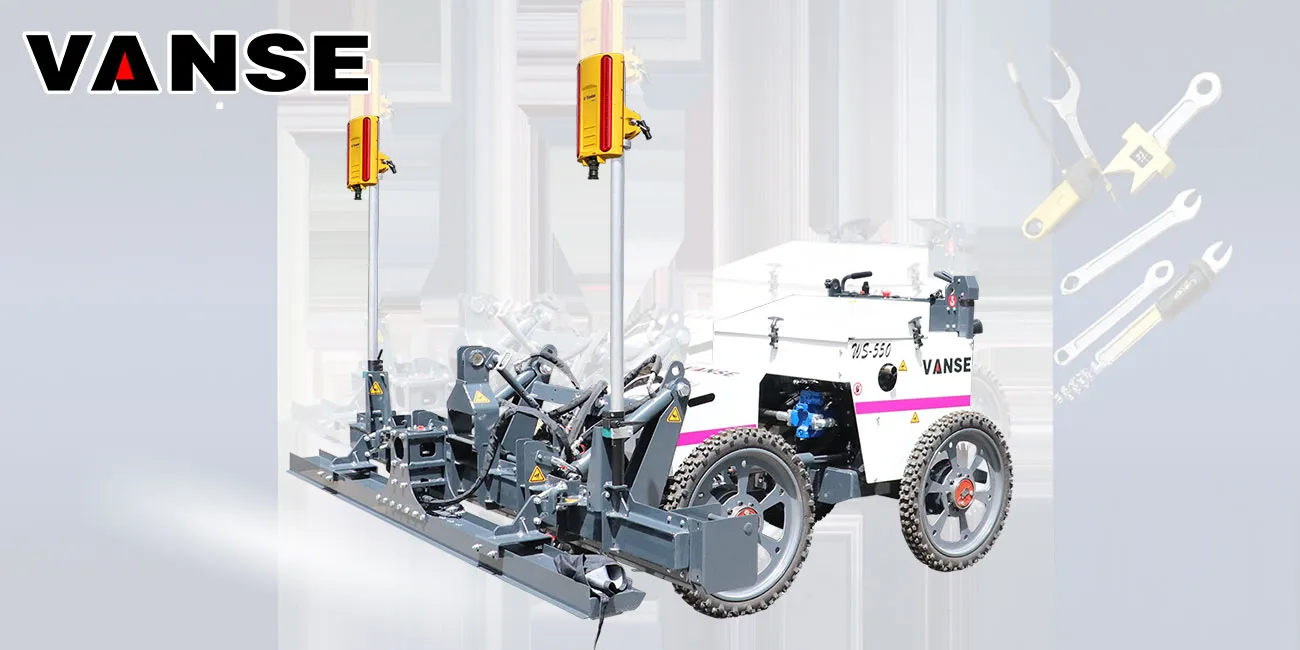
Concrete laser leveling machines are crucial for efficient concrete paving and leveling. Daily maintenance directly impacts their accuracy, service life, and construction safety. The following are key points for daily maintenance, covering pre- and post-operation inspections, key component care, fluid management, and storage procedures:
1. Pre-operation inspection: ensure that the initial status of the equipment is normal
A comprehensive inspection before operation is the first line of defense to prevent failures, and the following should be paid special attention to:
Appearance and Structural Inspection
Inspect the machine body and frame for deformation, cracks, or looseness. Check that connecting bolts (such as those securing the scraper and vibrator) are tight. If loose, tighten them to the specified torque.
Check the housings of precision components, such as the laser transmitter and receiver, for integrity and the lenses for stains, scratches, or damage to ensure signal reception is not interfered with.
Powertrain Inspection
Before starting the engine, check that the fuel, engine oil, and coolant levels are within standard ranges. Use clean diesel fuel of the specified grade to prevent impurities from clogging the fuel lines.
Check the quality of the engine oil. If the oil is found to be emulsified, blackened or contains impurities, the oil and oil filter must be replaced in time.
Hydraulic and Drive System Inspection
Check the hydraulic oil tank level and inspect the hydraulic oil for clarity, foam, impurities, or discoloration (normal hydraulic oil is light yellow or amber). If contamination is severe, replace the hydraulic oil and filter.
Inspect the hydraulic lines and joints for leaks and check for aging and wear. If any problems are found, replace seals or lines immediately.
Test the transmission components (such as chains and gears) of the travel drive and leveling mechanisms for smooth operation, abnormal noise, and proper chain tension. Add grease if necessary.
Electrical and control system inspection
Check the laser transmitter for sufficient power and stable signal transmission. Calibrate the laser receiver's sensitivity to ensure leveling accuracy meets requirements.
Check the control panel buttons and indicators for proper operation, and the wiring harness connections for security and damage or short circuit hazards.
Test the emergency stop button to ensure it can immediately shut off power in an emergency, ensuring the safety of equipment and personnel.
2. Monitoring During Operation: Promptly Identify and Address Abnormalities
During operation, it is important to monitor the equipment's operating status in real time to prevent minor faults from escalating into further damage.
Operating sound monitoring: During normal operation, the engine, hydraulic pump, and transmission components should produce no abnormal noise. If any unusual noises (such as metallic friction, banging, or high-frequency whistling) are detected, the machine must be immediately stopped for inspection to identify the source of the problem (such as bearing wear, component seizure, or abnormal hydraulic system pressure).
Temperature monitoring: Observe the engine water temperature, engine oil temperature, and hydraulic oil temperature to ensure they are within the normal range (generally 80-95°C for engine water and 30-60°C for hydraulic oil). If temperatures are excessively high, the machine must be shut down for cooling and the cooling system must be checked (e.g., whether the radiator is clogged and the fan is functioning properly) to prevent component damage caused by overheating.
Performance monitoring: Pay attention to travel speed, whether the leveling mechanism is rising and falling smoothly, and whether the vibration frequency is normal. If movement is sluggish, weak, or irregular, this may indicate a hydraulic system leak, insufficient pressure, or a transmission component failure, requiring prompt shutdown and inspection.
3. Post-Operation Cleaning and Maintenance: Extending Equipment Life
After completing a job, thoroughly clean the equipment and perform targeted maintenance to prevent component damage from concrete solidification and impurity accumulation.
Thorough Cleaning
Use a high-pressure water jet to rinse concrete residue from the machine body, leveling base, vibrator, scraper, and other components. Pay special attention to removing dust and stains from the laser receiver and sensor to ensure proper signal transmission.
Clean dust and debris from the engine, hydraulic oil tank, and radiator to maintain proper heat dissipation.
Inspect and clean the air filter element. Replace it if severely clogged to prevent insufficient engine air intake, resulting in reduced power or increased wear.
Lubrication and Maintenance
According to the equipment manual, add the appropriate type of grease to all lubrication points (such as bearings, pins, chains, gears, and hydraulic cylinder piston rods) to ensure smooth operation of transmission components and reduce wear.
Please focus on lubricating the moving joints of the travel mechanism and leveling mechanism. After lubrication, run the operating parts several times to ensure even distribution of the grease.
Component Repositioning and Inspection
Lower the leveling mechanism to the ground, retract all retractable components, turn off the laser transmitter, and store it properly to avoid damage from collisions.
Check the bolts connecting all components for looseness and re-tighten key bolts (such as the leveling mechanism mounting bolts and hydraulic line connectors).
Drain the fuel tank for water and sediment. Check the fuel filter for impurities and replace the filter element if necessary.
Fluid Replenishment
Refill fuel, engine oil, and coolant to standard levels. If hydraulic oil is low, add the same type of hydraulic oil to avoid mixing different grades, which may cause performance degradation.
4. Regular Deep Maintenance: Perform Systematic Maintenance According to Cycles
In addition to daily maintenance, regular deep maintenance is required based on the equipment's age or workload. This is generally categorized as weekly, monthly, and quarterly/annual maintenance.
| Maintenance Cycle | Maintenance Details |
| Weekly Maintenance | 1. Replace engine oil and oil filter; |
| 2. Check hydraulic system pressure for normal operation and tighten hydraulic line joints; | |
| 3. Check chain and belt tension and wear, and adjust or replace if necessary; | |
| 4. Test laser system calibration accuracy and recalibrate if deviations are detected. | |
| Monthly Maintenance | 1. Replace hydraulic oil and hydraulic oil filter, return filter, and suction filter; |
| 2. Inspect hydraulic cylinder piston rod for scratches and deformation, and seals for leakage, and replace if necessary; | |
| 3. Check tires and tracks for wear and adjust tire pressure or track tension; | |
| 4. Clean or replace the fuel filter and inspect fuel lines for deterioration. | |
| Quarterly/Annual Maintenance | 1. Thoroughly inspect internal engine components (e.g., valve clearance, piston ring wear), and perform repairs if necessary. |
| 2. Inspect the performance of the hydraulic pump and motor, testing pressure and flow rates to ensure they meet specifications. Repair or replace any degraded performance. | |
| 3. Perform a comprehensive flaw detection on structural components, inspecting for cracks and deformation, especially welds, and perform reinforcement if necessary. | |
| 4. Calibrate the laser control system and replace any aging sensors, wiring harnesses, and other electrical components. |
5. Long-Term Storage and Maintenance: Protective Measures During Idle Time
If the equipment needs to be stored for an extended period (over 1 month), the following protective measures must be taken to prevent rust and aging of components:
Park the equipment in a dry, ventilated indoor area. If stored outdoors, cover with a tarp to protect it from sunlight and rain.
After thoroughly cleaning the equipment, apply anti-rust oil to all exposed metal surfaces (such as piston rods, pins, and chains) to prevent rust.
Drain the fuel tank or add fuel stabilizer to prevent fuel deterioration and clogging of the oil lines. Replace the engine oil and hydraulic oil to prevent impurities in the oil from corroding components during storage.
Raise the equipment so that the tires and tracks are off the ground to prevent deformation caused by prolonged stress. Raise the leveling mechanism to its highest position and loosen the hydraulic cylinder piston rod to prevent prolonged stress and aging of the seals.
Disconnect the negative battery cable or charge the battery regularly to prevent battery damage due to low power. When storing the laser transmitter, remove the battery and store it separately in a dry place.
Regularly (monthly) start the equipment and run it for 10-15 minutes to check the operation of all components and ensure that the lubricant is evenly distributed to prevent sticking.
6. Other Precautions
Proper Operation:
Operators must undergo professional training and strictly follow the equipment manual. Avoid overloading, speeding, and illegal operation (such as forced steering on uneven surfaces or striking the leveling mechanism against hard objects) that may damage the equipment.
Parts Management: When replacing parts, use genuine or qualified parts. Avoid using inferior parts that may degrade equipment performance or cause secondary failures.
Record and Traceability:
Maintain an equipment maintenance log to record the time, content, replaced parts, and troubleshooting of each maintenance session. This facilitates tracking of equipment status, identifies potential issues promptly, and develops targeted maintenance plans.
Through the above daily maintenance measures, the failure rate of the concrete laser leveling machine can be effectively reduced, ensuring that the equipment is always in good operating condition, improving construction efficiency and leveling quality, and extending the service life of the equipment.
Click the below to jump immediately!!!


Thanks to All the Friends Who Support and Trust Shandong Vanse Machinery Technology Co., Ltd.
If you want to know more about Shandong Vanse Machinery Technology Co., Ltd. or have any questions, please feel free to contact us:
Our Factory
Shandong Vanse Machinery Technology Co., Ltd.








Share this article

About the Author: Shandong Vanse Machinery Technology Co., Ltd.
Shandong Vanse Machinery Technology Co., Ltd. is a high-tech manufacturer specializing in concrete construction machinery, including laser screeds and related equipment. The company integrates R&D, production, and global sales, with products exported to over 60 countries and widely used in infrastructure projects worldwide.
Previous Post
Next Post
Related Articles
You Might Also Like
How to choose a concrete laser leveling machine?
When choosing a concrete laser leveling, you need to consider the following aspects: ✈Machine performance First, you need to understand the performance and specifications of the machine, including power, speed, accuracy, adjustability, etc. Different models of machines have different performances, and the appropriate model needs to be selected according to construction needs and site conditions. ✈Construction requirements Laser leveling machines with different powers and speeds need to be selected according to specific construction needs. For example, pouring concrete over a large area requires the use of high-power, high-speed machines, while smaller areas or delicate jobs require the use of low-power, low-speed machines. ✈Site conditions It is necessary to consider the conditions of the site, such as ground flatness, humidity, concrete thickness, etc. For uneven floors or occasions where thicker concrete needs to be laid, a laser leveling machine with automatic leveling function is required. ✈Operator proficiency The proficiency of operators has a direct impact on construction quality and efficiency. Therefore, it is necessary to consider the technical level and training of the operator and select a machine that is easy to operate and maintain. ✈Price and after-sales service The price and after-sales service of the machine need to be considered, including warranty period, maintenance, spare parts supply, etc. It is necessary to conduct full comparison and evaluation before purchasing, and choose products with high cost performance. ✈Brand and reputation Choosing a well-known brand and a manufacturer with a good reputation can guarantee the quality of the machine and the level of service. You can refer to the reviews and suggestions of other users to understand the advantages and disadvantages of different products and market feedback. To sum up, there are many factors to consider when selecting a concrete laser leveling, including performance, construction requirements, site conditions, operator proficiency, price and after-sales service, as well as brand and reputation. Before purchasing, you need to make a full comparison and evaluation to choose the best product that meets your needs.How accurate is a concrete laser leveling machine
The accuracy of a concrete laser leveling machine (laser leveling) is its defining feature and what justifies its significant cost. The answer is two-tiered: the machine's instrumental accuracy and the resulting floor flatness specification it can achieve. Here's a detailed breakdown: This refers to how precisely the machine follows the laser reference plane. Laser System Accuracy: The rotating laser transmitter that sets the plane is typically accurate to ±1.5 mm to ±3 mm (±1/16" to ±1/8") at a radius of up to 300 meters. This is extremely precise over a very large area. Machine Control Accuracy: The leveling's sensors (masts or mobile receivers) lock onto this laser plane. The onboard computer constantly adjusts the hydraulic cylinders to keep the leveling head exactly on grade. The system's resolution for adjusting the leveling head is generally within ±1.5 mm (±1/16") of the laser plane in real-time. In short, the machine itself is capable of placing and striking off the concrete surface to within a tolerance of about 1.5-3 mm (1/16" – 1/8") of the designed elevation across the entire slab. This is the industry-standard metric, expressed as F-Number (FF/FL). This is what engineers specify and what ultimately matters for the floor's performance. FF (Floor Flatness): Measures local smoothness and waviness over a 24-inch (600 mm) rolling radius. High FF means a very smooth surface with minimal bumps/dips. FL (Floor Levelness): Measures conformity to the overall specified grade over a 10-foot (3 meter) span. High FL means the floor is consistently level over long distances. Standard Industrial Floors: A modern laser leveling can consistently and easily achieve FF 35 / FL 25 or better. This is a high-quality warehouse or manufacturing floor. Superflat Floors: This is where laser leveling truly shine. They are the standard tool for achieving: FF 50 / FL 40 (Standard for high-rack warehouses with narrow aisles). FF 100 / FL 80+ (Extreme requirements for robotic, Very Narrow Aisle (VNA), or AS/RS systems). Achieving these numbers requires not only the laser leveling but also exceptional subgrade preparation, concrete mix design, and expert finishing/troweling. Manual leveling: Even with skilled workers using a straightedge, achieving better than FF 20 / FL 15 consistently is very difficult. Results are highly variable and dependent on crew skill and fatigue. Ride-on Vibratory leveling: An improvement over manual work, but typically max out at around FF 25 / FL 20. The machine's potential accuracy can only be realized if the following are controlled: Stable, Well-Prepared Subgrade: A soft or uneven subbase will lead to slab settlement and distortion, ruining flatness. Proper Laser Setup: The laser transmitter must be positioned correctly and on a stable tripod, with the correct grade slope programmed. Concrete Mix Design & Placement: A consistent, stable mix with proper slump (low water-cement ratio) is essential. Concrete must be placed in a timely manner ahead of the leveling. Finishing Operations: The laser leveling creates a perfectly struck-off surface, but the final flatness is sealed by the subsequent finishing (troweling) process. Bump cutting (early passes with ride-on trowels) is critical to maintain the flatness the leveling established. A concrete laser leveling machine is capable of producing floor flatness (F-Numbers) that are 2 to 5 times better than what is possible with traditional manual methods. Metric: It can create a surface within ±3 mm of perfect elevation across a vast area. Specification: It is the essential tool for routinely achieving FF 50/FL 40 and can reach FF 100/FL 80+ for the most demanding superflat applications. In essence, the accuracy is not just about following a laser; it's about delivering a quantifiable, superior, and consistent floor quality that meets modern industrial performance standards, which is why it has become indispensable for large-scale commercial projects. Note: The parameters provided in this document are for reference only and are not mandatory. Due to differences in technical characteristics between different brands and models of laser levelers, please consult the manufacturer for a suitable solution before actual operation. This reference document assumes no responsibility for any issues arising from failure to follow the manufacturer's instructions.The ‘beauty’ work of the ground depends on the laser leveling machine (2)
The "beauty" work of the ground depends on the laser leveling machine (2) In detail, after reading the previous article, you already know a little about laser leveling machines. Some environments that require relatively high ground flatness, such as: shopping malls, airports, etc., and it is no longer suitable to continue construction by manually grinding the ground Because this will greatly affect the efficiency and quality of the work, the concrete laser leveling machine alone will take the lead. 2. Reasonable workload The size and nature of the working load of the concrete laser leveling machine have an important influence on the loss process of the machine. In general, the wear of parts increases proportionally with the load. Wear increases when a part is subjected to higher than average design loads. In addition, when other conditions are the same, the stable load has less wear, less failure and lower life than the dynamic load. Ensuring the normal working load mainly depends on the operator's use of the concrete laser leveling machine. One must pay attention not to work under the maximum load that the machine can bear, and use the machine within its capacity. As the manager of the concrete laser leveling machine, when appointing the operator, the random information and operation manual of the concrete laser leveling machine should be handed over to the operator, so that they can normally grasp the mechanical properties and operating procedures, and should not be arbitrarily assigned Relevant information is withheld. Second, try to ensure the uniform addition and subtraction of the mechanical load, so that the machinery is in a relatively gentle load change. Specifically, it is necessary to increase and decrease the throttle more evenly to prevent the engine and working devices from fluctuating greatly. 3. Use lubricating oil scientifically According to statistics, more than half of the failures of concrete laser leveling machines are caused by poor lubrication. Due to the precision of the parts of the concrete laser leveling machine, good lubrication can maintain a normal working gap and a suitable working temperature, thereby reducing the wear of the parts and reducing mechanical failures. Normal and reasonable lubrication is one of the effective measures to reduce mechanical failures. For this reason, one is to choose lubricants reasonably. During use, neither low-grade lubricants nor other types of lubricants can be used instead, let alone inferior products. The second is to always check the quantity and quality of lubricants. 4. Timely maintenance and repair Various failures will inevitably occur during the use of the concrete laser leveling machine. Among these failures, some failures may have a slight impact on mechanical equipment, while some are more serious, and may even cause major accidents such as machine crashes and human deaths. Experience has shown that major mechanical failures are often caused by minor failures. The reason is that the timely disposal of minor faults has been neglected. Therefore, for mechanical failures, regardless of their size, they should be eliminated in time, so as to maintain the normal performance of the machinery and reduce the possibility of causing larger failures.