Technical Knowledge
Cost-Benefit Comparison of Laser Leveling Machine and Traditional Manual Leveling (Labor Savings VS Equipment Investment)
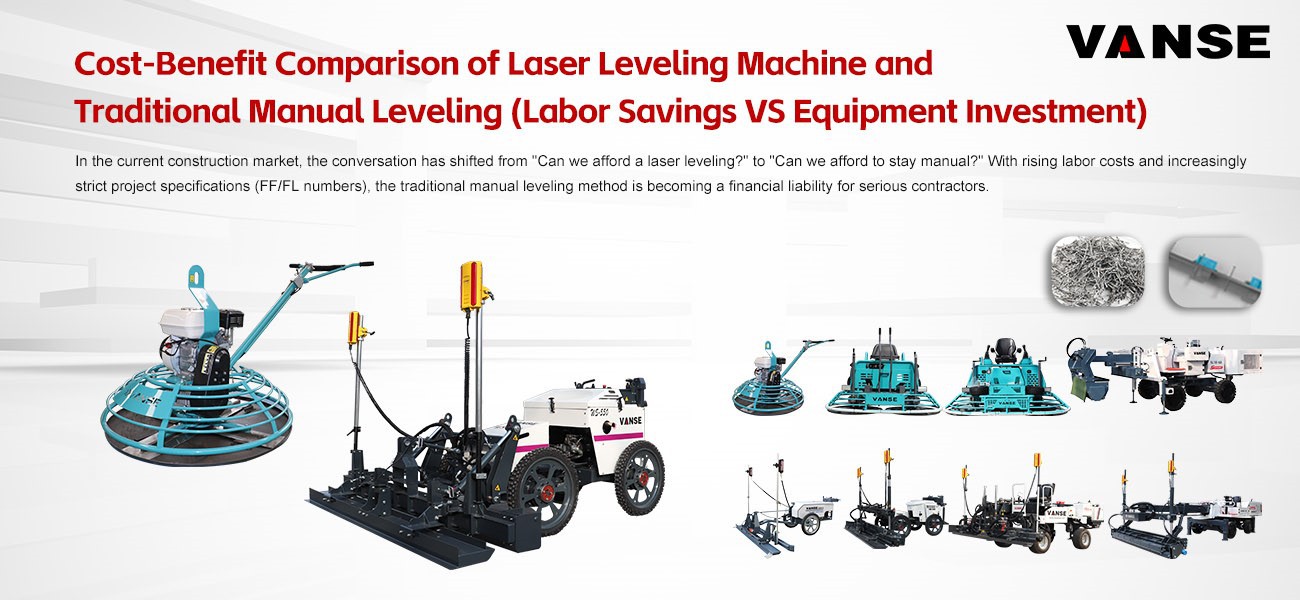
In the current construction market, the conversation has shifted from "Can we afford a laser leveling?" to "Can we afford to stay manual?" With rising labor costs and increasingly strict project specifications (FF/FL numbers), the traditional manual leveling method is becoming a financial liability for serious contractors.
If you’re weighing the Equipment Investment of a Vanse Concrete Laser Leveling Machine against the perceived "low cost" of manual labor, here is the professional breakdown of the real ROI.
1. The Productivity Gap: Square Meters per Hour
Manual leveling is slow, grueling, and dependent on the physical stamina of your crew.
Manual: A highly skilled 10-man crew might manage 600–800m² in a long, exhausting day.
Vanse Workflow: With a Vanse YZ25-4/YZ28-4S/WS940/WS940C or the telescopic YZ30-4E, that same crew (or even a smaller one) can easily cover 2,500–3,500m² per day.
The Math: You are essentially quadrupling your output. In the international market, where project timelines are aggressive, this speed allows you to take on 3x more projects per year with the same headcount.
2. Labor Savings: From 12 Men to 5
The "hidden cost" of manual leveling isn't just the hourly wage; it’s the insurance, the management, and the human error.
Manual: You need a massive team for distribution, leveling, and vibrating.
The Vanse Fleet Solution:
Replace 4 guys with shovels with one Vanse Concrete Distributor or a Mini Dumper.
Replace the 6-man leveling team with one Concrete Laser Leveling Machine operator.
Instead of manual "dusting," use an Automatic Topping Spreader to ensure uniform wear-resistance.
Result: You cut your specialized labor requirements by over 50%. In regions like North America or Europe, the machine often pays for itself in labor savings alone within 6–9 months.
3. Quality Control: FF/FL Scores and Rework
Manual leveling rarely hits the "Superflat" specs required for modern VNA warehouses.
The Risk: If a manual floor fails an FF/FL test, you face the nightmare of grinding or, worse, a "rip and replace" order.
The Vanse Guarantee: Vanse machines react to laser signals 10 times per second. By using a Vanse Power Trowel following the laser leveling, you achieve a "burnished" mirror finish that passes inspection the first time. Precision Concrete Cutting Machines from Vanse then ensure the joints are clean, preventing late-stage cracking.
4. Comparison Table: Manual vs. Vanse Ecosystem
| Metric | Traditional Manual Leveling | Vanse Laser Leveling System |
| Crew Size | 10–15 Workers | 4–6 Workers |
| Daily Output | 500 – 800 m² | 2,500 – 3,500 m² |
| Precision (FF/FL) | Low to Medium (Subject to fatigue) | High to Superflat (Consistent) |
| Physical Strain | Extremely High (High turnover) | Low (Operated via joystick/seat) |
| Surface Hardness | Uneven (Manual spreading) | Superior (Automatic Topping Spreader) |
| Long-term Cost | High (Labor + Rework risk) | Low (Maintenance + Depreciation) |
The "Vanse Ecosystem" Advantage
When you visit www.vansemac.com, you aren't just looking at a price tag; you’re looking at a business transformation tool.
The Concrete Distributor and Mini Dumper handle the heavy lifting.
The Laser Leveling Machine handles the precision.
The Topping Spreader and Power Trowel handle the durability.
The Concrete Cutting Machine handles the finish.
Final Verdict: Is it worth the investment?
If your business goal is to stay small and handle residential driveways, manual is fine. But if you want to bid on Amazon-scale warehouses, logistics hubs, or high-end industrial bays, the equipment investment in a Vanse fleet is the only way to remain competitive.
The investment isn't just in the steel and hydraulics; it’s an investment in guaranteed quality and massive labor efficiency.
Explore the full range and request a quote at www.vansemac.com to see how the numbers work for your specific market.
Note: The parameters provided in this document are for reference only and are not mandatory. Due to differences in technical characteristics between different brands and models of laser levelers, please consult the manufacturer for a suitable solution before actual operation. This reference document assumes no responsibility for any issues arising from failure to follow the manufacturer's instructions.
Thanks to All the Friends Who Support and Trust Shandong Vanse Machinery Technology Co., Ltd.
If you want to know more about Shandong Vanse Machinery Technology Co., Ltd. or have any questions, please feel free to contact us:
Our Factory
Shandong Vanse Machinery Technology Co., Ltd.








Share this article

About the Author: Shandong Vanse Machinery Technology Co., Ltd.
Shandong Vanse Machinery Technology Co., Ltd. is a high-tech manufacturer specializing in concrete construction machinery, including laser screeds and related equipment. The company integrates R&D, production, and global sales, with products exported to over 60 countries and widely used in infrastructure projects worldwide.
Previous Post
Next Post
Related Articles
You Might Also Like
How to judge the quality of concrete power trowel?
– If it is a fuel engine, a high-quality engine starts quickly. Under normal temperature conditions (such as 10-35 degrees Celsius), it should be able to start within 3-5 seconds after pulling the starter rope or pressing the electric start button. For example, brands such as Honda and Briggs & Stratton have a good reputation, reliable quality, strong and stable power. – The engine should be stable during operation, without obvious shaking and abnormal noise. You can judge by observing the vibration of the body when the trowel is working. If the vibration is too severe, it may be caused by unreasonable installation or poor quality of the internal parts of the engine. – The power must meet the use requirements. Generally, the power of the trowel used for small indoor floor construction may be around 3-5 horsepower, while the power of the trowel used for large-area outdoor projects may reach 7-10 horsepower or even higher. Insufficient power will lead to low trowel efficiency, while excessive power may cause energy waste and increase the difficulty of operation. – Check the brand and parameters of the motor. High-quality motors are usually more efficient and can effectively use electrical energy. For example, motors from brands such as Siemens in Germany and Wolong in China have certain quality guarantees. – The insulation performance of the motor should be good to prevent leakage accidents. You can check the protection level mark of the motor. Generally, it is required to reach IP44 and above, which means that the motor can prevent the entry of solid foreign objects larger than 1mm and can prevent water splashing. – The motor heats up normally during operation and will not overheat. After working continuously for 1-2 hours, touch the motor housing with your hand and feel that the temperature is not hot (the temperature does not exceed about 70-80 degrees Celsius). If the motor overheats, it may shorten the life of the motor or even damage the motor. – High-quality trowel chassis are usually made of high-strength aluminum alloy or high-quality steel. Aluminum alloy chassis is light, corrosion-resistant, easy to operate and has a long service life; steel chassis is strong and can withstand greater pressure. For example, some high-end brands of trowel chassis are made of aviation aluminum alloy, which is strong and light. – The thickness of the chassis is also an important factor. Thicker chassis (generally around 4-6mm thick) are more wear-resistant and less likely to deform. You can judge whether the thickness of the chassis meets the requirements by simple measurement or comparison with other brands. – The surface of the chassis should be very flat and smooth, and the flatness error should be controlled within ±0.5mm. This can be preliminarily judged by naked eye observation and hand touch. A more accurate method is to use tools such as a level to measure. If the chassis is not flat, the ground flatness will be poor and uneven during the troweling process. – The blade is generally made of high-hardness alloy steel, which has good wear resistance and toughness. For example, 65Mn alloy steel blades are hard and not easy to break. You can check the product manual or consult the manufacturer to understand the blade material. – High-quality blades undergo heat treatment processes such as quenching to improve their hardness and wear resistance. The surface hardness generally reaches around HRC50-60, which allows the blade to maintain good shape and performance after long-term friction with the concrete surface. – The number of trowel blades varies depending on the size and purpose of the trowel. Generally, small trowels have 4-6 blades, and large trowels may have 8-10 or more. The blade layout should be reasonable to ensure that the ground is fully and evenly troweled during work. For example, the blades are symmetrically distributed around the chassis, and the spacing between adjacent blades is uniform to avoid troweling dead corners. – The height of the armrest should be moderate, generally around 80-100cm, so that operators of different heights can hold it easily. The handrail material should have good anti-slip properties, such as rubber-wrapped metal handrails, so that the hand is not easy to slip during operation, improving the safety of operation. – The handrail should be able to flexibly adjust the angle to adapt to different operating postures and working scenes. For example, when operating in a narrow space such as a corner, the handrail can be adjusted to a suitable angle for easy operation. – The weight of the trowel should be moderate. Too light may cause the machine to have poor stability and easy to jump during operation; too heavy will increase the difficulty of operation. Generally, the weight of a small hand-held trowel is about 60-100kg, and the weight of a ride-on trowel may be about 200-300kg. – The center of gravity of the machine is reasonably designed to ensure good balance during operation. It can be judged by actual operation or observing the state of the machine at work. If the machine is easy to tip over or one side is heavy, it means that the balance is not good. – The trowel should be equipped with complete protective devices, such as emergency brakes. In case of emergencies, the operator can quickly stop the machine. The brake device should be sensitive and reliable, with a short braking distance. Generally, when the machine is running at full speed, the machine should stop rotating within 2-3 seconds after pressing the brake button. – Rotating parts (such as blades) should have protective covers, which should be firm and reliable to prevent operators from accidentally touching the high-speed rotating blades. The material of the protective cover is generally metal or high-strength plastic, and there should be obvious warning signs on the protective cover. – In addition to the motor insulation performance mentioned above, the power cord of the electric trowel machine should have a good insulation layer and a moderate length, generally about 5-10m, which is convenient for operation and will not be too long to cause safety hazards. – The machine should have a grounding device to prevent leakage accidents. The grounding resistance must meet the standard requirements and generally does not exceed 4 ohms. – Choose a well-known brand of trowel machines, which usually have a strict production quality control system and a good reputation. – Good after-sales service is an important guarantee of quality. Manufacturers should be able to provide timely technical support, such as maintenance manuals, operation videos and other materials. And when the product fails, they can provide fast maintenance services, including the supply of parts and door-to-door service by maintenance personnel. The maintenance outlets are widely distributed, which is convenient for users to contact manufacturers or maintenance personnel in time when needed.Which factors ought to be thought about when purchasing a concrete laser leveling machine?
When purchasing a concrete laser leveling, you need to consider construction requirements, equipment performance, cost-effectiveness and other factors to ensure that the equipment can adapt to the project scenario, improve construction efficiency and reduce long-term costs. The following are the core factors that need to be focused on: – For large-area floors (single area exceeds 1000㎡) such as large industrial plants (such as automobile plants and logistics warehouses), it is suitable to choose large laser levelings ( such as VANSE YZ40-4E, YZ30-4E, etc. ), which have a large operating width (3-4 meters) and high efficiency (average daily construction of 4000-5000㎡), can reduce joints and ensure overall flatness. – For small plants, workshops or narrow areas (such as around equipment foundations and corners), small hand-held laser levelings ( such as DZ25-2, DZ30-2, etc. ) are suitable, with flexible bodies that can operate in small spaces. – If the factory has AGV robots, precision equipment or high-bay warehouses (forklifts need to travel at high speed), the flatness requirements are extremely high (such as 2-meter ruler deviation ≤3mm, or even ≤1mm), and you need to choose a high-precision laser system (such as imported laser transmitters, accuracy ±0.5mm/10m) and a more rigid leveling head (to reduce the impact of body deformation). – Ordinary industrial plants (such as warehouses) can choose medium-precision equipment to meet the basic flatness. – When the floor thickness is large (such as 200-300mm, including steel fiber and steel mesh), you need to pay attention to the paving capacity of the equipment, choose a high-power engine (such as 40-60 horsepower), a heavy-duty scraper and a vibrating system (vibration depth ≥300mm) to ensure that the concrete is vibrated densely and avoid honeycomb surface. – If the ground needs to carry heavy equipment (such as forklifts and machine tools above 10 tons), the equipment must have sufficient paving uniformity to reduce local settlement caused by differences in concrete density. – Laser transmitter: Prioritize imported brands ( such as Trimble in the United States, Leica in Switzerland, and Topcon in Japan ), whose laser signals have strong anti-interference ability (avoid the influence of sunlight and other equipment signals), to ensure the uniformity of the benchmark during large-scale construction. – Control system: Whether it has automatic leveling function (such as automatic slope compensation, real-time correction of height difference), which can reduce human errors when operated by novices. – Engine power: High-power (such as more than 50 horsepower) equipment is suitable for high-intensity and continuous operation, especially in high-temperature environments where concrete sets quickly, and can quickly complete paving. – Operation speed: It needs to match the concrete supply (such as paving 80-150m³ per hour) to avoid the inability to trim the concrete after initial setting due to the equipment being too slow. – Leveling machine head: Rigid frame (such as square steel welding) has strong anti-deformation ability and prolongs service life; scraper and vibrator materials (such as high chromium alloy) need to be wear-resistant to reduce replacement frequency. – Tires/tracks: If the ground is soft during construction in the factory, crawler equipment (large ground contact area) is more anti-sinking; tire type (flexible movement) can be selected for hardened ground. – Whether it supports synchronous spreading of wear-resistant materials (such as integrated spreader) to reduce subsequent processes; – Folding design (such as foldable head) for easy transportation and entry into narrow factories. – The choice of imported or domestic equipment depends on personal budget and construction projects. – Fuel consumption: high-power equipment has high fuel consumption (such as 8-15L per hour), which needs to be calculated in combination with the construction volume; – The price and replacement frequency of wearing parts (vibrators, scrapers), choose a brand with sufficient supply of accessories. – Whether the manufacturer provides localized services (such as nearby repair outlets) to avoid delays in construction due to equipment failure (Shandong VANSE Machinery Technology Co., Ltd. has its own agents in the United States, Mexico, Russia, Spain, Thailand, Uzbekistan, the United Kingdom, Australia, Brazil and other countries, with branches + overseas warehouses in Malaysia and its own overseas warehouses in Saudi Arabia. Engineers are online 24 hours a day, and dedicated personnel will answer your questions, worry-free throughout the process); – Training support: whether operation and maintenance training are provided, especially important for novice teams; – Warranty policy: warranty duration (such as 1-2 years) and scope (whether core components are covered). – Reference industry cases: give priority to brands that are widely used in industrial plant construction ( VANSE Machinery Technology Co., Ltd.'s equipment has undertaken the construction of large and small logistics parks, as well as large supermarkets, and provides construction solutions. It has completed TR34 and DM1 standard floor laying in Saudi Arabia ), and its equipment performance has been verified in practice. – User evaluation: Understand the stability and failure rate of the equipment through peer feedback and industry forums to avoid choosing niche brands that lead to subsequent maintenance difficulties. When purchasing, it is necessary to combine the area, flatness requirements, and concrete thickness of the plant construction, give priority to matching the accuracy, efficiency and structural durability of the equipment, and balance the procurement cost with the long-term operating cost, and choose a brand with guaranteed after-sales service. For example, automobile plants (high flatness, large area) are suitable for imported large laser leveling machines; small and medium-sized new energy plants (medium area, high precision) can choose domestic mid-to-high-end equipment to maximize cost performance. Click the below to jump immediately!!! ARMOUR JOINT CONCRETE LEVELING MACHINE LIGHT TOWER POWER TROWEL SLIPFORM MACHINE STEEL FIBER TOPPING SPREADER TRACKED MINI DUMPERSpecial technical measures for safety protection in concrete pouring construction
Objective: To prevent safety accidents such as collapse, falls from heights, mechanical injuries, and electric shock during concrete pouring construction, ensure the safety of construction workers' lives and equipment and property, and standardize operation procedures, this special measure is formulated in accordance with regulations and standards such as the "Code for Safety Inspection of Construction Sites" (JGJ59) and the "Code for Construction of Concrete Structures" (GB50666). Scope of application: This measure is applicable to various concrete pouring operations in building construction, municipal engineering, Bridges, tunnels, etc., including the pouring construction of different parts such as foundations, main structures, and secondary structures. Before construction, a special construction plan should be prepared, clearly specifying the pouring sequence, material distribution method, machinery selection and safety protection requirements. It should be implemented after approval by the technical supervisor. Conduct three-level safety briefings for all personnel involved in the operation: project-level briefing on the overall safety risks of the construction, team-level briefing on the operation norms of the positions, and on-site briefing on the potential hazards of specific operation points (such as edges, openings, and high-voltage line locations). The briefings must be signed for confirmation and archived. Inspect the surrounding environment of the pouring area: Clear the debris on the work surface, and confirm that 1.2-meter-high guardrails have been set up at the edges (such as foundation pits, floor slab edges) and openings (with 20cm high toe boards at the bottom of the guardrails and an additional horizontal bar in the middle). The guardrails should be painted with red and white warning paint and hung with close-mesh safety nets. Check the load on the working surface: Verify the bearing capacity of the formwork support system to ensure that the concrete stacking height does not exceed the specification requirements (the stacking height during floor slab pouring is ≤100mm), and prevent the support from collapsing due to overloading. Check for electrical safety: Confirm that the distribution box meets the requirements of "one machine, one switch, one leakage protection, and one protection". The cables in the pouring area should be overhead or run through pipes for protection to prevent damage from being crushed. When working in a humid environment, the lighting voltage should be 36V or lower, which is a safe voltage. Concrete conveying equipment (pump trucks, ground pumps, placing machines) : Check whether the braking system, hydraulic system and pipe joints of the equipment are in good condition. The outriggers of the pump truck need to be supported on a solid ground (with steel plates or square timbers as pads), and confirm that the outriggers are fully extended and the ground bearing capacity meets the requirements. Protective supplies: Personal protective equipment such as safety helmets, anti-slip shoes, insulating gloves, and dust masks should be provided. When working at heights, safety belts (high hanging and low use) and operation platforms (fully covered with scaffolding boards and surrounded by guardrails) should be prepared. Backup emergency supplies (such as first aid kits, fire extinguishing equipment, and warning tapes). High-altitude work protection: When the pouring height is ≥2 meters, an operation platform or scaffolding must be used. It is strictly prohibited to stand on formwork or steel bars for work. Workers should fasten their safety belts, and the hooks of the safety belts should be hung on solid structural components. It is strictly prohibited to walk on unfixed components. Edge operation protection: When pouring foundation pits, slopes and other edge parts, set up warning areas and prohibit non-operation personnel from entering. Workers should maintain a safety distance of no less than 1 meter from the edge of the edge. Anti-slip scaffolding boards should be laid if necessary. Dust-proof and heat-proof protection: During summer pouring, shading measures should be taken to prevent personnel from suffering from heatstroke. When pouring in winter, when hot water is used to mix concrete, it is necessary to prevent steam scalding. Workers should wear anti-scalding gloves. When there is a lot of cement dust, wear dust masks and set up spray dust suppression equipment on site. Operation precautions for pump trucks and material distribution machines: No one is allowed to stand within the rotation radius of the material distribution rod of the pump truck. Before operation, make sure there are no high-voltage lines or obstacles within the rotation range. The placing machine should be firmly fixed. Before use, check whether the outriggers and the rotating mechanism are locked. It is strictly forbidden to carry out pouring operations when the placing machine is in motion. Vibrator usage protection: The operator of the vibrator should wear insulating shoes and insulating gloves. The cable of the vibrating rod should be protected from damage. It is strictly forbidden to drag the cable. When vibrating, avoid touching the steel bars and formwork to prevent the vibration rods from bouncing and injuring people. When the vibrator is not in use, cut off the power supply and place it in a dry area. Concrete transportation protection: When transporting concrete by tanker, the driver must abide by traffic rules. No one is allowed to stand under the unloading port of the tanker. The ground pump conveying pipeline is firmly fixed. Check the sealing condition of the pipeline joints to prevent concrete leakage and spraying from injuring people. When replacing the pipeline, first turn off the power of the ground pump, release the pressure, and then disassemble it. During the pouring process, dedicated personnel should be assigned to monitor the formwork support system, with a focus on checking the verticality of the vertical rods, the spacing of the horizontal rods, and the setting of the sweeping rods. If any deformation of the vertical rods or loosening of the horizontal rods is found, the pouring should be immediately halted, and personnel should be organized to evacuate. Work can resume only after the reinforcement and rectification are completed. The pouring sequence follows the principle of "symmetrical pouring and layered pouring" to avoid instability of the support system due to excessive local loads. The thickness of the layered pouring shall be carried out in accordance with the specifications (generally ≤500mm), and it is strictly prohibited to pour the formwork in a centralized manner at one time to avoid deformation. Regular maintenance and servicing of concrete conveying equipment, vibrators and other machinery should be carried out. The operating status of the equipment should be recorded. If any fault is found, the machine should be stopped immediately for repair. It is strictly prohibited to operate with faults. Mechanical operators must be certified and familiar with the equipment operation procedures. Unlicensed personnel are strictly prohibited from operating. When the pump truck is in operation, a dedicated person should be assigned for command. The command personnel should use standard signals (flag language or walkie-talkies) to avoid communication errors with the driver. When the fabricating machine is moving, it should proceed slowly to prevent collision with structural components or personnel. On-site electricity usage should be operated by professional electricians. It is strictly prohibited for non-electricians to connect or disconnect wires. The distribution box in the pouring area is locked and a warning sign saying "Beware of Electric Shock" is posted. There are no debris within 1.5 meters around the distribution box. When working in rainy weather, cover the distribution box and electrical equipment, and check the grounding resistance (grounding resistance ≤4Ω) to prevent leakage accidents. After the operation is completed, cut off the power supply of all equipment, organize the cables, and avoid crushing or soaking them. Collapse accident handling: In the event of a collapse of the formwork support, immediately stop the operation, organize personnel to evacuate to a safe area, and prohibit blind rescue. Call the 120 emergency number and at the same time use excavators, jacks and other equipment to clear the collapsed objects and rescue the trapped people to prevent secondary collapse. Handling of falls from heights and mechanical injuries: In the event of a person's fall or mechanical injury, immediately stop the operation, transfer the injured person to a safe area, check the injured person's consciousness and breathing. If fractures or bleeding occur, take temporary immobilization and hemostasis measures, and call 120 for medical treatment. In the event of an electric shock accident, cut off the power supply first, then rescue the injured person to prevent the rescuers from getting electrocuted. Fire accident handling: In case of fire caused by electrical faults or flammable materials burning, immediately cut off the power supply, use on-site fire extinguishing equipment to put out the fire, evacuate people to a safe area, call 119 to report the fire, and at the same time clear flammable materials around to prevent the fire from spreading. Daily inspection: Before each day's work, the team conducts a pre-shift safety inspection, with a focus on personal protective equipment, equipment status, and protective facilities. The project organizes safety inspections every week to identify potential hazards and issue rectification notices, and follows up on the rectification progress. Special acceptance: Before pouring, a special acceptance shall be conducted on the formwork support system, operation platform and electrical equipment. Only after the acceptance is qualified and signed for confirmation can the pouring operation begin. If the acceptance is not qualified, construction is strictly prohibited until the rectification meets the standards. Safety education and training should be provided to newly arrived workers. Only after passing the assessment can they take up their posts. Regularly organize special training on concrete pouring safety, explaining accident cases, operation norms, and emergency skills to enhance personnel's safety awareness. Special operation personnel (such as pump truck drivers, electricians, and scaffolders) must hold relevant certificates to work. Those with expired certificates or those that have not undergone annual review are prohibited from engaging in related operations. Regularly organize refresher training for special operation personnel to update their safety knowledge. Instructions for Use: This plan is a general template. Before the specific implementation of each project, it should be refined and supplemented according to the characteristics of the project (such as super-high, super-heavy, large-span structures, etc.), especially the control measures for major hazard sources.