Technical Knowledge
How to Achieve ±1mm/3m Flatness Control with Concrete Laser Leveling Machine?
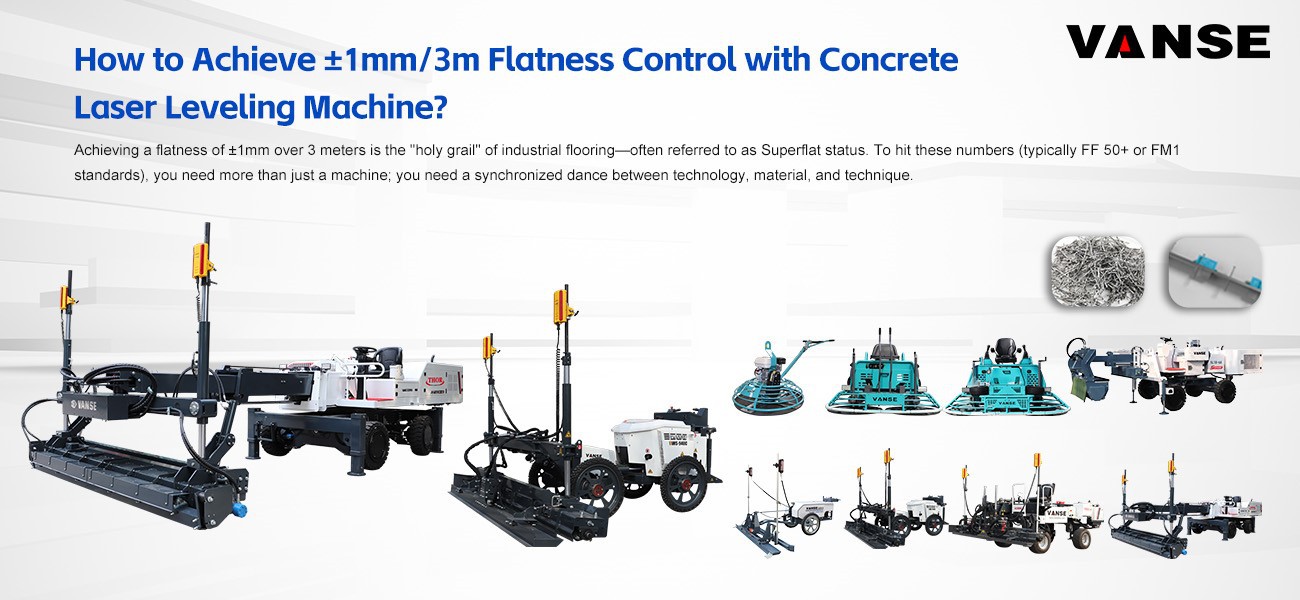
Achieving a flatness of ±1mm over 3 meters is the "holy grail" of industrial flooring-often referred to as Superflat status. To hit these numbers (typically FF 50+ or FM1 standards), you need more than just a machine; you need a synchronized dance between technology, material, and technique.
If you’re a contractor aiming for that level of precision, here is a professional breakdown of how to master it using a Concrete Laser Leveling Machine, with some insider tips on the Vanse technology that makes it possible.
1. It All Starts with the "Brain": Laser System Calibration
You can’t hit ±1mm if your reference point is off by 2mm. Global buyers know that the laser system is the most critical component.
The Pro Tip: Use a high-quality transmitter (like Leica or Trimble) and set it up on a stable, vibration-free tripod.
The Vanse Edge: Most Vanse laser leveling machines, such as the WS940C or the telescopic YZ40-4E, are designed to integrate seamlessly with world-class laser systems. The machine’s receivers pick up the signal at a frequency of 10 times per second, making real-time micro-adjustments to the hydraulic leveling head before the concrete even has a chance to settle.
2. Concrete Slump: The Secret Ingredient
You can have the best laser leveling in the world, but if your concrete slump varies from truck to truck, your floor will be a "rollercoaster."
The Pro Tip: Keep your slump consistent (ideally 120mm–160mm depending on the mix). If the concrete is too wet, it will sink after the machine passes; too dry, and the vibrator won't consolidate it properly.
The Vanse Edge: Vanse machinery is built with high-frequency vibrators (up to 4000rpm). This ensures that even with a slightly lower slump (which is better for long-term durability), the machine can still liquefy the surface just enough to get that perfect, glassy finish in a single pass.
3. The "One-Pass" Rule: Integrated Leveling Heads
In the old days, you’d leveling, then check, then leveling again. Every time you touch the concrete, you risk making it worse.
The Pro Tip: Look for an integrated leveling head that performs leveling, leveling, and vibrating simultaneously.
The Vanse Edge: If you look at the Vanse YZ series, the leveling head is a masterpiece of engineering. It’s a 3-in-1 system. As the machine moves, the auger removes excess concrete, the vibrator consolidates the slab, and the scraper plate leaves a level surface-all controlled by the laser system. This "one-pass" efficiency is exactly how you maintain that ±1mm tolerance over 3 meters without over-working the material.
4. Overlap and Speed: The Operator’s Touch
Even with full automation, the operator’s path matters.
The Pro Tip: Maintain a consistent travel speed and ensure a 20cm–30cm overlap between passes. This "blends" the cold joints and prevents "ridges" between lanes.
The Vanse Edge: For large-scale projects, the Vanse Telescopic Boomed Laser leveling (like the YZ30-4E) is a game-changer. The 6-meter boom means the machine stays stationary while the head does the work. This eliminates tire tracks and weight-shifting issues, which are the #1 enemies of superflat floor precision.
Final Word
Hitting ±1mm/3m isn't magic-it's physics. By combining the automated precision of a Vanse Concrete Laser Leveling Machine with consistent material and a smart operator, you don't just meet the specs; you set the standard for the industry.
For more technical specs and to see these machines in action, visit the experts at Vanse Machinery ( www.vansemac.com ).
Note: The parameters provided in this document are for reference only and are not mandatory. Due to differences in technical characteristics between different brands and models of laser levelers, please consult the manufacturer for a suitable solution before actual operation. This reference document assumes no responsibility for any issues arising from failure to follow the manufacturer's instructions.
Thanks to All the Friends Who Support and Trust Shandong Vanse Machinery Technology Co., Ltd.
If you want to know more about Shandong Vanse Machinery Technology Co., Ltd. or have any questions, please feel free to contact us:
Our Factory
Shandong Vanse Machinery Technology Co., Ltd.








Share this article

About the Author: Shandong Vanse Machinery Technology Co., Ltd.
Shandong Vanse Machinery Technology Co., Ltd. is a high-tech manufacturer specializing in concrete construction machinery, including laser screeds and related equipment. The company integrates R&D, production, and global sales, with products exported to over 60 countries and widely used in infrastructure projects worldwide.
Previous Post
Next Post
Related Articles
You Might Also Like
Laser leveling– summer maintenance notice
*In summer, the construction must first prevent the engine from overheating. Under normal circumstances, the temperature of the engine should not exceed 95°. If the temperature is too high, you should choose a cooler position to stop the cooling. When the machine is stopped, the hood can be ventilated and cooled. *It is necessary to detect the amount of cooling water in time. When the water radiator reaches 100°, do not rush to add cooling water. Instead, stop the engine immediately after idling and then add coolant. *Clean the radiator often. Includes coolant radiator / oil radiator / hydraulic oil radiator to prevent poor heat dissipation. *The construction temperature is high in summer, and the tire pressure and tire temperature should be checked frequently. If the temperature of the tire is too high, stop it in time and place it in a cool place to cool down. Remember to use the wrong method of deflation or cold water to cool down. *Maintenance-free batteries need to be checked frequently for their working conditions. The observation hole shows that green represents normal. *Prevent engine knocking. Before entering the summer, the carbon deposits in the combustion chamber, valve top and other parts should be completely removed to maintain good heat dissipation and normal compression ratio; it is necessary to check and adjust the fuel supply advance angle to prevent engine deflagration. *Always check the temperature of the hydraulic oil and hydraulic transmission oil. If the temperature is too high, stop it and stop it. Do not operate at high temperatures. *After the construction is finished, it is necessary to clean the spreader roller in time, otherwise it will cause damage to the machine and affect the spreading effect.Key points for quality control of diamond wear-resistant floor construction
What are the key points of quality control in the construction of diamond wear-resistant flooring? With the continuous development of the industrial and commercial fields, diamond wear-resistant flooring is increasingly widely used in factories, warehouses, parking lots and other places due to its high strength, wear resistance, anti-slip and beautiful appearance. However, the construction quality of diamond wear-resistant flooring is directly related to its service life and performance. Therefore, it is very important to strictly control the key points of quality during the construction process. This article will elaborate on the key points of quality control in the construction of diamond wear-resistant flooring in order to provide a useful reference for the majority of construction personnel. 1. Material selection and testing standards The selection of materials is the basis for ensuring the quality of diamond wear-resistant flooring. First of all, high-quality diamond aggregates that meet national standards should be selected to ensure that their performance indicators such as hardness, wear resistance, and particle size distribution meet the requirements. Secondly, a high-performance special binder for wear-resistant flooring should be selected to ensure that it has good bonding properties with diamond aggregates. Finally, for other auxiliary materials required for construction, such as interface agents and sealants, products with reliable quality and stable performance should also be selected. In terms of material testing, the materials such as diamond aggregate and binder entering the factory should be strictly inspected and accepted, including appearance inspection and performance testing. Materials that do not meet the requirements should be resolutely returned to ensure the qualification of the construction materials. 2. Base treatment and flatness requirements Base treatment is a key link in the construction of diamond wear-resistant floor. Before construction, the base should be thoroughly cleaned to remove oil, floating dust and other debris to ensure that the base is clean and dry. For bases with defects such as cracks and potholes, repairs and leveling should be carried out to ensure that the base is flat and dense. Flatness is one of the important indicators for evaluating the quality of diamond wear-resistant floor. During the construction process, the flatness should be strictly controlled to ensure that the surface of the floor after construction is flat and smooth. To this end, mechanical grinding, scraping and other methods can be used to pre-treat the base to improve the flatness of the base. 3. Construction environment and temperature and humidity control The construction environment has a significant impact on the quality of the gold side sand floor. During the construction process, the construction environment should be kept dry and well ventilated to avoid construction in a humid and rainy environment. At the same time, the temperature of the construction site should be strictly controlled to avoid construction under conditions of too high or too low temperature, so as not to affect the curing speed of the material and the performance of the floor. In addition, temperature is also a key factor affecting the construction quality. In a high temperature environment, the moisture in the material is not easy to volatilize, which may cause problems such as sanding and opening of the floor. Therefore, the material ratio and construction process should be adjusted according to the ambient temperature during construction to ensure the quality of the floor. 4. Construction process and technical points The construction process of diamond wear-resistant floor includes primer construction, diamond aggregate spreading, wear-resistant layer construction, sealing treatment and other steps. In each step, the construction specifications should be strictly followed to ensure the construction quality. In the primer construction, the primer should be ensured to be uniform and leak-free to enhance the adhesion between the floor and the base. The spreading of diamond aggregate should be uniform and appropriate to avoid problems such as uneven thickness and aggregate accumulation. The construction of the wear-resistant layer should be carried out in multiple times, and polishing and trimming should be carried out in time after each construction to ensure that the floor surface is flat and smooth. Finally, sealing treatment is carried out to improve the wear resistance and aesthetics of the floor. In terms of technical points, the following points should be noted: First, control the construction speed to avoid quality problems caused by too fast or too slow; second, ensure the cleanliness and integrity of the construction equipment to avoid equipment failure affecting the construction quality; third, strengthen on-site construction management to ensure the continuity and stability of the construction process. 5. Post-maintenance and hardening period management After the construction of diamond wear-resistant floor is completed, it needs to be maintained and hardened for a certain period of time. During the maintenance period, the floor surface should be kept dry and clean to avoid damage to the floor by liquids such as water and oil. At the same time, heavy rolling or mechanical operation on the floor should be avoided to avoid damage to the floor. The hardening period is a critical period for the formation of floor strength and wear resistance. During the hardening period, the maintenance and care of the floor should be strengthened to ensure its normal curing. After the hardening period, the floor can be comprehensively inspected to ensure that it meets the design requirements. 6. Quality inspection and acceptance standards Quality inspection is an important means to ensure the construction quality of diamond wear-resistant floor. During and after the construction, the floor should be regularly inspected for quality, including flatness, hardness, wear resistance, compressive strength and other indicators. For parts that do not meet the requirements, rectification and treatment should be carried out in a timely manner. Acceptance standards are an important basis for evaluating the construction quality of diamond wear-resistant floor. During the acceptance process, acceptance should be carried out in strict accordance with national standards and design requirements to ensure that all indicators of the floor meet the requirements. For floors that fail the acceptance, they should be rejected and the construction unit should be required to make rectifications. 7. Common problems and preventive measures During the construction of diamond wear-resistant floor, common problems such as sanding, cracking, and unevenness may occur. The occurrence of these problems is often related to factors such as material quality, construction technology, and environmental conditions. Therefore, during the construction process, effective preventive measures should be taken to avoid the occurrence of these problems. For the problem of sanding, reliable diamond aggregate and binder can be selected to ensure that the material has good bonding properties. At the same time, strengthen the base treatment to improve the density and flatness of the base. For cracking problems, the construction speed and temperature should be controlled to avoid construction at too fast or too high a construction speed and too high or too low a temperature. In addition, strengthen the post-maintenance and hardening period management to ensure the normal solidification of the floor. Unevenness is an important factor affecting the aesthetics and performance of the floor. In order to prevent the occurrence of unevenness, the flatness of the base layer should be strictly controlled, and the base layer should be pre-treated by mechanical grinding, scraping and other methods. In addition to the above-mentioned aspects, the quality control points of diamond wear-resistant floor construction also involve the professional quality of construction personnel, the selection and maintenance of construction equipment, and safety management during construction. These aspects will be further elaborated below. First of all, the professional quality of construction personnel is crucial to ensuring construction quality. Construction personnel should undergo professional training, be familiar with the construction process and technical requirements of diamond wear-resistant floor, and be able to master the operation methods of construction equipment. At the same time, construction personnel should also have a high sense of responsibility and a rigorous work attitude, operate strictly in accordance with construction specifications, and ensure that each construction step meets quality requirements. Secondly, the selection and maintenance of construction equipment are also key factors affecting construction quality. Construction equipment with stable performance and easy operation should be selected to ensure that the equipment can operate normally during the construction process. At the same time, regularly maintain and service the construction equipment, check the wear and performance of the equipment, replace damaged parts in time, and ensure the integrity and reliability of the equipment. In addition, safety management during the construction process is also an aspect that cannot be ignored. Strict safety management systems and operating procedures should be formulated to ensure the personal safety of construction personnel and the stable operation of construction equipment. Obvious safety warning signs and protective measures should be set up at the construction site to avoid safety accidents. At the same time, safety education and training should be carried out for construction personnel to improve their safety awareness and self-protection ability. In the construction process of diamond wear-resistant floor, attention should also be paid to environmental protection and energy saving. Select materials and construction equipment with good environmental performance to reduce the emission of pollutants such as noise and dust during construction. At the same time, optimize the construction process and process, reduce energy consumption and resource consumption, and achieve green construction and sustainable development. In summary, the quality control points of diamond wear-resistant floor construction involve many aspects, which require the cooperation and guarantee of construction personnel, equipment, materials, environment and other aspects. Only under the premise of strictly controlling the quality points of each construction link can the construction quality and performance of diamond wear-resistant floor be guaranteed to reach the expected goals. Finally, it should be emphasized that the construction quality control of diamond wear-resistant flooring is not only related to the current use effect, but also to its long-term service life and performance. Therefore, construction units and construction personnel should always adhere to quality as the core, user demand as the guide, and continuously improve their own technical level and professional quality to provide users with more high-quality and reliable diamond wear-resistant flooring products and services. Before concluding this article, it should also be pointed out that with the continuous advancement of science and technology and the continuous innovation of construction technology, the construction quality control of diamond wear-resistant flooring will continue to face new challenges and opportunities. In the future, we should continue to strengthen the research and exploration of diamond wear-resistant flooring construction technology, continuously improve and optimize construction technology and processes, improve construction quality and efficiency, and make greater contributions to promoting the healthy development of the flooring industry. In summary, the key points of quality control of diamond wear-resistant flooring construction are a complex and systematic project, which requires us to strictly control every link in the construction process, pay attention to details and standardization. Only in this way can we ensure that the quality and performance of diamond wear-resistant flooring are in the best state and create a safe, comfortable and beautiful use environment for users.What is the market prospect of concrete trowel machine?
1. Market demand analysis With the rapid development of the construction industry, the market demand for concrete trowels is also increasing. At present, concrete trowelling machines are mainly used in construction processes such as smoothing, compacting and polishing concrete surfaces such as floors, walls, and ceilings of buildings. With the acceleration of urbanization and the continuous advancement of infrastructure construction, the market demand for concrete trowels will continue to grow. At the same time, as people's requirements for the living environment continue to increase, the requirements for the appearance and internal quality of buildings are also getting higher and higher. Therefore, the market demand for concrete trowels will become more diversified, and they need to meet the needs of different customers and provide more personalized and high-quality construction services. 2. Technology development trends With the continuous development of science and technology, the technology of concrete trowels is also constantly improving. In the future, concrete trowels will be more efficient and intelligent to adapt to higher quality and higher efficiency construction requirements. 1. Efficiency: Future concrete trowel machines will adopt more advanced drive systems and transmission systems to improve the operating speed and stability of the equipment. At the same time, advanced control technology is used to realize automated and intelligent operation of equipment and improve construction efficiency and quality. 2. Intelligentization: With the continuous development of artificial intelligence, Internet of Things and other technologies, future concrete trowels will be more intelligent. By introducing sensors, cameras and other equipment, real-time monitoring and feedback of equipment operating status and construction quality can be achieved, the self-diagnosis and repair capabilities of equipment can be improved, downtime can be reduced, and equipment utilization and construction efficiency can be improved. 3. Greening: With the continuous improvement of environmental awareness, the environmental protection requirements for concrete trowels are also increasing. Future concrete trowels will be made of environmentally friendly materials to reduce environmental pollution. At the same time, the equipment will have the characteristics of low noise and low energy consumption to reduce energy consumption and operating costs. In addition, the equipment will be driven by renewable energy sources, such as solar energy, wind energy, etc., to reduce dependence on traditional energy sources. 4. Modularization: Future conc rete trowel machines will adopt modular design to facilitate equipment maintenance and replacement. At the same time, the equipment will have multiple working modes and parameter adjustment functions to adapt to different construction environments and requirements. 3. Industry competition landscape Currently, there are multiple brands and models of concrete trowel machines on the market, and competition is fierce. The main competitors include well-known domestic brands and foreign brands. Domestic brands have advantages in price and market share, while foreign brands have advantages in technical level and product quality. In the future, as market competition intensifies and technology levels continue to improve, the concrete trowel market will see more intense competition. Enterprises need to continuously improve product quality and technical level, strengthen brand building and marketing, in order to win more market share. 4. Impact of policies and regulations Policies and regulations also have a greater impact on the concrete trowel market. The government's regulation and management of the construction industry will promote the healthy development of the concrete trowel market. At the same time, the government's increased environmental protection requirements will promote the development of concrete trowels in a green and environmentally friendly direction. In addition, the government's support and promotion of new technologies and products will also have a positive impact on the concrete trowel market. 5. Forecast of future development trends According to the analysis of market demand and technology development trends, the compact soil trowel market will show the following development trends in the future: 1. Efficiency and intelligence have become mainstream: In the future, concrete trowel machines will be more efficient and intelligent, meeting the construction requirements of higher quality and higher efficiency. 2. Greening and environmental protection have become a trend: With the improvement of environmental awareness, concrete trowels will pay more attention to the improvement of environmental performance in the future and promote the market to develop in the direction of green and environmental protection. 3. Increased demand for personalized customization: In the future, consumers will have higher and higher demands for personalization. Concrete trowel machines will pay more attention to personalized customization services to meet the needs of different customers. 4. Brand competition will become more intense: As market competition intensifies and technology levels continue to improve, brand competition will become more intense, and companies need to strengthen brand building and marketing to win market share.