Technical Knowledge
Concrete finishing equipment for high FF scores
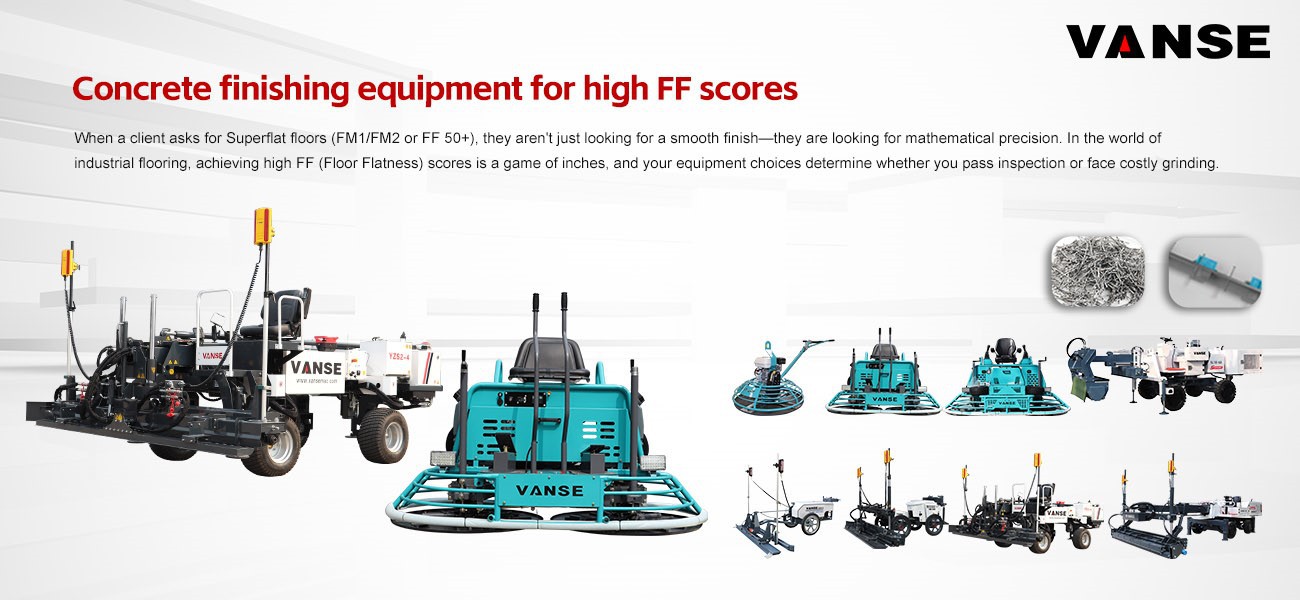
When a client asks for Superflat floors (FM1/FM2 or FF 50+), they aren't just looking for a smooth finish-they are looking for mathematical precision. In the world of industrial flooring, achieving high FF (Floor Flatness) scores is a game of inches, and your equipment choices determine whether you pass inspection or face costly grinding.
To consistently hit those high-spec numbers, you need a synchronized fleet. Here is the professional equipment breakdown for high FF scores, featuring the specialized lineup from Vanse Machinery.
1. The Foundation: Concrete Laser Leveling Machine
You can’t finish a floor flat if it wasn't placed flat. The Concrete Laser Leveling Machine is the most critical variable for FF scores.
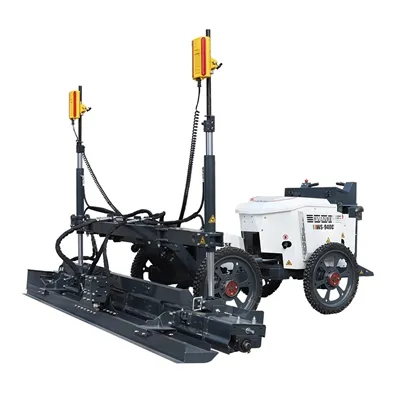
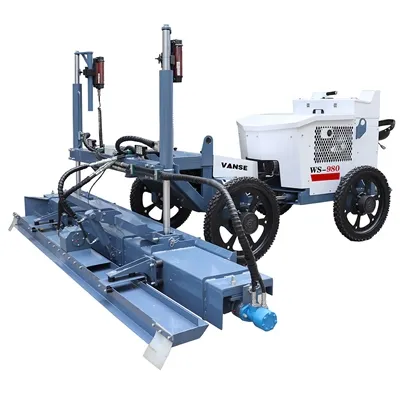
The Vanse Approach: For large-scale warehouse projects, the Vanse YZ30-4E Telescopic Boomed Laser leveling is the industry standard. Its 360-degree rotation and 6-meter telescopic boom allow the leveling head to reach out and strike off the concrete while the machine remains stationary. This prevents "tire track" deviations. For tighter workspaces, the WS940/WS940C/YZ28-4S/YZ25-4 offers the same high-frequency vibration and laser precision in a more agile frame.
2. Strategic Placement: Concrete Distributor & Mini Dumper
Consistency is the enemy of "dips" and "mounds." If your concrete is dumped in massive, uneven piles, the leveling has to work harder, which can lead to inconsistencies in FF scores.
The Workflow: Use a Vanse Concrete Distributor to ensure an even "ribbon" of concrete is placed across the bay. To get material into the strips quickly without disturbing the subgrade, the Vanse Mini Dumper (available in electric and gasoline) is the perfect support tool. It allows for controlled, precise dumping that makes the laser leveling’s job much easier.
3. Surface Integrity: Topping Spreader
High FF floors often require a dry-shake hardener for wear resistance. If you spread this manually, you risk creating "hills" and "valleys" that ruin your flatness numbers.
The Vanse Approach: The Vanse Automatic Topping Spreader applies the material with mechanical consistency. By linking the spreader’s output to the machine's travel speed, you get a uniform layer that integrates perfectly with the wet concrete, preserving the flatness achieved by the laser leveling machine.
4. The Final Polish: Ride-on Power Trowel
Once the slab is leveled, you need to densify it. However, a "chattering" trowel can actually lower your FF score.
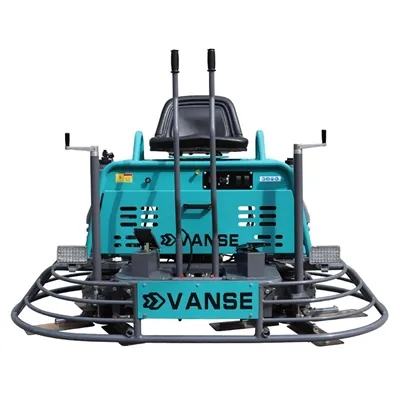
The Workflow: Transition to a Vanse VS1046 Ride-on Power Trowel. With its heavy-duty gearbox and high-torque BRIGGS & STRATTON engine, it provides the steady, powerful compaction needed to "burnish" the floor. Its precision pitch control allows the operator to make micro-adjustments to the blades, smoothing out the surface to a mirror finish without introducing new waves into the slab.
5. Managing the Stress: Concrete Cutting Machine
Even a Superflat floor will fail if the joints are ragged or spalled.
The Workflow: As soon as the concrete can support it, use a Vanse Concrete Cutting Machine (Floor Saw) for your contraction joints. A stable, high-speed saw ensures the edges of the joints stay crisp, which is vital for the long-term maintenance of FF scores once heavy forklift traffic begins.
Why Global Contractors Invest in the Vanse Ecosystem
When you browse www.vansemac.com, you’re looking at a complete Superflat Solution. Here’s why this workflow is the gold standard for international buyers:
Labor Efficiency: A full Vanse fleet can turn a 12-man manual crew into a high-output 5-man team.
Data-Driven Results: These machines are designed to meet ACI 117 and TR34 standards. When you use a Vanse laser leveling followed by a Vanse power trowel, you are practically guaranteed higher F-numbers.
Reliability: In high-spec flooring, equipment downtime can ruin a pour. Vanse uses world-class components (Honda, Rexroth, Danfoss) to ensure your fleet keeps moving until the last pass is done.
Final Word
Achieving high FF scores isn't a secret-it’s a process. By combining the placement precision of the Concrete Distributor, the leveling power of the Laser leveling, and the finishing torque of the Power Trowel, you create a floor that isn't just flat-it's Vanse Flat.
Visit www.vansemac.com to see our full lineup and start hitting those FM1 numbers on your next project.
Note: The parameters provided in this document are for reference only and are not mandatory. Due to differences in technical characteristics between different brands and models of laser levelers, please consult the manufacturer for a suitable solution before actual operation. This reference document assumes no responsibility for any issues arising from failure to follow the manufacturer's instructions.
Thanks to All the Friends Who Support and Trust Shandong Vanse Machinery Technology Co., Ltd.
If you want to know more about Shandong Vanse Machinery Technology Co., Ltd. or have any questions, please feel free to contact us:
Our Factory
Shandong Vanse Machinery Technology Co., Ltd.








Share this article

About the Author: Shandong Vanse Machinery Technology Co., Ltd.
Shandong Vanse Machinery Technology Co., Ltd. is a high-tech manufacturer specializing in concrete construction machinery, including laser screeds and related equipment. The company integrates R&D, production, and global sales, with products exported to over 60 countries and widely used in infrastructure projects worldwide.
Previous Post
Next Post
Related Articles
You Might Also Like
How to judge whether the performance of the concrete power trowel is stable?
– Power output stability: During the operation of the trowel, observe whether its power output is stable. For electric trowels, you can monitor by connecting power detection equipment (such as a power meter). If the power fluctuation range is small under normal working load (for example, the fluctuation range is within ±5% of the rated power), it means that the performance of the motor is relatively stable. For example, a trowel with a rated power of 3kW has an actual working power of 2.85-3.15kW, which is relatively stable. – Heating condition: After the motor (or engine) has been working continuously for a period of time (such as 1-2 hours), check its heating level. Touch the motor housing with your hand (be careful to prevent burns). If it is just warm, it means that the heat dissipation is good and the performance is stable. If it feels very hot, there may be a heat dissipation problem or an internal motor fault, which will affect the performance stability. Generally speaking, the motor housing temperature does not exceed 70-80 degrees Celsius, which is the normal range. – Inspection of transmission components: Check the transmission belt, chain or transmission shaft of the trowel. If it is a belt drive, observe whether the belt slips during operation. A high-quality trowel belt has good friction and toughness, and will not show obvious relaxation or slippage during normal operation. For chain drive, check whether the chain can smoothly transmit power from the motor to the trowel disc, the chain tension is moderate, and there is no abnormal jump or chain derailment. The transmission shaft should be checked for firm connection and looseness or abnormal vibration during rotation. – Rotation stability: Observe the rotation state of the trowel disc during operation. Under normal circumstances, the trowel disc should rotate at a uniform speed without obvious shaking or eccentricity. After the trowel is started, you can stand a little further away and observe the edge of the trowel disc to see if there is any swing up, down, left, or right. If the rotation accuracy of the trowel disc is high and the deviation is within a small range (for example, the edge of the trowel disc does not exceed 2-3 mm), it means that it has good stability and can ensure the uniformity of the trowel effect. – Firmness of installation of the trowel disc: Check the installation of the trowel disc on the trowel disc. The trowel disc should be installed tightly and will not loosen or fall off during operation. You can initially check the firmness of its installation by gently shaking the trowel disc by hand. In addition, after the trowel machine has been running for a period of time, check again whether the trowel disc has shifted to ensure that it can stably participate in the trowel work. – Test the trowel effect multiple times: Perform trowel tests on different ground areas (such as areas with the same area, similar concrete materials and casting conditions). If the indicators such as ground flatness and glossiness after each troweling are close, it means that the performance of the trowel machine is stable. For example, if the gloss meter is used to measure the gloss of the floor after troweling, and the difference of multiple measurement results is within a small range (such as the gloss difference does not exceed 5-10 gloss units), it means that the trowel machine can output performance stably and achieve consistent troweling effect. – Vibration amplitude during operation: During the operation of the trowel machine, observe the vibration of the machine body. You can put your hand on the outer shell of the machine body to feel the vibration. If the vibration is slight, it means that its structural design is reasonable and the parts are closely matched. Generally speaking, when a high-performance and stable trowel machine is working, the vibration amplitude of the machine body is small, and the vertical vibration displacement does not exceed 1-2 mm. – Structural strength of the machine body: Check the frame structure of the trowel machine. The machine body of a high-quality trowel machine is made of solid metal materials (such as high-strength aluminum alloy or steel), and the frame is firmly connected without loose parts. When subjected to certain external forces (such as collisions during transportation or reaction forces during work), the machine body will not be deformed or damaged, thus ensuring the stability of its performance. – Stability of handles and control components: Check whether the handle design of the trowel is reasonable, comfortable to hold, and will not loosen or shake during operation. The control buttons (such as start/stop buttons, speed adjustment buttons, etc.) are sensitive to operation and reasonably located, which is convenient for operators to operate during work. If the handles and control components can work stably during operation, without misoperation or inconvenience in operation, it also reflects the stability of the trowel performance from the side. – Flexibility and stability of movement and steering: For walk-behind trowels, test their movement and steering performance. The trowel should be able to move flexibly on the ground, turn smoothly, and not get stuck or lose control. For example, when troweling corners or edge areas, the trowel can stably change direction and perform fine troweling operations, which indicates that its performance is stable and reliable during operation.How to evaluate performance indicators of concrete laser leveling machine?
•••★••• Introduction Concrete laser leveling machine is an indispensable and important equipment in modern construction. The evaluation of its performance indicators is of great significance to ensure construction quality, improve work efficiency and reduce operating costs. This article will discuss how to comprehensively evaluate the performance of concrete laser leveling machines from aspects such as leveling efficiency, flatness accuracy, equipment stability, laser control system, energy consumption and environmental protection, ease of operation, maintenance and upkeep, and durability and lifespan. Performance. •••★••• Leveling efficiency Leveling efficiency is one of the important indicators to measure the performance of concrete laser leveling machine. When evaluating leveling efficiency, the following aspects are mainly considered: 1. Working speed: The working speed of the equipment directly affects the leveling efficiency. Generally speaking, the faster the working speed, the higher the leveling efficiency. However, it should be noted that working too fast may lead to a decrease in flatness accuracy. 2. Leveling area: The leveling area reflects the concrete surface area that the equipment can process per unit time. A larger leveling area means higher leveling efficiency. 3. Leveling thickness range: The wider the concrete thickness range that the equipment can handle, the stronger its applicability and the leveling efficiency will increase accordingly. •••★••• Flatness accuracy Flatness accuracy is an important indicator for measuring the construction quality of concrete laser leveling machines. When evaluating flatness accuracy, the following aspects are mainly considered: 1. Flatness error: The smaller the flatness error, the higher the flatness accuracy of the equipment. Generally speaking, high-precision concrete laser leveling machines can achieve lower flatness errors. 2. Flatness uniformity: Evaluating the uniformity of flatness in different areas and at different times helps to judge the stability and consistency of the equipment. •••★••• Equipment stability Equipment stability is a key factor in ensuring the continuous and efficient operation of concrete laser leveling machines. When evaluating equipment stability, the following aspects are mainly considered: 1. Equipment structure: Reasonable equipment structure can improve the stability and durability of the equipment. When evaluating equipment construction, focus on its resistance to vibration, impact, and wear. 2. Control system: A stable control system is the key to ensuring the normal operation of the equipment. When evaluating a control system, pay attention to its anti-interference ability, response speed, and fault self-diagnosis capabilities. •••★••• Laser control system The laser control system is the core part of the concrete laser leveling machine. Its performance directly affects the levelinging quality and efficiency. When evaluating the laser control system, the following aspects should be mainly considered: 1. Laser ranging accuracy: Laser ranging accuracy determines the device's ability to perceive ground height. The high-precision laser distance measurement system can achieve more accurate leveling results. 2. Laser tracking stabilizer: The laser tracks the stabilizer to maintain the accuracy of the equipment during continuous operation. The stable laser and hydrazone system can ensure that the equipment maintains high leveling accuracy during long-term operation. •••★••• Energy consumption and environmental protection With the advent of the concept of energy conservation and environmental protection, the energy consumption and environmental protection of equipment have attracted more and more attention. When evaluating the energy consumption and environmental protection of concrete laser leveling machines, the following aspects should be mainly considered: 1. Energy consumption level: Lower energy consumption level means lower costs incurred by the equipment during operation, and also helps reduce energy waste. 2. Noise level: The lower the noise generated during the operation of the equipment, the smaller the impact on the surrounding environment and operators, and the more it meets environmental protection requirements. 3. Emissions: For concrete laser leveling machines that use fuel or gas, it is also an important consideration to evaluate whether their emissions comply with relevant environmental standards. •••★••• Operation convenience Operation convenience is of great significance to improving construction efficiency and reducing labor costs. When evaluating the ease of operation of a concrete laser leveling, the following aspects should be considered: 1. Control system interface: The concise and clear control system interface helps operators quickly master equipment operation skills. 2. Operating steps: Reasonable operating steps can reduce the tediousness and mistakes during the operation and improve work efficiency. 3. Degree of automation: A higher degree of automation can reduce the skill requirements for operators and reduce the impact of human factors on construction quality. •••★••• Maintenance and maintenance Equipment maintenance and upkeep are crucial to extending equipment life and maintaining stable performance. When evaluating the maintenance and upkeep needs of a concrete laser leveling, the following aspects should be considered: 1. Maintenance cycle: A reasonable maintenance cycle can ensure that the equipment is always in good condition during operation. 2. Maintenance content: Detailed maintenance content guidance can help operators correctly maintain equipment and prevent potential failures. 3. Replacement of wearing parts: Evaluating the replacement cycle and cost of equipment wearing parts can help predict long-term operation and maintenance costs. •••★••• Durability and lifespan Durability and lifespan are important indicators for measuring the long-term performance of concrete laser leveling machines. When evaluating the durability and life of equipment, the following aspects are mainly considered: 1. Material selection: High-quality materials can improve the wear resistance and corrosion resistance of the equipment, thereby extending the service life of the equipment. 2. Manufacturing process: Exquisite manufacturing process can ensure that potential defects and hidden dangers are reduced during the manufacturing process of the equipment, and the durability of the equipment is improved. 3. Maintenance records: Understanding the equipment's maintenance records and historical faults will help evaluate the overall performance and remaining life of the equipment. •••★••• Summary To sum up, evaluating the performance indicators of concrete laser leveling requires comprehensive consideration from many aspects. By evaluating indicators such as leveling efficiency, flatness accuracy, equipment stability, laser control system, energy consumption and environmental protection, ease of operation, maintenance and upkeep, durability and lifespan, we can fully understand the performance of the equipment. Provide scientific basis for choosing a suitable concrete laser leveler. At the same time, regular maintenance and upkeep are also key measures to ensure stable equipment performance and extend service life.