Technical Knowledge
Will improper blade angle adjustment affect the working efficiency of the power trowel?

Improper blade angle adjustment will affect the working efficiency of the trowel machine, as follows
Increase trowel time
When the blade angle is too large, the blade cuts too deep into the concrete surface. In each trowel stroke, the blade's role on the concrete is mainly scraping rather than leveling and troweling. It takes many repeated operations to achieve a certain degree of flatness, which undoubtedly increases the trowel time. If the blade angle is too small, due to insufficient pressure on the concrete surface, it is impossible to effectively fill the low-lying areas on the concrete surface at one time, and repeated trowel operations are also required, resulting in longer overall working time.
Reduce machine travel speed
Improper blade angle adjustment will change the resistance encountered by the trowel machine during operation. For example, if the angle is too large, the machine needs to overcome greater resistance to move forward, which will significantly reduce the machine's travel speed. Similarly, if the angle is too small, although the resistance may be relatively small, since the concrete cannot be effectively troweled, in order to ensure the quality of troweling, the operator will have to reduce the machine's travel speed to increase the contact time between the blade and the concrete surface, thereby reducing work efficiency.
Increased energy consumption
Due to improper blade angle, the trowel machine needs to consume more energy to overcome additional resistance or complete multiple repetitive operations during operation. For example, when the angle is too large, the motor needs to output more power to drive the blade to rotate and the machine to move forward, resulting in increased energy consumption. At the same time, the machine may also shorten its service life under high load operation, increase maintenance costs and downtime, and further affect work efficiency.
Thanks to All the Friends Who Support and Trust Shandong Vanse Machinery Technology Co., Ltd.
If you want to know more about Shandong Vanse Machinery Technology Co., Ltd. or have any questions, please feel free to contact us:
Our Factory
Shandong Vanse Machinery Technology Co., Ltd.








Share this article

About the Author: Shandong Vanse Machinery Technology Co., Ltd.
Shandong Vanse Machinery Technology Co., Ltd. is a high-tech manufacturer specializing in concrete construction machinery, including laser screeds and related equipment. The company integrates R&D, production, and global sales, with products exported to over 60 countries and widely used in infrastructure projects worldwide.
Previous Post
Next Post
Related Articles
You Might Also Like
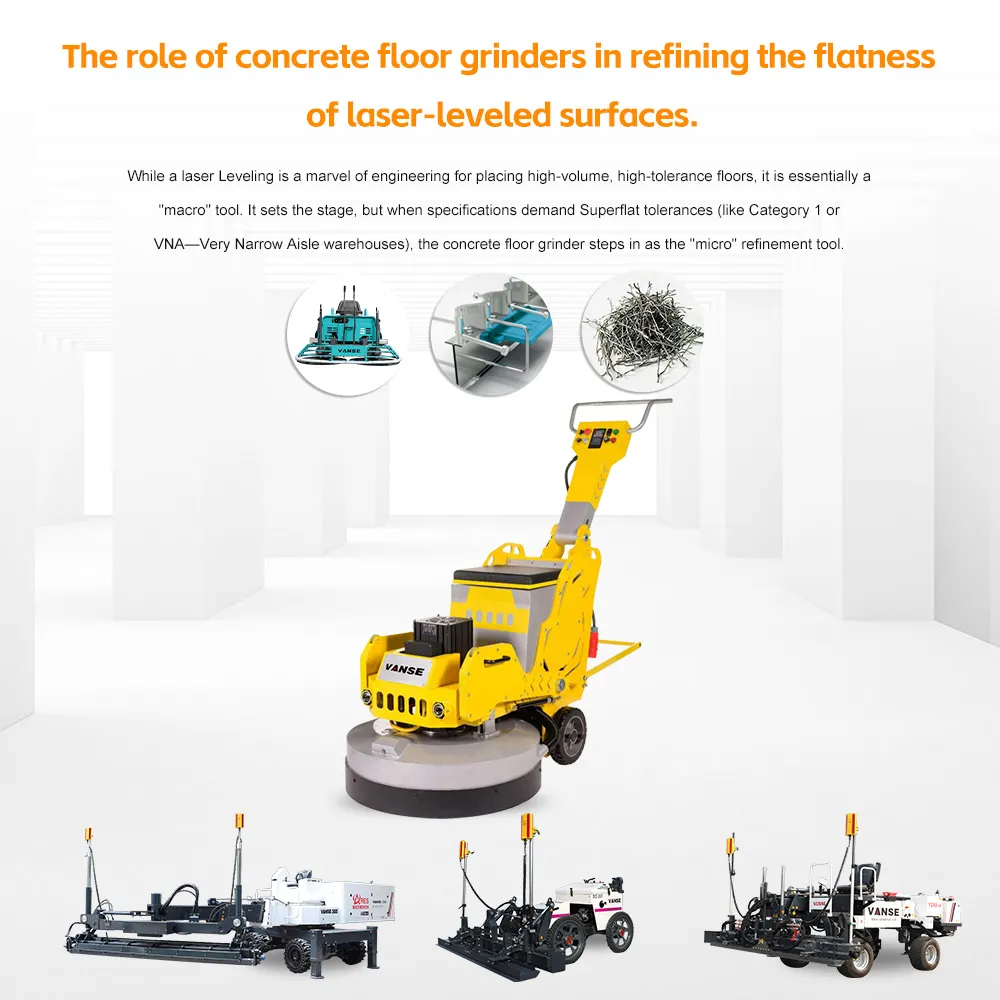
The role of concrete floor grinders in refining the flatness of laser-leveled surfaces
While a laser Leveling is a marvel of engineering for placing high-volume, high-tolerance floors, it is essentially a "macro" tool. It sets the stage, but when specifications demand Superflat tolerances (like Category 1 or VNA-Very Narrow Aisle warehouses), the concrete floor grinder steps in as the "micro" refinement tool. Here is how grinding bridges the gap between a good pour and a perfect surface. Even the best laser Leveling can leave behind subtle periodic waves caused by the vibration frequency of the Leveling head or slight settling of the concrete. The Problem: These waves might only be 1–2 mm high, but at high speeds, a forklift will feel them as significant vibrations. The Solution: Heavy-duty planetary grinders equipped with coarse metal-bond diamonds act as a "plane." Because the machine has a large, rigid footprint, it bridges the valleys and shaves off the peaks (high spots), effectively flattening the Waviness Index. One of the biggest enemies of laser-leveled floors is drying shrinkage, which causes the edges of the concrete slabs to "curl" upward at the saw-cut joints. The Impact: A floor that was perfectly level on day 1 may have "steps" at the joints by day 28. The Refinement: Grinders are used to "chase" these joints. By grinding across the joint, the machine transitions the height difference into a long, imperceptible slope, ensuring smooth wheel transitions for equipment. In the world of floor tolerances, we use F-numbers to measure quality: FF (Flatness): Relates to the bumpiness of the surface. FL (Levelness): Relates to the tilt of the slab. Laser leveling is excellent at achieving high FF (Levelness) because it follows a laser plane. However, achieving an FF (Flatness) above 60 or 80 usually requires mechanical grinding. The grinder removes the "noise" in the data, smoothing out the micro-texture that a Leveling simply cannot address. Feature Laser Leveling (Placement) Floor Grinder (Refinement) Primary Goal Bulk leveling and consolidation. Precision flattening and smoothing. Tolerance Range Good to Great (FF 25–45). Exceptional (Up to FF 100+). Material State Wet/Plastic concrete. Cured/Hardened concrete. Surface Profile Closed-face (cream) finish. Refined, open, or polished finish. For high-spec projects, contractors use a "Measure-Grind-Measure" loop: Initial Measurement: Use a floor profiler (like a Dipstick) to map the high and low spots of the laser-leveled floor. Targeted Grinding: The grinder is used specifically on the "red zones" (high spots) identified by the software. Verification: The floor is re-measured to ensure it meets the Narrow Aisle (VNA) specification. Note: Grinding to refine flatness is different from grinding for aesthetics. In flatness refinement, the goal is stock removal (shaving the concrete), which often exposes the aggregate. If the client wants a uniform look, the entire floor must be ground to the same depth. Would you like me to explain the different types of diamond grit sequences used for stock removal versus final polishing? Contact us NOW Note: The parameters provided in this document are for reference only and are not mandatory. Due to differences in technical characteristics between different brands and models of laser levelers, please consult the manufacturer for a suitable solution before actual operation. This reference document assumes no responsibility for any issues arising from failure to follow the manufacturer's instructions.Laser leveling machine manufacturers professional sharing: the correct way to use the equipment
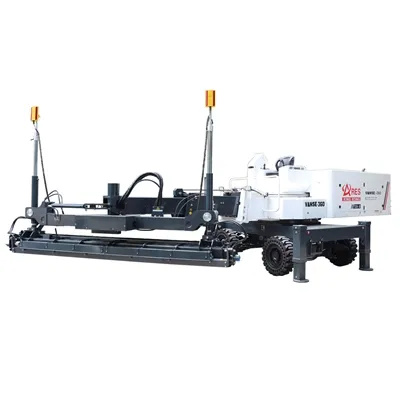
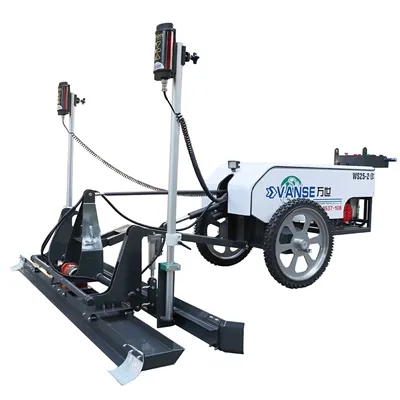
Laser leveling machine is an indispensable equipment in the construction industry. It is indispensable in the construction of large highways. In order to ensure the smooth progress of construction and the smoothness of the road surface, it is necessary to master the correct use of laser leveling machine. Secondly, you should read the instruction manual of the equipment before use, because this will make you familiar with the internal structure of the equipment as soon as possible, so as to achieve correct operation. The following laser leveling machine manufacturer will show you the correct use of laser leveling machine. 1. Laser leveling machine manufacturers explain from a professional perspective that it is important not to work under a load that exceeds the load that the machine can bear. The laser leveling machine should be used to the best of one's ability. As a laser leveling machine manager, when designating an operator, the laser leveling machine random data and operation manual should be handed over to the operator so that he can master the mechanical performance and operating procedures normally, and the relevant data should not be withheld at will. 2. Laser leveling machine manufacturers explain from a professional perspective that it is necessary to try to ensure the uniform addition and subtraction of the load of the laser leveling machine, so that the machine is in a relatively gentle load change. Specifically, it is necessary to add and subtract the throttle more evenly to prevent the ups and downs of the engine and working device. 3. Laser leveling machine manufacturers explain the scientific use of lubricants from a professional perspective. According to statistics, more than half of the leveling machine failures are caused by poor lubrication. Due to the precision of the various parts of the laser leveling machine, good lubrication can keep it in a normal working gap and a suitable working temperature, thereby reducing the degree of wear of the parts and reducing mechanical failures. Normal and reasonable lubrication is one of the effective measures to reduce mechanical failures. To this end, first, it is necessary to reasonably select lubricants. During use, neither low-grade lubricants nor other types of lubricants can be used as substitutes, let alone inferior products. Second, the quantity and quality of lubricants should be checked frequently. 4. Laser leveling machines should be maintained and repaired in a timely manner. Laser leveling machines will inevitably have various failures during use. Among these failures, some failures may have a very small impact on mechanical equipment, while some are more serious and may even cause major accidents of machine destruction and death. The knowledge shared by the laser leveling machine manufacturer for you has basically come to an end here. If you have the intention to understand the equipment, you can contact us by phone, or log in to our official website and leave us a message. We will solve your problem as soon as we see it. Thank you for your reading.Construction conditions of concrete laser leveling machine under different environmental conditions
The impact and adaptability of the concrete laser leveling machine on the environment and its use under different climate conditions are as follows: 1. Impact on the environment The impact of concrete laser leveling machines on the environment is mainly reflected in the following aspects: Reduce dust and noise Compared with traditional concrete leveling methods, concrete laser leveling machines use advanced laser measurement and control technology to accurately control the leveling thickness and slope, reducing the waste of concrete materials and dust. At the same time, due to the use of a low-noise engine, the machine makes relatively little noise and has less impact on the surrounding environment and residents. High efficiency and water saving The concrete laser leveling uses advanced water-saving technology during the construction process, which can effectively reduce water usage. At the same time, the machine can also recycle waste water and sewage, further reducing water consumption. Improve construction efficiency Compared with traditional concrete leveling methods, concrete laser leveling machines have the characteristics of automation, intelligence and high precision, which can greatly improve construction efficiency. At the same time, the construction speed of the machine can also be adjusted as needed to adapt to different construction needs. 2. Adaptability to the environment The concrete laser leveling machine has strong adaptability to the environment and can be used for construction in different climate conditions. Specifically, the adaptability of the machine is reflected in the following aspects: Adapt to different climate conditions The concrete laser leveling machine adopts advanced dust-proof, rain-proof, wind-proof and other measures, and can carry out construction under different climate conditions. At the same time, the machine is also equipped with a heating device and a heat preservation device, which can operate normally in low-temperature environments, improving the adaptability and reliability of the machine. Adapt to different terrain and geological conditions The concrete laser leveling machine adopts advanced mechanical and hydraulic control systems, which can accurately control the leveling thickness and slope, and adapt to different terrain and geological conditions. At the same time, the machine is also equipped with a variety of different attachments such as working heads and scrapers, which can be selected for different construction needs. Adaptable to different materials and concrete mix ratios The concrete laser leveling machine adopts advanced laser measurement and control technology, which can accurately control the leveling thickness and slope, and adapt to different materials and concrete mix ratios. At the same time, the machine can also be adjusted and modified as needed to adapt to different construction needs and material properties. 3. Effects of use under different climate conditions The use effects of concrete laser leveling machines under different climate conditions are as follows: Under high temperature conditions Under high temperature conditions, concrete laser levelinging machines need to strengthen dust-proof, rain-proof, wind-proof and other measures to ensure the normal operation and construction effect of the machine. At the same time, high temperature will also accelerate the solidification speed of concrete. Construction time and concrete mix ratio need to be reasonably arranged to ensure construction quality and use effect. Under low temperature conditions Under low temperature conditions, the concrete laser leveling needs to strengthen heating and insulation measures to ensure the normal operation and construction effect of the machine. At the same time, low temperature will also affect the initial setting time and strength growth rate of concrete. Construction time and concrete mix ratio need to be reasonably arranged to ensure construction quality and use effect. Under humid conditions Under humid conditions, the concrete laser leveling needs to strengthen moisture-proof, waterproof and other measures to ensure the normal operation and construction effect of the machine. At the same time, moisture will also affect the solidification speed and strength growth rate of concrete. Construction time and concrete mix ratio need to be reasonably arranged to ensure construction quality and use effect. Under windy and sandy conditions Under windy and sandy conditions, the concrete laser leveling needs to strengthen dust-proof, wind-proof and other measures to ensure the normal operation and construction effect of the machine. At the same time, wind and sand will also affect the accuracy and stability of the laser measurement and control system. It is necessary to strengthen the maintenance and upkeep of the equipment to ensure the accuracy and effectiveness of the equipment. In short, the concrete laser leveling machine performs well in terms of environmental impact and adaptability and its use in different climate conditions. It has the characteristics of high efficiency, precision and intelligence, and can greatly improve construction efficiency and quality. Under different climate conditions, as long as appropriate measures and technical means are taken, the machine can still operate normally and achieve good results.