Technical Knowledge
The importance of after-sales service when purchasing a laser leveling machine

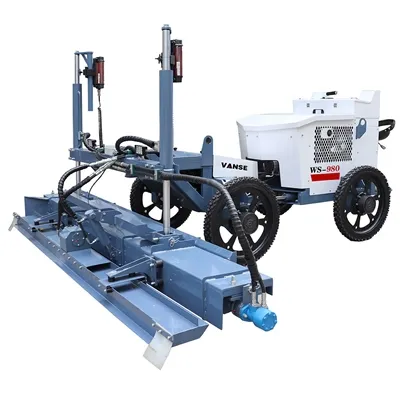
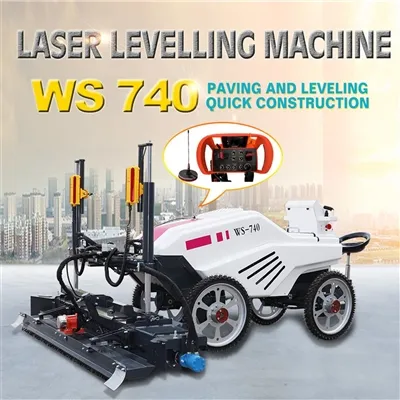
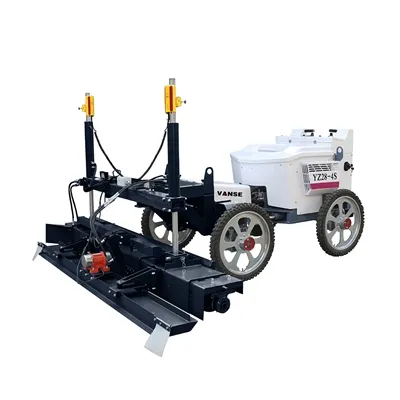
Today's building floor construction uses laser leveling machines, and the quality of the floor paved is much better than that of traditional methods – first, the flatness and levelness of the floor are improved by more than 3 times, and the density and strength of the floor are increased by more than 20%. At the same time, it can also shorten the construction period by 40% and save about 49% of labor. It can also greatly save costs in later maintenance, because laser leveling machine construction can more easily lay high-strength concrete, low-slump concrete and fiber mud concrete. The construction effect of the laser leveling machine is good, and it is a step for laser leveling machine manufacturers to gain praise from users, but if they want to gain a long-term foothold, they still need solid after-sales service to support them.
As a laser leveling machine manufacturer, Shandong Vanse Machinery has been working hard to provide services to all customers, no matter where you are in the world. But words are not enough. You can only understand our services when you need help. Here are 4 reasons why after-sales support is particularly important when purchasing a laser leveling machine.
1. Time is money
When you encounter problems during the construction of your equipment and need assistance, you can immediately contact the after-sales service engineer. You don't have to wait a few days to call. This is why you need excellent after-sales support. It will be critical when you need it, especially when you invest in a laser leveling machine. We know that all contractors are located in different time zones and work at different times. This is why we provide support services for our products.
2. Get solutions immediately when you need them
When you encounter problems, our services are always available to help you identify the root cause of the problem and find solutions. The value of our products is that on the job site, you only need to take care of your own affairs. Our excellent products can help you complete most of the work.
3. Make your equipment available anytime, anywhere
Before construction, you need to ensure that the machine is properly maintained and in good condition. Whether you are an experienced operator or a novice operator, or your machine has been idle for a long time, we can provide corresponding services. Our service agreement can ensure that you will not encounter any problems when you are ready to work and need to run the machine.
4. Understand how to maintain your laser leveler
For every product we manufacture, we will provide after-sales support at any time, and at the same time we hope that our customers will know some knowledge about how to maintain the product. In addition to providing maintenance plans for each customer, customer service will also follow your every step of maintenance.
The service life of a leveler is generally very long, and it is inevitable to encounter after-sales maintenance services in the middle, so when purchasing, you must understand the importance of laser leveling after-sales service, and examine the company's after-sales service capabilities.
Thanks to All the Friends Who Support and Trust Shandong Vanse Machinery Technology Co., Ltd.
If you want to know more about Shandong Vanse Machinery Technology Co., Ltd. or have any questions, please feel free to contact us:
Our Factory
Shandong Vanse Machinery Technology Co., Ltd.








Share this article

About the Author: Shandong Vanse Machinery Technology Co., Ltd.
Shandong Vanse Machinery Technology Co., Ltd. is a high-tech manufacturer specializing in concrete construction machinery, including laser screeds and related equipment. The company integrates R&D, production, and global sales, with products exported to over 60 countries and widely used in infrastructure projects worldwide.
Previous Post
Next Post
Related Articles
You Might Also Like
How does the concrete laser leveling machine ensure construction accuracy?
1. Laser technology Laser technology is one of the most important components of concrete laser leveling machines, providing the equipment with high-precision measurement and positioning capabilities. Through the characteristics of laser, the equipment can accurately measure and position the construction surface, ensuring that the leveler can accurately control the depth and position of the scraper during work, thus improving construction accuracy. 2. Sensing technology Sensing technology is also a key part of the concrete laser leveling machine, which can monitor the operating status and working accuracy of the equipment in real time. Through various sensors, such as pressure sensors, displacement sensors and angle sensors, the equipment can monitor the pressure, position and angle of the scraper in real time, and feed this information back to the control system to adjust the operating status of the equipment in a timely manner to ensure construction Accuracy 3. Automation control system The automatic control system is the core part of the concrete laser leveling machine, which can realize automatic control and intelligent management of the equipment. Through the automated control system, the equipment can automatically complete various operations such as calibration, leveling, and detection, reducing the impact of human factors on construction accuracy. At the same time, the automated control system can also intelligently adjust the operating parameters and status of the equipment according to different construction needs and environmental conditions, improving the adaptability and construction accuracy of the equipment. In short, the concrete laser leveling machine can achieve high-precision measurement, control and intelligent management by using advanced technologies such as laser technology, sensing technology and automated control systems, thus ensuring the accuracy and quality of construction. The application of this technology has greatly It improves the efficiency and precision of concrete construction and provides strong support for the construction of buildings, roads, bridges and other fields.Concrete Laser Leveling Machine Application Fields
The concrete laser leveling is an efficient construction equipment that is widely used in modern construction sites. It has a wide range of applications and can be used in many fields, such as industrial plants, workshops, automated three-dimensional warehouses, electronic appliances, food materials, pharmaceutical large-scale warehouse supermarkets, logistics centers, exhibition centers, docks, container yards, cargo yards, Airport runways, aprons, parking lots, squares, residential grounds, municipal roads, etc. In industrial plants and workshops, concrete laser levelings can lay flatter floors for production lines, facilitate the movement of equipment, machines and personnel, and improve production efficiency and product quality. In automated three-dimensional warehouses, this equipment can provide a flat floor for the storage and transportation of goods, improving the operational efficiency of the warehouse and the safety of goods. In the fields of electronic appliances and food materials, concrete laser leveling machines can provide flat floors for production workshops and warehouses to ensure product quality and safety. In the pharmaceutical field, this equipment can provide a dust-free, flat floor for pharmaceutical production and storage, ensuring the quality and safety of pharmaceuticals. In large warehouse supermarkets and logistics centers, concrete laser leveling machines can provide a flat floor for the storage and transportation of goods, improve the turnover efficiency of goods and reduce damage to goods. In the exhibition center, this equipment can provide a flat floor for the exhibition hall to ensure the smooth progress of the exhibition. In terminals and container yards, concrete laser levelings can provide a flat surface for the transportation of goods and equipment, improve terminal operation efficiency and reduce damage to goods. In airport runways, this equipment can provide a flat surface for aircraft to take off and land, ensuring the safety of aircraft and the comfort of passengers. In parking lots and squares, concrete laser levelings can provide vehicles with a smooth driving surface, reduce vehicle wear and noise, and improve driving safety and comfort. In residential grounds and municipal pavements, this equipment can provide residents with smooth and beautiful roads and public facilities, improving residents' quality of life and the image of the city. In general, the concrete laser leveling machine is an efficient, accurate, and flexible sensor device that is used in many fields such as construction, transportation, and T industries. It has injected new impetus into the development of various industries and promoted the construction industry. development of the industry. With the continuous development of new technologies, concrete laser levelings have unlimited development potential and will become an indispensable and important equipment in the construction industry. In addition to the application areas mentioned above, concrete laser levelings can also be used in other places where ground leveling is required. For example, in the construction of garden landscapes, the equipment can provide flat ground for garden roads and squares: in the construction of sports venues, the equipment can provide flat, non-slip ground for sports venues; in the agricultural field, the equipment can provide flat, non-slip ground for farmland. and greenhouses provide a flat ground to improve crop growth efficiency and yield. In addition, concrete laser levelinging machines can also be used in some special environments. For example, in cold areas, the equipment can work normally in low-temperature environments to facilitate winter construction; in desert areas, the equipment can adapt to construction in harsh environmental conditions such as sandstorms; in marine environments, the equipment can be used Construction of offshore platforms and docks In short, the application fields of concrete laser leveling machines are very wide and can be used in various places and special environmental conditions that require smoothing of the ground. With the continuous advancement of technology and the continuous expansion of application fields, the application prospects of concrete laser leveling machines will become even broader.How to choose suitable supporting facilities for concrete laser leveling machine
The selection of supporting facilities for concrete laser leveling machines needs to comprehensively consider factors such as construction requirements, site conditions, and equipment performance. The following are specific suggestions: 🎊 Laser transmitter and receiver: Products with high precision and good stability should be selected, such as Swiss Leica and American Trimble's laser transmitter and receiver, which can accurately control the construction surface and cover various situations such as planes, slopes, and double slopes (three-dimensional). Ensure that the emission range of the laser transmitter can meet the area requirements of the construction site, the signal transmission is stable, and the anti-interference ability is strong. 🎊 Vibration equipment: If the thickness of the concrete to be constructed is large, a high-frequency plug-in vibrator with a vibration frequency of more than 100Hz can be selected, such as a motor-mounted plug-in vibrator, which is generally 50-100mm in diameter. It can be selected according to the slump of concrete and the actual construction situation. When the slump is large, a smaller diameter can be selected. The effective action radius is generally 4-10 times the diameter of the vibrator rod. The vibration spacing should not be greater than 1.5 times its effective action radius, and not greater than 500mm. For large-scale construction, consider equipping a row vibrator with a spiral distributor and a loose control scraper, and with an automatic walking function to improve construction efficiency. 🎊 Concrete conveying equipment: Select a suitable concrete pump according to the size of the construction site and the amount of concrete poured. If the site is large and the amount of pouring is large, a large concrete pump truck with strong conveying capacity and long conveying distance can be selected; if the site is narrow or indoor construction is required, a small concrete pump or ground pump can be considered to ensure that the concrete can be delivered to the construction site in a timely and even manner, matching the construction speed of the laser leveler. 🎊 Tredging equipment: After the concrete is leveled, it needs to be troweled. You can choose a driving power trowel (VS836/VS836H) and select the appropriate model and power according to the construction area. Large-scale floor construction can use a large driving power trowel (VS1046/VS1046H) to improve work efficiency; for corners or small areas, a small hand-held power trowel (VS436/VS424) can be used to ensure the overall flatness and finish of the floor. 🎊 Measuring tools: Levels, total stations and other measuring tools are essential for site elevation measurement before construction and flatness monitoring during construction. Instruments with accuracy that meets construction requirements should be selected, and they should be easy to operate and measure accurately, so that construction personnel can adjust the construction parameters of the laser leveler in a timely manner. 🎊 Auxiliary tools: Such as levels, rulers, and scales, which can be used to check the flatness of the floor at any time, find problems in time and make adjustments. Plastic films, curing agents, etc. can also be prepared for maintenance after concrete pouring to ensure the normal growth of concrete strength and improve floor quality. Click the below to jump immediately!!! ARMOUR JOINT CONCRETE LEVELING MACHINE LIGHT TOWER POWER TROWEL SLIPFORM MACHINE STEEL FIBER TOPPING SPREADER TRACKED MINI DUMPER