Technical Knowledge
Can a concrete laser leveling machine handle slopes? Which settings work best?
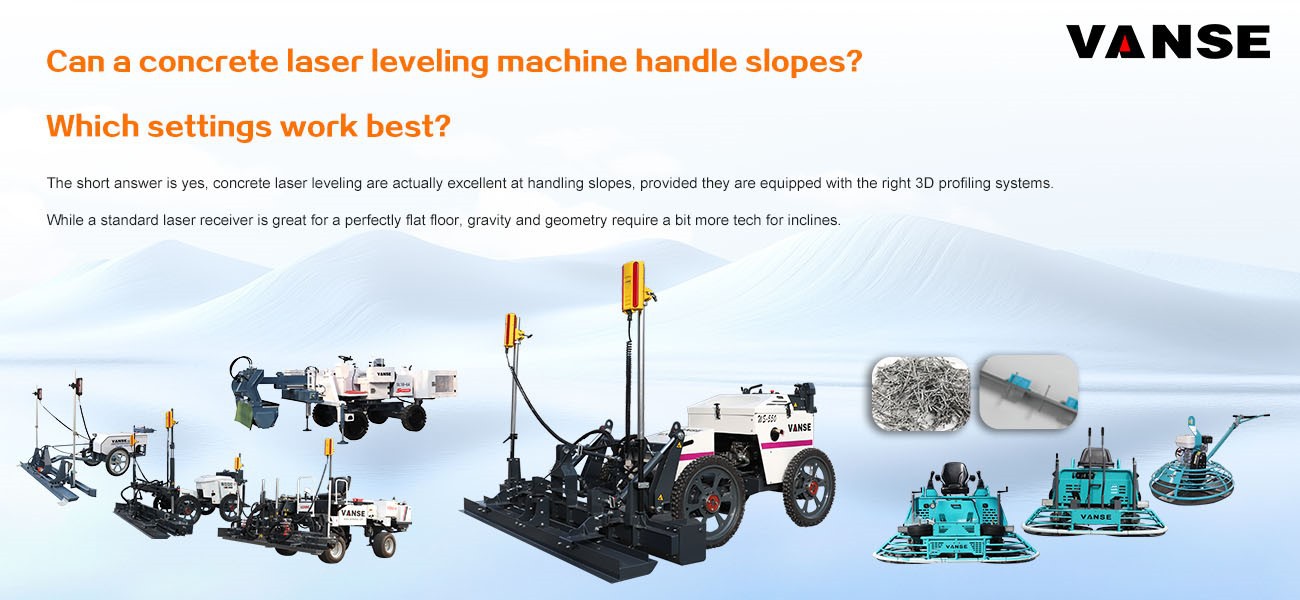
The short answer is yes, concrete laser leveling are actually excellent at handling slopes, provided they are equipped with the right 3D profiling systems. While a standard laser receiver is great for a perfectly flat floor, gravity and geometry require a bit more tech for inclines.
How it Works: 2D VS 3D Systems
Standard laser leveling uses a rotating laser transmitter on a tripod and receivers on the machine. This creates a flat "plane" of light.
Single/Dual Slopes (2D): If you are doing a simple parking lot ramp or a consistent drainage slope, you can physically tilt the laser transmitter on its tripod to a specific percentage (e.g., a 1% grade). The machine will then follow that tilted plane.Complex Contours (3D): For complex curbs, valleys, or multi-directional slopes, the machine uses 3D Profiling Systems (often involving a Total Station or GPS). This allows the leveling to automatically adjust the head height based on its exact coordinate position on a digital map.
Best Settings & Operational Tips
To get the best finish on a slope, you can't just "set it and forget it." You need to account for the way wet concrete behaves under gravity.
1. Adjust the Augur Speed
On a slope, concrete tends to "slump" or migrate downward.
Setting: Keep the auger speed high enough to move excess material but not so fast that it creates a "wave" of concrete that pulls away from the high side.
2. Vibrator Frequency
The vibrator is what settles the aggregate and brings the "cream" to the top.
Setting: On steep slopes, lower the vibration frequency slightly. Over-vibrating on an incline can cause the concrete to fluidize too much, leading it to slide down the hill before it sets (slumping).
3. "Down-Hill" VS "Up-Hill" leveling
Best Practice: Generally, you want to pull the machine up the slope or work across the fall. Pulling downhill can lead to "shingling," where the leveling head pushes too much material in front of it, resulting in an uneven thickness.
4. Laser Compensation Settings
If your machine has slope compensation software, ensure it is toggled on. This adjusts the hydraulic response time to ensure the leveling head reacts instantly to changes in elevation without "hunting" or bouncing, which happens more often on uneven grades.
Summary Table: Slope Optimization
| Factor | Standard Flat Setting | Slope Setting |
| Laser Mode | Horizontal / Level | Grade / Manual Slope |
| Vibration | High / Normal | Reduced (to prevent slump) |
| Travel Speed | Faster | Slower & More Consistent |
| Concrete Slump | 4" – 5" | 3" – 4" (Lower is better for slopes) |
Note: The parameters provided in this document are for reference only and are not mandatory. Due to differences in technical characteristics between different brands and models of laser levelers, please consult the manufacturer for a suitable solution before actual operation. This reference document assumes no responsibility for any issues arising from failure to follow the manufacturer's instructions.
Thanks to All the Friends Who Support and Trust Shandong Vanse Machinery Technology Co., Ltd.
If you want to know more about Shandong Vanse Machinery Technology Co., Ltd. or have any questions, please feel free to contact us:
Our Factory
Shandong Vanse Machinery Technology Co., Ltd.








Share this article

About the Author: Shandong Vanse Machinery Technology Co., Ltd.
Shandong Vanse Machinery Technology Co., Ltd. is a high-tech manufacturer specializing in concrete construction machinery, including laser screeds and related equipment. The company integrates R&D, production, and global sales, with products exported to over 60 countries and widely used in infrastructure projects worldwide.
Previous Post
Next Post
Related Articles
You Might Also Like
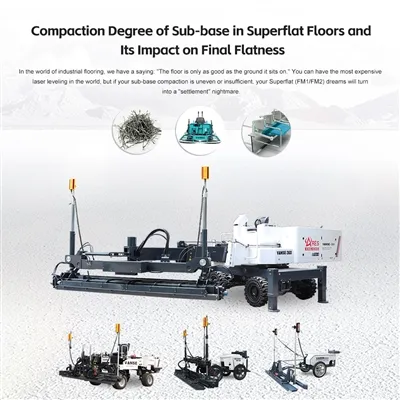
Compaction Degree of Sub-base in Superflat Floors and Its Impact on Final Flatness
In the world of industrial flooring, we have a saying: "The floor is only as good as the ground it sits on." You can have the most expensive laser leveling in the world, but if your sub-base compaction is uneven or insufficient, your Superflat (FM1/FM2) dreams will turn into a "settlement" nightmare. If you're a contractor or facility owner, understanding the link between sub-base compaction degree and final flatness (FF/FL numbers) is critical. Here's a professional breakdown of how to get the foundation right, featuring the technical workflow from Vanse Machinery. Think of the sub-base as an anvil. When you use a Power Trowel to densify the concrete, the concrete is being compressed between the blades and the sub-base. If the sub-base has "soft spots" (low compaction degree), the slab will deflect under the weight of the machines and the concrete itself. The Impact: Even a 2mm settlement in the sub-base during the pour can tank your FL (Levelness) scores. This is why a compaction degree of at least 95% to 98% Proctor density is usually the standard for high-spec warehouses. A common mistake is compacting the sub-base perfectly, then driving heavy concrete trucks over it, creating deep ruts that ruin the uniformity. The Vanse Solution: Instead of heavy trucks, pro contractors use a Vanse Concrete Distributor or the Vanse Mini Dumper. These machines are designed to be agile. The Vanse Mini Dumper (available in electric or gasoline) allows you to move concrete to the exact spot without the massive point-load of a transit mixer, preserving the integrity of your compacted sub-grade. Even with good compaction, the weight of a leveling machine can sometimes cause micro-movements in the sub-base. The Vanse Solution: This is where the Vanse YZ30-4E Telescopic Boomed Laser leveling is a game-changer. Unlike traditional "drive-in" leveling, the telescopic boom allows the leveling head to reach out 6 meters while the machine stays stationary. This minimizes the "footprint" on the compacted sub-base, ensuring that the laser-accurate strike-off is based on a stable reference point, not a moving one. If the sub-base isn't uniform, the concrete will cure at different rates, leading to "curling" at the joints-the #1 enemy of long-term flatness. Use a Vanse Automatic Topping Spreader to apply hardener uniformly. This ensures the "skin" of the concrete is as tough as the base. Follow up with a Vanse VS1046H Ride-on Power Trowel. The high-torque 35HP BRIGGS & STRATTON engine provides the force needed to "burnish" the floor. If your sub-base is solid, this troweling process creates a rock-hard, Superflat surface that won't shift over time. Finally, protect those joints with a precision Vanse Concrete Cutting Machine (Floor Saw) to ensure stress is relieved exactly where it should be. Factor Poor Compaction Result Vanse-Enabled Professional Result FF/FL Scores Fails due to micro-settlement. Hits FM1/FM2 consistently. Joint Health Spalling and curling. Clean, stable transitions with Floor Saws. Labor Cost High (due to rework/grinding). Low (Get it right the first time). Equipment Performance Machines "sink" or vibrate poorly. Maximum precision with Telescopic leveling. You can't cheat the physics of a Superflat floor. Hitting ±1mm over 3 meters requires a solid sub-base and the world's most precise machinery. By combining the placement agility of the Mini Dumper with the telescopic reach of the Vanse Laser leveling (www.vansemac.com), you ensure that your floor stays flat from the day of the pour until decades of forklift traffic later. Don't build on a weak foundation. Explore the full Vanse fleet today and see how our technology supports your highest-spec projects. Note: The parameters provided in this document are for reference only and are not mandatory. Due to differences in technical characteristics between different brands and models of laser levelers, please consult the manufacturer for a suitable solution before actual operation. This reference document assumes no responsibility for any issues arising from failure to follow the manufacturer's instructions.How to evaluate the reliability of concrete laser leveling machine?
In the field of modern concrete construction, concrete laser leveling machine (concrete laser leveling machine or concrete laser leveler) has become the preferred equipment for many large projects due to its high efficiency and precision. With the continuous increase in the industry's requirements for construction quality and efficiency, as well as the continuous development of industries such as infrastructure construction and real estate, the market demand for concrete laser leveling machines is growing. According to relevant reports, the global concrete laser leveling machine market size is expected to reach US$1.76 billion in 2025, with an annual growth rate of approximately 11.4%. In this context, it is particularly important to evaluate the reliability of concrete laser leveling machines, which is not only related to construction quality, but also closely related to the cost and progress of the project. Leveling accuracy is the core performance indicator of concrete laser leveling machines, which directly determines the flatness of the concrete surface after construction. In projects such as airport runways and precision electronic factories that require extremely high ground flatness, high-precision laser leveling machines are indispensable. Some of the internationally renowned brands use advanced 3D laser scanning technology to achieve a flatness accuracy of ±2 mm. Some leading domestic companies, such as Shandong Vanse Machinery Technology Co., Ltd., currently have product accuracy of ±2 mm, of which the WS940C/YZ30-4E uses 3D laser scanning technology. When evaluating the leveling accuracy, you can view the technical parameter description of the equipment and refer to the test data of actual construction cases. At the same time, pay attention to the stability of the laser system. Stable laser signal transmission can ensure continuous and accurate leveling operations. For example, in the floor construction of large shopping malls, the use of high-precision laser leveling machines can ensure that the floor will not cause uneven laying of floor tiles or inconvenience for pedestrians due to flatness problems during long-term use. Work efficiency directly affects the construction progress and cost of the project. Taking the common large-scale industrial plant construction as an example, the traditional manual leveling method not only consumes a lot of manpower, but also has a slow construction speed, while the concrete laser leveling machine shows significant advantages. The concrete laser paving and leveling machine can complete 3,000 square meters of work per day and 350 square meters per hour (depending on the type of machine, the construction area completed varies), greatly shortening the construction cycle. When evaluating work efficiency, it is necessary to comprehensively consider parameters such as the equipment's travel speed, vibration frequency, and scraping width. At the same time, combined with the actual construction environment, such as site size and concrete supply, it is necessary to determine whether the equipment can maintain efficient operation under different working conditions. For example, in the construction of a narrow underground parking lot, the mobility and flexible operation of the equipment have a greater impact on work efficiency. As the "eye" of the concrete laser leveling machine, the stability of the laser system is crucial. A stable laser system can ensure that the equipment continues to provide an accurate elevation benchmark during long-term operation. Some high-end laser leveling machines are equipped with a dual-axis automatic compensation system, which can effectively reduce the interference of the laser signal caused by uneven ground or equipment vibration. When evaluating the stability of the laser system, the performance of the equipment under different ground conditions can be observed, such as whether the laser system can quickly adjust and maintain stable elevation control when constructing on a foundation with large undulations. At the same time, understand the protection level and anti-interference ability of the laser transmitter, as well as whether it has an automatic calibration function. For example, in a dusty construction site, a laser transmitter with a good dustproof design can better maintain signal stability and ensure the accuracy of the leveling operation. Reasonable structural design is the basis for ensuring the stable operation and durability of the concrete laser leveling machine. The overall structure of the equipment should fully consider the stress conditions during operation to ensure that key components such as the frame and vibrating device have sufficient strength and rigidity. Taking the driving laser leveling machine as an example, its frame structure needs to bear the weight of the equipment itself, the weight of the operator, and the vibration impact during operation. Therefore, it is mostly welded with high-strength steel and optimized to disperse stress and prevent deformation or breakage. In addition, the layout of the equipment should be easy to operate and maintain, and the connection and transmission methods between the components should be simple and reliable. For example, some advanced laser leveling machines adopt a modular design, integrating components with different functions into independent modules, which is convenient for quick replacement of faulty modules during maintenance and shortening downtime. The manufacturing process is directly related to the quality and reliability of the equipment. During the manufacturing process of high-quality concrete laser leveling machines, extremely high processing accuracy is required for parts. Taking the scraper of the leveling machine as an example, the surface flatness and straightness errors must be controlled within a very small range to ensure uniformity and high precision when leveling concrete. At the same time, advanced welding technology and surface treatment technology are also the key to improving equipment quality. For example, the use of robot welding technology can ensure uniform and firm welds and improve the stability of welding quality; hot-dip galvanizing or painting of key components can effectively enhance the anti-corrosion ability of the equipment and extend its service life. When evaluating the manufacturing process level, you can check the production qualifications and quality certification system of the equipment manufacturer, as well as understand its reputation and performance in the industry. For example, manufacturers with ISO quality management system certification usually follow stricter quality control standards during the production process. The durability of key components of concrete laser leveling machines, such as engines, hydraulic systems, electrical components, etc., directly affects the overall service life of the equipment. Take the engine as an example. Under the condition of continuous long-term operation, high-quality engines can maintain stable power output, and have good heat dissipation performance and low failure rate. Some laser leveling machines that use well-known brand engines can run for thousands of hours without failure under harsh working conditions after rigorous durability testing. When evaluating the durability of key components, you can check the brand, model and related technical parameters of the components to understand their reputation and actual application cases in the market. At the same time, pay attention to the warranty period of the components provided by the manufacturer. A longer warranty period usually means confidence in the quality of the components. For example, if the oil pump, oil cylinder and other components in the hydraulic system are made of high-quality materials and advanced manufacturing processes, leakage and wear can be effectively reduced, and the reliability and durability of the system can be improved. Equipment that is easy to maintain can reduce the cost of use and improve the availability of the equipment. The concrete laser leveling machine should have a design that is convenient for inspection, cleaning and replacement of parts. For example, the engine hood of the equipment should be easy to open, so as to facilitate daily inspection of oil level, air filter and other components; the installation position of key components should be easy to operate, such as the filter element of the hydraulic system, which should be designed in a position that is easy to disassemble and replace. In addition, the manufacturer should provide a detailed maintenance manual to clarify the maintenance cycle, maintenance items and operation methods, and provide original parts support in a timely manner. Some advanced laser leveling machines are also equipped with a fault diagnosis system that can quickly locate the fault point and provide accurate maintenance instructions for maintenance personnel. For example, when the electrical system of the equipment fails, the fault diagnosis system can prompt the specific fault code through the indicator light or display screen to help maintenance personnel quickly troubleshoot the problem and shorten the maintenance time. By investigating the actual performance of concrete laser leveling machines under different working conditions, we can more intuitively understand its reliability. In the construction of large storage centers, due to the large ground area and high flatness requirements, the laser leveling machine needs to work continuously for a long time, which is a great test for the stability and durability of the equipment. In the construction of some outdoor parking lots with complex terrain, the equipment not only has to deal with the ups and downs of the ground, but may also face the influence of bad weather. At this time, the adaptability and reliability of the equipment are particularly important. By collecting construction feedback from similar projects, we can fully understand the advantages and disadvantages of the equipment under different working conditions. User feedback and word of mouth are important bases for evaluating the reliability of concrete laser leveling machines. In industry forums, social media groups and professional equipment evaluation websites, a large number of users' evaluations of laser leveling machines of different brands and models can be collected. For example, after using a certain brand of laser leveling machine for a period of time, some users reported that the laser system of the equipment had a problem of reduced accuracy after half a year of use, while other users praised a certain equipment for its simple operation and convenient maintenance, and stable performance in multiple projects. In addition, you can communicate with construction companies and engineering contractors who have actually used the equipment to understand the problems they encountered during long-term use and their evaluation of the overall performance of the equipment. By comprehensively analyzing a large number of user feedback, we can have a more accurate understanding of the reliability of concrete laser leveling machines of different brands and models, and provide a strong reference for equipment selection. Click the below to jump immediately!!! ARMOUR JOINT CONCRETE LASER LEVELING MACHINE LIGHT TOWER POWER TROWEL SLIPFORM MACHINE STEEL FIBER TOPPING SPREADER TRACKED MINI DUMPERHow to troubleshoot the laser signal loss fault of the concrete laser leveling machine? Can I solve it myself or do I need to find professional maintenance personnel?
If the laser signal of the concrete laser leveling is lost, in most cases, you can first check it step by step by yourself. If the problem still cannot be solved after checking, you need to contact professional maintenance personnel. The core troubleshooting logic is "gradually locating from the signal source to the receiving end", first eliminating external interference and simple connection issues, and then determining hardware faults. Troubleshooting in the following order can solve over 80% of signal loss problems without the need for professional tools: Check the status of the laser emitter Confirm whether the transmitter is powered on and whether the power indicator light is on normally (if it is not on, check whether the power cord is plugged in tightly and whether the power adapter is damaged). Observe whether the transmitter is placed horizontally and whether the bottom leveling bubble is in the center (tilting will cause signal deviation, and manual leveling needs to be re-done or the automatic leveling function should be enabled). Investigate signal occlusion and interference Check if there are any obstacles such as steel bars, construction tools, personnel, etc. between the transmitter and the receiving probe of the leveling machine, and clear the straight area between the two. Stay away from other strong light sources or electromagnetic equipment, such as electric welding machines, large frequency converters, and powerful flashlights, as these devices can interfere with the laser signal. Check the connection of the receiving system Check whether the laser receiving probe on the leveling machine is loose or displaced, and whether there is dust or concrete slurry on the probe lens. Wipe the lens with a clean soft cloth. Check the connection cable between the probe and the main unit, and confirm whether the plug is tightly inserted and whether the cable is damaged (if the cable is damaged, it can be temporarily wrapped with insulating tape, and needs to be replaced later). Restart the device and restore factory Settings Turn off the power of the transmitter and the leveler, wait for 1 to 2 minutes, and then restart them. Some temporary signal disorders can be resolved by restarting. If restarting is ineffective, refer to the equipment manual and restore the laser control system to its factory Settings (Note: Record the commonly used parameters before restoring). Test the signal receiving range Move the leveler to a position close to the transmitter (such as within 3 to 5 meters) and observe whether the signal can be received. If it can receive at close range but not at long range, it might be due to insufficient power of the transmitter or a decrease in the sensitivity of the probe. Further hardware testing is required. If the signal is still lost after completing the above troubleshooting, it indicates a hardware fault. It is not recommended to disassemble it by yourself. Please contact the maintenance personnel Transmitter failure: For instance, if the laser tube of the transmitter burns out or the internal circuit board is damaged, it will be manifested as no laser being emitted after power-on, or the laser intensity significantly weakening. The receiving probe is damaged: The internal photosensitive element of the probe is faulty. Even without obstruction, it cannot receive signals. The sensitivity of the probe needs to be tested with a dedicated instrument. Host control system failure: The communication module between the host and the receiving system is damaged, which is manifested as a direct error "signal interruption" after the equipment is turned on. Professional personnel are required to inspect the circuit or replace the module. Note: The parameters provided in this document are for reference only and are not mandatory. Due to differences in technical characteristics between different brands and models of laser levelers, please consult the manufacturer for a suitable solution before actual operation. This reference document assumes no responsibility for any issues arising from failure to follow the manufacturer's instructions.