Technical Knowledge
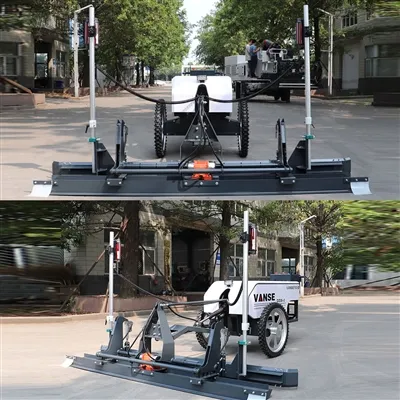
What are the applicable scenarios for concrete laser leveling machines?
Concrete laser leveling machines are suitable for a variety of scenarios. The following are some common applicable scenarios:
1. Floor construction: Concrete laser leveling machine can be used for various floor construction, such as industrial plants, commercial plazas, parking lots, airport runways, etc.
2. Road construction: Concrete laser leveling machine can be used for the construction of urban roads, highways, bridges and other roads.
3. Bridge construction: Concrete laser leveling machine can be used for bridge construction, such as bridge decks, piers, etc.
4. Airport construction: Concrete laser leveling machine can be used for the construction of airport runways.
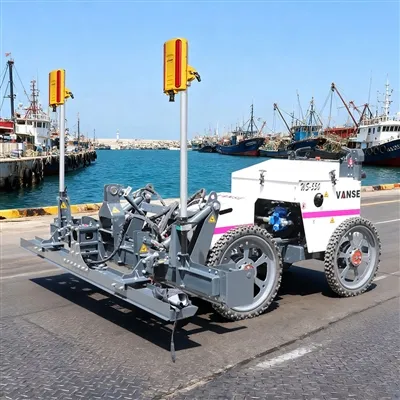
5. Others: Concrete laser leveling machines can also be used for construction in underground parking lots, subway platforms, squares and other places. In general, concrete laser leveling machines are suitable for large-area floor construction, such as large industrial plants, workshops, Automated three-dimensional warehouses, clean factories such as electronic appliances, food materials, medicine, etc., large warehouse supermarkets, logistics centers, convention and exhibition centers, etc., as well as outdoor floors such as docks, container yards, freight yards, squares, residential floors, municipal roads, etc. In addition, the concrete laser leveling machine is also suitable for the construction of various roads and bridges.
The above information is for reference only. If necessary, you can consult us.


Thanks to All the Friends Who Support and Trust Shandong Vanse Machinery Technology Co., Ltd.
If you want to know more about Shandong Vanse Machinery Technology Co., Ltd. or have any questions, please feel free to contact us:
Our Factory
Shandong Vanse Machinery Technology Co., Ltd.








Share this article

About the Author: Shandong Vanse Machinery Technology Co., Ltd.
Shandong Vanse Machinery Technology Co., Ltd. is a high-tech manufacturer specializing in concrete construction machinery, including laser screeds and related equipment. The company integrates R&D, production, and global sales, with products exported to over 60 countries and widely used in infrastructure projects worldwide.
Previous Post
Next Post
Related Articles
You Might Also Like
How to evaluate the construction effect of concrete laser leveling machine?
•••◁●▷••• Introduction As an important innovation in modern building construction technology, the concrete laser leveling machine's construction effect has a significant impact on project quality and efficiency. This article will discuss how to evaluate the construction effect of concrete laser leveling machines from many aspects, including improved flatness, improved work efficiency, enhanced quality stability, reduced material waste, reduced labor costs, easy operation, strong adaptability and long-term Obvious benefits, etc. •••◁●▷••• Improved flatness 1. The concrete laser leveling machine uses laser technology to perform precise leveling. Compared with traditional construction methods, its flatness is greatly improved, ensuring that the ground is smooth and beautiful. 2. The improvement of flatness not only enhances the use function of the floor but also helps the smooth progress of subsequent decoration projects. •••◁●▷••• Improvement of work efficiency 1. The concrete laser leveling machine has a high degree of automation and fast construction speed, which greatly improves work efficiency. 2. Compared with traditional construction methods, the use of concrete laser leveling machines can shorten the construction period and speed up the project progress. •••◁●▷••• Enhanced quality stability 1. The concrete laser leveling can achieve precise control during the construction process, reducing the impact of human factors on construction quality. 2. The use of concrete laser leveling machine can ensure the stability and uniformity of construction quality and improve the quality level of the project. •••◁●▷••• Reduced material waste 1. The concrete laser leveling machine can accurately control the amount of concrete used during the construction process, effectively reducing material waste. 2. Reducing material waste not only helps save costs, but is also beneficial to environmental protection and sustainable development. •••◁●▷••• Reduced labor costs 1. The concrete laser leveling machine has a high degree of automation, which reduces the dependence on skilled workers and reduces labor costs. 2. Using a concrete laser leveler can also reduce the number of personnel during the construction process and reduce labor costs. •••◁●▷••• High ease of operation 1. The operating system of the concrete laser leveling machine is simple and easy to understand, and you can start operating it after a brief training. 2. The simplicity of operation enables construction workers to quickly master the use of the equipment and improve construction efficiency. •••◁●▷••• Strong adaptability 1. Concrete laser leveling machine is suitable for different types of concrete floor construction, such as parking lots, warehouses, factories, etc. 2. The highly adaptable characteristics of the concrete laser leveling enable it to achieve efficient and high-quality construction in various complex environments. •••◁●▷••• Obvious long-term benefits 1. The use of concrete laser leveling machine can improve the quality of the project, extend the service life of the project and reduce maintenance costs. 2. Long-term use of concrete laser leveling machines can improve the competitiveness of enterprises and establish a good image of the enterprise. •••◁●▷••• Conclusion In summary, the construction effect of the concrete laser leveling machine is significant in improving flatness, improving work efficiency, enhancing quality stability, reducing material waste, reducing labor costs, improving ease of operation, enhancing adaptability, and achieving long-term benefits. It has obvious advantages in all aspects. With the advancement of science and technology and the development of the construction industry, concrete laser levelings will play a more important role in the future and make greater contributions to the sustainable development of the construction industry.Concrete finishing-trowel machine
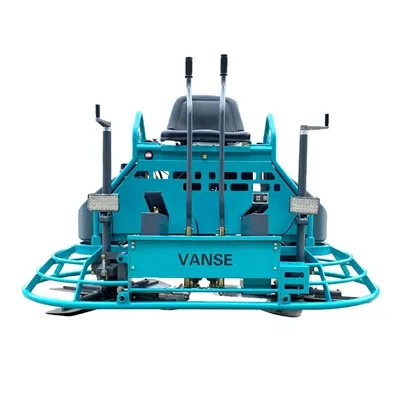
Concrete finishing is not an easy job. During construction, workers' hands, backs and knees are easily injured. The advent of trowels allows construction workers to stand and operate when finishing concrete. Based on the size of the project, the number of people and the customer's requirements for the surface layer, the construction party can consider purchasing a trowel. If you are a construction party specializing in concrete coloring, dyeing or home decoration polishing, you may not need to buy a ride-on trowel (double-disc machine). This type of trowel is not only expensive, but also has a higher hardness after finishing, and there is no such high requirement for the above-mentioned types of floors. In fact, a walk-behind trowel is sufficient to meet the work requirements of small-area floor slurry finishing. Under what circumstances should you consider investing in a trowel? Generally speaking, the construction area is an important consideration. "Even small-area projects can use trowels, even if the project is only a few hundred square meters. As long as the construction area reaches 100 square meters, a trowel must be used. If it exceeds 300 square meters, a small ride-on trowel must be considered." From another perspective, the working efficiency of a single-disc trowel is equivalent to that of three construction workers using traditional manual finishing tools such as scrapers. It seems that the biggest advantage of the trowel is to increase the construction speed. But this is only a one-sided understanding of the advantages of the trowel. The trowel does not simply increase the speed but the efficiency when dealing with large-area construction. To put it further, the trowel allows the construction party to choose a more appropriate time to start the machine when dealing with large-area construction, instead of having to start early because of the need to consider the overall area of construction like traditional construction. 1. Before use, check whether the motor, electrical switch, cable and wiring are normal and meet the regulations, and install a leakage protector. 2. Before use, check and clean the debris on the trowel to avoid the whole machine jumping during use. 3. After the power is turned on, the test run is carried out. The blades rotate in a clockwise direction and must not be reversed. 4. The operator should wear insulating shoes and insulating gloves. The cable is carried by the assistant, who should also wear insulating shoes and insulating gloves. Be careful to prevent the cable insulation layer from being scratched and causing electric shock accidents. 5. If the trowel fails, it needs to be shut down and the power is cut off before it can be repaired. 6. The trowel should be stored in a dry, clean environment without corrosive gases. The handle should be placed in the specified position. It should not be loaded and unloaded rudely during transfer. 1. During construction, pay attention to the temperature of the motor reducer not exceeding 80° 2. The oil of the turbine box needs to be checked frequently. If it is lower than the oil mark, please add oil in time. The machine should be cleaned in time after each use, especially the wiper should be clean and stored in a dry, clean and non-corrosive environment. When the wiper is worn to 30mm on one side, loosen the nut, turn the wiper around and tighten the screw again to achieve the purpose of using two pairs. The angle of the trowel can be adjusted by turning the hand wheel to achieve the ideal effect of rough trowel. If you need to stop the machine during construction, please turn off the power in time. When the gasoline engine stops, press the switch on the handle in time to stop the machine. The floor effect after the trowel is processed is more uniform, the construction speed is faster, and the operation is more convenient. Long-term operation with a handheld trowel will easily fatigue the construction worker's knees, shoulders and elbows, which will affect the construction effect. Simply put, using a trowel makes the originally difficult operation easier, and it is a better equipment for floor finishing.Performance & Quality Standards
There are clear international and industry standards for evaluating the performance and quality of concrete laser Leveling machines, which determine whether the equipment can achieve high-precision and high-efficiency construction. The following are the core evaluation dimensions: This is the "gold standard" for measuring the construction results, measured by a digital Profiler (Dipstick/Face Profiler), and the result is the Fʟ /F ʟ value. F <s:1> (flatness FF): Measures the undulation of the inner surface over short distances (typically 300mm, 1m, 3m). The higher the value, the flatter the surface. Advanced warehousing and logistics centers have extremely high requirements. Fʟ (levelness FL): It measures the consistency of the overall elevation over a long distance (usually 10 meters). The higher the value, the more level it is. It is of vital importance for the installation of large factories and precision equipment. Standard reference Common industrial floor: Fʟ 20-30 / Fʟ 15-25 General warehouse floor: F <s:1> 30-40 / Fʟ 20-30 Superflat floor: F <s:1> ≥ 50, Fʟ ≥ 40. This is the core indicator of high-performance laser Leveling. Excitation force and frequency: Sufficient and adjustable excitation force (usually measured in kilonewtons kN) is the key to ensuring the concrete is fully compacted and reducing air bubbles. High-frequency vibration can enhance the uniformity of the surface slurry. Overall rigidity of the machine: The machine body, telescopic arm and scraper assembly must be sturdy to resist the huge resistance of concrete, ensuring no deformation or vibration during long-term construction. Laser receiving and control system: The accuracy of the system (usually within ±1.5mm), response speed and anti-interference ability directly determine the accuracy of elevation control. The high-end equipment is compatible with 3D GPS/GNSS control systems, enabling automatic control of pile-free and complex slopes. Controllability and automation: Whether it has functions such as one-click leveling, soft landing, and automatic cruise control, which can reduce operational difficulty and enhance construction consistency. Paving width and efficiency: The maximum paving width (such as 3 meters, 4 meters, 6 meters) directly affects the area of a single operation. Wide-format models (such as the Wanshi YZ40-4E) are highly efficient in open Spaces. Machine maneuverability: including steering mode (two-wheel, four-wheel, crab track), climbing ability, ground clearance, etc., determines its passability in complex terrains. Special function adaptation: Can it handle special materials such as steel fiber reinforced concrete (with prevention of fiber floating) and lightweight concrete? Core component brands: The brands of key components such as engines (like Yanmar and Kubota), hydraulic systems (like Rexroth and Kawasaki), and sensors are the fundamental guarantee of durability. Protection grade: The IP protection grade of the main electrical and hydraulic components determines their dust-proof and water-proof capabilities, directly affecting their reliability in harsh construction site environments. Maintenance convenience: Whether there are centralized lubrication points, easy-to-inspect cabin doors, intelligent fault diagnosis systems, etc., these designs can significantly reduce downtime. Mandatory certifications: Safety certifications that must be obtained for sales in the target market, such as the CE certification in the European Union, the EPA engine emission certification in North America, and the CCC certification in China. Environmental protection standards: The engine needs to comply with emission standards such as Euro V (Stage V) and American Tier 4 Final. Ergonomics and safety design: including emergency stop buttons, sound and light alarms, anti-collision design, and ROPS/FOPS (rollover/falling object) cabs that comply with standards, etc. Clarify project requirements: First, confirm the F /Fʟ grade, concrete type and construction environment of the project design requirements. This is the fundamental for choosing the performance level of the equipment. Matching machine capabilities To pursue an ultra-flat floor, it is necessary to choose high-end models with strong vibration force and precise control systems (such as large riding models). If the site is limited and there are multiple columns and walls, hand-guided models with good mobility and controllability should be given priority. Verification of compliance and certification: When exporting or using for specific projects, certifications such as CE and EPA are hard requirements and must be verified before procurement. Examine long-term value: Focus on core component brands and protective designs, which have a greater impact on the total life cycle cost and availability rate of equipment than the initial price. When choosing a laser Leveling, the construction result standard (FF/FL) should be the primary goal. The equipment structure and certification standards should be used as the guarantee to achieve this goal, and the final decision should be made in combination with the construction efficiency requirements. If you could inform me of the specific project type (such as logistics warehouse, manufacturing workshop) or the particular challenges you are facing (such as handling steel fibers, large slopes), I can provide you with a more targeted equipment performance analysis. Note: The parameters provided in this document are for reference only and are not mandatory. Due to differences in technical characteristics between different brands and models of laser levelers, please consult the manufacturer for a suitable solution before actual operation. This reference document assumes no responsibility for any issues arising from failure to follow the manufacturer's instructions.