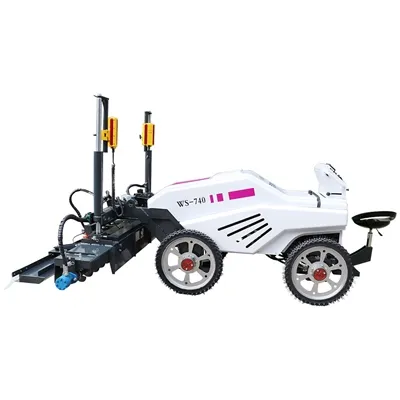
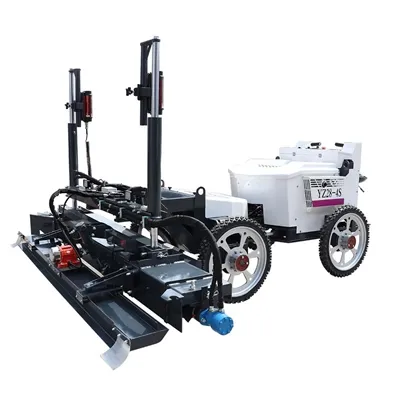
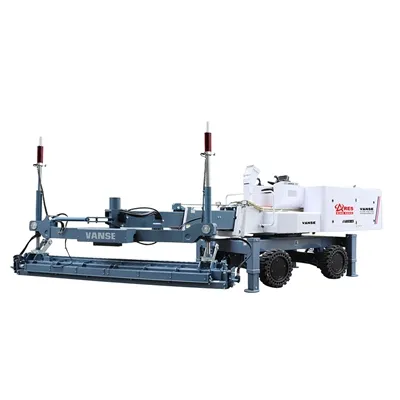
Technical Knowledge
Key points for selecting concrete laser leveling machine
▼1▲
Laser transmitter
The laser transmitter is the core component of the concrete laser leveling, and its quality directly affects the performance of the leveling. When selecting, you should pay attention to the following points:
1. Laser type:
Choose the appropriate laser type, such as ammonia laser, semiconductor laser, etc., to meet different construction needs.
2. Laser wavelength:
Different wavelengths of laser have different penetrating capabilities and reflection properties on concrete, and should be selected according to actual needs.
3. Laser power:
The size of laser power directly affects the construction effect and should be selected according to the construction area and accuracy requirements.
4. Stability:
The laser transmitter should have high stability to ensure continuity and accuracy during the construction process.
▼2▲ Flatness control system
The flatness control system is an important part of the concrete laser leveling, and its performance has a vital impact on the construction effect. When selecting, you should pay attention to the following points:
1. Control accuracy:
The control accuracy of the flatness control system should meet the construction requirements to ensure the flatness of the concrete surface.
2. Response speed:
The system's response speed should be fast to adapt to changes during the construction process.
3. Reliability:
The system should have high reliability to ensure the stability and continuity of the construction process.
4. Ease of use:
The operation of the system should be simple and easy to understand, making it convenient for construction personnel to operate and debug.
▼3▲ Laser receiver
The laser receiver is a device used to receive the laser signal emitted by the laser transmitter, and its quality directly affects the construction effect. When selecting, you should pay attention to the following points:
1. Reception range:
The laser receiver should have a wide reception range to meet the needs of different construction environments
2. Sensitivity:
The sensitivity of the receiver should be high to ensure that the laser signal can be accurately received.
3. Stability:
The receiver should have high stability to adapt to various changes during the construction process.
4. Anti-interference ability:
The anti-interference ability of the receiver should be strong to reduce false alarms and false alarms during the construction process.
▼4▲ Control system
The control system is the core control unit of the compacted soil laser leveler, and its performance plays a vital role in the performance of the leveler. When selecting, you should pay attention to the following points:
1. Control accuracy:
The control accuracy of the control system should be high to achieve precise flatness control.
2. Stability:
The control system should have high stability to ensure the normal operation of the leveling machine.

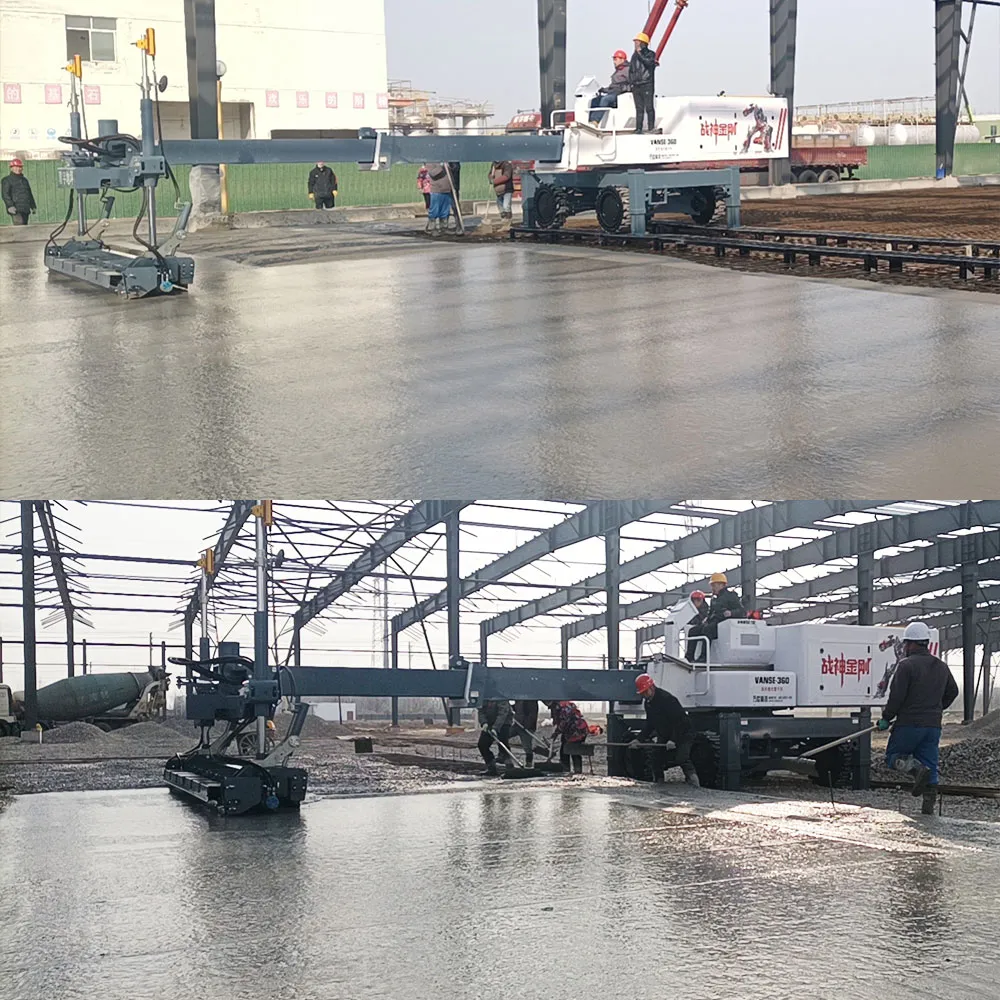
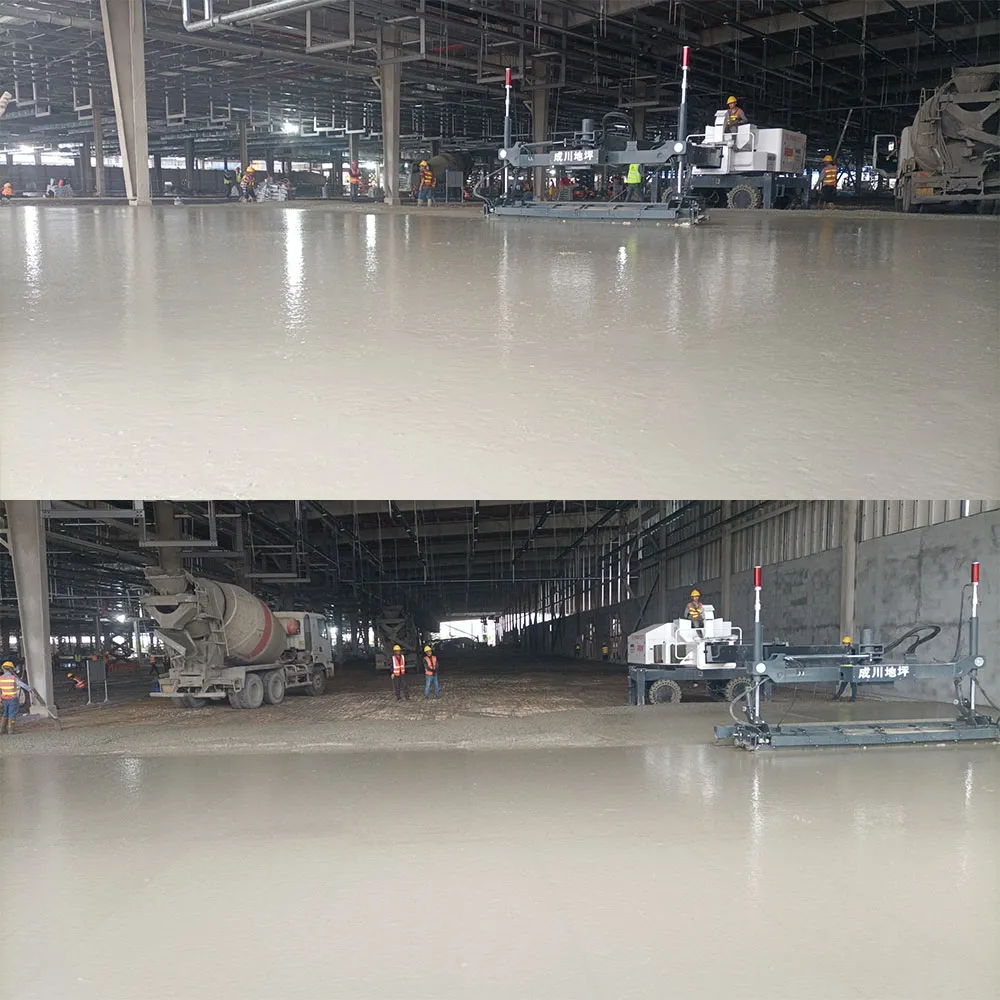
Thanks to All the Friends Who Support and Trust Shandong Vanse Machinery Technology Co., Ltd.
If you want to know more about Shandong Vanse Machinery Technology Co., Ltd. or have any questions, please feel free to contact us:
Our Factory
Shandong Vanse Machinery Technology Co., Ltd.








Share this article

About the Author: Shandong Vanse Machinery Technology Co., Ltd.
Shandong Vanse Machinery Technology Co., Ltd. is a high-tech manufacturer specializing in concrete construction machinery, including laser screeds and related equipment. The company integrates R&D, production, and global sales, with products exported to over 60 countries and widely used in infrastructure projects worldwide.
Previous Post
Next Post
Related Articles
You Might Also Like
The good choice to improve efficiency, the most cost-effective concrete laser leveling machine
With the continuous development of the world economy and the continuous increase of the world's population, the construction industry is also booming. The technical level of the construction industry continues to improve. Take floor construction for example! In the past, our floors may have been finished manually, but now laser leveling machines have appeared. It is completely suitable for occasions that could only be handled manually. However, with the rapid development of the economy, there are more and more such machines, so that people do not know how to choose them. So how do we choose a cost-effective machine? It should not be difficult for us to know that there is a concrete laser leveling machine used for large-area floor construction, so we first need a machine with a small flatness error to complete the project to avoid major changes in the entire project due to a small error. So the second question is, how long will it take us to complete such a large-area project? Therefore, we have to choose a machine with a large workload. For example, Aolide has a small machine that can complete an area of more than 1,500 square meters in just half a day. It is a good choice in this regard. Finally, it's cost-effectiveness. Many machines are high-priced but low-profile equipment, which costs a lot of money. Well, according to my experience, when constructing a building and watching their workers complete the construction bit by bit, using a small laser leveling machine, the entire project is very beautiful. . Although this small machine has a small body and head, it does have a great effect. Therefore, this type of small machinery is very popular on the market now, and it can also be recycled, recycled and disassembled to meet individual needs.How to ensure stable construction quality when using laser leveling machine to level large-area floor concrete?
– Before construction, the site should be thoroughly cleaned to remove debris, garbage and loose parts of the original ground. For example, for the renovation project of old factory buildings, all oil stains and broken concrete blocks on the ground need to be cleaned up. For the base, if there is any unevenness, it needs to be repaired and compacted. If the base is a soil foundation, it should be layered and rolled according to the design requirements to make its compaction degree reach more than 90%, providing a solid foundation for concrete pouring. – At the same time, the drainage slope should be set. According to the purpose of the site and the design requirements, the general drainage slope is not less than 0.3% – 0.5%. Through precise measurement and layout, determine the drainage direction and slope control points to ensure smooth drainage and avoid water accumulation affecting the quality of the floor. – Select qualified concrete raw materials, including cement, sand and gravel, admixtures, etc. Cement should be selected with strength grades that meet the design requirements, such as ordinary Portland cement P.O42.5 or P.O52.5, and the stability and setting time of cement should be checked. The particle size and mud content of sand and gravel should meet the specifications. For example, the maximum particle size of coarse aggregate should not be greater than 31.5mm, and the mud content should not exceed 1%; the mud content of fine aggregate should not exceed 3%. – Strictly design and test the concrete mix ratio. According to the use function of the floor (such as heavy-duty industrial floor, ordinary warehouse floor, etc.), strength requirements and construction environment, the best mix ratio is determined through laboratory trial mixing. During the construction process, concrete mixing should be carried out strictly according to the mix ratio, and the performance indicators such as slump of concrete should be tested regularly. The slump is generally controlled between 120-180mm to ensure good working performance of concrete. – Before construction, fully commission the concrete laser leveling machine. Check the operating status of the engine or motor to ensure the normal operation of the power system. For example, the engine should start quickly, run smoothly, and have no abnormal noise and shaking. For the laser system, it is necessary to perform precise calibration and adjust the height and angle of the laser transmitter so that the laser plane it emits is consistent with the design elevation of the floor. – Calibrate the scraper, vibrator and other working parts of the leveler. The flatness error of the scraper should be controlled within ±1mm, and the frequency and amplitude of the vibrator should be adjusted according to factors such as the slump and thickness of the concrete. Generally, the vibration frequency is between 3000-5000 times/minute, and the amplitude is between 3-5mm to ensure that the concrete can be fully vibrated and leveled. – Use appropriate concrete pouring methods, such as pumping or self-unloading. During the pouring process, the pouring speed and height should be controlled to avoid segregation of concrete. For example, when pumping concrete, the discharge port height should not exceed 1.5m, and the concrete should be evenly distributed on the site. – Use the spreading function of the laser leveler or cooperate with other spreading equipment to spread the concrete evenly on the site. The thickness of the material should be slightly higher than the design elevation, generally 10-20mm higher, to leave a margin for the leveling work. During the material laying process, care should be taken to avoid the accumulation of concrete in one place, resulting in excessive local thickness. – When operating the laser leveling machine, the equipment should be kept moving at a uniform speed, and the speed is generally controlled between 1-2m/min. The operator should adjust the scraper height and vibration frequency of the leveling machine in time according to the laser signal and the automatic leveling function of the equipment. For example, when the laser receiver detects that the ground is higher than the design elevation, the leveling machine automatically adjusts the scraper to descend and scrapes off excess concrete; when it is lower than the design elevation, the scraper rises, and the vibrator strengthens the vibration to fill the low-lying area with concrete. – During the leveling process, attention should be paid to the connection of adjacent construction areas. The leveling work of adjacent areas should be completed before the initial setting of the concrete, and the flatness and density of the connection should be guaranteed. Generally, the overlapping construction method is adopted, and the overlapping width is between 10-20cm to ensure the flatness and integrity of the entire floor. – Professional quality inspection personnel are equipped to check the flatness, density and elevation of the floor in real time during the construction process. Use tools such as level, 2m ruler and feeler gauge for inspection. For example, for each construction area (such as 100-200 square meters), use 2m ruler and feeler gauge to check the flatness, and the flatness error should be controlled within ±3mm; use level to check the elevation, and the elevation error should be controlled within ±5mm. – For parts that do not meet the quality requirements, timely adjustments and repairs should be made. If it is found that the local flatness exceeds the tolerance, it can be repaired by using a small leveling tool or manual smoothing method; for areas with insufficient density, use a flat vibrator to vibrate again or an inserted vibrator to supplement the vibration. – After the concrete is leveled, the finishing treatment is carried out according to the use requirements of the floor. If it is an industrial floor that requires wear resistance, mechanical smoothing and manual fine smoothing can be carried out after the initial setting of the concrete. Mechanical troweling generally uses a driving trowel, and the number of troweling passes is not less than 3 times, so that the floor surface reaches a certain gloss and hardness. – After finishing, timely maintenance should be carried out. You can use methods such as covering with plastic film, straw mats or spraying curing agents. The curing time is determined according to factors such as the type of concrete and the ambient temperature, and is generally not less than 7-14 days. During the curing period, the concrete surface should be kept moist to avoid cracks in the concrete due to water loss. – During the curing period, the floor should be protected as a finished product, and warning signs should be set up to prevent people and vehicles from walking or working on the floor that does not meet the strength requirements. For example, for heavy-duty industrial floors, heavy vehicles are strictly prohibited from passing when the concrete strength does not reach more than 70% of the design strength. – After the curing period, quality acceptance is carried out in accordance with design requirements and relevant standards. The acceptance content includes indicators such as the flatness, strength, and thickness of the floor. For example, the thickness and strength of the floor can be tested by core sampling, and the strength should reach the designed strength level; a laser flatness meter is used to test the flatness of the entire floor to ensure that the flatness of large-area floors meets quality requirements.Technical Parameters And Performance Indicators Of Concrete Laser Leveling Machine
Technical parameters and performance indicators of concrete laser leveling machine 1. Equipment overview Concrete laser leveling machine, as an advanced ground leveling equipment, integrates computer control technology, laser measurement and control technology, server drive technology, electronic measurement and sensor technology. Its high leveling efficiency and precision make it occupy a place in the modern construction industry. This article will provide a detailed analysis of the technical parameters and performance indicators of concrete laser leveling machines. 2. Detailed explanation of technical parameters The technical parameters of the concrete laser leveling mainly cover the following aspects: ★Engine parameters: The engine of the equipment is its power source, and its power, speed and other parameters directly affect the operating efficiency of the leveler. Generally speaking, concrete laser leveling machines use high-performance, low-fuel consumption diesel engines to ensure continuous and stable operation of the equipment. ★Laser measurement and control parameters: The laser measurement and control system is the core component of the leveling machine, and its accuracy and stability directly affect the leveling quality. Parameters such as the power, wavelength, and beam stability of the laser transmitter, as well as parameters such as the sensitivity and resolution of the laser receiver, are all important indicators for evaluating the performance of the laser measurement and control system. ★Leveling parameters: Leveling parameters mainly include the width, height, angle, etc. of the scraper. These parameters determine the adaptability of the leveling machine to the ground and the leveling effect. The width of the scraper should be adapted to construction sites of different widths, and the height and angle adjustment can be fine-tuned according to the undulations and leveling requirements of the ground. ★Hydraulic system parameters: The hydraulic system provides power for the movement of the leveler, lifting and lowering of the scraper, etc. Parameters such as the power, flow, and pressure of the hydraulic pump, as well as parameters such as the stroke and speed of the hydraulic cylinder, are all important indicators for evaluating the performance of the hydraulic system. 3. Performance indicator analysis The performance indicators of the concrete laser leveling can mainly be analyzed from the following aspects: ★Construction efficiency: Construction efficiency is one of the important indicators to measure the performance of the leveler. High-efficiency leveling machines can complete large-area leveling work in a short period of time, thereby improving construction efficiency and reducing construction costs. ★Leveling accuracy: Leveling accuracy is the core indicator for evaluating the performance of a leveling machine. High-precision leveling machines can ensure that the smoothness and flatness of the ground meet design requirements and improve construction quality. ★Adaptability: The adaptability of the leveler to different ground surfaces is also one of its performance indicators. The highly adaptable leveling machine can cope with various complex ground conditions, such as foundation heights and fluctuations, concrete initial setting time, etc., ensuring the leveling quality. ★Stability: The stability of the equipment is the key to ensuring continued stable operation. A leveler with good stability can reduce the failure rate and increase the service life of the equipment. 4. Overview of application areas Concrete laser leveling machines are widely used in engineering construction fields such as roads, bridges, airports, and storage facilities. In these fields, concrete laser leveling machines have become an indispensable tool in the construction process due to their efficient and precise working methods. Especially in large-area floor construction, concrete laser levelings can greatly improve construction efficiency and quality, and reduce labor costs and time costs. 5. Summary of advantages and characteristics The advantages and characteristics of concrete laser leveling machines are mainly reflected in the following aspects: ★High construction efficiency: Using advanced laser measurement and control technology and server driving technology can greatly improve construction efficiency and reduce construction time. ★High leveling accuracy: Th e laser measurement and control system can accurately control the elevation and flatness of the ground to ensure construction quality. ★Strong adaptability: The leveling machine can adapt to various complex ground conditions, such as foundation heights, initial setting time of concrete, etc. ★Easy to operate: The equipment adopts an automated control system, which is simple to operate and easy to master. ★Energy saving and environmental protection: Using advanced laser technology, it can reduce energy consumption and noise pollution, and has less impact on the environment. 6. Market prospects As the modern construction industry continues to develop, the demand for ground leveling equipment is also increasing. As an advanced floor leveling equipment, concrete laser leveling machine has been widely used in the construction industry due to its advantages such as high efficiency, accuracy and environmental protection. With the continuous advancement of technology and the continuous expansion of the market, the market prospects of concrete laser leveling machines are very broad. In the future, with the continuous development of intelligent and automated technology, concrete laser levelings will be more intelligent, efficient and environmentally friendly, providing more powerful support for the development of the construction industry. 7. Maintenance and maintenance suggestions In order to ensure the long-term stable operation and extend the service life of the concrete laser leveling, it is recommended to perform the following maintenance and upkeep work regularly: ★Engine maintenance: Change the engine oil regularly and clean the oil filter to ensure that the engine lubrication system is clean and effective. ★Laser measurement and control system maintenance: Regularly check the working status of the laser transmitter and receiver to ensure their normal operation. Clean the laser lens and reflective surface and keep them clean and dry. ★Hydraulic system maintenance: Regularly check the oil level and quality of hydraulic oil to ensure the normal operation of the hydraulic system. Clean the hydraulic tank and filter to prevent impurities and moisture from entering the hydraulic system. ★Cleaning of the entire machine: Re gularly clean dust, oil and other debris on the surface and inside of the equipment to keep the equipment clean and tidy. 8. Conclusion As an advanced ground leveling equipment, concrete laser leveling machine has been widely used in the construction industry. Its advantages such as high efficiency, precision and environmental protection make it an indispensable and important equipment in modern building construction. With the continuous advancement of technology and the expansion of the market, concrete laser levelings will play a more important role in the future construction industry.