Technical Knowledge
Quality Control Methods for Ensuring Uniform Distribution of Wear-Resistant Aggregates
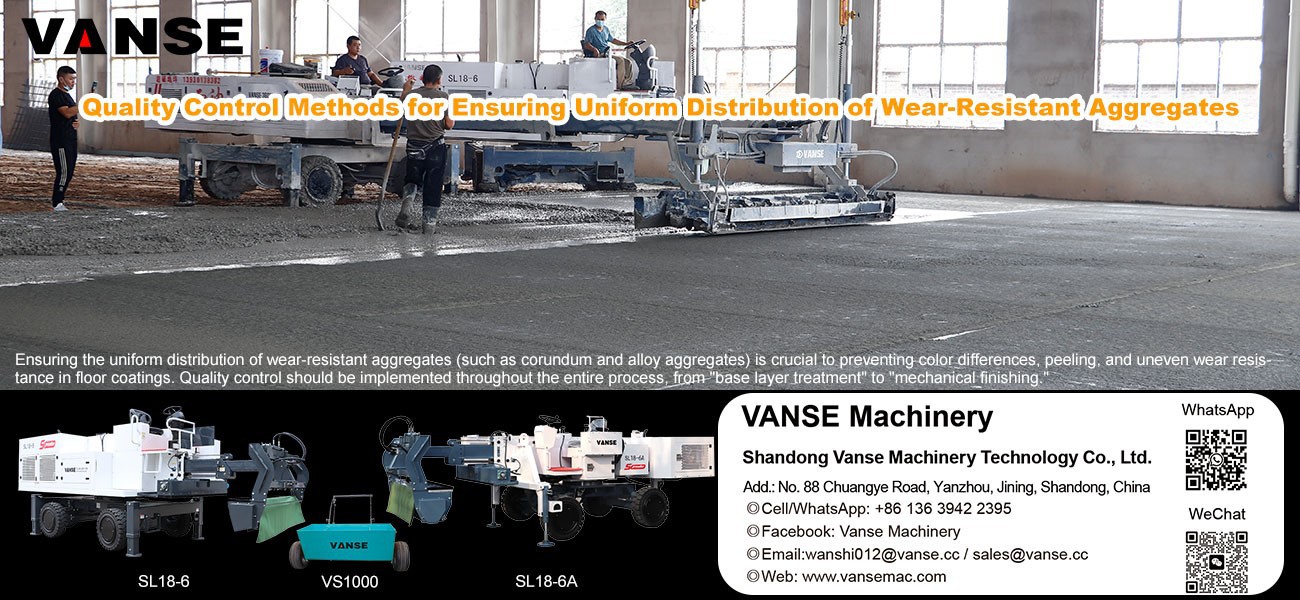
Ensuring the uniform distribution of wear-resistant aggregates (such as corundum and alloy aggregates) is crucial to preventing color differences, peeling, and uneven wear resistance in floor coatings. Quality control should be implemented throughout the entire process, from "base layer treatment" to "mechanical finishing."
The following are the core control methods for achieving uniformity:
1. Quantitative Area Management (the most direct method)
Do not rely solely on experience for random spreading; instead, adopt **"grid management."**
Grid division: Based on the total amount used (e.g., 5 kg/m²), divide the construction surface into several equal areas.
Quota placement: Pre-place the corresponding weight of aggregate in the center of each area to ensure consistent consumption in each grid cell.
2. Principle of Staged Application
The "two-stage application method" effectively re pairs gaps left after the first application.
First application (2/3 of the total amount): Applied when the concrete is initially setting (footprint indentation of approximately 5mm), utilizing the bleed water from the base layer to moisten the aggregate.
Second application (1/3 of the total amount): After the first application is finished and smoothed, a reinforcing application is performed in a perpendicular direction, focusing on areas with lighter color or sparser aggregate.
3. Mechanical and Tool Assistance
Mechanical Spreading Machines: For large-area construction, the use of automatic spreading machines is recommended. Compared to manual application, mechanical spreaders can precisely control the amount of material applied per square meter through rotational speed and travel speed, greatly improving consistency.
Manual Assistance: When spreading manually, use a "scattering" motion rather than "pouring," and ensure the material is distributed evenly.
4. Node and Edge Control
Edge Prioritization: In areas difficult for large machinery to cover, such as column edges and wall corners, manual application of extra material and manual compaction should be performed first.
Joint Treatment: At construction joints, the application amount should slightly overlap to ensure that the hardness and flatness of the joint area are consistent with the main surface.
5. Construction Environment and Timing Monitoring
Avoid strong winds: During indoor construction, doors and windows should be closed to prevent drafts that could cause fine aggregates to deviate during placement, resulting in localized areas with insufficient material.
Strictly prohibit adding extra water: If the aggregate is locally too dry, direct watering is strictly prohibited. The slurry generated by the power trowel should be used for wetting; otherwise, it will lead to reduced surface strength and color differences.
Quality inspection tips:
After spreading, assess the consistency of the color (checking for light or dark patches) and the balance of moisture content by visual inspection. If localized areas appear lighter in color, it usually indicates an excess of aggregate or insufficient moisture in that area. Mechanical troweling to bring the mortar to the surface should be performed immediately.
Note: The parameters provided in this document are for reference only and are not mandatory. Due to differences in technical characteristics between different brands and models of laser levelers, please consult the manufacturer for a suitable solution before actual operation. This reference document assumes no responsibility for any issues arising from failure to follow the manufacturer's instructions.
Thanks to All the Friends Who Support and Trust Shandong Vanse Machinery Technology Co., Ltd.
If you want to know more about Shandong Vanse Machinery Technology Co., Ltd. or have any questions, please feel free to contact us:
Our Factory
Shandong Vanse Machinery Technology Co., Ltd.








Share this article

About the Author: Shandong Vanse Machinery Technology Co., Ltd.
Shandong Vanse Machinery Technology Co., Ltd. is a high-tech manufacturer specializing in concrete construction machinery, including laser screeds and related equipment. The company integrates R&D, production, and global sales, with products exported to over 60 countries and widely used in infrastructure projects worldwide.
Previous Post
Next Post
Related Articles
You Might Also Like
What are the technical parameters of the concrete power trowel machine?
Detailed explanation of technical parameters of concrete trowel machine 1. Equipment size ★ Length: The length of a concrete trowel is usually determined based on its design and work requirements. Generally speaking, longer trowels are suitable for large-area concrete construction. ★ Width: The width of the trowel determines how wide a concrete surface it can operate on. Generally speaking, wider trowels are more efficient at improving work efficiency. ★ Height: The height determines the stability and convenience of the trowel during operation. Generally speaking, lower trowels are easier to operate, but may also be slightly less stable than taller models. 2. Weight of trowel machine The weight of a trowel reflects its construction materials and design. Generally speaking, heavier trowels provide greater stability and durability, but may also be slightly more cumbersome to transport and operate. 3. Trowel machine power Power determines the power and efficiency of the trowel during operation. Generally speaking, higher power can provide better smoothing effect and faster construction speed. 4. Troweling machine speed RPM reflects the speed of the trowel during operation. Generally speaking, higher rotational speed can provide faster construction speed, but it may also affect the smoothing effect. 5. Number of trowel blades The number of blades determines how finely and efficiently the trowel can operate. Generally speaking, more blades provide better smoothing results, but may also increase manufacturing costs and maintenance 6. Trowel blade diameter Blade diameter reflects the trowel's working capabilities and efficiency. Generally speaking, larger blade diameters provide better smoothing results and faster application speeds 7. Trowel blade material The blade material determines its wear resistance and service life. Generally speaking, high-quality blade materials provide better wear resistance and longer service life 8. Trowel blade thickness Blade thickness reflects its hardness and durability. Generally speaking, thicker blades have better hardness and longer service life, but may also affect their flexibility. 9. Trowel blade angle The angle of the blade determines how finely and efficiently it operates. Generally speaking, proper blade angle can provide better smoothing effect and faster construction speed. 10. Trowel blade wear resistance Wear resistance reflects the durability and service life of the blade. Generally speaking, blades with good wear resistance can provide better use experience and maintenance intervals. 11. How to operate the trowel machine The operation method determines the user's convenience and comfort. Generally speaking, simple operation can provide a better user experience and work efficiency.Is there a direct relationship between the power of the trowel machine and the trowel effect?
– Trowels with higher power are usually more powerful. For example, in the concrete floor construction of large-scale construction projects, if a driving trowel with higher power (such as 5.5kW – 7.5kW) is used, its motor can provide enough torque to rotate the trowel blade at a higher speed. In this way, when facing a large area of rough ground, the unevenness of the concrete surface can be quickly smoothed, effectively improving work efficiency. – A high-power trowel has more advantages when dealing with thicker concrete surfaces or ground materials with a certain hardness. Because it can more easily overcome resistance, cut the trowel blade into the material surface to a certain depth, compact and smooth the material, and make the ground smoother. – High-power trowels may have better speed stability. Due to its sufficient power, the speed of the trowel blade can be kept relatively stable during operation, even if the local hardness of the ground changes or it is uneven. This helps to achieve a more uniform trowel effect. For example, when troweling the floor of an industrial plant, a high-power trowel can better deal with the small potholes and bumps that may exist on the ground, making the troweled ground more uniform in gloss and flatness. – The material and design of the trowel blade are crucial to the trowel effect. For example, the use of high-quality alloy steel trowel blades has better hardness and wear resistance. Driven by a trowel of the same power, this trowel blade can better smooth the ground and has a longer service life. – Different types of trowel blades are suitable for different ground materials and construction requirements. For example, for indoor floors with high precision requirements, a trowel blade with fine texture may be required. This trowel blade can achieve a delicate trowel effect at a lower power through its special texture design. – The operator's proficiency in operating the trowel will affect the trowel effect. An experienced operator can reasonably control the trowel's walking speed, trowel angle and other parameters according to the actual situation of the ground. Even if a trowel with a smaller power is used, a better trowel effect can be obtained through reasonable operation, such as multiple cross trowels. – The operator's control over the construction process is also very important. For example, the use requirements of the trowel are different in the initial setting stage and the final setting stage after concrete pouring. If the operator can accurately grasp the timing and choose the appropriate power and trowel method, the ideal trowel effect can be achieved. – The initial flatness and material quality of the ground have a great influence on the trowel effect. If the ground itself is seriously uneven, such as large cracks, potholes or local looseness caused by unreasonable concrete material ratio, then relying solely on the power of the trowel will not be able to obtain a good trowel effect. In this case, the ground foundation needs to be repaired first, and then the trowel is used for troweling.How often should emery floors be cleaned and maintained?
Frequency of cleaning and maintenance of emery floor 1. Characteristics of emery floor Emery floor, as the common name for wear-resistant hardened floor in China, has quickly occupied an important position in the field of floor decoration such as industrial sites, docks, parking lots, commercial stores, and logistics warehouses with its excellent wear resistance, compression resistance, and impact resistance since it was introduced by foreign companies in the 1990s. This floor has various colors, including cement color, gray, green, yellow, red, etc. The surface is dense and not easy to dust, and it is easy to clean. Compared with traditional industrial floor terrazzo, emery floor not only has higher cost performance and service life, but also greatly simplifies the construction process. It can be constructed simultaneously with concrete, saving a lot of time and labor. However, the microstructure of emery floor shows that its surface is relatively rough, and there is a capillary structure of concrete, which makes the floor not resistant to penetration, pollution, and corrosion of substances such as acid, alkali, and oil. Therefore, in daily use, the cleaning and maintenance of emery floor is particularly important. 2. Factors affecting the use environment The use environment is a key factor affecting the frequency of cleaning and maintenance of emery floor. Emery floors are usually faced with a variety of harsh environmental challenges, such as the operation of heavy machinery, the splashing of chemicals, and the penetration of water. These factors will directly affect the life and performance of the floor. For example, the operation of heavy machinery will cause frequent impact and friction on the floor, accelerating the wear of the floor; the splashing of chemicals may cause corrosion and discoloration of the floor surface; and the long-term penetration of water may cause cracking and dusting of the floor. In addition, the way of use will also have an important impact on the frequency of cleaning and maintenance of the floor. If heavy objects are often placed on the floor or a large number of objects are operated, the pressure and load on the ground will increase, thereby accelerating the wear and aging of the floor. 3. Cleaning and maintenance cycle recommendations Considering the characteristics of emery floors and the influence of the use environment, we recommend regular cleaning and maintenance of emery floors. The specific frequency can be adjusted according to actual conditions, but it is generally recommended to clean the floor at least once a week. During the cleaning process, the garbage and debris on the ground should be cleaned up first, and then professional cleaning agents and tools should be used for deep cleaning. In addition, for oil stains or other difficult-to-remove stains, specific cleaning agents or tools may be required for treatment. At the same time, we also recommend regular maintenance and care for the Jinze sand floor. This includes checking the integrity of the floor, promptly discovering and dealing with possible cracks or damage: regularly waxing or applying protective agents to the floor surface to improve its wear resistance and corrosion resistance; and ensuring that the use environment is dry and clean to avoid excessive moisture and chemicals from damaging the floor. 4. Professional cleaning and maintenance process The professional diamond sand floor cleaning and maintenance process usually includes the following steps: first, conduct a comprehensive inspection of the floor and record the areas and problems that need special attention; second, use professional cleaners and tools to deep clean the floor to remove stains and grease; then, make necessary repairs and treatments to the floor surface, such as filling cracks and polishing uneven areas; finally, wax or apply protective agents to the floor as needed to enhance durability and beauty. During the cleaning and maintenance process, standard cleaners and tools should be used to avoid using chemicals or sharp tools that damage the floor. At the same time, the professional skills and operating specifications of the cleaning and maintenance personnel should be ensured to avoid unnecessary damage to the floor. 5. Selection of maintenance materials and equipment When choosing maintenance materials and equipment, attention should be paid to their quality and performance. For cleaning agents, products that are harmless to the diamond floor and have good cleaning effects should be selected; for waxing or coating protective agents, wear-resistant, corrosion-resistant and environmentally friendly products should be selected. In terms of equipment, cleaning and maintenance equipment with stable performance and easy operation should be selected, such as high-pressure cleaning machines, vacuum cleaners, polishing machines, etc. These equipment can not only improve the efficiency and quality of cleaning and maintenance, but also reduce damage to the floor. 6. Daily maintenance and precautions In addition to regular cleaning and maintenance, daily maintenance of diamond floors is equally important. First, the use environment should be kept dry and clean to avoid excessive moisture and chemicals from damaging the floor. Secondly, people and items entering the floor should be properly managed and controlled to avoid scratches or impacts on the floor caused by sharp or heavy objects. In addition, the integrity of the floor should be checked regularly to detect and deal with possible problems in a timely manner. During use, the following points should also be noted: First, avoid scratching the floor surface with hard objects; second, avoid direct contact of strong acids, alkalis and other chemicals on the floor surface; third, regularly clean and maintain to keep the floor clean and beautiful. 7. Common problems and solutions In the process of using diamond sand floor, you may encounter some problems, such as reflection, noise and cracking. For these problems, we can adopt some effective solutions. For example, for reflection problems, it can be handled by grinding, waxing or spraying; for noise problems, sound insulation materials or processes can be used to improve; for cracking problems, it is necessary to pay attention to basic treatment and material selection during construction and maintenance to ensure the integrity and stability of the floor. In addition, stains or scratches that occur during use should be handled and repaired in time. For stains, professional cleaning agents can be used to remove them; for scratches, local repairs or overall renovations can be performed according to the depth and area of the scratches. 8. Summary and long-term planning In summary, the cleaning and maintenance of diamond sand floor is the key to ensuring its long-term performance and aesthetics. Through regular cleaning and daily maintenance, the service life of the floor can be effectively extended and the maintenance cost can be reduced. At the same time, choosing appropriate maintenance materials and equipment and standardized operating procedures are also important factors to ensure the cleaning and maintenance effect. In the future, with the advancement of science and technology and the improvement of environmental protection requirements, the cleaning and maintenance technology of diamond sand floor will also be continuously updated and improved. From a long-term perspective, for the maintenance and management of diamond sand floor, we also need to consider the following points: First, strengthen the training and management of floor users. Through training and publicity, improve the awareness and attention of users to floor protection, and avoid floor damage caused by human factors. Secondly, establish a complete cleaning and maintenance file. Record the time, content, effect, etc. of each cleaning and maintenance, so as to track and analyze the use of the floor, and find and solve problems in time. In addition, pay attention to industry development trends and technological innovation. With the continuous development of the floor industry, new materials, processes and technologies continue to emerge. We should maintain a keen insight, timely understand and master new technologies and methods to improve the cleaning and maintenance effect and service life of the floor. Finally, strengthen the environmental protection management of the floor. When choosing cleaning and maintenance materials and equipment, attention should be paid to their environmental performance and reducing pollution to the environment. At the same time, discarded cleaning and maintenance materials and equipment should be properly handled to avoid adverse effects on the environment. In short, the cleaning and maintenance of diamond sand floor is a long-term and important task, which requires us to invest sufficient time and energy in management and maintenance. Through scientific cleaning and maintenance methods and standardized operating procedures, we can ensure the long-term performance and aesthetics of the floor, and provide strong support for the production and operation of the enterprise. In actual operation, we also need to flexibly adjust the frequency and methods of cleaning and maintenance according to the specific use environment and floor conditions. For example, in areas with heavy oil pollution, it may be necessary to increase the frequency of cleaning or use stronger detergents; in areas with dense traffic, it may be necessary to strengthen daily maintenance and maintenance work. In addition, for some special cases, such as large-scale wear or severe pollution of the floor, we need to take professional repair and renovation measures in time. This may require the help of a professional floor repair team and advanced repair technology to ensure that the integrity and aesthetics of the floor are restored. In future development, with the application of intelligent and automated technologies, the cleaning and maintenance of diamond sand floor is expected to achieve higher efficiency and lower costs. For example, by introducing intelligent cleaning robots and automated maintenance systems, we can achieve regular and fixed-point cleaning and maintenance of the floor, reducing the tediousness and errors of manual operations. In short, the cleaning and maintenance of diamond sand floor is a comprehensive task that requires us to consider and implement from multiple aspects. Through scientific management and maintenance measures, we can ensure the long-term performance and aesthetics of the floor, and provide strong guarantees for the sustainable development of the enterprise.