Liquid Hardener VS Dry-Shake Hardener: Which is Better for Warehouse Flooring?
January 30, 2026
Liquid Hardener VS Dry-Shake Hardener: Which is Better for Warehouse Flooring? 2
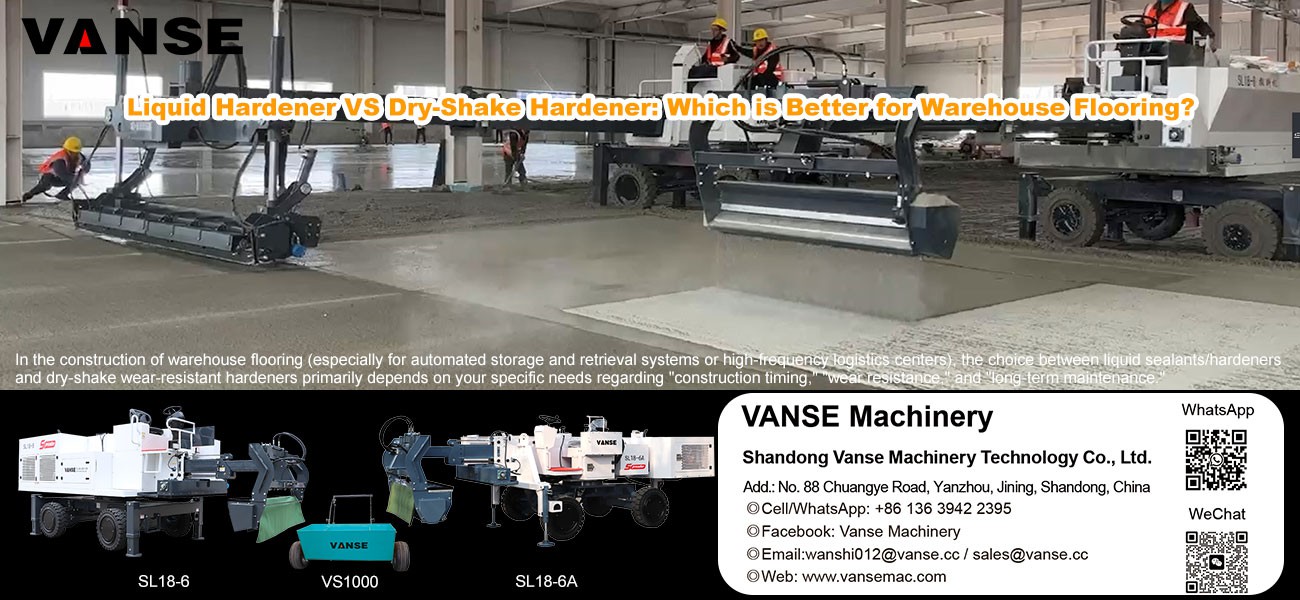
In the construction of warehouse flooring (especially for automated storage and retrieval systems or high-frequency logistics centers), the choice between liquid sealants/hardeners and dry-shake wear-resistant hardeners primarily depends on your specific needs regarding "construction timing," "wear resistance," and "long-term maintenance."
Below is an in-depth comparative analysis of the two:
1. Core Differences Comparison
Dimensions
Dry-shake hardener (corundum/alloy)
Liquid Sealing and Hardening Agent
Construction timing
Applied simultaneously with concrete (during the initial setting of newly laid flooring)
Applied after concrete is formed (suitable for both new and old floors)
Working principle
Physical coverage: Forms a dense, wear-resistant layer of 3-5mm
Chemical reaction: Penetrates and fills capillaries, increasing hardness
Impact resistance
Extremely strong, suitable for heavy machinery and pallet impacts
Generally, relies on the inherent structural strength of the original concrete
Dustproof effect
Good, but slight dusting may occur with use
Excellent: Thoroughly seals pores, achieving a dust-free level
Aesthetics
Available in various colors (green, gray, red, etc.)
Retains the original cement color, becoming brighter with use over time
2. Why choose dry-shake hardener?
If your warehouse is a new construction project and involves the installation of heavy-duty shelving or frequent forklift turning:
Physical protection: It forms an extremely hard "protective shield" on the floor surface, capable of withstanding the high-intensity shear forces exerted by forklift wheels on the ground.
Low overall cost: Construction is carried out simultaneously with concrete pouring, eliminating the need for a second mobilization, making it the most classic solution for industrial warehouses.
3. Why choose liquid hardeners?
If your warehouse requires extremely high levels of cleanliness, or if you are renovating an old floor:
Increased Mohs hardness: Through chemical reaction, the surface Mohs hardness reaches 7-8, effectively preventing cement particles from flaking off.
Nearly zero maintenance costs: No waxing or special maintenance is required; the friction from forklifts actually acts as a polishing agent, making the floor brighter with use.
Penetration power: It can penetrate 3-8mm into the concrete, solving the problem of internal looseness in the concrete.
4. Best Practices for Warehouse Flooring: A Winning Combination
Currently, high-standard warehouse flooring (such as those used in logistics parks like JD.com and Cainiao) typically employs a combined approach:
Step 1: Dry-shake the metallic aggregate onto the concrete during placement to establish basic wear resistance and impact resistance.
Step 2: After the curing period of the floor is complete, spray the liquid concrete densifier/sealer for penetration and sealing.
Advantages of this combination:
Completely eliminates dusting: It overcomes the drawback of dry-shake hardeners potentially producing dust in the later stages.
Impermeable and stain-resistant: Prevents forklift oil leaks or stains from penetrating the floor surface.
Extra-long lifespan: Provides a service life of over 20 years, meeting the long-term operational needs of warehouses.
Recommendations:
For elevated warehouses/precision storage facilities: A combined solution is strongly recommended.
For ordinary transfer yards/outdoor platforms: Applying a dry-shake hardener alone will suffice.
Note:The parameters provided in this document are for reference only and are not mandatory. Due to differences in technical characteristics between different brands and models of laser levelers, please consult the manufacturer for a suitable solution before actual operation. This reference document assumes no responsibility for any issues arising from failure to follow the manufacturer's instructions.
About the Author: Shandong Vanse Machinery Technology Co., Ltd.


Shandong Vanse Machinery Technology Co., Ltd. is a high-tech manufacturer specializing in concrete construction machinery, including laser screeds and related equipment. The company integrates R&D, production, and global sales, with products exported to over 60 countries and widely used in infrastructure projects worldwide.

Power Trowel Blade Selection: Carbon Steel, Magnesium Alloy, or Plastic Blades?
When choosing power trowel blades, the material directly affects the smoothness, gloss, and presence of burn marks (black streaks) on the floor. Below are the key differences and applicable scenarios for carbon steel, magnesium alloy, and plastic blades: Carbon steel is the most commonly used blade material for power trowels, primarily divided into high-carbon steel and cold-rolled steel. Advantages: High Durability: Extremely hard, capable of withstanding prolonged high-speed friction. Good Smoothness: Due to its hardness and some elasticity, it effectively fills small pits on concrete surfaces. Moderate Cost: Excellent cost-performance ratio, making it the first choice for most large-area industrial floors. Disadvantages: Prone to leaving black burnish marks on concrete surfaces, caused by metal particles abrading and embedding into the concrete surface. Applications: Base leveling (combination blades) and hardened floors that do not require special decorative effects. Note: On power trowels, magnesium alloy is more often used for hand floats or specific leveling discs/machines than for high-speed rotating finishing blades. Advantages: Extremely lightweight: Lighter than aluminum, reducing operator workload. Opens capillaries: Magnesium alloy effectively opens the capillaries of the concrete surface, removing excess water (bleed), allowing aggregates to settle and slurry to float. Non-stick: Magnesium alloy is less likely to stick to concrete than other metals. Disadvantages: Less wear-resistant than carbon steel and unsuitable as a final "smoothing" tool. Applications: Leveling and initial smoothing of concrete after initial setting. These blades are typically made of high-performance reinforced plastics such as polycarbonate or special composite materials. Advantages: No Black Marks: Completely eliminates the "scorching" problem of metal blades, leaving no black marks. High Gloss and Smoothness: Provides a uniform and bright gloss even when concrete hardens quickly. Chemical Resistance: Will not rust, suitable for special flooring materials. Disadvantages: More expensive, and wears out faster than carbon steel. Suitable for: Colored concrete, artistic flooring, epoxy flooring, or showroom floors where aesthetics are paramount. Features Carbon steel blade Magnesium alloy (commonly found in scrapers) Plastic blades Main Applications Leveling, hardening and finishing Slurry raising, initial leveling Decorative, seamless finishing Abrasion Resistance Extremely high hardness Medium Lower finish Surface Finish May leave black marks Rough, facilitates drainage Glossy, no discoloration Weight Relatively heavy Extremely light Lighter finish Recommended Stage Final hardening and finishing Initial setting and slurry raising Fine finishing for decorative surfaces If you are working on a typical factory workshop or underground warehouse floor: Choose a carbon steel combination blade with a leveling tray. This is the most economical and efficient solution. If you are working on colored or white decorative flooring: You must choose plastic blades. Although more expensive, this prevents the flooring from becoming unusable. If you are leveling manually: Prioritize a magnesium alloy trowel, as it will help you easily complete the initial leveling and finishing. Note: The parameters provided in this document are for reference only and are not mandatory. Due to differences in technical characteristics between different brands and models of laser levelers, please consult the manufacturer for a suitable solution before actual operation. This reference document assumes no responsibility for any issues arising from failure to follow the manufacturer's instructions.
Read More
May 22, 2024
Concrete laser leveling machine construction plan
Concrete laser leveling machine construction plan 1. Project background and requirements With the acceleration of urbanization, concrete construction occupies a pivotal position in the construction industry. To ensure the quality and efficiency of concrete construction, the use of advanced construction equipment and technology is crucial. This project aims to achieve efficient and accurate concrete floor leveling by using a concrete laser leveling machine to meet the high requirements of modern buildings for flatness, smoothness and construction efficiency. The project requirements are clear, including the area of the construction area, concrete strength grade, flatness requirements, and construction period. At the same time, factors such as the site environment, climatic conditions, and the skill level of construction personnel need to be fully considered to ensure the feasibility and effectiveness of the construction plan. 2. Leveling machine model selection Depending on the project needs, it is crucial to choose the right concrete laser leveling machine model. When choosing a leveler, you need to consider the following factors: ☑ Construction area and terrain conditions: Large projects or wide sites are suitable for large leveling machines, while narrow or complex terrain is more suitable for small or flexible leveling machines. ☑ Concrete type and requirements: Concrete of different strengths and grades have different performance requirements for the leveling. It is necessary to select a leveling machine model that can meet the construction requirements. ☑ Equipment performance and technical parameters: Pay attention to key technical parameters such as laser system accuracy, leveling efficiency, and control performance of the leveling machine to ensure that the equipment can meet the requirements of construction accuracy and efficiency. Combining the above factors, this project selected a machine with stable performance and Concrete laser leveling machine model that is easy to operate and highly adaptable to ensure construction quality and efficiency. 3. Preparation work before construction Before construction, sufficient preparations need to be made, including: ☑ On-site survey and measurement: Conduct detailed survey and measurement of the construction area to determine the construction scope and reference points to provide a basis for the installation and calibration of the leveling machine. ☑ Equipment and material preparation: Check the integrity of the leveling and related equipment to ensure that the equipment can operate normally; at the same time, prepare concrete materials and other auxiliary materials required for construction. ☑ Personnel organization and training: Organize a professional construction team and conduct safety and technical training before construction to ensure that construction personnel are familiar with equipment operation, safety regulations and construction technology. 4. Leveling machine operation process During the construction process of the leveling machine, the following operating procedures need to be followed: ☑ Equipment installation and calibration: Install and calibrate the leveler according to the equipment instructions, ensure that the laser transmitter and receiver are in optimal working condition, and perform initial testing and adjustment. ☑ Concrete laying and leveling: Lay concrete according to construction requirements and use a leveling machine for preliminary leveling. By adjusting the parameters and working mode of the leveler, high-precision leveling of the concrete surface is achieved ☑ Follow-up processing and maintenance: After leveling is completed, necessary follow-up processing is carried out, such as finishing, compaction, etc. At the same time, according to the maintenance requirements of the concrete, a reasonable maintenance plan is formulated to ensure that the quality and strength of the concrete meet the design requirements. During operation, please pay attention to the following points: Strictly operate in accordance with the equipment instructions and construction techniques to avoid misoperation or illegal operation. During the leveling process, it is necessary to observe the flatness and smoothness of the concrete surface at any time, and adjust the parameters and working mode of the leveling machine in a timely manner. Pay attention to safety matters, such as wearing safety helmets, protective glasses and other protective equipment to ensure the personal safety of construction workers. 5. Quality control and safety measures To ensure construction quality and safety, the following measures need to be taken: ☑ Quality control: During the construction process, special quality inspection personnel are set up to monitor the concrete laying and leveling process in real time to ensure that the construction quality meets the design requirements. At the same time, regular maintenance and upkeep of the leveling machine is carried out to ensure stable and reliable performance of the equipment. ☑ Safety measures: Establish a sound safety management system and provide safety education and training to construction personnel. Set up obvious safety warning signs at the construction site to ensure that construction workers understand and abide by safety regulations. At the same time, safety inspection and maintenance are carried out on the leveling machine to ensure that the equipment is safe and reliable during operation. 6. Construction progress and arrangements To ensure construction progress and efficiency, detailed construction plans and arrangements need to be made: ☑ According to the project needs and site conditions, formulate a reasonable construction plan and schedule, and clarify the tasks and time nodes of each stage ☑ Strengthen on-site management and coordination to ensure that the construction team can carry out construction in an orderly manner according to the plan ☑ Timely adjust construction plans and arrangements according to actual conditions to deal with various problems and challenges that may arise, 7. Later maintenance and upkeep After the construction is completed, post-maintenance and maintenance of the concrete laser leveling machine is a key link to ensure its long-term stable operation and extend its service life. Specifically include the following aspects: ☑ Cleaning and maintenance: After construction, clean the concrete residue and dust on the surface of the leveler in time to keep the equipment clean. Regularly clean and maintain the inside of the equipment, such as replacing filters, cleaning fuel tanks, etc., to ensure normal operation of the equipment. ☑ Lubrication and tightening: Regularly check the lubrication system and fasteners of the leveling machine, add lubricating oil or grease in time, and tighten loose parts to ensure the flexibility and stability of each component of the equipment. ☑ Repair and replacement; repair or replace faulty or damaged parts in a timely manner. During the maintenance process, operations must be carried out in accordance with the equipment instructions and relevant technical specifications to ensure maintenance quality and safety. At the same time, equipment maintenance files need to be established to record the maintenance and repair status of the equipment, so as to understand the operating status and maintenance history of the equipment at any time and provide a strong guarantee for the long-term use of the equipment. In summary, the concrete laser leveling machine construction plan covers the project background and needs, leveling machine model selection, pre-construction preparations, leveling machine operating procedures, quality control and safety measures, construction progress and arrangements, and subsequent maintenance. In terms of construction and maintenance, in actual construction, it is necessary to closely combine the specific conditions of the project, scientifically formulate construction plans, and rationally allocate resources to ensure construction quality and progress. At the same time, we should strengthen safety education and training for construction personnel, improve safety awareness, and ensure safety and stability during the construction process. Through the implementation of this concrete laser leveling machine construction plan, we can achieve efficient and accurate concrete floor leveling, improve construction quality, reduce construction costs, and contribute to the development of the modern construction industry. At the same time, it also provides useful reference and reference for the construction of subsequent similar projects. In terms of later maintenance and upkeep, in addition to routine cleaning, lubrication and repairs, the following points should also be noted: ☑ Strengthen technical training for equipment operators, improve their equipment operation and maintenance levels, and ensure that equipment is used and maintained correctly ☑ Establish a complete equipment management system, clarify the responsibilities and requirements for equipment maintenance, and ensure that equipment is maintained in a timely and effective manner. ☑ For equipment that has been idle for a long time, regular inspection and maintenance should be carried out to prevent damage or performance degradation due to long-term idleness. In addition, when selecting equipment, its reliability and durability should be considered to reduce the cost of later maintenance and replacement. At the same time, during the construction process, the construction quality should be strictly controlled to avoid increasing the maintenance burden of the equipment due to construction quality problems. . In short, the formulation and implementation of the concrete laser leveling construction plan requires comprehensive consideration of many factors, including project requirements, equipment performance, construction environment, personnel quality, etc. Through scientific planning, careful organization and strict management, we can ensure construction quality and safety, improve construction efficiency, reduce construction costs, and lay a solid foundation for the successful implementation of the project.
Read More
June 14, 2023
Use the concrete laser leveling machine to control the temperature!
When the concrete laser leveling machine performs operations on the road surface, some parts of the equipment may overheat due to the increase in temperature, which will affect the correct leveling effect of the equipment. So, how should the temperature of the leveling machine be controlled during work? Next, let's take a look at how our company's technicians teach you how to control the temperature of the leveling during operation! How to control the temperature during leveling operation? First of all, controlling the temperature of the leveling machine is one of the keys to ensure the quality of leveling. When the equipment is being leveled, it should meet the requirements of relevant standards according to the type of asphalt, label, consistency, ambient temperature, and leveling thickness. Secondly, when the construction temperature of expressways and first-class roads is lower than 10°C, and the construction temperature of other grades of roads is lower than 5°C, leveling is not suitable. If it is necessary to carry out leveling work, the temperature of the road leveling machine should be increased, and there are also low-temperature leveling requirements that meet the regulations. After the plate is heated and leveled, it is pressed immediately to shorten the length of the press. Finally, remember that during leveling, the requirements of relevant standards should be met according to the type of asphalt, label, consistency, ambient temperature, leveling thickness, etc. In this case, it is relatively simple and easy to control the temperature. Precautions for leveling machine: 1. After finishing the leveling operation, carry out the routine maintenance work according to the content of the routine maintenance procedure. 2. The working devices and moving mechanisms of the leveling machine that are in direct contact with the asphalt mixture during operation, after the operation, spray with diesel oil and then run for a period of time to remove the residual asphalt on it, so that it can run freely and rotate flexibly. It is forbidden to spray diesel oil on the electric control system and helix to prevent fire and combustion when electrified. 3. After leveling the two-ash soil, wash it with water to wash off the white material. After washing, use waste hydraulic oil to lubricate the moving parts of the scraper conveyor chain, and apply anti-rust oil to the piston rod. Be careful not to allow water to wash into the electrical appliances and bearings to prevent short circuits and foreign objects entering the bearings. 4. Clean and check the elevation adjustment device of the slope gauge, and lubricate the lead screw with grease. Apply grease to the slide rails of the floating arm. Grease each oil filling point until the seam overflows. For levelers with oil filling cups, observe the consumption and fill them up at any time. Have you learned all the above? If you want to know more about concrete laser leveling machine, please continue to pay attention to this website!
Read More
Online now. Replies personally on WhatsAppFionaCustomer specialist
Hi! I am here to help you find the right solution for your project.
You can share your product, capacity, or project needs. Our specialist will help you work out the next step.
Would you like a quick answer? Tap below to speak directly with our specialist on WhatsApp.