Technical Knowledge
Laser leveling machine manufacturers: Standardized use to extend its life is no longer a problem

As we all know, the service life of the laser leveler is limited. If you don't want the life of the leveler to end early, you need to follow the rules during use. As an expert in the production and use of levelers, laser levelers naturally have a lot of knowledge that others don't know. In order to help users learn to use the leveler, laser levelers will give a detailed introduction in today's content, so please don't miss it.
▲ After the laser leveler manufacturer completes the leveling operation, it will perform routine maintenance operations in accordance with the contents of the routine maintenance procedures.
▲ The working devices and motion mechanisms of the leveler that are in direct contact with the asphalt mixture during the operation are sprayed with diesel after the operation and then run for a period of time to remove the residual asphalt on them, so that they can operate freely and rotate flexibly. It is forbidden to spray diesel on the electronic control system and spiral wire to prevent fire and burning when the power is turned on.
▲ After leveling the fly ash soil operation, flush with water to flush away the white material. After flushing, use waste hydraulic oil to lubricate the active parts of the scraper conveyor chain, and apply anti-rust oil to the piston rod. Be careful not to flush the electrical appliances and bearings with water to prevent short circuits and foreign objects from entering the bearings.
▲ Clean and check the vertical slope meter lifting and adjustment device, and apply grease to the screw. Apply grease to the floating arm slide rail. Grease each oil filling point until the joints overflow. For leveling machines with oil filling cups, observe the consumption and fill them up at any time.
▲ Due to the high efficiency of construction, the later seam cutting needs to keep up. Generally, each laser paving leveling machine is equipped with 7-8 seam cutting machines to meet the requirements.
▲ The speed of the laser leveling machine should not be too fast during the leveling operation;
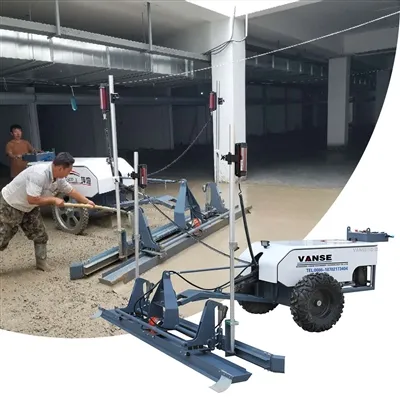
▲ The laser leveling machine manufacturer should perform initial leveling before concrete leveling, and the concrete after initial leveling should be higher than the established elevation.
▲ It is advisable to use ground film covering maintenance in the early stage, and cover the non-woven fabric after cutting the seam.
▲ When installing the laser transmitter, be careful to avoid obstacles;
▲ During the construction process, due to the side pressure of concrete, the steel mesh is easy to move horizontally. For this reason, an isolation bench is directly placed on the adjacent steel mesh, and the horizontal movement of the steel mesh is effectively controlled, and the bench can be used in rotation.
The above is the relevant matters that our concrete laser leveling machine manufacturer tells you. I hope it can help you. If you want to buy it, please contact us as soon as possible. The contact number and company address of our company are at the bottom of the screen. Whether you call for details or come to the factory for inspection, we warmly welcome you.
Thanks to All the Friends Who Support and Trust Shandong Vanse Machinery Technology Co., Ltd.
If you want to know more about Shandong Vanse Machinery Technology Co., Ltd. or have any questions, please feel free to contact us:
Our Factory
Shandong Vanse Machinery Technology Co., Ltd.








Share this article

About the Author: Shandong Vanse Machinery Technology Co., Ltd.
Shandong Vanse Machinery Technology Co., Ltd. is a high-tech manufacturer specializing in concrete construction machinery, including laser screeds and related equipment. The company integrates R&D, production, and global sales, with products exported to over 60 countries and widely used in infrastructure projects worldwide.
Previous Post
Next Post
Related Articles
You Might Also Like
Quantitative assessment of single-machine operation efficiency of the power trowel (such as the number of square meters processed per day)
Quantitative assessment of the single-machine operation efficiency of the power trowel is the key to project planning and cost accounting. It should be made clear that a fixed "daily processing square meters" cannot be provided, as efficiency is significantly influenced by numerous variables. However, we can establish a detailed evaluation model and provide a reasonable efficiency range through calculation. The daily operation efficiency of a single machine (㎡/ day) mainly depends on the following three core factors: Work efficiency (㎡/ day) = Theoretical work efficiency of the machine (㎡/ hour) × daily effective working time (hours) × work coordination coefficient Now let's break down each factor one by one. This refers to the efficiency of the power trowel in continuous operation under "ideal conditions". It is mainly determined by the width of the machine and the operating speed. The common disc diameters of the polishing machine include 800mm, 1000mm, 1200mm, etc. The effective working width is usually about 100-200mm smaller than the disc diameter to prevent collision. Working speed: The speed at which the operator controls the movement based on the slump of the concrete and the required flatness, generally ranging from 10 to 25 meters per minute. Calculation formula Theoretical work efficiency (㎡/ hour) = effective working width (m) × working speed (m/min) × 60 (min) For example, calculate A 1000mm (1 meter) disc diameter power trowel has an effective working width of approximately 0.9 meters and operates at an average speed of 15 meters per minute. Theoretical work efficiency = 0.9m × 15m /min × 60min = 810 square meters per hour Please note: This is the theoretical maximum value and does not take into account U-turns, overlapping areas, process waiting times, etc. A standard construction day is usually measured in 8 hours, but the actual time spent on plastering work is far less than 8 hours. The following time needs to be deducted: Process waiting time (the most crucial factor) : After the concrete is poured, it must be waited for to reach an appropriate initial setting state (the depth of the footprints when a person steps on it is about 5-10mm) before the smoothing process can begin. This waiting time is greatly affected by the weather (temperature, humidity, wind speed), ranging from 2 hours to over 6 hours. This means that only 1 to 2 operation cycles may be carried out within a day. Process connection time: coordination with laser screed machines, edge and corner treatment, water sprinkling and curing, etc. Equipment movement and adjustment time: Transfer between different areas of the construction site. Operator rest time. Therefore, the effective daily polishing operation time is usually between 4 and 6 hours. If only one large working surface is handled in a day, the effective time may only be 2 to 3 hours. This is the key coefficient that brings the theoretical value back to reality, usually ranging from 0.5 to 0.8. It encompasses the following impacts: Overlapping area: To ensure flatness, each walking path needs to have an overlap of approximately 100mm. Turning and U-turn: The time it takes to make a U-turn at the boundary of the area. Multiple operations: Concrete power troweling usually requires 2 to 3 coats (rough power troweling, fine power troweling), and the later coats will be faster, but the same area is counted multiple times. Complex area handling: Areas such as around columns, along walls, and at equipment foundations that require meticulous operations will significantly reduce overall efficiency. On-site conditions: Ground flatness foundation, lighting conditions, etc. We combine the above factors to estimate the two scenarios: Scenario One: Efficient Operations (Large warehouses, factory floors) Conditions: Large and regular area, good weather for quick setting, skilled teamwork, and the use of a 1000mm power trowel. Theoretical efficiency: ~810 square meters per hour Effective time: 5 hours per day Synergy coefficient: 0.7 The daily work volume = 810 × 5 × 0.7 ≈ 2800 square meters Scenario Two: Conventional/Inefficient Operations (Commercial floors, with many obstacles) Conditions: The area is divided, there are many columns and walls, the weather is average, and an 800mm power trowel is used. Theoretical efficiency: (0.7m × 15m /min × 60) ≈ 630 square meters per hour Valid time: 4 hours per day Synergy coefficient: 0.5 The daily work volume = 630 × 4 × 0.5 ≈ 1250 square meters Based on the above analysis, for the most common 800mm – 1000mm power trowelers on the market, the reasonable quantification range of their single-machine daily operation efficiency is between 1,200 square meters and 2,500 square meters. Lower limit (~1200 square meters per day) : Applicable to floors with average conditions, obstacles, and requiring multiple operations. Upper limit (~ 2,500 square meters per day) : Suitable for ground areas with superior conditions and large areas. In extreme cases: Under super-large areas and ideal conditions, experienced teams can achieve over 3,000 square meters per day. For very scattered and complex working surfaces, the efficiency may be lower than 1,000 square meters per day. Manual edge smoothing is a key limitation: no matter how efficient the smoothing machine is, it still requires manual handling of the edges and corners that the machine cannot reach. The number of corners and the difficulty of handling them will directly affect the overall progress. A power troweling machine team is usually equipped with one machine and 2 to 3 workers (1 person operates the machine and 1 to 2 people handle the corners and auxiliary work). The quality of concrete is the foundation: The mix proportion and slump of concrete directly affect its setting speed and workability, and are the fundamental factors determining efficiency. For planning: When making a construction plan, it is recommended to adopt a conservative estimate, such as planning at 1,500 square meters per unit per day, and reserve a certain buffer time to deal with uncertain factors such as weather. It is hoped that this detailed quantitative evaluation model can help you plan projects and calculate costs more accurately. Note: The parameters provided in this document are for reference only and are not mandatory. Due to differences in technical characteristics between different brands and models of laser levelers, please consult the manufacturer for a suitable solution before actual operation. This reference document assumes no responsibility for any issues arising from failure to follow the manufacturer's instructions.VANSE Group’s excellent after-sales service team serves every customer with heart, builds the VANSE brand with quality, and makes products go global.
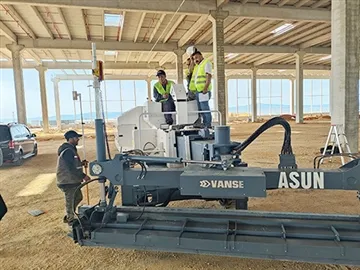
VANSE Group's excellent after-sales service team serves every customer with heart, builds the VANSE brand with quality, and makes products go global. The large-scale 360 degree laser leveling machine is equipped with advanced laser system and full hydraulic control system, which makes the concrete construction ground more precise and dense, and meets the high standard construction requirements while efficiently constructing. The application of a large 360 degree laser leveling machine will ensure the achievement of various high standard engineering construction standards, comprehensively improve the quality of engineering construction, and create higher value for customers. A large 360 degree laser leveling machine is a device that uses the laser emitted by the transmitter as the reference plane, and controls the leveling head in real-time through the laser receiver on the laser leveling machine, thereby achieving high-precision and rapid concrete leveling. It is developed for modern industrial factories, large shopping malls, warehouses, and other large areas of cement concrete floors, which have increasingly high requirements for ground quality such as strength, flatness, and levelness. VANSE Group engineers serve Turkish customers. The telescopic arm of a large 360 degree laser leveling machine is 6 meters long, and the leveling work width is 4 meters. It can complete the leveling of 24 square meters of concrete per minute. The flexible and efficient hydraulic control system can control the height of the scraper and fabric rotation, maintaining the flatness of the leveling layer. Another characteristic of the 360 degree concrete laser leveling machine is to save labor, improve efficiency, shorten the construction period by two-thirds, and reduce more than half of the labor. Large 360-degree laser leveling machine is your best choice!Large-area ultra-flat wear-resistant floor concrete laser leveling machine one-time forming construction method
At the moment when the construction field is constantly innovating, the pursuit of flatness, strength and construction efficiency in large-area floor construction has reached a new height. Traditional construction methods are difficult to accurately control flatness when dealing with large-scale ground operations, and the construction period is long. The use of concrete laser leveling machine Beton – Laser – Nivelliermaschine to implement one-time forming construction has become an effective solution to break through these bottlenecks and provide strong guarantees for creating high-quality ultra-flat wear-resistant floors. Excellent precision: With the help of advanced laser systems, Macchina livellatrice laser per calcestruzzo has extremely high control accuracy for ground elevation, and can control flatness deviation within a very small range, far exceeding traditional construction methods, and meeting the stringent requirements of high-standard ultra-flat floors. Efficient operation: The equipment has a leading degree of automation, and a large area of ground leveling can be completed in a single operation. Compared with traditional manual leveling, the construction period is greatly shortened and the construction efficiency is greatly improved. Material optimization: With precise elevation control, it can effectively avoid the situation of too much or too little concrete laying, reduce material waste and construction costs. Performance enhancement: Uniform vibration during the leveling process makes the internal structure of the concrete more compact and uniform, significantly enhances the strength and wear resistance of the ground, and extends the service life of the ground. This method is widely used in various large-area places with high requirements for ground flatness and wear resistance, such as industrial plants that need to withstand the operation of heavy equipment; logistics warehouses, where frequent cargo handling causes great damage to the ground; large shopping malls, where there is a large flow of people and the ground needs to be beautiful; parking lots, where vehicles frequently enter and exit and test the durability of the ground, etc. The core of Extendedoras de hormigón lies in the collaborative work of high-precision laser transmitters and receivers. The laser transmitter emits a stable horizontal laser beam, just like building a precise reference plane in the air. The laser receiver is installed on the leveling machine frame to capture the laser signal in real time and quickly transmit it to the control system. The control system automatically and accurately adjusts the height of the screed blade according to the received signal to ensure accurate leveling of the concrete surface during the process. At the same time, the vibrating device equipped with the screed works synchronously to fully vibrate the concrete, ensure its density, and lay the foundation for high-quality ground. Base treatment → measurement and layout → installation of formwork → concrete pouring → laser leveling machine leveling → surface treatment (smoothing, spreading wear-resistant materials, etc.) → maintenance Base treatment Thoroughly remove debris, dust, oil and other pollutants on the surface of the base to ensure that the surface of the base is clean and flat, providing a good foundation for subsequent construction. Use compaction machinery to compact the base. For weak foundations, effective measures such as replacement and reinforcement piles are required to improve the bearing capacity of the base and prevent later ground settlement. Measurement and layout Use precision measuring instruments such as total stations to accurately measure and lay out the elevation control lines and construction boundaries of the floor according to the requirements of the design drawings. Set firm control points at a certain distance (usually 3-5 meters) on the base. These control points serve as key references for the initial positioning and calibration of the laser leveling machine to ensure the accuracy of the equipment's running trajectory and elevation control. Install the formwork Install the formwork strictly according to the measured layout position. The formwork should be made of materials with high strength and good rigidity, such as high-quality steel formwork or reinforced wooden formwork. Use a level to accurately adjust the elevation of the top surface of the formwork so that it is completely consistent with the design elevation. The joints of the formwork should be tight, and sealing strips or tapes can be used to seal to prevent leakage during concrete pouring and affect the quality of the ground. Preferably use commercial concrete, and its mix ratio needs to be professionally optimized according to factors such as engineering design strength, durability, and construction environment to ensure that the concrete performance meets the construction requirements. Concrete is efficiently transported to the construction area through equipment such as concrete pump trucks or mixer trucks. Pour in layers and sections from one end to the other. The pouring thickness should be 2-3 cm higher than the design elevation, and space for leveling should be reserved. During the pouring process, use an inserted vibrator or a flat vibrator to vibrate the concrete in time. The vibration points should be evenly distributed to avoid leakage or over-vibration and ensure the density of the concrete. Laser leveling machine leveling After the concrete pouring is completed, the laser leveling machine should be driven into the construction area as soon as possible to avoid the initial setting of the concrete affecting the leveling effect. Start the laser transmitter and laser leveling machine in turn, calibrate and debug the equipment comprehensively, and check whether the laser signal reception, scraper lifting control, and vibration device operation are normal. The operator sets a reasonable leveling machine route and speed according to the shape and area of the construction site. The general speed is controlled at 1-3 meters per minute. During the leveling machine's movement, pay close attention to the equipment's operating status and the concrete surface. If local unevenness, depressions or convexities are found, stop the machine immediately and use manual filling or shoveling to repair. Surface treatment For ordinary floors, use a trowel machine for mechanical troweling after the initial setting of the concrete and before the final setting. The trowel machine operates in a horizontal and vertical cross-pattern, and generally needs to be troweled 3-5 times until the ground surface is flat, smooth, and free of smear marks. For wear-resistant floors, when the concrete is initially set, the wear-resistant materials (such as metal aggregates and non-metallic aggregate wear-resistant materials) selected according to the design requirements will be evenly spread on the concrete surface, and the spreading amount will be determined according to the material description and design requirements. After spreading, use a trowel to smooth the surface so that the wear-resistant materials and concrete are fully integrated to form a solid and wear-resistant floor surface. Maintenance After the ground construction is completed, maintenance work should be carried out immediately. Sprinkling maintenance can be used. The number of sprinkling times per day is determined according to the temperature and humidity, generally not less than 3-5 times, to keep the ground moist; plastic film can also be covered to prevent water evaporation and maintain the internal humidity of the concrete; curing agent can also be sprayed to form a protective film on the ground to achieve the maintenance effect. The curing time is usually not less than 7-14 days, and the specific duration is determined according to the concrete strength growth and relevant specifications. During the maintenance period, it is strictly forbidden for people and vehicles to walk or roll on the ground to prevent damage to the ground strength growth process and ensure that the final strength of the ground meets the design requirements. Concrete: must strictly meet the design strength grade requirements, have good workability, fluidity and durability, and ensure easy pouring and vibration during construction. Wear-resistant materials: accurately select wear-resistant materials according to the actual needs of the project and design standards. Metal aggregate wear-resistant materials have the characteristics of high hardness and high strength; non-metal aggregate wear-resistant materials have excellent performance in impact resistance and anti-static, and can be selected as needed. Formwork materials: steel formwork has the advantages of high strength and high turnover; wooden formwork has certain advantages in shape adaptability and splicing flexibility. Appropriate formwork materials can be selected according to construction conditions and cost considerations, but their strength and rigidity must meet construction requirements. Extendedoras de hormigón: According to the size of the construction site, the complexity of the shape and the ground design requirements, reasonably select equipment models with power, leveling width and accuracy. Laser transmitter and receiver: Closely matched with laser leveling machine, laser transmitter emits stable and accurate laser beam, receiver accurately captures signal, the two work together to ensure high precision of elevation control, and their performance directly affects the quality of ground leveling. Concrete delivery equipment: Concrete pump truck has strong mobility and is suitable for concrete delivery in different site conditions; mixer truck can ensure the uniformity and working performance of concrete during transportation, and can be reasonably used according to the construction site conditions. Trowel machine: Divided into hand-held type and driving type, selected according to the ground area and construction efficiency requirements. Its high-speed rotating trowel compacts and smoothes the ground to make the ground flat and smooth. Measuring instruments: Total station is used for large-area high-precision measurement and layout; level can accurately measure elevation; theodolite assists in determining angles and verticality. These measuring instruments jointly provide accurate data support for positioning and elevation control during construction. Quality management system construction: Set up a professional quality management team to clarify the specific responsibilities of each member in the stages of construction preparation, construction process and quality acceptance. Formulate a detailed quality management system and set clear and quantifiable quality goals, such as controlling the ground flatness deviation within ±2 mm. Raw material quality control: Each batch of raw materials such as concrete and wear-resistant materials entering the site shall be inspected and tested strictly in accordance with relevant standards. Concrete needs to be tested for slump, compressive strength and other indicators; wear-resistant materials need to be tested for their wear resistance, hardness and other properties to ensure that the quality of raw materials fully meets the design and specification requirements and ensure the quality of the project from the source. Construction process quality supervision: Arrange professional quality management personnel to supervise the entire construction process and strictly follow the established construction process and operation points. Focus on monitoring whether the laser operation is standardized, including equipment calibration, travel speed and route control; whether the concrete pouring and vibration meet the requirements, such as pouring sequence, vibration time and depth, etc.; the timing of polishing in the surface treatment process, the uniformity of wear-resistant material spreading, etc., and timely rectification when problems are found. Quality acceptance: After the construction is completed, the ground is comprehensively inspected in accordance with the current relevant national specifications and standards. Use professional measuring tools to detect the flatness and elevation deviation of the ground; use equipment such as rebound testers to detect the ground strength; and use wear resistance testers to test the wear resistance of wear-resistant floors. Only after all indicators meet the requirements after testing can the project quality be determined to be qualified. Building a safety management system: Develop a complete safety management system covering all aspects such as construction site safety protection, equipment operation specifications, and personnel safety training. Clarify the safety responsibilities of personnel in various positions, and implement safety responsibilities at all levels from project managers to front-line construction personnel. Safety education and training: Regularly organize construction personnel to participate in safety education and training, including safety regulations, safety operating procedures, accident case analysis, etc. New employees must undergo three-level safety education and training and pass the assessment before they can take up their posts. Special types of work (such as electricians, welders, machine operators, etc.) must be certified to work, and continuously improve the safety awareness and operating skills of construction personnel. Safety protection at the construction site: Set up obvious safety warning signs at the entrance of the construction site and dangerous areas (such as deep foundation pits, high-altitude working areas, etc.). Set up protective railings and safety nets for high-altitude working surfaces; equip construction workers with qualified personal protective equipment such as safety helmets, safety belts, safety shoes, and supervise their correct wearing and use. Equipment safety management: Establish a regular inspection and maintenance system for construction equipment such as laser levelers and concrete conveying equipment, conduct equipment appearance inspections and performance tests before and after each use, and conduct regular comprehensive maintenance and repairs. During the operation of the equipment, operators must strictly abide by the operating procedures, and illegal operations are strictly prohibited to prevent safety accidents caused by equipment failures or improper operations. Construction dust control: Harden the main roads in the construction site, and arrange special personnel to sprinkle water to reduce dust regularly. Sand, stone and other materials that are prone to dust are stored in closed silos, or covered with dustproof nets to reduce dust pollution. Construction noise control: Plan construction time reasonably to avoid high-noise operations during residents' rest time (such as 22:00 to 6:00 the next day). Take noise reduction measures for high-noise equipment such as concrete pumps and vibrators, such as installing silencers and setting up soundproof covers, to reduce the impact of construction noise on the surrounding environment. Waste treatment: Set up classified trash cans and waste storage sites at the construction site to classify and collect construction waste and domestic waste generated during the construction process. Recyclable waste (such as scrap steel, waste wood, etc.) is recycled and reused; non-recyclable waste is transported to designated locations for proper disposal in accordance with the requirements of local environmental protection departments to prevent environmental pollution. Economic benefits: The one-time forming construction method of the laser leveling machine has greatly improved construction efficiency, shortened the construction period, and correspondingly reduced labor costs and equipment rental costs. Accurate leveling effectively reduces concrete waste and saves material costs. Comprehensive calculations can significantly improve the economic benefits of the project. Social benefits: The high-quality, ultra-flat, wear-resistant floor created by this method can effectively improve the performance and durability of the building, reduce the cost of later maintenance and renovation, provide the society with better building space, and create good social benefits. Environmental benefits: By implementing a series of environmental protection measures, such as dust control, noise control, and reasonable disposal of waste, the pollution of the surrounding environment during the construction process is reduced, which conforms to the concept of green environmental protection and sustainable development, and produces positive environmental benefits.