Technical Knowledge
Experience in adjusting the operating parameters of the power trowel machine (such as rotational speed and blade Angle) for different concrete mix ratios and additives
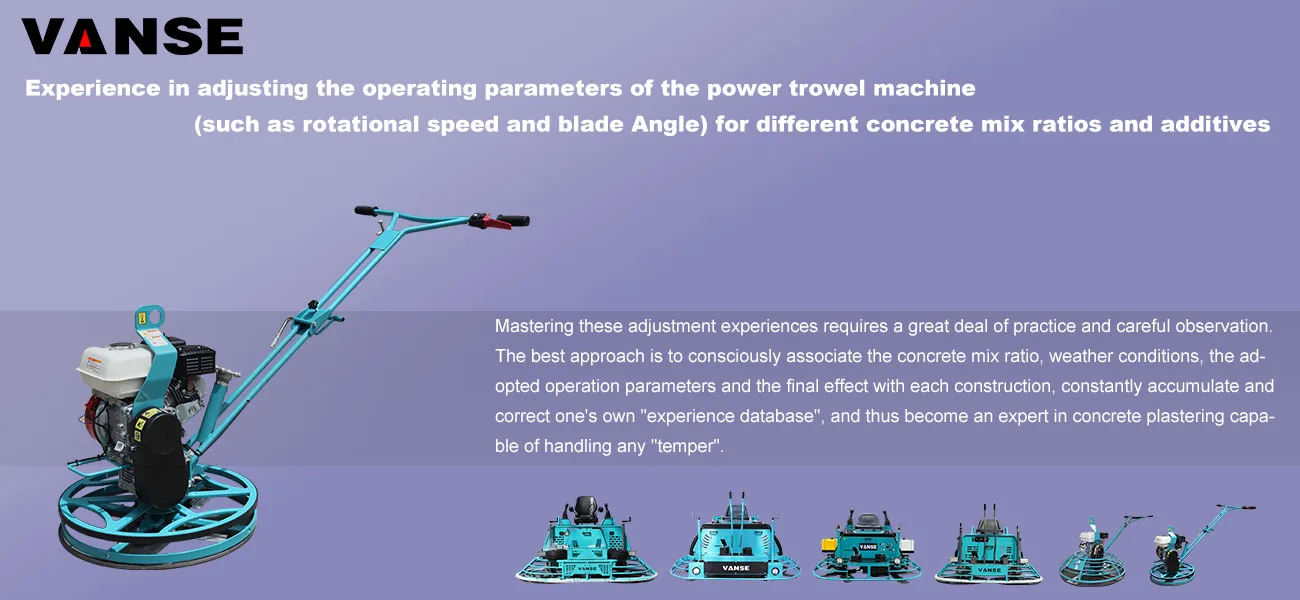
Adjusting the operating parameters of the power trowel machine for different concrete ratios and additives is a key technology for achieving high-grade floor quality (such as super-flat floors and wear-resistant floors).
The following are the experiences and guidelines for adjusting the operating parameters of the power trowel machine according to the characteristics of different concretes:
The core principles for adjusting the operating parameters of a polishing machine
Understanding the interaction: The "temperament" of concrete (setting speed, hardness, bleeding) determines how the power trowel should "treat" it.
Observation is more important than presetting: Parameters have no fixed values, and the only criterion is the state of the concrete surface. An excellent operator is one who "watches the work" during construction rather than mechanically timing.
Step by step: From low speed to high speed, from large angles to small angles, gradually apply pressure and improve precision.
Ⅰ. Adjust the strategy based on the concrete mix ratio and the type of additives
1. High-grade/low water-binder ratio concrete (C40 and above, often used for wear-resistant floors)
Characteristics: High cement content, dense slurry, fast setting speed, high early strength, and low bleeding.
Operational challenge: The operation window period is short, making it easy to miss the best polishing opportunity. The surface is prone to rapid hardening and it is difficult to extract slurry.
Adjustment strategy
Rotational speed
The first pass (disc slurry lifting) : It should be done a little earlier and at a medium to low speed (about 60-80 RPM). Because the slurry is thick, sufficient force is needed to bring it to the surface, but if the rotational speed is too high, it will curl the slurry and roughen the surface.
Second and third coats (power trowel polishing) : After the surface is slightly dry, immediately change the power trowel and use medium-high speed (about 90-120 RPM). High speed helps to make the surface very dense and bright. Once you notice a significant increase in machine resistance and the surface starts to feel "rough", it indicates that the final setting is approaching and you need to stop immediately.
Blade Angle
The first power trowel: The Angle can be slightly level (about 3-5°), mainly for leveling and avoiding too deep a cut.
Subsequent power trowel: As the surface hardness increases, gradually raise the blade Angle (about 5-10°), and use the sharp edge of the blade to perform a "cutting" type of polishing to achieve an extremely high gloss.
Core experience: "Racing against time". Personnel and equipment must be ready. Once the concrete meets the conditions for machine operation, continuous work should be carried out immediately until completion.
2. Concrete mixed with retarders (for large-scale pouring or in high-temperature weather)
Characteristics: The initial and final setting times are significantly prolonged. The surface remains in a "soft" state for a long time, but the interior is slowly setting.
Operational challenges: Prone to premature operation, which can damage the surface structure; The long waiting time affects the construction efficiency. It may be accompanied by bleeding.
Adjustment strategy
Rotational speed
First round (disc) : You must wait! Until the depth of the foot depression is less than 5mm. Use a low speed (about 50-70 RPM) to lift the slurry smoothly, as the surface support force is still insufficient.
Subsequent polishing: The interval between each application is quite long, requiring great patience. Always use medium and low speeds to avoid surface "wavy" or "curled skin" caused by excessive speed.
Blade Angle
Throughout the entire process, always maintain a relatively small Angle (approximately 0-5°). Because concrete is soft, if the Angle is too large, it will overly erode the surface and form grooves.
Core experience: "Patience". Never be in a hurry to use the computer. If there is bleeding on the surface, it should be scraped off with water first or wait for it to evaporate. The operation mainly involves "gentle kneading".
3. Concrete mixed with early strength agents (in low-temperature environments or under tight construction schedules)
Characteristics: Fast setting speed and rapid strength growth.
Operational challenge: The operational window period is extremely short, almost an "accelerated version" of high-grade concrete, making it easier to miss the opportunity.
Adjustment strategy
Rotational speed
All rounds: The pace should be fast. The disc and the first power trowel operation can be combined or carried out quickly and continuously. The rotational speed can be medium to high (80-100 RPM) to complete compaction and smoothness within a limited time.
Blade Angle
The blade Angle can be raised relatively quickly. When applying the second coat of gloss, a relatively large Angle (about 7-10°) can be adopted to seize the final opportunity for pressing.
Core experience: "Prediction and connection". The operator must constantly observe the surface changes. After the disc operation, the power trowel operation should be seamlessly connected. Machines can't stop. When people rest, the machines don't.
4. Concrete with high fly ash or mineral powder content (green and environmentally friendly proportioning)
Characteristics: The early strength is relatively low, and the setting speed is slightly slower, but the later strength is high, and the surface is easier to smooth.
Operational challenges: Low surface strength in the early stage and prone to damage; However, the slurry has good lubricity and is prone to excessive polishing, which can lead to bleeding.
Adjustment strategy
Rotational speed
First pass (disc) : The waiting time is similar to or slightly longer than that of ordinary concrete. Lift the slurry smoothly at medium speed (about 70-90 RPM).
Subsequent polishing: Due to its excellent lubricity and wear resistance, it can be polished multiple times at medium speed, making it easy
Ⅱ. Summary Table for Adjusting Operating Parameters of the power trowel Machine
| Concrete type | Disk stage rotational speed | The rotational speed of the power trowel stage | Suggested blade Angle | Core operational philosophy |
| High grade/low water-binder ratio | Medium and low speed (60-80 | Medium and high speeds (90-120) | From flat (3-5°) to steep (5-10°) | Race against time and increase pressure step by step |
| Add retarder | Low speed (50-70 | Medium and low speed (70-90) | Always maintain a small Angle (0-5°) | Wait patiently and operate gently |
| Adulterated with early strength agents | Medium and high speeds (80-100) | Medium and high speeds (90-110 | Quickly increase the Angle (7-10°) | Predictive connection, quick and decisive |
| High-admixture | Medium speed (70-90) | Medium speed (80-100) | Medium Angle (5-8° | Gentle multiple times, taking advantage of the characteristics |
Note: The unit of rotational speed is RPM (revolutions per minute), which is an empirical reference value. The specific speed should be subject to the machine model and on-site conditions.
Ⅲ. General Golden Rule and Diagnostic Techniques
The "Better late than early" rule: No matter what the ratio is, it is better to apply the gloss on the machine a little later than a little earlier. The machine may be strenuous at night, but in the morning it will completely damage the surface structure and cannot be remedied.
Footprint Method for timing:
Disc operation: Footprint depth is approximately 3 to 5 mm.
The first power trowel: The depth of the footprint is approximately 1-2 mm.
Final polished: The footprints are extremely shallow or non-existent, and the foot feel is hard.
Listen to its sound, observe its trace
Too high rotational speed/too early timing: The machine makes a dull sound, has high resistance, and there are "slurry" or "scratches" marks on the back of the blade.
Too low speed/too late timing: The machine jumps severely, the blade "floats" on the surface and cannot be eaten, leaving white scratches without luster.
The Angle and rotational speed are optimally matched: the machine operates smoothly, with uniform sound, and the blade leaves a uniform, bright, and traceless surface after passing through.
Conclusion
Mastering these adjustment experiences requires a great deal of practice and careful observation. The best approach is to consciously associate the concrete mix ratio, weather conditions, the adopted operation parameters and the final effect with each construction, constantly accumulate and correct one's own "experience database", and thus become an expert in concrete plastering capable of handling any "temper".
Note: The parameters provided in this document are for reference only and are not mandatory. Due to differences in technical characteristics between different brands and models of laser levelers, please consult the manufacturer for a suitable solution before actual operation. This reference document assumes no responsibility for any issues arising from failure to follow the manufacturer's instructions.
Thanks to All the Friends Who Support and Trust Shandong Vanse Machinery Technology Co., Ltd.
If you want to know more about Shandong Vanse Machinery Technology Co., Ltd. or have any questions, please feel free to contact us:
Our Factory
Shandong Vanse Machinery Technology Co., Ltd.








Share this article

About the Author: Shandong Vanse Machinery Technology Co., Ltd.
Shandong Vanse Machinery Technology Co., Ltd. is a high-tech manufacturer specializing in concrete construction machinery, including laser screeds and related equipment. The company integrates R&D, production, and global sales, with products exported to over 60 countries and widely used in infrastructure projects worldwide.
Previous Post
Next Post
Related Articles
You Might Also Like
How to Develop a Maintenance Plan for a Concrete Laser Leveling Machine
Concrete laser leveling machine is a high-precision and high-efficiency construction equipment. In order to ensure that it always maintains a good working condition, prolongs its service life and reduces the occurrence rate of failures, this maintenance plan is specially formulated. Corresponding maintenance is required before, during and after daily operations. This is the basis for ensuring the normal operation of the equipment. Before operation: Check whether the fuel, lubricating oil and hydraulic oil of the equipment are sufficient. If insufficient, add them in time to ensure that all systems can operate normally. At the same time, check whether key components such as laser transmitters and receivers are clean and intact, and whether there are loose or damaged phenomena to ensure the accuracy of the laser system. In addition, check whether the tire pressure is normal, whether there are damages or foreign objects on the tire surface, and ensure the safety of the equipment. During operation: Pay close attention to the operating status of the equipment, listen for abnormal sounds from the engine, hydraulic system, etc., and observe whether the indications of each instrument are normal. If an abnormality is found, the machine should be stopped for inspection immediately. Only after the fault is eliminated can the operation be continued to avoid the expansion of small faults. After operation: Clean up concrete residues, dust and other debris on the surface of the equipment in time to prevent the concrete from being difficult to remove after solidification, which will affect the heat dissipation and appearance of the equipment. When cleaning optical components such as laser transmitters and receivers, use special cleaning tools and detergents to avoid scratching the lens. Check whether the bolts and nuts at each connection are loose, and tighten them in time if they are. On the basis of daily maintenance, a more comprehensive inspection and maintenance is carried out once a week. Check the engine's air filter. If there is a lot of dust on the surface of the filter element, it should be cleaned or replaced to ensure smooth engine air intake and improve combustion efficiency. Check the oil tank of the hydraulic system, observe the oil level and oil quality of the hydraulic oil. If the oil quality deteriorates (such as emulsification, blackening, etc.), the hydraulic oil and filter element should be replaced in time. At the same time, check whether there is leakage at the connection of the hydraulic pipeline, and if there is leakage, it should be handled in time. Check the braking system of the equipment, including the wear of the brake pads and the level of the brake fluid, to ensure good braking performance and ensure the safety of the equipment and operators. Lubricate each lubrication point of the equipment, select appropriate lubricants according to the requirements of the equipment manual, ensure that all moving parts are well lubricated and reduce wear. Carry out in-depth inspection and maintenance every month to detect and eliminate potential faults in time. Check the engine's fuel filter. If the filter element is blocked, it should be replaced in time to prevent impurities from entering the engine and causing engine wear. Check the electrical system of the equipment, including the connection of the wires, the power and voltage of the battery, etc., to ensure that the electrical system works properly. If the battery power is insufficient, it should be charged in time; if the wire is damaged or aged, it should be replaced in time. Check the calibration of the laser system. If the accuracy deviation of the laser transmitter and receiver is found, it should be calibrated in time to ensure the construction accuracy of the equipment. Check the structural components of the equipment, such as the frame, scraper, etc., for deformation, cracks and other damage. If there is any damage, it should be repaired or replaced in time. Establish an equipment maintenance record ledger to record in detail the time, content, maintenance personnel and other information of each maintenance, so as to trace the maintenance of the equipment and provide a basis for the repair and maintenance of the equipment. Formulate emergency measures, formulate corresponding emergency treatment plans for common equipment failures (such as engine failure to start, hydraulic system failure, etc.), and equip with necessary maintenance tools and spare parts so that timely repairs can be carried out when equipment fails to reduce downtime. By strictly implementing this maintenance plan, the reliability and service life of the concrete laser leveling machine can be effectively improved to ensure the smooth progress of construction work. Click the below to jump immediately!!! ARMOUR JOINT CONCRETE LASER LEVELING MACHINE LIGHT TOWER POWER TROWEL SLIPFORM MACHINE STEEL FIBER TOPPING SPREADER TRACKED MINI DUMPERApplication cases and performance requirements of concrete laser leveling in smart city construction (such as municipal roads and airport runways)
Concrete laser leveling machines have evolved from simple industrial floor construction equipment to indispensable high-precision and high-efficiency key equipment in the construction of smart city infrastructure. The following will elaborate in detail on its specific application cases and performance requirements in the construction of smart cities. The value of the concrete laser leveling lies in its ability to achieve extremely high flatness and levelness in one go and over a wide range, which is crucial for the infrastructure that relies on seamless connection and reliability in smart cities. Application scenarios: Mainly used for the paving and leveling of the base layer (water-stabilized layer) and surface layer of roads. In the "white-to-black" (asphalt overlay on cement pavement) project, an extremely smooth cement concrete base is provided for the asphalt surface layer. The value of smart cities Laying the foundation for intelligent transportation systems: Extremely smooth roads are ideal environments for vehicle-road coordination (V2X) and autonomous driving. It can reduce vehicle jolts, ensure the stability and accuracy of data from on-board sensors (lidar, cameras), and enhance driving safety and comfort. Enhancing road durability: High flatness avoids stress concentration, reduces rutting, pushing and cracking on the road surface, lowers maintenance costs throughout the entire life cycle, and aligns with the concept of "long-term management" in smart cities. Integrated intelligent construction: It can be combined with a 3D digital paving system to directly utilize the BIM model data of the road for construction, without relying on traditional physical pile foundations. This achieves pile-free construction, which is more precise, faster, and reduces human errors. Application scenario: This is one of the fields with the most stringent requirements for flatness. It is used for the new construction and major repair of runways, taxiways and aprons. The value of smart cities Flight safety and comfort: The flatness of the runway directly affects the safety of aircraft takeoff and landing as well as the comfort of passengers. The laser leveling can achieve an extremely high precision of less than 3 millimeters per 4-meter drop, meeting the strict standards of institutions such as the FAA (Federal Aviation Administration of the United States). Ensuring airport operational efficiency: A flat apron can guarantee smooth parking of aircraft, precise connection of jet Bridges, and efficient loading and unloading of goods. At the same time, it reduces the vibration damage to the aircraft on the runway and lowers the maintenance costs for airlines. Supporting the construction of smart airports: It provides an ideal foundation plane for the installation of sensors on airport runways (such as aircraft tracking sensors) and the installation of Internet of Things devices. Application scenarios: railway stations, subway station squares, bus hub stations, port and wharf storage yards, etc. The value of smart cities Seamless connection and accessibility: The flat ground facilitates the rapid gathering and distribution of people, vehicles and goods, especially providing an unobstructed passage environment for the disabled and the elderly. Supporting smart logistics: In ports and logistics parks, a flat storage yard is the foundation for the efficient and safe operation of intelligent equipment such as automated guided vehicles (AGVs) and automated gantry cranes. Even a slight deviation in the slope can cause the equipment to stop working or position wrongly. Enhancing the city's image: Large areas of high-precision flooring are a manifestation of the beauty and practicality of modern urban public Spaces. Application scenarios: It is used for the construction of the bottom cushion layer of pipe galleries and road surfaces. The value of smart cities Provide a platform for inspection robots: A flat bottom surface of the pipe gallery is the prerequisite for the stable operation of automatic inspection robots and the precise collection of data (such as temperature, humidity, and equipment status). Convenient for pipeline installation and maintenance: The flat foundation ensures the accuracy of subsequent pipeline support installation, facilitating standardized construction and rapid maintenance. To be competent for the above-mentioned high-standard application scenarios, the concrete laser leveling machine needs to have the following performance: Flatness and levelness: These are the core indicators. The equipment must be capable of stably achieving values of FF (flatness) ≥ 50, FL (levelness) ≥ 40, or even higher values (such as FF/FL > 100). For special projects such as runways, specific standards must be met (for example, the gap under a 3-meter straight ruler should be ≤3mm). System stability: The laser emission system, control system and hydraulic actuator must possess extremely high anti-interference capabilities and long-term operational stability to prevent drift or malfunction during prolonged and large-scale construction. 3D control system integration: This is an inevitable requirement for the construction of smart construction sites. The leveling machine should be capable of seamless integration with the 3D control system composed of GNSS (Global Navigation Satellite System), total stations, etc. By importing BIM or 3D design models, "form-based construction" can be achieved, completely getting rid of the reliance on traditional layout. Data collection and output: The equipment should be capable of real-time recording of data such as elevation, position, and workload during the construction process, and can transmit the data to the project management platform via the network to achieve digital traceability and quality monitoring of the construction process. High power and high efficiency: To deal with the large-scale concrete pouring in municipal engineering, high-power engines and efficient vibration systems are needed to ensure that the daily construction area can reach several thousand square meters. Complex working condition handling capacity: Capable of adapting to concrete of different grades and slump degrees; Have the ability to handle single and double slope ground. The equipment should be sturdy and durable, capable of adapting to the harsh environment on the construction site. Flexible sizes and models: We offer flat heads of various specifications to meet the needs of projects of different scales, ranging from narrow pipe galleries to wide runways. Core component quality: Core components such as the hydraulic system, laser sensor, and control computer should come from internationally renowned brands to ensure their reliability and lifespan. Structural design: The machine body structure is sturdy and can withstand long-term high-intensity construction operations. Key parts are designed to prevent wear and tear. Simple operation interface: Operators can quickly set parameters and monitor the status of the equipment through an intuitive graphical interface.Excessive bleeding: A large amount of water rises to the surface, forming a layer of cement slurry with an extremely high water-cement ratio. Convenient maintenance and upkeep: The equipment should be designed with channels that facilitate daily inspection, maintenance, and replacement of vulnerable parts, reducing downtime and enhancing equipment utilization. In the construction of smart cities, the concrete laser leveling has evolved from "a tool" to "a data-driven construction node". Through its inherent high-precision characteristics, it provides a precise reference surface of the physical world for the "nerve endings" (sensors, smart devices) and "arteries" (roads, runways) of smart cities. Selecting and applying laser leveling that meet the above performance requirements and integrating them into the BIM-based digital construction process is a key technical path for building high-quality, long-life, perceptible and interconnected smart city infrastructure. This is not only an upgrade in construction technology, but also a manifestation of the transformation of the construction management model towards intelligence and refinement Note: The parameters provided in this document are for reference only and are not mandatory. Due to differences in technical characteristics between different brands and models of laser levelers, please consult the manufacturer for a suitable solution before actual operation. This reference document assumes no responsibility for any issues arising from failure to follow the manufacturer's instructions.Laser leveling machine failure is inevitable after long-term use. Early treatment ensures safety
1. Material problems ○ Improper concrete mix ratio, too little cement content or too high mud content in sand will lead to insufficient ground strength and easy sanding. ○ The strength grade of the selected cement is not enough to meet the construction requirements. 2. Construction problems ○ Improper operation of the laser leveler, such as too fast leveling speed, leads to insufficient density of concrete. ○ Poor grasp of the finishing time, too early or too late finishing will affect the quality of the ground. ○ Inadequate maintenance, concrete lacks water during the hardening process, affecting the development of strength. 3. Environmental problems ○ Too high or too low construction environment temperature will affect the coagulation and hardening of concrete and increase the risk of sanding. ○ Low air humidity and too fast evaporation of water on the concrete surface can also easily lead to sanding. 1. Material aspects ○ Optimize the concrete mix ratio, ensure moderate cement content, and control the mud content of sand. ○ Choose cement with appropriate strength grade to ensure the strength requirements of the ground. 2. Construction ○ Operators should be proficient in the use of laser leveling machines, control the leveling speed, and ensure the density of concrete. ○ Accurately grasp the finishing time, generally finishing after the initial setting of concrete and before the final setting. ○ Strengthen maintenance, such as covering with plastic film and sprinkling water to keep the concrete surface moist, and the curing time is not less than 7 days. 3. Environmental ○ Adjust the construction time and maintenance measures according to the ambient temperature to avoid construction under extreme temperatures. ○ In a dry environment, the number of sprinkling water can be appropriately increased to maintain the humidity of the concrete surface.