Technical Knowledge
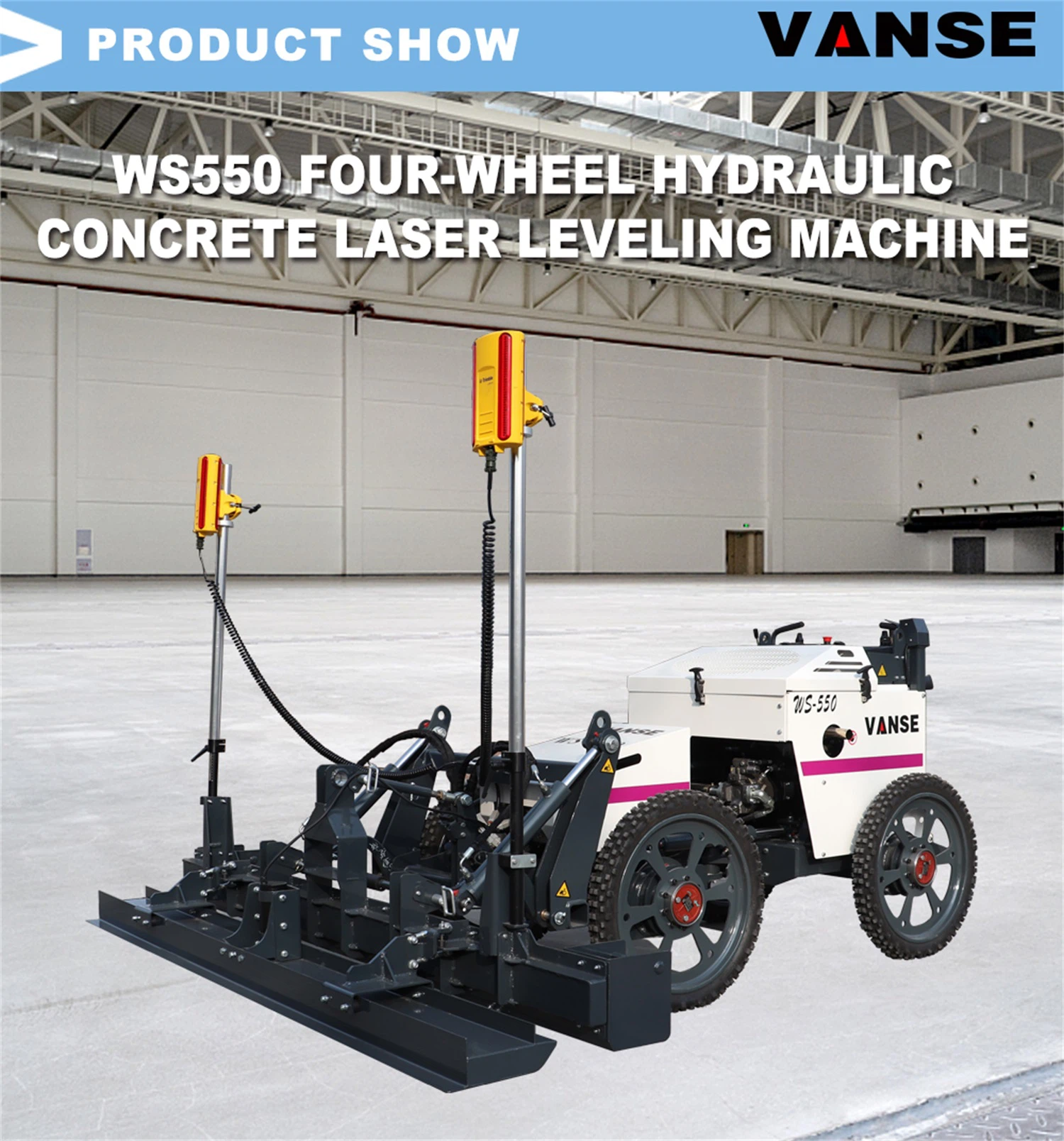
Large area concrete floor laser leveling machine one-time forming construction method
••▶•• Project Overview ••◀••
With the rapid development of the modern construction industry, the requirements for the flatness, levelness and aesthetics of large-area concrete floors are getting higher and higher. Traditional floor and floor construction methods often have problems such as long construction period and unstable quality. Therefore, the use of laser leveling machines for one-time construction of large-area concrete floors has become an efficient and high-quality choice.
••▶•• Construction preparation ••◀••
1. Construction personnel training:
Ensure that the operators are familiar with the operating principles and safety procedures of the laser leveler and have certain construction experience.
2. Equipment inspection:
Conduct a comprehensive inspection of the laser leveling machine used in construction to ensure that it is in good working condition.
3. Preparation of construction materials:
Select concrete materials that meet the requirements to ensure construction quality.
4. On-site survey:
Conduct a detailed survey of the construction site to understand the terrain, climate and other conditions, and formulate corresponding construction plans.
••▶•• Construction process ••◀••
1. Foundation treatment:
Clean the construction site to ensure that the foundation is smooth and free of debris. If necessary, perform foundation leveling
2. Formwork support:
According to the design requirements, support the formwork to ensure it is flat and stable.
3. Concrete pouring:
Pour concrete evenly on the formwork according to the mix ratio required by the design.
4. Laser leveling:
Immediately after the concrete is poured, use a laser leveling machine for leveling. Through the laser control system, it is ensured that the flatness and levelness of the ground meet the design requirements.
5. Surface treatment:
Before the initial setting of concrete, use professional tools for surface treatment to eliminate defects such as bubbles and blisters on the surface.
6. Maintenance:
After the concrete is finally set, perform timely maintenance to ensure the strength and beauty of the concrete. few,
••▶•• Construction Key Points ••◀••
1.
Ensure the flatness and stability of the formwork to avoid deformation or displacement during construction.
2.
Control the pouring speed and amount of concrete to ensure that the concrete can be evenly distributed on the formwork.
3.
When using the laser leveling machine, ensure the accuracy of the laser control system and adjust the equipment parameters in a timely manner to ensure the leveling effect.
4.
During surface treatment, pay attention to the operating strength and speed to avoid damage to the concrete.
5.
D
uring the curing process, the moisture of the concrete surface should be maintained to prevent the concrete from drying out or cracking.
••▶•• Quality acceptance ••◀••
After the construction is completed, the quality inspection of the floor of the building will be carried out. Check whether the ground flatness, levelness, aesthetics and other indicators meet the design requirements. If problems are found, deal with them promptly.
••▶•• Conclusion ••◀••
The one-time construction method of laser levelinging for large-area concrete floors has the advantages of short construction period, stable quality, and high aesthetics. Through strict construction preparation and process control, it can be ensured that the construction quality meets the requirements. At the same time, it is necessary to pay attention to the key points of construction and quality acceptance links to ensure the smooth progress of the construction process and the final quality standards.
Thanks to All the Friends Who Support and Trust Shandong Vanse Machinery Technology Co., Ltd.
If you want to know more about Shandong Vanse Machinery Technology Co., Ltd. or have any questions, please feel free to contact us:
Our Factory
Shandong Vanse Machinery Technology Co., Ltd.








Share this article

About the Author: Shandong Vanse Machinery Technology Co., Ltd.
Shandong Vanse Machinery Technology Co., Ltd. is a high-tech manufacturer specializing in concrete construction machinery, including laser screeds and related equipment. The company integrates R&D, production, and global sales, with products exported to over 60 countries and widely used in infrastructure projects worldwide.
Previous Post
Next Post
Related Articles
You Might Also Like
What damage will improper blade angle adjustment cause to the power trowel blade?
– When the blade angle is too large, the contact angle between the blade and the concrete surface is too vertical. During the troweling process, the friction and shear force on the blade will increase. This will cause the material on the blade surface to wear faster, making the blade edge blunt and reducing the service life of the blade. – If the blade angle is too small, the contact area between the blade and the concrete surface will increase, and the pressure per unit area will decrease. However, since it takes longer and more troweling operations to achieve the desired effect, the number of frictions between the blade and the concrete will increase, which will also accelerate the wear of the blade. – When the angle is too large, the pressure and torque on the blade during work are large, which can easily cause the blade to bend and deform. This deformation may be more obvious when working continuously for a long time or handling hard concrete. – If the angle is too small, although the pressure on a single blade is relatively small, due to the uneven overall force, the blade will be subjected to uneven force during rotation, which may also cause the blade to twist or deform in the long run. – Due to improper angle adjustment, the blade will be subjected to abnormal stress during operation. When the stress exceeds the bearing limit of the blade material, cracks will appear on the blade surface. If the cracked blade continues to be used, the crack may gradually expand and eventually cause the blade to break. – When the angle is too large, the impact force on the blade is greater, which is more likely to cause cracks and breaks; when the angle is too small, the blade will also crack due to fatigue under repeated unbalanced stress, increasing the risk of breakage.The laser leveling machine oil temperature rises, it is the right thing to do to find out the cause in time
The road surface under our feet is very flat. In fact, it is only after leveling that we can achieve the effect we see today. When it comes to leveling the ground, we must talk about the laser leveling machine, because the reason why the road surface is so flat now is inseparable from the efforts of the laser leveling machine. However, when we use the leveling machine to work, sometimes some abnormal conditions will occur, such as how to solve the problem of too high oil temperature? If the oil temperature of the hydraulic system of the laser leveling machine is too high, the viscosity of the oil will be reduced, the leakage will increase, the oil film of the lubricated parts will be destroyed, and the wear of the parts will be aggravated; at the same time, high temperature will also cause the sealing gasket made of rubber and other materials to age prematurely and damage. Therefore, it is very important to control the appropriate oil temperature. 1. Check whether the oil level in the oil tank is too low. Experience shows that high oil temperature is often caused by lack of oil in the oil tank, so it should be replenished in time when it is lacking oil. 2. Whether the hydraulic oil filter and circuit are blocked. 3. Whether the radiator is normal. If a large amount of dust adheres to the radiator, it may cause poor heat dissipation and increase the oil temperature. Since the working environment of the laser leveling machine is dusty, the radiator should be cleaned in time. 4. Is the quality of the hydraulic oil qualified? If the added oil quality is unqualified, the system oil temperature will also be too high. In addition, the hydraulic system is working when it is short of oil, which is easy to cause damage to the pump and motor. Therefore, after the oil shortage fault is eliminated, the operating status of the pump and motor should be checked, and the damaged parts of the pump and motor should be replaced if necessary. 1. After completing the leveling operation, perform routine maintenance operations in accordance with the contents of the routine maintenance procedures. 2. The working devices and motion mechanisms of the leveling machine that are in direct contact with the asphalt mixture during operation should be sprayed with diesel after the operation and then run for a period of time to remove the residual asphalt on it, so that it can operate freely and rotate flexibly. It is forbidden to spray diesel on the electronic control system and spiral wire to prevent fire and combustion when the power is turned on. 3. After the laser leveling machine is leveled, flush it with water to wash away the white material. After flushing, use waste hydraulic oil to lubricate the moving parts of the scraper conveyor chain, and apply anti-rust oil to the piston rod. Be careful not to flush water to the electrical and bearing parts to prevent short circuits and foreign objects from entering the bearings. 4. Clean and check the lifting and adjusting device of the laser leveling machine longitudinal slope meter, and lubricate the screw with grease. Apply grease to the floating arm slide rail. Grease each oil filling point until the joint overflows. For leveling machines with oil filling cups, observe the consumption and fill them up at any time. This is the first part of the small knowledge about the increase in oil temperature of laser leveling machines. We will continue to update it for you later. I hope that the content shared can help you solve the problem better. If you want to know more exciting information about leveling machines, please visit our official website at any time to inquire.Precise Judgment of Troweling Timing in Grindstone Floor Construction (Initial Setting VS Final Setting Window)
For the construction of grindstone/marble flooring (a type of wear-resistant aggregate flooring), accurately controlling the "initial setting" and "final setting" time windows of the concrete is the sole key technical node that determines whether the final floor can form a high-hardness and high-maintenance integrated surface layer. If it is not handled properly, it may result in the floor becoming dusty or cracking, and in severe cases, the expensive wear-resistant aggregate layer may peel off over a large area. According to the ASTM C403 standard and the GB/T 50080 standard, the setting process of concrete is defined by penetration resistance: Stage Penetration resistance value Physical state description Initial setting 3.5 MPa The concrete begins to lose its plasticity, capable of withstanding pressure but losing its fluidity. Final setting 27.6 MPa The concrete has completely lost its plasticity and possesses a certain structural strength. For the diamond sand flooring, the entire period between the initial setting and final setting constitutes a valuable "golden construction window". Initial Setting Phase (Sowing and Mixing Window): At this stage, the surface of the concrete has lost its fluidity, but still has sufficient moisture content and plasticity of the slurry. After the aggregate is sown on the surface, it can rely on its own weight to embed into the uncompletely set surface layer of the concrete. Through mechanical mixing operations, the aggregate can be closely bonded with the underlying slurry. Final Setting Phase (Fine Grinding and Hardening Window): As the hydration reaction accelerates, the hardness of the slurry significantly increases and heat begins to be generated. At this time, multiple mechanical troweling operations with high-speed and high-pressure trowels are required to repeatedly press and squeeze the calcium hydroxide and excess water in the hydration products to the surface for evaporation, thereby reducing the water-cement ratio of the surface cement slurry to the lowest. At the construction site, due to variations in environmental temperature and humidity, cement type, and mix ratio, it is not sufficient to rely solely on theoretical time countdown. Dynamic judgment must be made based on experience and equipment. ⏱️ Reference Time: Approximately 2-4 hours after concrete pouring (earlier in hot and windy weather, later in cold and humid weather). ① Thumbprint Test (The Most Classic and Accurate On-site Determination Method) Operation: Apply force with the thumb to press the concrete surface. Too early: The thumb easily sinks into a deep pit (>1cm), and there is a large amount of slurry emerging around it. Optimal Initial Setting Window: The depth of the thumbprint is only 3-5mm, the outline is clear, and there is no cement slurry seeping from the edge of the thumbprint. This is a very crucial signal, indicating that the concrete has reached the initial strength to support the abrasive concrete and grinding machine weight, but the surface still has stickiness for the aggregate to grip. ② Footprint Method Operation: Construction personnel stand on the concrete surface with both feet and observe the sinking depth. Optimal Initial Setting Window: The depth of the footprint is approximately 5mm, the edge is clear, no slurry is emerging, and there is a slight sinking sensation when walking. ③ Scratch Method Operation: Use a nail to scratch the concrete surface. Optimal Initial Setting Window: The scratch can maintain its shape, the edge is slightly raised and does not automatically heal. This is a strong signal that the mechanical initial grinding (squeezing out the slurry) can begin. ⏱️ Reference time: Approximately 4-8 hours after concrete pouring (within 2-4 hours after the initial setting ends). Signs of judgment: The "bleed water sheen" on the concrete surface has completely disappeared; walking no longer leaves visible footprints; a deep scratch can only be left by pressing with fingernails, or white powder appears. Core process operation: At this point, immediately replace with a hard steel polishing blade, adjust the blade angle to nearly zero, and perform high-speed, multiple polishing operations to completely seal the capillary pores on the surface. In the construction of ceramic aggregate flooring, the misjudgment of the time window can lead to irreversible structural defects: Type of misjudgment Physical performance Consequences Early intervention (spraying or applying) The concrete is too soft and cannot support the weight of the aggregates and machinery. The corundum particles sink into the concrete and lose their wear-resistant properties; the trowel sinks and sticks to the slurry, damaging the internal structure of the concrete, resulting in surface peeling and reduced strength. Late intervention (spraying or applying) The concrete has entered the final setting and even hardening stage. The corundum cannot bond with the underlying concrete, causing hollowing, cracking, and exposed sand; the trowel cannot effectively smooth out the slurry and compact it, which is time-consuming, laborious, and prone to causing surface cracking. During the actual construction process, even if workers accurately determine the initial and final setting time windows, they still need to cooperate with high-performance troweling equipment to convert this judgment into high-quality ground. In large-scale diamond sand floor construction, traditional manual work faces a fatal paradox: To prevent local concrete from drying out too quickly, workers have to start the polishing operation earlier, resulting in a white and dusty quality issue on the entire floor. At this time, an efficient troweling machine is no longer just a speed tool; it is a physical guarantee to ensure the consistency of the construction window. The technical materials on the Vanse mechanical website clearly state: The troweling machine provides the construction party not only an increase in speed, but more importantly, the ability to choose the appropriate "machine operation time" when dealing with large-scale construction. Mechanical operations can complete the synchronous densification treatment of thousands of square meters of the floor within the most precise few tens of minutes of the concrete hardening curve, without having to start prematurely like traditional manual work due to the large area. The technical specifications of Vanse mechanical require that the troweling operation be strictly carried out in two stages: The first stage (initial setting window period) – leveling and rough troweling: At this time, a Vanse troweling machine's leveling disc (Float Pan) or negative-angle wide and thick blade should be configured. The main function is to use the machine's rotational torque to uniformly rub and fuse the diamond sand aggregate and the concrete surface slurry, causing the aggregate to sink and the slurry to float. For this stage, the Vanse seat-mounted troweling machine has a relatively large self-weight pressure, which is conducive to thoroughly compacting the floating slurry and diamond sand during the initial setting stage of the concrete. The second stage (final setting window period) – fine troweling and sealing: Remove the leveling disc and replace it with a Vanse high-maintenance alloy blade (such as tungsten carbide hard alloy blade). Adjust the blade angle to be close to zero, increase the troweling machine's speed. The Vanse mechanical supports a wide range of blade angle adjustment and variable speed control to ensure that in the high-density troweling operation within the final setting window, the surface cement slurry can be further densified, forming a dust-free and high-gloss hardened layer. The initial and final setting times of concrete are greatly affected by environmental temperature, humidity, and wind speed, which are uncontrollable variables. What can be done at the construction site is to rely on high-quality and highly reliable troweling equipment to ensure stable and efficient completion of full coverage operations within the extremely precise window. The high-performance troweling machine of Vanse mechanical can maintain the stability of the equipment operation during continuous high-intensity final troweling operations, avoiding construction interruptions caused by equipment failures – and if the equipment stops during the final setting stage, it will cause cold seams in the entire floor construction, resulting in uneven wear resistance or even cracking. In the construction of diamond sand flooring, the initial setting window is the "last chance" for the diamond sand to achieve physical adhesion with the concrete, while the final setting window is the "accelerated hardening period" for sealing the ground's capillary pores and enhancing density. Only by relying on rigorous on-site judgment methods (thumb pressing method/footprint method/scraping mark method) and the precise polishing equipment of Vanse Machinery, can high-quality and highly wear-resistant diamond sand-hardened flooring be achieved within the short time window of the concrete hydration reaction. If you need to learn more about the phased construction parameters and specific models of Vanse polishing machines, please visit the official website www.vansemac.com or contact its technical team via email [email protected]. Note: The parameters provided in this document are for reference only and are not mandatory. Due to differences in technical characteristics between different brands and models of laser levelers, please consult the manufacturer for a suitable solution before actual operation. This reference document assumes no responsibility for any issues arising from failure to follow the manufacturer's instructions.