Technical Knowledge
In order to ensure the quality of construction, the following points should be observed when using the laser leveling machine:

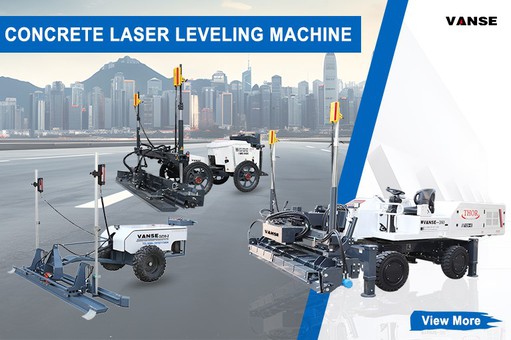
Laser leveling machine is an advanced equipment used for ground leveling in construction. It uses laser technology to achieve high-precision plane leveling. In order to ensure the quality of construction, the following points should be followed when using laser leveling machine:
1. **Accurately set the laser transmitter**:
– The laser transmitter must be accurately installed and adjusted to ensure that the laser beam it emits is perpendicular to the ground and remains horizontal throughout the working area.
2. **Calibrate the leveling machine**:
– Before starting the operation, the laser leveling machine needs to be calibrated to ensure that its receiver can correctly read the laser signal and accurately control the leveling height.
3. **Check the ground conditions**:
– Before construction, the ground should be pre-treated, including cleaning up debris, treating weak foundations, etc., to ensure that the ground foundation is solid and stable.
4. **Set reference points**:
– According to the design requirements, set reference points at the construction site, which will serve as standard references for leveling operations.
5. **Continuous monitoring**:
– When using a laser leveling machine, the intensity of the laser signal and the working status of the leveling machine should be continuously monitored to ensure that the machine is always operating on the correct plane.
6. **Operator training**:
– Operators should receive professional training to understand the working principle and operating specifications of the laser leveler to avoid quality problems caused by misoperation.
7. **Regular maintenance**:
– Regularly maintain and service the laser leveler, check the accuracy of the laser transmitter and receiver, and ensure the normal operation of the mechanical part.
8. **Quality control**:
– During the construction process, periodic quality inspections should be carried out, and the leveling effect should be verified using a level or other measuring tools, and the construction parameters should be adjusted in time.
9. **Records and reports**:
– Detailed records of various data and parameters during the construction process, including the setting values of the laser leveler, terrain changes in the construction area, etc., are required to facilitate later analysis and quality traceability.
Through the above measures, the laser leveler can be effectively used to improve construction efficiency and quality, reduce manual errors, and ensure that the ground flatness meets the design requirements.
Thanks to All the Friends Who Support and Trust Shandong Vanse Machinery Technology Co., Ltd.
If you want to know more about Shandong Vanse Machinery Technology Co., Ltd. or have any questions, please feel free to contact us:
Our Factory
Shandong Vanse Machinery Technology Co., Ltd.

Share this article

About the Author: Shandong Vanse Machinery Technology Co., Ltd.
Shandong Vanse Machinery Technology Co., Ltd. is a high-tech manufacturer specializing in concrete construction machinery, including laser screeds and related equipment. The company integrates R&D, production, and global sales, with products exported to over 60 countries and widely used in infrastructure projects worldwide.
Previous Post
Next Post
Related Articles
You Might Also Like
The impact of the maturity of the rental market on the sales strategies of power trowels and the business models of manufacturers
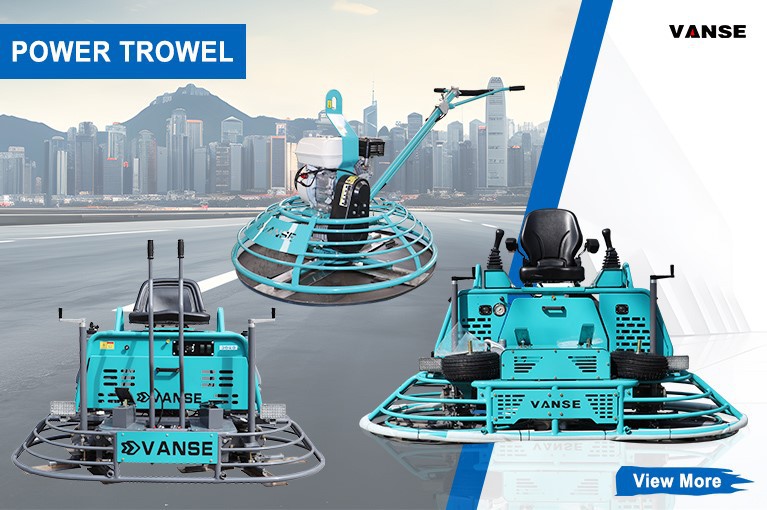
The maturity of the leasing market is a core variable influencing the construction machinery industry, especially for equipment like power trowels. It will have a fundamental impact on the sales strategies and business models of manufacturers. Let's explore this influence in detail in two parts below. The maturity of the rental market directly changes who the manufacturers' "customers" are and how they deal with them. Target customers: mainly end users, such as construction team leaders, individual contractors, and small and medium-sized construction companies. Core of sales strategy Price-driven: Customers are extremely sensitive to prices, and their purchase decisions are mainly based on the initial purchase cost. Function and durability promotion: Emphasize the basic functions, power and "durability" of the product, as the equipment is used and maintained by the owner themselves, and what they care about is "how long it can be used without recouping the cost". Channel penetration: Relying on a wide network of distributors to cover scattered end customers, providing timely in-stock purchases and basic after-sales services. Marketing methods: mainly offline stores, industry exhibitions, and referrals from acquaintances. Target customers: Professional leasing companies have become core major customers (such as United Leasing, Solar Belt Leasing, etc.), as well as large contractors. Core of sales strategy Value and total cost of ownership driven: Price is no longer the only factor. Leasing companies are more concerned about the total cost of ownership, including: Reliability & Attendance Rate: Does the machine rarely break down? Because idle machines mean a loss of rent. Maintenance convenience & Service Cost: Is it easy to maintain on a daily basis? Are the components cheap and readily available? Residual value: How much can the equipment still be sold for after several years of use? This is directly related to the asset return of the leasing company. Standardization and universality: Leasing companies hope that for products of the same brand or even the same platform, their operation methods, maintenance procedures and components can be as universal as possible to reduce training costs and inventory pressure. Direct sales to major clients and customization: Manufacturers will establish dedicated major client teams to directly connect with large leasing companies, and even provide customized products based on their specific needs (such as special color markings, software interfaces, and security configurations). Data and service support: Remote data monitoring (optional) is provided to assist leasing companies in managing equipment fleets, predicting maintenance times, and optimizing equipment deployment The maturity of the rental market has not only changed "what to sell" and "to whom to sell", but also profoundly promoted the transformation of manufacturers' "who I am". Core model: Production, manufacturing and sales The core of a manufacturer is to produce a product and then sell it. The business chain is basically over at this point. The profits mainly come from the sales of new machines. After-sales service is a cost center, and its main purpose is to support sales and prevent customer complaints. The rise of the rental market has forced manufacturers to transform from mere "equipment manufacturers" to "comprehensive solution providers". Model Evolution One: From selling products to operating assets Manufacturers have realized that their equipment is the "asset" that leasing companies use to make money. Therefore, they need to ensure that this asset can operate efficiently and economically throughout its entire life cycle. This has given rise to an extreme pursuit of reliability, durability and residual value management. Manufacturers will proactively release residual value reports and design products that are easy to refurbish to maintain their brand's value in the second-hand market. Model Evolution Two: Financial Services Become a key pillar Financial companies affiliated with or cooperating with manufacturers have become crucial. They offer to leasing companies: Flexible financial leasing solutions help it expand its fleet. Credit support helps its customers (end tenants) rent equipment more easily. This is not only a tool to boost sales, but also a source of profit in itself. Model Evolution Three: The proportion of after-market and service revenue has increased The new machine sales market fluctuates with the economic cycle, but the large fleet of existing equipment brings stable after-market income. Manufacturers actively sell original factory parts, repair services, extended warranties and maintenance contracts. The profit margins of these businesses are usually higher than those of new machine sales. Services have transformed from a "cost center" to a "profit center". Model Evolution Four: Exploration of Datafication and Service Orientation By installing sensors on the equipment, manufacturers can offer: Remote diagnosis and predictive maintenance can notify the leasing company in advance that the equipment may need repair, reducing unexpected downtime. Fleet management report helps leasing companies understand equipment utilization rate, fuel consumption, working hours, etc., and optimize business decisions. This initiated an upgrade in the business model from "selling hardware" to "selling hardware + services + data". Model Evolution Five: Entering the second-hand equipment and leasing business Some powerful manufacturers (such as Caterpillar) establish official certification and resale channels for used equipment, which helps control residual value and provides customers with full life-cycle options. A few manufacturers may even directly enter the market, operate their own leasing businesses, compete or cooperate with downstream customers, and gain a deeper understanding of market demands. Dimension A low-maturity rental market A highly mature rental market Core customers Scattered end users Large leasing companies, major contractors Competitive focus Price, basic functions TCO (Total Cost of Ownership), reliability, residual value Product Strategy It meets basic needs with a wide variety of models Platform-based, standardized and customizable Sales relationship One-time transaction, through the distributor Strategic cooperation, direct management of major clients Source of profit It mainly relies on the sales of new models New machine sales + after-market services + financial services Service role Cost center, supporting sales Profit center, independent business segment Business model Equipment manufacturer Provider of equipment asset management and solutions The maturity of the leasing market is a key force driving the evolution of the power trowel machine and even the entire construction machinery industry. It forces manufacturers to shift their focus from one-time sales of products to the value of operating equipment throughout its entire life cycle. In mature markets, the competition among manufacturers is no longer a simple price war, but a comprehensive ecological competition concerning brand reputation, service networks, financial support and digital capabilities. For manufacturers who want to enter or establish themselves in mature markets such as North America and Europe, understanding and adapting to these rules of the game is a prerequisite for success. Note: The parameters provided in this document are for reference only and are not mandatory. Due to differences in technical characteristics between different brands and models of laser levelers, please consult the manufacturer for a suitable solution before actual operation. This reference document assumes no responsibility for any issues arising from failure to follow the manufacturer's instructions.Automatic concrete spreader VS manual spreading Which ensures more uniform distribution of hardener for super flat floors
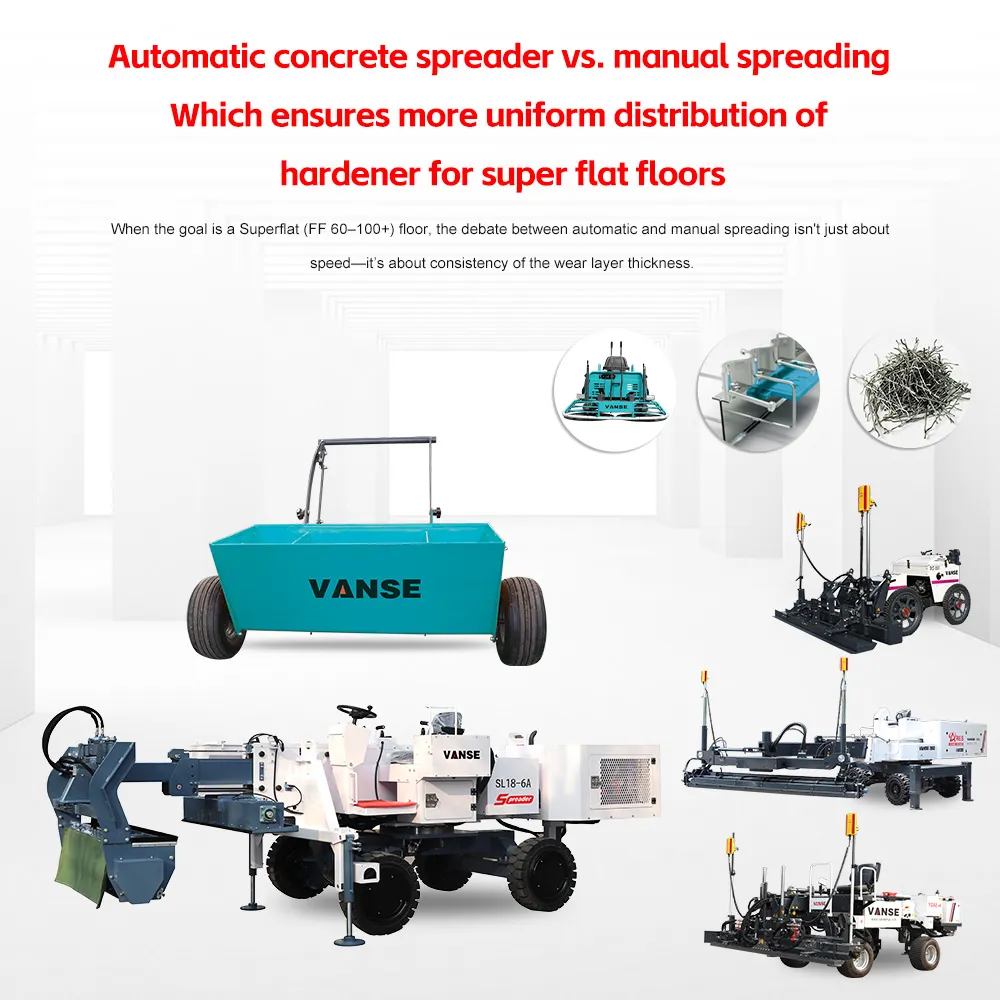
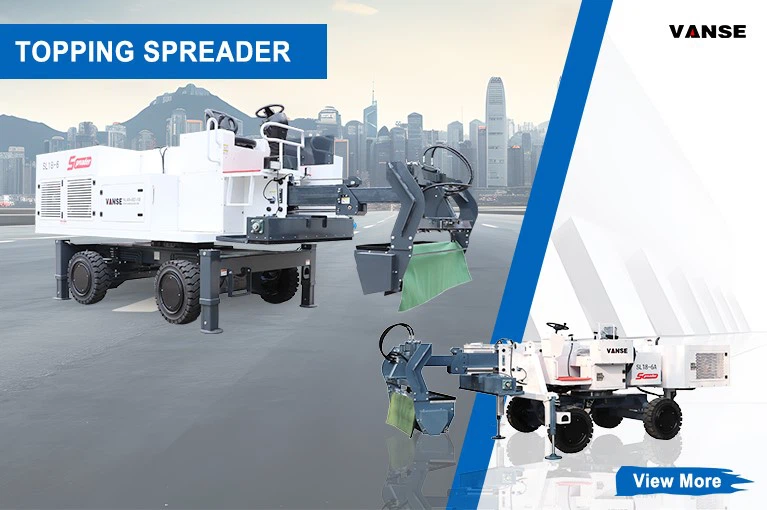
When the goal is a Superflat (FF 60–100+) floor, the debate between automatic and manual spreading isn't just about speed-it's about consistency of the wear layer thickness. For high-precision projects, Automatic Spreading wins decisively. Here is the technical breakdown of why manual spreading is often the "weak link" in achieving Superflat tolerances. To maintain a Superflat surface, the concrete must hydrate and shrink at exactly the same rate across the entire slab. Automatic Spreader: Uses a computer-controlled, fluted rotor (similar to an agricultural seed drill). It drops a metered amount of material (e.g., exactly 5.0 kg/㎡) regardless of travel speed. This ensures the "chemical demand" for water from the base slab is identical everywhere. Manual Spreading: Relies on a worker tossing material from a bucket or bag. Even the most skilled worker will create "heavy" spots (where the pile is 8 mm thick) and "light" spots (where it is 2 mm thick). The Superflat Consequence: Heavy spots suck more moisture out of the slab, causing localized "humps" or "blisters" that a power float cannot easily fix. A Superflat floor requires a perfectly level plane. Automatic (Telescopic): Machines like use a telescopic boom to "fly" the spreader head over the concrete. The head never touches the wet slab, meaning it doesn't leave ruts or footprints that would disturb the FL established by the laser Leveling. Manual: Requires workers to walk on the wet concrete (even with "snowshoes"). Every footstep is a displacement of aggregate and a micro-dip in the levelness that must be "re-floated." In Superflat construction, every time you touch the concrete, you risk degrading the F-number. Feature Automatic Spreader Manual Spreading Precision ± 2% variance ± 20-30% variance Surface Integrity No contact with slab (Telescopic) High contact (Footprints/Ruts) Timing Fast; covers large areas in minutes Slow; can lead to "cold joints" Dust Control Integrated skirts (low dust) High dust (affects laser receivers) Bond Strength Even hydration = uniform bond Uneven hydration = delamination risk In Superflat projects, the laser transmitter is the "Source of Truth." Manual spreading often creates a cloud of cement dust as workers toss the hardener. This dust can refract or "scatter" the laser beam, causing the laser Leveling or the laser-guided power floats to receive false signals. Automatic spreaders have enclosed hoppers and drop the material from a height of only a few centimeters, keeping the air clear and the laser signals accurate. The only time manual spreading is preferred is in extremely tight corners or around complex "box-outs" where a large machine cannot reach. However, for the main "runway" of a VNA (Very Narrow Aisle) warehouse, manual spreading is generally prohibited by high-end specifications. Automatic spreading is mandatory. Manual spreading introduces too much human error in volume distribution. On a Superflat project, an extra 2 mm of dry-shake in one spot can create a "peak" that fails the FF floor profiler test after the concrete cures. Would you like me to provide a sample specification clause that contractors use to mandate automatic spreading for VNA warehouse projects? Contact us NOW Note: The parameters provided in this document are for reference only and are not mandatory. Due to differences in technical characteristics between different brands and models of laser levelers, please consult the manufacturer for a suitable solution before actual operation. This reference document assumes no responsibility for any issues arising from failure to follow the manufacturer's instructions.Concrete finishing equipment for high FF scores
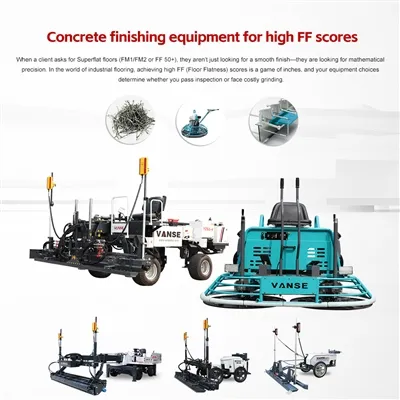
When a client asks for Superflat floors (FM1/FM2 or FF 50+), they aren't just looking for a smooth finish-they are looking for mathematical precision. In the world of industrial flooring, achieving high FF (Floor Flatness) scores is a game of inches, and your equipment choices determine whether you pass inspection or face costly grinding. To consistently hit those high-spec numbers, you need a synchronized fleet. Here is the professional equipment breakdown for high FF scores, featuring the specialized lineup from Vanse Machinery. You can't finish a floor flat if it wasn't placed flat. The Concrete Laser Leveling Machine is the most critical variable for FF scores. The Vanse Approach: For large-scale warehouse projects, the Vanse YZ30-4E Telescopic Boomed Laser leveling is the industry standard. Its 360-degree rotation and 6-meter telescopic boom allow the leveling head to reach out and strike off the concrete while the machine remains stationary. This prevents "tire track" deviations. For tighter workspaces, the WS940/WS940C/YZ28-4S/YZ25-4 offers the same high-frequency vibration and laser precision in a more agile frame. Consistency is the enemy of "dips" and "mounds." If your concrete is dumped in massive, uneven piles, the leveling has to work harder, which can lead to inconsistencies in FF scores. The Workflow: Use a Vanse Concrete Distributor to ensure an even "ribbon" of concrete is placed across the bay. To get material into the strips quickly without disturbing the subgrade, the Vanse Mini Dumper (available in electric and gasoline) is the perfect support tool. It allows for controlled, precise dumping that makes the laser leveling's job much easier. High FF floors often require a dry-shake hardener for wear resistance. If you spread this manually, you risk creating "hills" and "valleys" that ruin your flatness numbers. The Vanse Approach: The Vanse Automatic Topping Spreader applies the material with mechanical consistency. By linking the spreader's output to the machine's travel speed, you get a uniform layer that integrates perfectly with the wet concrete, preserving the flatness achieved by the laser leveling machine. Once the slab is leveled, you need to densify it. However, a "chattering" trowel can actually lower your FF score. The Workflow: Transition to a Vanse VS1046 Ride-on Power Trowel. With its heavy-duty gearbox and high-torque BRIGGS & STRATTON engine, it provides the steady, powerful compaction needed to "burnish" the floor. Its precision pitch control allows the operator to make micro-adjustments to the blades, smoothing out the surface to a mirror finish without introducing new waves into the slab. Even a Superflat floor will fail if the joints are ragged or spalled. The Workflow: As soon as the concrete can support it, use a Vanse Concrete Cutting Machine (Floor Saw) for your contraction joints. A stable, high-speed saw ensures the edges of the joints stay crisp, which is vital for the long-term maintenance of FF scores once heavy forklift traffic begins. When you browse www.vansemac.com, you're looking at a complete Superflat Solution. Here's why this workflow is the gold standard for international buyers: Labor Efficiency: A full Vanse fleet can turn a 12-man manual crew into a high-output 5-man team. Data-Driven Results: These machines are designed to meet ACI 117 and TR34 standards. When you use a Vanse laser leveling followed by a Vanse power trowel, you are practically guaranteed higher F-numbers. Reliability: In high-spec flooring, equipment downtime can ruin a pour. Vanse uses world-class components (Honda, Rexroth, Danfoss) to ensure your fleet keeps moving until the last pass is done. Achieving high FF scores isn't a secret-it's a process. By combining the placement precision of the Concrete Distributor, the leveling power of the Laser leveling, and the finishing torque of the Power Trowel, you create a floor that isn't just flat-it's Vanse Flat. Visit www.vansemac.com to see our full lineup and start hitting those FM1 numbers on your next project. Note: The parameters provided in this document are for reference only and are not mandatory. Due to differences in technical characteristics between different brands and models of laser levelers, please consult the manufacturer for a suitable solution before actual operation. This reference document assumes no responsibility for any issues arising from failure to follow the manufacturer's instructions.