Automatic concrete spreader VS manual spreading Which ensures more uniform distribution of hardener for super flat floors
March 5, 2026
Automatic concrete spreader VS manual spreading Which ensures more uniform distribution of hardener for super flat floors 2
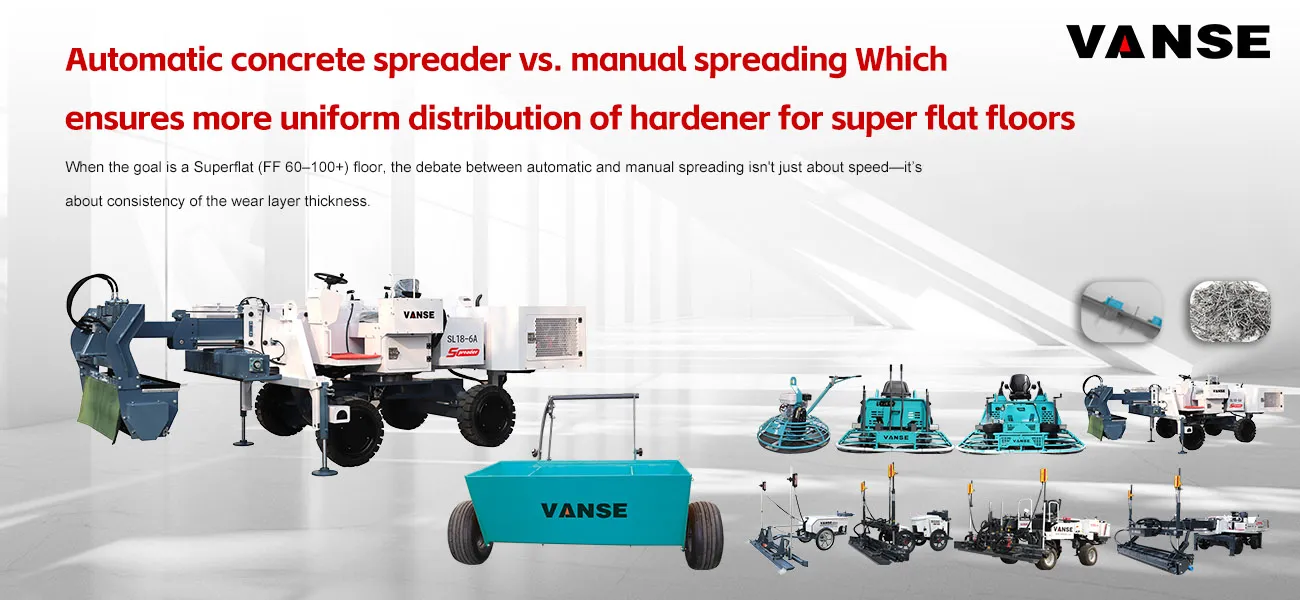
When the goal is a Superflat (FF 60–100+) floor, the debate between automatic and manual spreading isn't just about speed-it’s about consistency of the wear layer thickness.
For high-precision projects, Automatic Spreading wins decisively. Here is the technical breakdown of why manual spreading is often the "weak link" in achieving Superflat tolerances.
1. Uniformity of Application Rate (kg/㎡)
To maintain a Superflat surface, the concrete must hydrate and shrink at exactly the same rate across the entire slab. Automatic Spreader: Uses a computer-controlled, fluted rotor (similar to an agricultural seed drill). It drops a metered amount of material (e.g., exactly 5.0 kg/㎡) regardless of travel speed. This ensures the "chemical demand" for water from the base slab is identical everywhere. Manual Spreading: Relies on a worker tossing material from a bucket or bag. Even the most skilled worker will create "heavy" spots (where the pile is 8 mm thick) and "light" spots (where it is 2 mm thick). The Superflat Consequence: Heavy spots suck more moisture out of the slab, causing localized "humps" or "blisters" that a power float cannot easily fix.
2. Impact on the "Levelness" Plane (FL)
A Superflat floor requires a perfectly level plane. Automatic (Telescopic): Machines like use a telescopic boom to "fly" the spreader head over the concrete. The head never touches the wet slab, meaning it doesn't leave ruts or footprints that would disturb the FL established by the laser Leveling. Manual: Requires workers to walk on the wet concrete (even with "snowshoes"). Every footstep is a displacement of aggregate and a micro-dip in the levelness that must be "re-floated." In Superflat construction, every time you touch the concrete, you risk degrading the F-number.
3. Comparative Performance for Superflat Projects
Feature
Automatic Spreader
Manual Spreading
Precision
± 2% variance
± 20-30% variance
Surface Integrity
No contact with slab (Telescopic)
High contact (Footprints/Ruts)
Timing
Fast; covers large areas in minutes
Slow; can lead to "cold joints"
Dust Control
Integrated skirts (low dust)
High dust (affects laser receivers)
Bond Strength
Even hydration = uniform bond
Uneven hydration = delamination risk
4. The "Laser Interference" Factor
In Superflat projects, the laser transmitter is the "Source of Truth." Manual spreading often creates a cloud of cement dust as workers toss the hardener. This dust can refract or "scatter" the laser beam, causing the laser Leveling or the laser-guided power floats to receive false signals. Automatic spreaders have enclosed hoppers and drop the material from a height of only a few centimeters, keeping the air clear and the laser signals accurate.
5. When Manual is (Rarely) Better
The only time manual spreading is preferred is in extremely tight corners or around complex "box-outs" where a large machine cannot reach. However, for the main "runway" of a VNA (Very Narrow Aisle) warehouse, manual spreading is generally prohibited by high-end specifications.
The Verdict for Superflat Floors
Automatic spreading is mandatory. Manual spreading introduces too much human error in volume distribution. On a Superflat project, an extra 2 mm of dry-shake in one spot can create a "peak" that fails the FF floor profiler test after the concrete cures.
Would you like me to provide a sample specification clause that contractors use to mandate automatic spreading for VNA warehouse projects? Contact us NOW
Note:The parameters provided in this document are for reference only and are not mandatory. Due to differences in technical characteristics between different brands and models of laser levelers, please consult the manufacturer for a suitable solution before actual operation. This reference document assumes no responsibility for any issues arising from failure to follow the manufacturer's instructions.
About the Author: Shandong Vanse Machinery Technology Co., Ltd.


Shandong Vanse Machinery Technology Co., Ltd. is a high-tech manufacturer specializing in concrete construction machinery, including laser screeds and related equipment. The company integrates R&D, production, and global sales, with products exported to over 60 countries and widely used in infrastructure projects worldwide.

VANSE leveling machine speaks with quality and service!
VANSE leveling machine speaks with quality and service! The laser transmitter of the concrete laser leveling machine generates a rotating laser. The laser receiver on the laser leveling machine receives the signal and is analyzed by the laser measurement and control system. The deviation will be fed back to the sensitive computer control system on the laser leveling machine. The linear actuator will adjust the height of the scraper to ensure leveling accuracy. Shandong VANSE Machinery, as the earliest and most professional manufacturer of laser leveling machines in China, believes that occasional quality problems are not enough to negate the strength of the entire brand. Does a brand have strength? The key lies in whether the company has a sound after-sales system and whether it can provide high-quality after-sales service in the first place. High-quality products are the theme of long-term development of enterprises, and high-quality services are the key to the sublimation of corporate brand image. Shandong VANSE laser leveling machine manufacturer has been committed to the research and development and production of concrete laser leveling machine products for many years. The product quality has also experienced the test of various working conditions, and the high-quality after-sales service has been recognized by the majority of users. Our service tenet As long as there is a VANSE laser leveling machine, we only need a call from you, and we can always provide you with high-quality services in the first time. We insist on making high-quality products and high-quality services!
Read More
May 22, 2024
Concrete laser leveling machine construction plan
Concrete laser leveling machine construction plan 1. Project background and requirements With the acceleration of urbanization, concrete construction occupies a pivotal position in the construction industry. To ensure the quality and efficiency of concrete construction, the use of advanced construction equipment and technology is crucial. This project aims to achieve efficient and accurate concrete floor leveling by using a concrete laser leveling machine to meet the high requirements of modern buildings for flatness, smoothness and construction efficiency. The project requirements are clear, including the area of the construction area, concrete strength grade, flatness requirements, and construction period. At the same time, factors such as the site environment, climatic conditions, and the skill level of construction personnel need to be fully considered to ensure the feasibility and effectiveness of the construction plan. 2. Leveling machine model selection Depending on the project needs, it is crucial to choose the right concrete laser leveling machine model. When choosing a leveler, you need to consider the following factors: ☑ Construction area and terrain conditions: Large projects or wide sites are suitable for large leveling machines, while narrow or complex terrain is more suitable for small or flexible leveling machines. ☑ Concrete type and requirements: Concrete of different strengths and grades have different performance requirements for the leveling. It is necessary to select a leveling machine model that can meet the construction requirements. ☑ Equipment performance and technical parameters: Pay attention to key technical parameters such as laser system accuracy, leveling efficiency, and control performance of the leveling machine to ensure that the equipment can meet the requirements of construction accuracy and efficiency. Combining the above factors, this project selected a machine with stable performance and Concrete laser leveling machine model that is easy to operate and highly adaptable to ensure construction quality and efficiency. 3. Preparation work before construction Before construction, sufficient preparations need to be made, including: ☑ On-site survey and measurement: Conduct detailed survey and measurement of the construction area to determine the construction scope and reference points to provide a basis for the installation and calibration of the leveling machine. ☑ Equipment and material preparation: Check the integrity of the leveling and related equipment to ensure that the equipment can operate normally; at the same time, prepare concrete materials and other auxiliary materials required for construction. ☑ Personnel organization and training: Organize a professional construction team and conduct safety and technical training before construction to ensure that construction personnel are familiar with equipment operation, safety regulations and construction technology. 4. Leveling machine operation process During the construction process of the leveling machine, the following operating procedures need to be followed: ☑ Equipment installation and calibration: Install and calibrate the leveler according to the equipment instructions, ensure that the laser transmitter and receiver are in optimal working condition, and perform initial testing and adjustment. ☑ Concrete laying and leveling: Lay concrete according to construction requirements and use a leveling machine for preliminary leveling. By adjusting the parameters and working mode of the leveler, high-precision leveling of the concrete surface is achieved ☑ Follow-up processing and maintenance: After leveling is completed, necessary follow-up processing is carried out, such as finishing, compaction, etc. At the same time, according to the maintenance requirements of the concrete, a reasonable maintenance plan is formulated to ensure that the quality and strength of the concrete meet the design requirements. During operation, please pay attention to the following points: Strictly operate in accordance with the equipment instructions and construction techniques to avoid misoperation or illegal operation. During the leveling process, it is necessary to observe the flatness and smoothness of the concrete surface at any time, and adjust the parameters and working mode of the leveling machine in a timely manner. Pay attention to safety matters, such as wearing safety helmets, protective glasses and other protective equipment to ensure the personal safety of construction workers. 5. Quality control and safety measures To ensure construction quality and safety, the following measures need to be taken: ☑ Quality control: During the construction process, special quality inspection personnel are set up to monitor the concrete laying and leveling process in real time to ensure that the construction quality meets the design requirements. At the same time, regular maintenance and upkeep of the leveling machine is carried out to ensure stable and reliable performance of the equipment. ☑ Safety measures: Establish a sound safety management system and provide safety education and training to construction personnel. Set up obvious safety warning signs at the construction site to ensure that construction workers understand and abide by safety regulations. At the same time, safety inspection and maintenance are carried out on the leveling machine to ensure that the equipment is safe and reliable during operation. 6. Construction progress and arrangements To ensure construction progress and efficiency, detailed construction plans and arrangements need to be made: ☑ According to the project needs and site conditions, formulate a reasonable construction plan and schedule, and clarify the tasks and time nodes of each stage ☑ Strengthen on-site management and coordination to ensure that the construction team can carry out construction in an orderly manner according to the plan ☑ Timely adjust construction plans and arrangements according to actual conditions to deal with various problems and challenges that may arise, 7. Later maintenance and upkeep After the construction is completed, post-maintenance and maintenance of the concrete laser leveling machine is a key link to ensure its long-term stable operation and extend its service life. Specifically include the following aspects: ☑ Cleaning and maintenance: After construction, clean the concrete residue and dust on the surface of the leveler in time to keep the equipment clean. Regularly clean and maintain the inside of the equipment, such as replacing filters, cleaning fuel tanks, etc., to ensure normal operation of the equipment. ☑ Lubrication and tightening: Regularly check the lubrication system and fasteners of the leveling machine, add lubricating oil or grease in time, and tighten loose parts to ensure the flexibility and stability of each component of the equipment. ☑ Repair and replacement; repair or replace faulty or damaged parts in a timely manner. During the maintenance process, operations must be carried out in accordance with the equipment instructions and relevant technical specifications to ensure maintenance quality and safety. At the same time, equipment maintenance files need to be established to record the maintenance and repair status of the equipment, so as to understand the operating status and maintenance history of the equipment at any time and provide a strong guarantee for the long-term use of the equipment. In summary, the concrete laser leveling machine construction plan covers the project background and needs, leveling machine model selection, pre-construction preparations, leveling machine operating procedures, quality control and safety measures, construction progress and arrangements, and subsequent maintenance. In terms of construction and maintenance, in actual construction, it is necessary to closely combine the specific conditions of the project, scientifically formulate construction plans, and rationally allocate resources to ensure construction quality and progress. At the same time, we should strengthen safety education and training for construction personnel, improve safety awareness, and ensure safety and stability during the construction process. Through the implementation of this concrete laser leveling machine construction plan, we can achieve efficient and accurate concrete floor leveling, improve construction quality, reduce construction costs, and contribute to the development of the modern construction industry. At the same time, it also provides useful reference and reference for the construction of subsequent similar projects. In terms of later maintenance and upkeep, in addition to routine cleaning, lubrication and repairs, the following points should also be noted: ☑ Strengthen technical training for equipment operators, improve their equipment operation and maintenance levels, and ensure that equipment is used and maintained correctly ☑ Establish a complete equipment management system, clarify the responsibilities and requirements for equipment maintenance, and ensure that equipment is maintained in a timely and effective manner. ☑ For equipment that has been idle for a long time, regular inspection and maintenance should be carried out to prevent damage or performance degradation due to long-term idleness. In addition, when selecting equipment, its reliability and durability should be considered to reduce the cost of later maintenance and replacement. At the same time, during the construction process, the construction quality should be strictly controlled to avoid increasing the maintenance burden of the equipment due to construction quality problems. . In short, the formulation and implementation of the concrete laser leveling construction plan requires comprehensive consideration of many factors, including project requirements, equipment performance, construction environment, personnel quality, etc. Through scientific planning, careful organization and strict management, we can ensure construction quality and safety, improve construction efficiency, reduce construction costs, and lay a solid foundation for the successful implementation of the project.
Read More
September 10, 2025
How can the performance and operation of a concrete laser leveling machine be optimized
Regarding the performance and operation optimization of concrete laser leveling machines, this is a systematic project that integrates equipment maintenance, advanced technology, and precise operation. Optimization can be approached from two perspectives: equipment performance optimization and operating method optimization. Equipment performance is the foundation for ensuring construction quality and efficiency. Optimization aims to ensure that the equipment is always in optimal working condition. Laser Transmitter: This is the "eyes" and "brains" of the equipment. Calibration: Perform a calibration check daily before starting work. Secure the receiver to a pole and verify that the elevation set by the laser transmitter matches the actual measurement. Even the slightest deviation can lead to extensive construction failure. Cleaning and Protection: Keep the laser transmitter lens clean to prevent dust and moisture from affecting the laser beam's accuracy. Store properly to prevent collisions. Leveling Head (Scraper and Vibrator): Check for wear: Regularly inspect the scraper for wear. Excessive wear can lead to reduced leveling accuracy and material waste. Replace or adjust promptly. Vibration Frequency Uniformity: Check that the vibrating rod is functioning properly to ensure uniform concrete compaction density across the entire leveling head to avoid localized honeycombing. Chassis and Travel System: Cleaning: After each construction phase, thoroughly clean any solidified concrete debris from the chassis, as this will significantly affect the smoothness of the next construction phase. Check Fasteners: Check all connecting components and bolts for looseness to ensure the structural stability of the equipment. Tires/Tracks: Check tire pressure and track wear to ensure stable ground contact. Multiple Laser Receivers: Equipping the leveling head with multiple laser receivers allows for more comprehensive monitoring of the head's real-time posture. This is particularly important for levelinging over large spans, effectively preventing errors caused by leveling head deformation. Intelligent Control System Upgrade: Monitor control system updates provided by equipment manufacturers. Newer systems may feature more advanced algorithms, enabling smoother control, fault diagnosis, and even grade control. High-Strength Components: For components subject to severe wear, such as scrapers, consider using more wear-resistant high-strength alloys or polyurethane materials to extend their service life. Advanced equipment requires scientific operating methods to maximize its effectiveness. Precise benchmark setting: This is the foundation of all work. A professional surveyor must use a high-precision level or total station to determine the position and elevation of the laser transmitter according to the design drawings. Ensure that the transmitter is set up in a stable, interference-free area. Formwork (steel formwork) installation: The top elevation of the formwork must be precisely aligned with the designed elevation of the laser leveling and securely fixed. The flatness of the formwork directly affects the construction quality of the edge areas. Base preparation and reinforcement mesh laying: The base layer (usually a crushed stone base) must be compacted and leveled; otherwise, uneven concrete thickness may occur, leading to cracking due to settlement. The steel mesh should be laid flat and supported with blocks to ensure its correct position in the concrete and prevent it from scraping against the rebar and shifting during equipment movement. Concrete material control: Slump: This is the key to success! The slump of concrete used for laser leveling must be strictly controlled, typically between 140-160mm. Excessive slump results in high concrete flow, causing backflow on both sides of the leveling as the leveling moves, forming waves. Excessive slump results in poor flow, high resistance to the leveling, prone to cracking, and difficulty maintaining density. Aggregate Size: Avoid using coarse aggregate with excessively large particle sizes to prevent it from clogging the leveling blade or vibrator. Unloading and Initial Spreading: Concrete should be evenly distributed during unloading to avoid piles. Initial spreading can be performed using a small excavator or manually, with a thickness slightly above the design elevation to reduce the load on the leveling. Equipment Path Planning: The operator should plan the leveling's path, typically adopting an S-shaped or spiral path, to avoid sharp turns on unset concrete, which can cause surface disturbance and elevation deviation. Matching Travel Speed and Vibration Frequency: The equipment should maintain a constant and slow speed. Excessive speed will result in incomplete vibration and surface ripples. Adjust the vibration frequency in real time based on the concrete slump. For high slumps, reduce the frequency appropriately; for low slumps, increase the frequency to ensure adequate vibration. Overlap Treatment: There should be a sufficient overlap between the two leveling paths (typically 10-20cm) to ensure a smooth transition at the joint with no height differences. Operator Skills: The operator must not only be able to operate the machine but also understand the characteristics of concrete. They should be able to observe the concrete's response (such as slurry seepage and surface gloss) to determine whether the vibration is sufficient and the speed is appropriate, allowing for immediate adjustments. Timely Curing: After initial setting, laser-leveled concrete floors should be immediately sprayed with a curing agent or covered with a film to retain moisture and prevent plastic shrinkage cracks caused by rapid water loss. The optimized leveled floor is denser, so early curing is particularly important. Connecting with Subsequent Processes: Time the joint cutting process appropriately (usually within 6-24 hours after construction, depending on the temperature and concrete strength development) to prevent random cracking. Optimize Category Specific Measures Purpose Equipment performance Daily laser system calibration Ensures absolutely precise elevation control Inspect and replace the leveling scraper Ensures levelinging results and smoothness Thoroughly clean the chassis of concrete debris Prevents elevation errors and equipment damage Operation Strictly control the concrete slump (140-160mm) Ensures proper fluidity, easy leveling, and no backflow Precisely set the formwork and laser reference Provides a foundation for high-quality construction Drive at a constant and slow speed, matching the vibration frequency Ensures adequate vibration and compaction of concrete Operator experience and fine-tuning Addresses unexpected on-site situations and enables dynamic optimization Timely water conservation and maintenance Prevents surface cracking and ensures overall quality By combining strict equipment maintenance, scientific construction preparation and refined operating procedures, the performance of the concrete laser leveling machine can be maximized, ultimately achieving ultra-high flatness, high density and high efficiency construction results. Note: The parameters provided in this document are for reference only and are not mandatory. Due to differences in technical characteristics between different brands and models of laser levelers, please consult the manufacturer for a suitable solution before actual operation. This reference document assumes no responsibility for any issues arising from failure to follow the manufacturer's instructions.