Technical Knowledge
How to use concrete power trowel correctly? Please example
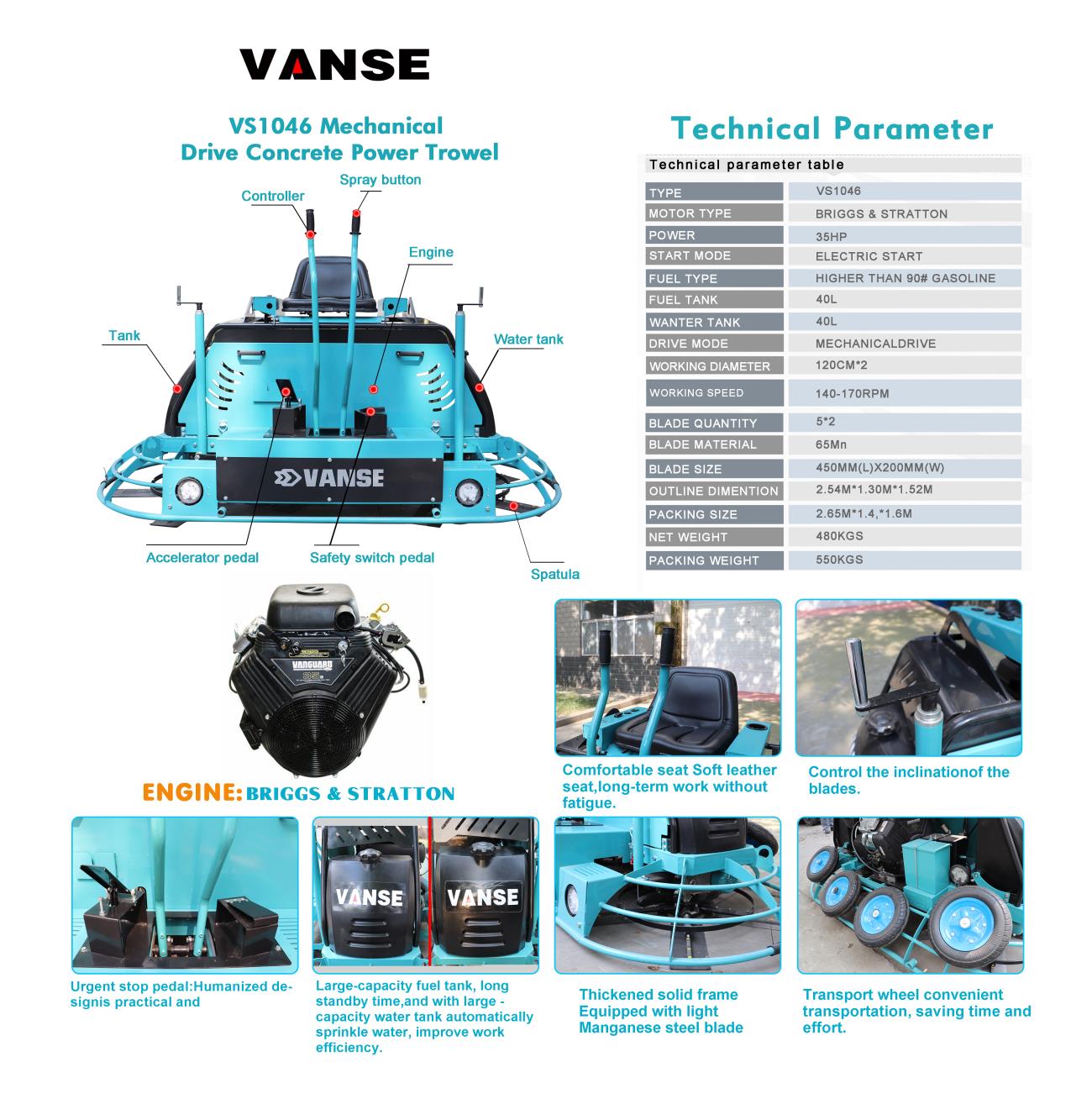
How to use a concrete trowel correctly
The concrete trowel is a construction machine widely used on concrete surfaces. Its main function is to smooth, compact and trim the concrete surface to improve its flatness and aesthetics. In order to ensure the correct use of the concrete trowel and extend its service life, here are some suggestions on how to use the concrete trowel correctly.
☀☀1. Preparation for machine operation
1.1 Check device status
Before operating the concrete trowel, you should check whether its various components are intact, including the motor, blades, bearings, etc. Ensure that all components are in good working order to ensure normal operation of the machine and construction efficiency
1.2 Determine the work area
Before operating the concrete trowel, you should identify the work area and make sure it is clean, flat, and free of debris. At the same time, the temperature of the work area should be ensured to be appropriate to avoid damage to the machine and concrete caused by excessively high or low temperatures.
☀☀2. Start operation
2.1 Adjust working mode
According to the specific conditions of the concrete surface, select the appropriate working mode, such as rough grinding, fine grinding, etc. After adjusting the working mode, check whether the machine parameters are correct, such as pressure, speed, etc.
2.2 Operating the trowel
When operating the concrete trowel, you should maintain a stable speed and pressure and avoid being too fast or too slow or too light or too heavy. At the same time, attention should be paid to observing the condition of the concrete surface and adjusting the working status of the machine in a timely manner. During operation, a safe distance should be maintained to avoid injuries from scratches or splashes by the blade.
☀☀3. Operation precautions
3.1 Maintain stable operation
When operating the compacted soil trowel, you should maintain a stable speed and pressure and avoid being too fast or too slow or too light or too heavy. This helps improve construction efficiency and quality and reduces damage to machines
3.2 Pay attention to safe distance
During operation, a safe distance should be maintained to avoid injuries from scratches or splashes by the blade. At the same time, attention should be paid to observing the surrounding environment to ensure construction safety.
☀☀4. Maintenance recommendations
4.1 Regular replacement of parts
In order to maintain the good condition and working efficiency of the concrete trowel, wearing parts and consumables such as blades, bearings, etc. should be replaced regularly. At the same time, attention should be paid to checking whether all parts of the machine are intact, and if damaged, they should be replaced in time.
4.2 Cleaning and lubrication
During use, the concrete trowel should be cleaned regularly to keep it clean and in good working order. At the same time, various parts of the machine should be lubricated regularly to reduce wear and extend service life.
4.3 Storage precautions
After use, the concrete trowel should be stored in a dry, ventilated place away from direct sunlight and humid environments. At the same time, all parts of the machine should be disassembled and stored to avoid damage caused by long-term exposure.
In short, the correct use of a concrete trowel requires certain skills and precautions. Only by following the correct operating methods and maintenance recommendations can the normal operation of the machine be ensured and construction efficiency and quality improved.
Thanks to All the Friends Who Support and Trust Shandong Vanse Machinery Technology Co., Ltd.
If you want to know more about Shandong Vanse Machinery Technology Co., Ltd. or have any questions, please feel free to contact us:
Our Factory
Shandong Vanse Machinery Technology Co., Ltd.








Share this article

About the Author: Shandong Vanse Machinery Technology Co., Ltd.
Shandong Vanse Machinery Technology Co., Ltd. is a high-tech manufacturer specializing in concrete construction machinery, including laser screeds and related equipment. The company integrates R&D, production, and global sales, with products exported to over 60 countries and widely used in infrastructure projects worldwide.
Previous Post
Next Post
Related Articles
You Might Also Like
Determining the initial setting time of concrete and mastering the optimal timing for power trowel operation
The determination of the initial setting time of concrete and the timing of the entry of the power trowel machine are the keys to ensuring that the floor is flat, solid and free of cracks. Below, I will elaborate in detail in two parts: one is how to determine the initial setting time of concrete, and the other is how to grasp the best time for the power trowel to enter the site for operation. Initial setting refers to a "critical point" at which concrete begins to transform from a plastic state to a solid state. At this point, the concrete loses its fluidity but has not yet acquired strength. According to the national standard "Standard Test Methods for Performance of Ordinary Concrete Mixtures", the initial setting time is scientifically determined by a penetration resistance meter. Method: Sift out the mortar from the concrete mixture and load it into a specific container. From the start of pouring, test with a penetration resistance meter at regular intervals (such as 30 minutes). The determination criterion: When the penetration resistance reaches 3.5 MPa, the corresponding time is the initial setting time. Applicable scenarios: Laboratories or major project sites, where precise data is required to guide construction. In actual construction, workers rely on simple and effective empirical methods: Acupressure method (the most classic) : Operation: Press the concrete surface firmly with your fingers (or feet). Judgment Too early: If the fingers can easily press down very deep and cement slurry overflows, it indicates that it is far from beginning to set. Close to initial setting: When pressed hard, only a clear fingerprint of 3-5 millimeters is left on the surface, but no cement slurry overflows. This is a very important signal. Initial condensation: It requires a great deal of force to leave a very shallow mark. Footprint method Operation: Construction workers stand on the concrete surface and observe the sinking of the footprints. Judgment Too early: Deep footprints, obvious subsidence, and cement slurry being squeezed out around. Close to initial setting: The depth of the footprints is relatively shallow (about 5mm), and the edges of the footprints are clear, with no obvious precipitation of slurry water. At this point, people can walk on it, but there is a slight sense of sinking. Scratch method Operation: Use a nail, screwdriver or power trowel to make a mark on the concrete surface. JudgmentToo early: The scratch will close quickly and be filled with cement slurry. Near initial setting: The scratch can maintain its shape, with the edge slightly raised and no longer closed. This is a strong indication that the first power trowel operation can begin. The entry and operation of the power trowel machine are not completed in one go, but are carried out in stages. Mistiming can lead to serious consequences: Entering the site too early: The concrete is too soft, and the machine will sink and stick to the slurry, damaging the concrete structure and causing the surface to peel and the strength to decrease. Entering the site too late: The concrete is already too hard, and the power trowel machine cannot effectively lift the slurry and smooth it out, which is time-consuming and laborious, and is prone to surface cracking. The best time and process for work The operation of a power trowel machine is usually divided into two key stages: Phase One: Initial smoothing (lifting the slurry and finishing the surface) Timing: The concrete is at or slightly above its initial setting point. Specific status When a person stands on it, the depth of the footprints is about 3 to 5 millimeters. By using the scratch method, the scratch can remain clear. When the power trowel blade is placed on it, it will not sink obviously. Assignment purpose: Press the aggregates (stones) slightly into the lower layer. Lift the surface cement slurry up. Carry out large-scale preliminary leveling. Key points of operation The operation is carried out using a disc (rubbing disc). The machine should not run too fast. It should move smoothly and slowly. Pay attention to overlapping areas that have been worked on to ensure no omissions. Phase Two: Fine grinding and polishing Timing: After the initial smoothing, when the moisture and luster on the concrete surface disappear and almost no footprints are left when stepped on (approximately 1-3 hours after the initial setting, depending on the environment). Specific status The color of the concrete surface begins to darken and become darker. There is a rough feeling when touched, but no hard or brittle sensation. At this point, the concrete has already possessed an initial load-bearing capacity. Assignment purpose: Eliminate the tiny scratches left by the disc operation. Further compact and smooth the surface to achieve the required flatness and smoothness. Seal the surface capillary pores to enhance wear resistance and impermeability. Key points of operation Remove the disc and use a blade (spatula) to carry out the operation. The rotational speed and moving speed of the machine can be appropriately increased. Cross-operation, multiple times of polishing, each time more meticulous than the previous one. Stage Description of concrete state Test method Operation of the power trowel machine Purpose Waiting period Soft, deep footprints, with bleeding Finger pressure/footprint method No entry allowed Let the concrete settle naturally and bleed water to evaporate Initial freezing point The footprints are 3 to 5mm deep, the scratches are clear, and there is no bleeding Finger pressure/scratch method Prepare to enter Determine the timing of the first operation First assignment Reach or slightly exceed the initial freezing point The same as above Install the disc and smooth it out at low speed Slurry extraction and initial leveling Fine grinding operation The surface water luster disappears, and the footprints are extremely shallow or non-existent Observe the color and footprints Replace the blade and polish at medium to high speed Compact, smooth surface, and seal Environmental factors influencing timing Temperature and wind speed: When the temperature is high and the wind is strong, water evaporation is fast, the initial setting time will be shortened, and all processes need to be advanced. Humidity: When the humidity is high, water evaporation is slow, and the initial setting time will be prolonged. Patience is required. The concrete mix ratio: The type of cement, water-cement ratio, and admixtures (such as retarders) all significantly affect the initial setting time. Final suggestion For important floor construction, "better late than early" is a safer principle. A little later, at most it will take more effort. However, entering the site too early will cause irreversible damage to the concrete structure. Skilled construction workers will dynamically adjust the entry and operation time of the power trowel machine through continuous observation and simple tests. Note: The parameters provided in this document are for reference only and are not mandatory. Due to differences in technical characteristics between different brands and models of laser levelers, please consult the manufacturer for a suitable solution before actual operation. This reference document assumes no responsibility for any issues arising from failure to follow the manufacturer's instructions.Selection and Installation Key Points of Formwork Systems in Super Flat Floor Construction
In the construction of super flat floors, the formwork system serves not only as lateral restraint but also as the baseline for elevation control. Since super flat floors typically utilize the "skip-pour method" or "long-strip paving," the stability and straightness of the formwork directly determine the flatness of the joints. The following are key points regarding the selection and installation of formwork systems for super flat floors: Traditional wooden formwork has been phased out in super-flat floor construction due to its susceptibility to deformation and low strength. The current mainstream solutions are as follows: Composition: Consists of two cold-drawn steel corner guards, load transfer bars, breakable bolts, and a lower steel plate. Advantages: No need to remove after construction; it remains in the floor as a permanent joint; effectively protects the concrete edges from impact damage by forklift wheels (prevents chipping). Applicable to: Longitudinal construction joints in very narrow aisle (VNA) areas. Requirements: Must possess sufficient rigidity, and the top surface must be machined and leveled. Advantages: When used with a laser leveling machine, it can serve as a physical reference for the leveling head. The accuracy of template installation directly affects the FL (Levelness) value, and the following steps must be followed: Precise elevation control: Use a high-precision leveling instrument (accuracy requirement within ± 0.5 mm ) for surveying. Denser measurement points: Set a fixed control point every 2 ~ 3 m along the template support trajectory to ensure straightness over long distances. Reinforcement design: The template must be firmly anchored to the base layer using steel reinforcement bars. In ultra-flat floor construction, the power trowel is heavy and vibrates strongly; even a 1 mm settlement of the template will result in unacceptable flatness in that area. Gap sealing: The gap between the bottom of the template and the base layer should be sealed with mortar to prevent leakage and the resulting "root rot" phenomenon, otherwise it will lead to honeycomb and pockmarked surfaces at the edges. Perpendicularity requirement: Dowel bars must be strictly parallel to the floor surface and perpendicular to the template surface. Displacement control: The use of dowel bar sleeves or supports is recommended. If the dowel bars tilt during pouring, it will cause irregular cracks in the concrete during shrinkage, rather than cracking at the predetermined joints. Key processes Technical Requirements Equipment coordination Top surface cleaning No old concrete or foreign objects shall remain on the top surface of the formwork. Manual inspection with a trowel is performed before pouring. Joint connection The connection between two formwork sections must have a "zero height difference" transition. A tongue-and-groove joint structure or reinforcing steel plates on the back are used. Demolding time The side formwork (non-armored joint) must be removed after the concrete strength reaches 2 to 3 MPa. Avoid using a sledgehammer to pry, to prevent damage to the edges of the newly poured concrete. When installing armored joints, it is important to pay attention to their three-dimensional adjustability. Adjustable height bolt supports are typically used, allowing for fine-tuning before concrete pouring to ensure the top surface of the angle steel is precisely at the design elevation. Misconception 1: Relying on laser Leveling without paying attention to formwork. Truth: When working near the edges of the formwork, laser Leveling are limited by the width of the Leveling blade and edge interference, often requiring the formwork as a physical reference. If the formwork is uneven, the flatness of the edges will inevitably be compromised. Misconception 2: Dowel bars are inserted directly through wooden formwork. Truth: This makes it very easy to dislodge the dowel bars during formwork removal, damaging the bond between the dowel bars and the initial setting concrete. It is recommended to use armored joints or steel formwork with professional sleeves. Note: The parameters provided in this document are for reference only and are not mandatory. Due to differences in technical characteristics between different brands and models of laser levelers, please consult the manufacturer for a suitable solution before actual operation. This reference document assumes no responsibility for any issues arising from failure to follow the manufacturer's instructions.Whether need buy concrete laser leveling, this article share you
Concrete laser screed machine is based on modern industrial plant, large shopping malls, warehouses and other large areas of cement and concrete ground, such as the ground quality such as strength, flatness, level and other higher and higher demand for development, applied to large-area flooring construction, in the reduction of construction seams at the same time, can also effectively solve the ground air drum, shell, cracking, inequality. About the working principle of the laser leveling machine, it is not complicated to understand, simply is a laser emission laser as the reference plane, through the laser leveling machine laser receiver real-time control of the flathead, so as to achieve high-precision concrete, rapid flattening of the equipmen. Advantage 1: Save on human input. People who have done the grade level know that in a large area of flooring construction, the traditional process of manual construction, the number of team members from about 15 people, a single shift to complete the workload within 700㎡. If using concrete laser screed machine, applied to large area floor ingress construction, the operation effect is greatly improved, 6 workers around the formation of the construction team, the average hour can complete 300m2 paving work, the average single shift can complete 2500 to 3500m2, especially suitable for the duration requirements of tight, large paving area, high quality requirements of the project. Advantage 2: Save capital investment and shorten construction cycle Traditional labor needs to advance the template, waste labor, delay the duration, can not effectively return funds. Concrete laser flatflating machine, high degree of automation, large area block one-time paving construction of the realization, so that the middle of the block does not need a module, in the reduction of branch templates, groove steel at the same time, but also further reduce the construction process, speed up the construction progress. Advantage 3: Very small leveling error The process principle of concrete laser flattening machine is to rely on gasoline generator power generation, electric drive laser measurement and control system, computer control system and servo drive system to complete the flat work by using the flathead, laser leveling machine to find flat does not need to pull the control line, also does not need the side template to control the ground elevation, and by the laser measurement and control system on the flat flating machine real-time control As long as the laser transmitter is not disturbed, no matter where the leveling machine moves, it ensures that the elevation of the ground as a whole after the paving is not affected. Advantage 4: Better overallground on the ground Traditional process construction, one day, one day pouring, can only a piece to jump open construction, the limitations are very large, can not be continuous operation, and the overall nature is not good, easy to cause the cumulative error of construction seams. Concrete laser flatflating machine, applied to flooring construction, it is very easy to achieve a large area of flooring one-time overall paving, this paving technology can be based on the need for arbitrary block construction, continuous operation to the completion of the entire floor, so that the overall nature of the ground is better, which is the use of traditional construction technology can not be done. Advantage 5: The ground is more compact and uniform, reducing the cost of post-maintenance Laser flattener is using 4000 times per minute of high-frequency vibrators, the flat head vibrator yat-bar uniform high-frequency vibration, so that the concrete ground is dense and avoidthes the pressure concentration caused by deformation caused by ground cracking. Can reduce cracks, can effectively solve the ground air drum, shell, cracking, inequality, so that the floor of the late maintenance costs greatly reduced.