Technical Knowledge
What are the safe operating procedures for concrete trowels?
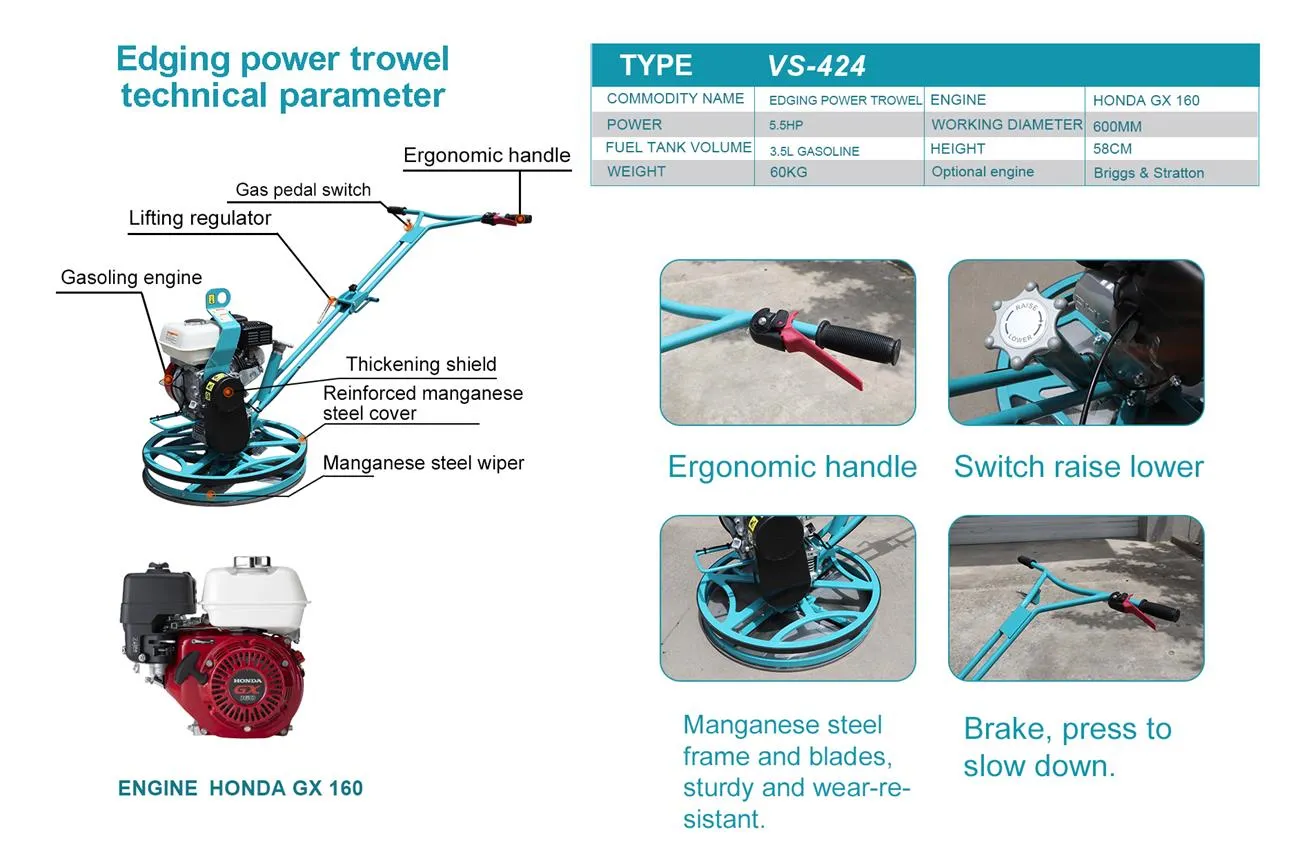
Concrete Trowel Machine Safety Operating Instructions
☀ Operator responsibilities and authorities
1. Operators must receive professional training and be familiar with the performance, structure and working principle of the concrete trowel before they can operate it.
2. The operator has the right to refuse to perform any illegal operations or dangerous instructions.
3. The operator is responsible for keeping the equipment clean and intact and ensuring its normal operation.
4. Operators should take good care of the equipment and report any damage or malfunction immediately.
☀☀ Equipment inspection and maintenance
1. Before each use, the operator should conduct routine inspections, including the tightening condition of each component of the machine, the lubrication condition and the safety of the electrical parts.
2. During the operation of the equipment, the operator should pay close attention to the operation of the machine, such as sound, temperature, etc. If there is any abnormality, the operator should stop the machine immediately for inspection.
3. After each use, the operator should clean the equipment and perform maintenance according to regulations, such as changing engine oil, cleaning blades and bearings, etc.
4. Regular inspection and maintenance of the equipment should be carried out in accordance with the manufacturer's recommendations, such as replacing worn parts, checking the electrical system, etc.
☀☀☀ Operating specifications
1. Operators must wear appropriate protective equipment, such as safety helmets, protective glasses, etc.
2. During operation, the operator should remain alert and avoid distraction.
3. When using the trowel to work, the operator should choose the appropriate operating speed and pressure according to the hardness of the concrete and the road condition.
4. When the equipment needs to be replaced with oil or repaired, the operator must turn off the power and use a safety lock or other safety device.
5. In case of emergency, such as fire, equipment failure, etc., the operator should stop the machine immediately and take necessary emergency measures.
☀☀☀☀ Safety protection measures
1. The concrete trowel should be placed on a flat, solid road surface and avoid operating on slopes or soft soil.
2. During operation, the operator should avoid standing on both sides of the trowel to prevent the blade from flying out and injuring people.
3. Before using the trowel, the operator should check the surrounding environment to ensure that there are no obstacles or human activities.
4. When equipment fails, the operator should stop the machine immediately and take corresponding safety measures, such as placing warning signs, evacuating personnel, etc.
5. When operating at night or in a dark environment, the operator should be equipped with lighting equipment and ensure that the equipment has sufficient light exposure.
6. During operation, operators should avoid overloading or overspeeding the equipment to prevent equipment damage or personal injury.
7. When the equipment is not used for a long time, the operator should store and maintain it according to the manufacturer's recommendations to ensure the long-term stability and safety of the equipment.
Summary: The safe operating procedures of the compacted soil troweling machine are an important guarantee to ensure the normal operation of the equipment and the safety of the operator. By clarifying the responsibilities and authorities of operators, strengthening equipment inspection and maintenance, standardizing operating procedures, and taking effective safety protection measures, potential safety hazards can be minimized and work efficiency and safety improved. In actual operations, operators should strictly follow the procedures and flexibly adjust and optimize the content of the procedures according to the actual situation.
Thanks to All the Friends Who Support and Trust Shandong Vanse Machinery Technology Co., Ltd.
If you want to know more about Shandong Vanse Machinery Technology Co., Ltd. or have any questions, please feel free to contact us:
Our Factory
Shandong Vanse Machinery Technology Co., Ltd.








Share this article

About the Author: Shandong Vanse Machinery Technology Co., Ltd.
Shandong Vanse Machinery Technology Co., Ltd. is a high-tech manufacturer specializing in concrete construction machinery, including laser screeds and related equipment. The company integrates R&D, production, and global sales, with products exported to over 60 countries and widely used in infrastructure projects worldwide.
Previous Post
Next Post
Related Articles
You Might Also Like
How to Verify Laser Leveling Effect through F-number (FF/FL) System?
In the high-stakes world of industrial flooring-especially for VNA (Very Narrow Aisle) warehouses and automated logistics hubs-"flat enough" isn't a measurement. To prove your work meets international standards, you need the F-number system (FF/FL). If you're using a Concrete Laser Leveling Machine and need to verify your results for a client, here is the professional's guide to understanding, measuring, and hitting those high scores. Before you pull out the testing equipment, you need to know what the numbers represent. Global buyers and engineers follow the ACI 117 standard, which breaks down into two parts: FF (Floor Flatness): This measures the "waviness" of the surface. Think of it as the small bumps and dips. High FF numbers mean a smoother ride for forklifts. FL (Floor Levelness): This measures the overall tilt or slope of the slab. It's about how close the floor is to the actual horizontal plane. Timing is everything. To get an accurate reading that reflects the machine's performance, measurements should be taken within 24 to 72 hours after placement. If you wait too long, concrete curling (due to drying) can throw off your FL numbers, even if your laser leveling did a perfect job. You can't verify a high F-number if the machine didn't produce it in the first place. This is where the engineering of your Concrete Laser Leveling Machine comes into play. Vanse Insight: To achieve FF numbers in the 50s or 60s (Superflat), the machine's hydraulic response must be instantaneous. Vanse's YZ series, uses high-speed laser receivers that talk to the leveling head 10 times per second. This constant, automatic correction is what eliminates the "waves" that tank your FF scores. Most international contractors use an F-Meter or a Dipstick® Profiler. Walk the Lines: You don't measure the whole floor randomly. You walk the device in straight lines across the slab. Data Collection: The device records the elevation changes every 12 inches (30cm). The Result: The software calculates a statistical average. If your goal was FF 50 and you hit FF 52, you've verified that your laser leveling machine and your crew executed the plan perfectly. When a buyer asks, "Can your machine hit FM1 standards?" they are asking about reliability. Here's how Vanse Machinery ( www.vansemac.com ) supports those high-spec requirements: Integrated Vibration: A major enemy of FF numbers is uneven concrete density. Vanse machines feature high-frequency vibration integrated directly into the leveling head, ensuring the slab is consolidated uniformly before the final pass. Telescopic Precision: For the highest FL accuracy, the Vanse YZ30-4E telescopic boom allows the machine to stay in one spot while the head extends. This removes the variable of machine weight shifting on the wet concrete, which is a common cause of "dips" in the F-number report. Dual-System Control: By combining top-tier laser transmitters (Leica/Trimble) with Vanse's proprietary hydraulic control, the margin for error is reduced to nearly zero. Note: The parameters provided in this document are for reference only and are not mandatory. Due to differences in technical characteristics between different brands and models of laser levelers, please consult the manufacturer for a suitable solution before actual operation. This reference document assumes no responsibility for any issues arising from failure to follow the manufacturer's instructions.The causes of common surface defects during construction and the related preventive measures for the operation of the power trowel machine
Let's focus on discussing how to prevent surface defects of concrete by standardizing the operation of power trowels. The following is a summary of targeted preventive measures based on common defects, aiming to provide a clear operational guide for construction. Defect type Core preventive measures (Operating Angle of the power trowel machine) Detailed explanation of key operation points 1. The surface shows signs of sanding and powdering No watering is allowed. Seize the opportunity for the initial grinding 1. Iron rule: Do not sprinkle water when grinding flour: This is the first principle for preventing sanding. When the surface becomes dry, wait for the right moment to polish it instead of sprinkling water. 2. The timing of initial grinding is accurate: When the concrete can withstand a person's foot subsidence of about 3-5mm, immediately use a disc for initial grinding to lift the slurry and bring the cement slurry to the surface. 2. Cracking/plastic shrinkage cracks Timely initial grinding and sealing for efficient operation 1. Seal the surface as early as possible: In high-temperature and windy weather, concrete may lose water before it begins to set. Once it is accessible to people, immediately use the disc of the power trowel to quickly lift the slurry to form a sealing layer and lock in the moisture. 2. Continuous operation: Plan the operation sequence well to ensure that the power trowel machine can continuously and efficiently complete the initial grinding and sealing of one area, avoiding surface water loss and cracking due to excessive intervals. 3. Uneven surface/Poor waviness Standardize the operation techniques and maintain uniformity 1. Use the cross-grinding method: The grinding paths of two adjacent times should be perpendicular to each other (one horizontally and one vertically) to avoid the formation of furrows due to unidirectional grinding. 2. Uniform and stable operation: Keep the machine moving at a constant speed and avoid sudden acceleration and deceleration. 3. Reduce downtime: It is strictly prohibited to leave the machine in one place for a long time to prevent local excessive vibration and subsidence. 4. Smooth steering: When turning or making a U-turn, lift the power trowel steadily to avoid forced twisting that may cause tool marks and bulges. 4. Surface color difference Unify the timing of light collection to avoid excessive grinding in certain areas 1. Unify the state of the working surface: Wait until the concrete setting state of the entire working surface is basically consistent (all reaching the required dryness and wetness for finishing) before starting the finishing. 2. "One-time Pass" principle: During the fine grinding and finishing stage, strive for success in one go and avoid repeatedly grinding local areas. For areas that truly need to be supplemented, they should be briefly touched upon. 5. Hollowing/peeling Avoid excessive light collection and prevent operation during bleeding 1. Identify the final setting point: When the sound of the power trowel rubbing against the ground becomes clear and the ground's reflectivity weakens, the operation should be stopped immediately. Forced light collection will damage the structure and cause delamination. 2. Do not work on standing water: When there is bleeding or accumulated water on the surface, the power trowel must not be used. The water should be removed first using a vacuum suction hose or rubber hose. To ensure the implementation of preventive measures, the following standardized operating procedures must be followed: Timing judgment: When the foot sinks by 25-30mm (or when a finger presses and leaves a fingerprint of 10-15mm). This is a key window for preventing cracking. Tool: Install the disc. Operation The machine maintains a steady speed. Perform the first grinding in the same direction, overlapping the previous one-third of the disc diameter. Objective: Slightly press down the coarser aggregates to bring the cement slurry to the surface, seal the surface evaporation channels, and provide a smooth foundation for subsequent fine grinding. Timing judgment: After the initial grinding, the surface footprints disappear, there is no free water, and it presents a matte state. Tool: Replace with a coarse power trowel (power trowel). Operation Adopt the crossover method: for instance, walk vertically for the first time and horizontally for the second time. This is the core to ensuring flatness. Adjust the Angle of the spatula to a slight upward Angle (about 1-3°), mainly to smooth it out. Objective: To eliminate the marks left by the disc, further compact the surface, and eliminate minor height differences. Timing judgment: When stepped on, there is almost no trace left. When the spatula passes over the surface, the trace is slight and can close quickly. Tool: The same or thinner spatula. Operation The Angle of the spatula can be adjusted to be flatter or slightly upward. The operation should be gentle and uniform, striving for success in one attempt. Objective: To make the surface particles more closely arranged to achieve a dense and smooth effect. At this point, any unnecessary operation is harmful. Timing is more important than anything else: The greatest skill of an operator is to accurately judge the setting state of concrete. Moisture is a double-edged sword: internal moisture is the source of strength, while surface excess moisture is the root cause of defects. Never sprinkle water. Uniformity is the foundation of flatness: maintaining a constant speed, crossing, and reducing pauses are the only ways to achieve high flatness. Know when to stop: Dimming is not the more times the better. Excessive dimming is a direct cause of hollowing and cracking. By integrating the above preventive measures and standardized procedures throughout the entire construction process, surface defects caused by improper operation of the power trowel can be minimized to the greatest extent, thereby effectively improving the final quality of the concrete floor. Note: The parameters provided in this document are for reference only and are not mandatory. Due to differences in technical characteristics between different brands and models of laser levelers, please consult the manufacturer for a suitable solution before actual operation. This reference document assumes no responsibility for any issues arising from failure to follow the manufacturer's instructions.What safety precautions should be taken when maintaining the concrete laser leveling machine?
As an important construction equipment in the modern construction industry, the maintenance of a concrete laser leveling machine is of great significance to ensure the normal operation of the equipment and extend its service life. However, in the process of maintenance, we must attach great importance to safety issues to ensure the safety of operators and the integrity of the equipment. This article will discuss in detail the safety precautions that need to be taken when maintaining a concrete laser leveling machine, mainly including safety preparations for the leveling machine shutdown, cleaning up debris in the work area, checking maintenance and operation sequence, following safety operation specifications, maintenance parts replacement precautions, personal protective equipment wearing, and emergency response plans. 01 Safety preparations for leveling machine shutdown Before performing maintenance, first ensure that the concrete laser leveling machine has been completely shut down and all operating switches have been placed in the "off" or "stop" position. This can effectively prevent safety accidents caused by misoperation or accidental start-up of the equipment. At the same time, the power supply of the leveling machine must be cut off to prevent the current from causing electric shock to the maintenance personnel. If the equipment is equipped with a battery or other energy storage device, it must also be ensured to be in a safe state. In addition, for possible hydraulic and pneumatic systems, it is necessary to wait for a period of time after shutdown to ensure that the pressure in the system is completely released. Before releasing the pressure, do not disassemble any parts related to the pressure system to avoid injury caused by the spraying of high-pressure liquid or gas. 02 Clean up debris in the work area Before maintenance begins, the work area must be thoroughly cleaned and all items and tools not related to maintenance must be removed to prevent them from becoming a hidden danger of tripping or slipping. Pay special attention to cleaning the space under the equipment to ensure that maintenance personnel can safely approach and operate the key components of the equipment. At the same time, it is also necessary to ensure that the lighting in the work area is sufficient so that maintenance personnel can clearly see every detail and potential danger points. If maintenance is required at night or in a dimly lit environment, appropriate lighting equipment should be used. 03 Inspection, maintenance and operation sequence When maintaining the concrete laser leveling machine, the correct inspection and operation sequence should be followed. First, the overall condition of the equipment should be checked, including whether the appearance, structure, connectors, etc. are intact. Secondly, follow the guidance of the equipment maintenance manual to check the wear and damage of key components one by one, such as blades, bearings, belts, etc. During the operation, the principle of easy first, difficult second, external first, internal second should be followed. For complex maintenance tasks, such as disassembling and replacing parts, make sure to understand the structure and function of the relevant parts, and follow the correct disassembly and installation sequence. During the operation, appropriate tools and methods should be used to avoid using violence or improper operation to cause equipment damage or personal injury. 04 Follow safe operation specifications When performing maintenance, you must strictly follow the safety operation specifications. First, make sure you are familiar with the operation and maintenance manual of the equipment, and understand the performance, characteristics and safety requirements of the equipment. Secondly, before performing any operation, you should carefully read the relevant safety tips and warnings to ensure that you understand the possible risks and precautions. During the operation, you should stay focused and cautious, and avoid distraction or impatience. For uncertain operations or problems, you should consult experienced colleagues or professionals in time. At the same time, it is strictly forbidden to carry out activities unrelated to work during maintenance, such as smoking, eating, etc., to avoid fire or other safety accidents. 05 Precautions for replacement of maintenance parts During the maintenance process, some worn or damaged parts may need to be replaced. When replacing parts, make sure to use regular brand and model parts that match the equipment. Do not use inferior or substandard parts to avoid affecting the performance and safety of the equipment. Before replacing parts, make sure that the power of the equipment is turned off and take necessary safety measures, such as wearing protective glasses and gloves. When removing and installing parts, use appropriate tools and methods and follow the correct operating sequence. After replacing parts, check whether the equipment is firmly connected and whether the parts are installed correctly, and perform necessary trial runs and tests to ensure the normal operation of the equipment. 06 Wearing of personal protective equipment When maintaining the concrete laser leveling machine, the operator must wear appropriate personal protective equipment. This includes but is not limited to safety helmets, protective clothing glasses, earplugs, gloves and non-slip shoes. These equipment can effectively protect the operator's head, eyes, ears, hands and feet from injury. For example, a safety helmet can protect the head from falling objects or collisions; protective glasses can prevent splashing particles or liquids from entering the eyes; earplugs can reduce the damage to hearing caused by noise at the work site; gloves can prevent hands from being cut or burned by sharp edges or high-temperature parts; non-slip shoes can provide good grip to prevent slipping during operation. 07 Emergency Response Plan Although we have taken various safety measures to prevent accidents, some emergencies may still occur in actual operations. Therefore, it is crucial to formulate and implement emergency response plans. First, all maintenance personnel should be familiar with the safety operation manual of the equipment, understand possible emergencies and corresponding response measures. Secondly, the maintenance site should be equipped with necessary first aid equipment and medicines so that initial treatment can be carried out in time when injuries occur. In addition, a clear emergency evacuation and rescue plan should be formulated to ensure that personnel can be quickly organized to evacuate and notify professional rescue teams in the event of serious accidents such as fires and leaks. At the same time, maintenance personnel should regularly conduct emergency response training and drills to improve their ability and level to respond to emergencies. By simulating emergencies in actual scenarios, maintenance personnel can remain calm, take response measures quickly and accurately when real accidents occur, and minimize casualties and property losses. In addition to the safety matters mentioned above, it is also necessary to pay attention to the handling of some details and special situations. For example, during the maintenance process, if serious faults or damage are found in the equipment, the work should be stopped immediately and reported to professional maintenance personnel for processing. Do not disassemble or repair it privately. In addition, during the maintenance process, you should always be vigilant and pay attention to changes in the surrounding environment. If there are any abnormal situations, you should deal with them or evacuate in time. In addition, for the long-term maintenance and maintenance of concrete laser leveling machines, a complete set of systems and processes must be established. This includes regular comprehensive inspection and maintenance of the equipment, recording the operating status and maintenance history of the equipment, so as to promptly discover potential safety hazards and deal with them. At the same time, regular training and education of maintenance personnel are also required to improve their safety awareness and operating skills to ensure the normal operation and safe use of the equipment. In summary, the safety matters that need to be paid attention to when maintaining the concrete laser leveling machine cover the aspects of safety preparation for shutdown, cleaning up debris in the work area, checking maintenance and operation sequence, following safety operation specifications, precautions for replacement of maintenance parts, wearing of personal protective equipment, and emergency response plans. Only under the premise of strictly abiding by these safety matters can the smooth progress of maintenance work be ensured, and the safety of personnel and the integrity of equipment can be guaranteed. Therefore, we must attach great importance to the maintenance of concrete laser leveling machines and continuously improve our safety awareness and operating skills. It is worth noting that although this article elaborates on the safety issues when maintaining concrete laser leveling machines, various special situations and unknown risks may still be encountered in actual operations. Therefore, in actual work, maintenance personnel should remain vigilant and cautious, respond flexibly according to actual conditions, and consult and seek help from professionals in a timely manner. At the same time, companies should also strengthen the training and management of maintenance personnel, improve their safety awareness and response capabilities, and ensure the smooth progress of maintenance work and the sustainable development of the company.