Technical Knowledge
How do the concrete laser leveling machines improve the flatness?
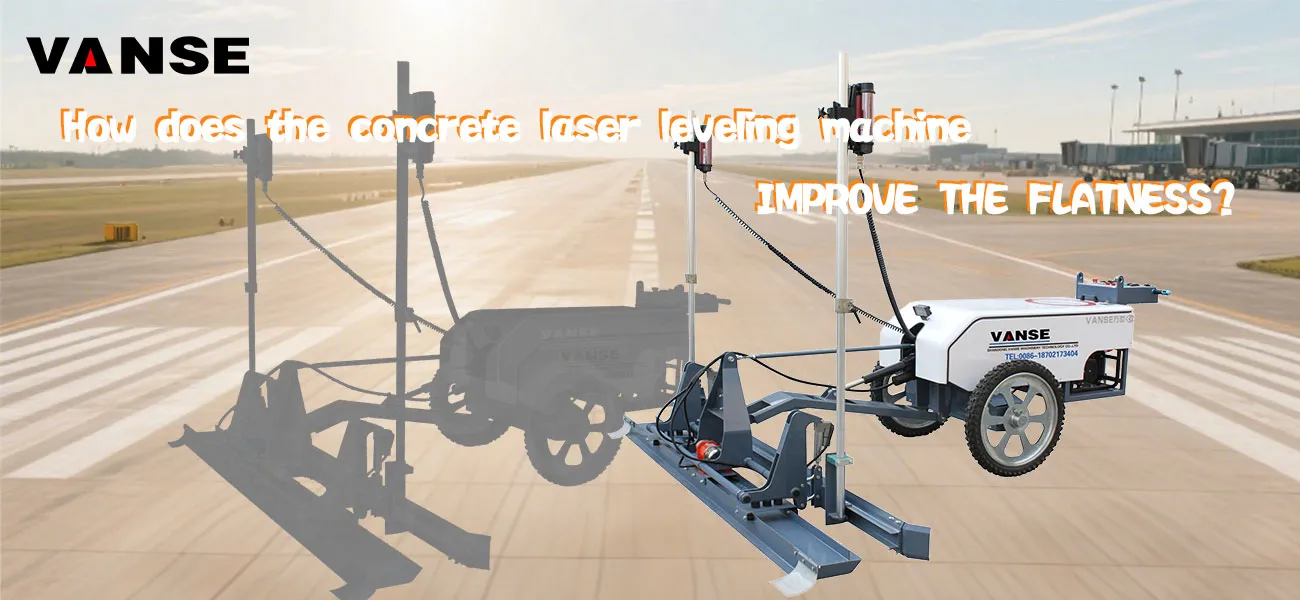
The ability of the concrete laser leveler to improve flatness is its core advantage. It fundamentally changes the traditional way of concrete leveling by combining modern laser technology, hydraulic systems and precision mechanical control.
To improve the smoothness of construction,Equipment principles, pre-construction preparation, construction process control and post-construction maintenanceThe following is a detailed explanation of the key measures and principles:
1. Core equipment principle: Why can laser leveling machine achieve high flatness?
Laser reference system:
Erect alaser transmitter, it will produce a very thin, constantly rotating laser plane (360°). This laser plane is the entire field. Absolute horizontal reference, its accuracy is very high (usually up to ±1mm/10m).
On the leveling machineLaser receiver, This laser signal will be captured in real time.
Intelligent control system:
The receiver transmits the signal to the leveler in real time.Vehicle control system (computer).
The control system compares the actual height received with the preset design elevation and calculates the height difference within milliseconds.
Hydraulic actuator system:
The control system immediately passes the calculated dropHydraulic valvesdrive. Hydraulic cylinder, to precisely adjust the height of the scraper.
This process is Continuous automatic, the machine is always leveling dynamically and in real time, replacing reliance on human judgment and manual operation and eliminating human errors.
2. How to improve flatness (key measures):
1) Pre-construction preparation: the foundation of the foundation
Foundation treatment: The compaction and smoothness of the base layer (usually crushed stone or stabilized soil) are crucial. While a laser machine can compensate for minor undulations in the base layer, large undulations can significantly impact the concrete usage and overall quality. The base layer should be evenly compacted with no noticeable bumps or indentations.
Set elevation precisely:
Laser transmitter installation: The laser transmitter must be firmly installed in a place with minimal interference from construction. Use a precise level to ensure it is absolutely level.
Input and verification of elevation: Accurately input the design elevation into the control system. Before construction, the site should be tested at multiple points (especially corners and center) withLaser receiving poleVerify the accuracy of the laser signal to ensure that the entire construction surface is within the effective laser scanning range.
Formwork (formwork) control: The top surface elevation and rigidity of the template must meet the requirements. Large errors in template elevation or deformation during pouring will directly affect the operating benchmark of the laser leveling machine.
2) Construction process control: refined management
Concrete material performance is consistent:
Slump: This is a key metric. The slump of each truckload of concrete must be uniform. Excessive slump variation can lead to varying degrees of aggregate segregation after paving, with some areas being too thin and others too dry. Laser leveling cannot effectively treat this uniformly, resulting in poor flatness after hardening. The ideal slump should be determined based on the floor thickness and reinforcement. Generally, a slump of 140-160mm is recommended for pumped concrete.
Mix ratio: Ensure the stability of concrete mix ratio.
Adequate concrete supply: Ensure the continuous supply of concrete to avoid the situation where the first poured concrete has initially set due to long waiting time, resulting in cold joints between the concrete and the later poured concrete, thus affecting the overall flatness.
Standardized operations:
Paving thickness: The initial paving concrete material should be 2-3 cm higher than the design elevation to leave operating margin for the leveling machine.
Routing method: The operator should be experienced and control the leveling machine to move forward smoothly and at a constant speed, avoiding sudden stops and sudden movements. The paths of adjacent milling discs (scrapers) should overlap to avoid missing parts.
Bleeding water treatment: If the concrete bleeds severely, the surface water should be scraped off in time before leveling, otherwise a weak layer will be formed on the surface, affecting the final surface strength and flatness.
3. Cooperation with subsequent processes: an indispensable link
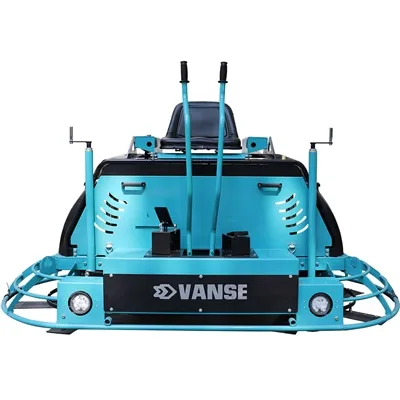
Timely grinding (milling): For floors with ultra-high flatness requirements (such as ultra-flat floors), after the laser leveling machine completes the operation and the concrete reaches the initial setting (people step on it and there is a footprint about 3-5mm deep), it will be used. Double disc driving trowel. Perform overall grinding (milling). This step can eliminate the tiny marks left by the laser leveling machine scraper and the unevenness caused by individual aggregates. It is a key step in achieving extremely high flatness.
Precise cutting and maintenance:
Slit: Expansion joints must be cut in time within the specified time (when the concrete strength reaches 25-30% of the design strength) to avoid irregular cracking that damages the flatness.
Maintenance: Use plastic film to fully cover or spray curing agent to provide sufficient moisturizing maintenance to prevent shrinkage cracks and peeling due to rapid water loss on the surface, there by protecting the flatness that has been achieved.
Summary and comparison: advantages over traditional methods
| Characteristic | Concrete laser leveling machine | Traditional manual leveling |
| Benchmark | Fixed absolute laser plane (precise) | Moving channel steel, rulers, or workers' sight lines (prone to error accumulation) |
| Control method | Computer real-time calculation, automatic hydraulic adjustment (intelligent, continuous) | Human judgment based on experience and manual operation (subjective, intermittent) |
| Flatness | Very high, can reach±2mm within 2 meters Even higher | Low, usually only reach4-5mm/2m |
| Efficiency | Extremely high, 10-20 times that of manual labor | Low, depends on the number and skill of workers |
| Artificial Dependency | Low, 1 operator and a few assistants | High, requires a large number of skilled workers |
In short, to improve the flatness of the concrete laser leveling machine, it must be recognized that it is a systematic project:
Relying on its high-tech "brain" (control system) and "eyes" (laser system) is a prerequisite, but the final effect also depends on a qualified "foundation" (base and formwork), uniform and stable "ingredients" (concrete), standardized "cooking techniques" (operating technology) and proper "post-processing" (polishing and maintenance).Only when every link is done well can the highest standard of flat floor be produced.
Thanks to All the Friends Who Support and Trust Shandong Vanse Machinery Technology Co., Ltd.
If you want to know more about Shandong Vanse Machinery Technology Co., Ltd. or have any questions, please feel free to contact us:
Our Factory
Shandong Vanse Machinery Technology Co., Ltd.








Share this article

About the Author: Shandong Vanse Machinery Technology Co., Ltd.
Shandong Vanse Machinery Technology Co., Ltd. is a high-tech manufacturer specializing in concrete construction machinery, including laser screeds and related equipment. The company integrates R&D, production, and global sales, with products exported to over 60 countries and widely used in infrastructure projects worldwide.
Previous Post
Next Post
Related Articles
You Might Also Like
Performance Characteristics And Usage Advantages Of Concrete Laser Leveling Machine
▷▷•▪◇ Introduction With the continuous advancement of science and technology, the construction industry is gradually moving towards a new era of efficient, precise and environmentally friendly construction. In this context, concrete laser leveling machines have gradually become the new favorite in the field of floor construction with their unique performance characteristics and usage advantages. This article will deeply explore the performance characteristics and usage advantages of concrete laser levelings, and analyze them based on specific cases, in order to provide reference and inspiration for relevant practitioners: ▷▷•▪◇ Performance characteristics of concrete laser leveling machine 1. Efficient construction: The concrete laser leveling machine adopts advanced laser measurement and control system and leveling device, which can realize large-area, fast and efficient concrete floor leveling operations. Compared with traditional construction methods, the use of laser leveling machines can greatly improve construction efficiency and shorten the construction period. 2. Precise control: The laser measurement and control system guides the leveling device to perform operations through precise laser beams to ensure that ground elevation, flatness and other parameters meet the design requirements. This precise control method can reduce construction errors and improve construction quality. 3. High degree of automation: The concrete laser leveling machine has a high degree of automation, which can reduce manual intervention and operation difficulty. Through intelligent handle operation, construction workers can easily control the entire construction process, improving the safety and convenience of operations. 4. Easy to operate: The laser leveling machine adopts an intelligent operating system and humanized design, allowing construction personnel to operate without professional training. This simple operation method not only reduces labor intensity, but also improves construction efficiency. 5. Wide scope of application: Concrete laser leveling machine is suitable for concrete floor construction of various sizes, shapes and materials. Whether it is indoors or outdoors, whether it is a large project or a small project, it can exert its excellent performance. ▷▷•▪◇ Advantages of using concrete laser leveling machine 1. Cost savings: Using a concrete laser leveler for construction can greatly improve construction efficiency and shorten the construction period, thereby reducing labor costs and equipment rental costs. In addition, laser leveling machines can effectively reduce the waste and rework rate of concrete materials, further saving costs. 2. Improve quality: Because laser leveling machines have precise control capabilities and efficient construction efficiency, they can significantly improve the quality of concrete floors. Using laser leveling machines for construction, ground flatness, elevation and other parameters are more in line with design requirements, reducing the occurrence of quality problems such as cracks and hollows. 3. Reduce labor intensity: The laser leveling machine has a high degree of automation and can turn heavy physical labor into mechanical operations, thereby reducing the labor intensity of construction workers. This advantage not only helps protect the physical health of construction workers, but also improves their work efficiency. 4. Enhance environmental protection: The laser leveling machine produces less noise, dust and other pollution during the construction process, which meets environmental protection requirements. In addition, using laser leveling machines for construction can also reduce the use of formwork and waste of concrete materials, further reducing the impact on the environment. ▷▷•▪◇ Actual case analysis In order to more intuitively demonstrate the performance characteristics and usage advantages of the concrete laser leveling machine, the following is an analysis based on a practical case. In a large-scale commercial complex project, the construction quality of the ground has an important impact on the appearance and functionality of the overall building. Traditional construction methods are difficult to meet the project's requirements for ground quality, construction period, and environmental protection. Therefore, the project party decided to use a concrete laser leveler for ground construction During the construction process, the laser leveler successfully achieved large-area, high-quality concrete floor leveling operations by virtue of its efficient, precise, and automated waiting points. Compared with traditional construction methods, the use of laser leveling machines not only improves construction efficiency and quality, but also significantly reduces labor costs and material waste. In addition, since the laser leveling machine produces less noise and dust during the construction process, it also meets the project party's environmental protection requirements. After strict testing and acceptance, the ground construction quality of this commercial complex project reached the expected goals. The project party is very satisfied with the performance and results of the laser leveling machine and believes that it provides a strong guarantee for the successful implementation of the project. ▷▷•▪◇ Conclusion and Outlook In summary, the concrete laser leveling machine shows broad application prospects in the field of floor construction with its efficient, accurate, automated performance characteristics and usage advantages. With the continuous advancement of science and technology and the continuous expansion of the market, it is believed that laser leveling machines will play a more important role in the future and provide strong support for the sustainable development and innovation of the construction industry. At the same time, we also expect more advanced technologies and equipment to continue to emerge, injecting new vitality into the green, smart, and efficient development of the construction industry.How to deal with the construction challenges of concrete laser leveling machines under special ground conditions?
To deal with the construction challenges of concrete laser leveling machines under special ground conditions, the following measures can be taken: 1. Strengthen technical training: Ensure that operators are familiar with machine performance and can operate accurately. Especially when facing different ground conditions, they should be able to flexibly adjust machine parameters. 2. Choose the appropriate construction method: Choose the appropriate construction method according to the ground conditions. For example, for soft ground, the preloading method or filling method can be used; for hard ground, the crushing method or milling method can be used. 3. Strengthen on-site management: Ensure the construction site is orderly and avoid cross-operation and chaos. At the same time, strengthen material management to ensure the quality and supply of concrete and other materials 4. Use auxiliary equipment: As needed, auxiliary equipment such as vibrators and polishers can be equipped to improve the leveling quality and efficiency. 5. Regular maintenance and upkeep: Ensure the normal operation of the machine by regularly inspecting and maintaining key components, such as laser transmitters, sensors, etc. 6. Strengthen communication and collaboration: Maintain close communication with all parties such as design and construction, solve problems encountered during construction in a timely manner, and ensure smooth progress of construction. 7. Use intelligent technology: Consider using automation and intelligent technology, such as machine vision, intelligent control, etc., to improve construction efficiency and accuracy. 8. Pay attention to safety: During the construction process, you should always pay attention to safety and take necessary safety measures to ensure the safety of personnel and equipment. In short, dealing with the construction challenges of concrete laser leveling machines under special ground conditions requires comprehensive consideration of technology, management, collaboration and other aspects. By strengthening training, selecting appropriate construction methods, strengthening on-site management, using auxiliary equipment, regular maintenance and upkeep, strengthening communication and collaboration, adopting intelligent technology, and paying attention to safety, we can effectively deal with these challenges and improve construction efficiency and project quality. .What should I do if the cement floor is uneven? Can the floor grinder smooth it?
The problem of uneven cement floors can be solved in a number of ways, one of which is using a floor sander. The following is a detailed answer to the problem of uneven cement floors, as well as detailed instructions on whether a floor grinder can smooth it. ☀Clean the base layer: Use tools to clean the base layer, including floating dust, oil stains, etc., to ensure that the base layer is smooth and clean. ☀Smooth the cement floor: Use cement mortar to smooth the cleaned base layer. During the smoothing process, tools such as a level should be used to ensure that the smoothed cement floor surface is flat. ☀Paving ceramic tiles: If you need to lay ceramic tiles, you should first spread a layer of dry cement mortar on the cement floor and scrape it with a scraper to ensure that the ceramic tiles are laid flat. ☀Use a floor grinder: If the cement floor that has been used is uneven or rough, you can consider using a floor grinder to grind it. A floor sander can remove stains and old coatings from the surface while smoothing the surface. ☀Choose the appropriate grinding disc: Choose the appropriate grinding disc according to the material and roughness of the ground to be polished. Grinding discs come in many different particle size grades. Grinding discs with finer grits are more expensive, but the grinding effect is better. ☀Install the grinding disc: Install the selected grinding disc on the grinder. Pay attention to the front and back sides and direction of the grinding disc to ensure that the grinding disc can operate normally. ☀Turn on the power: Turn on the power switch of the grinder and adjust the switch to the appropriate speed. Generally speaking, the higher the speed of the grinder, the better the grinding effect, but it will also increase noise and wear. ☀Start grinding: Use a hand-held grinder to grind on the ground, and choose different grinding methods according to the actual situation, such as linear grinding, circular grinding, etc. During the grinding process, pay attention to maintaining uniform strength and speed to avoid excessive wear or missed grinding. ☀Turn off the power: After completing grinding, turn off the power switch and remove the grinding disc for cleaning and maintenance. The floor grinder is suitable for grinding and polishing various hard floor materials, such as cement floors, ceramic tile floors, terrazzo floors, etc. At the same time, it can also be used for renovation and repair of old floors. ☀Before using the floor grinder, be sure to check whether the power cord and plug are intact to avoid leakage or electric shock. At the same time, make sure that all parts of the machine are installed correctly, especially the direction and tightening of the grinding discs. ☀During use, pay attention to maintaining safe posture and operating methods. Generally speaking, grinders should be held with both hands to avoid excessive pressure and uneven wear caused by one-handed operation. At the same time, be careful to avoid excessive force or rapid movement to avoid damage to the machine or personal injury. ☀During the grinding process, pay attention to the flatness and roughness of the ground. If you find that there are serious unevenness or stains on the ground, you should deal with them accordingly before continuing to polish. At the same time, appropriate grinding discs and grinding methods should be selected according to the actual situation to ensure grinding quality and efficiency. ☀After use, turn off the power in time and perform cleaning and maintenance. Clean the grinding disc and the dust and debris inside the machine, check each component for damage or wear, and replace or repair it in time if necessary. At the same time, regular care and maintenance should be carried out in accordance with the instructions provided by the manufacturer. Note: The parameters provided in this document are for reference only and are not mandatory. Due to differences in technical characteristics between different brands and models of laser levelers, please consult the manufacturer for a suitable solution before actual operation. This reference document assumes no responsibility for any issues arising from failure to follow the manufacturer's instructions.