Technical Knowledge
How to avoid over-vibration with laser leveling on fiber concrete?
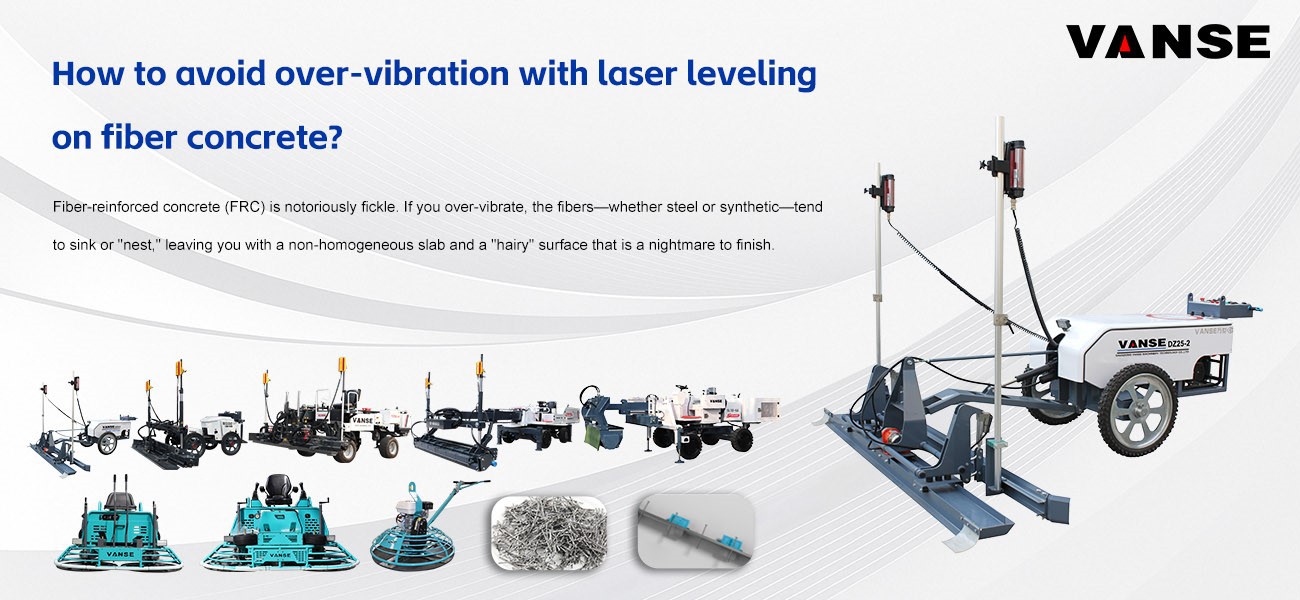
Fiber-reinforced concrete (FRC) is notoriously fickle. If you over-vibrate, the fibers-whether steel or synthetic-tend to sink or "nest," leaving you with a non-homogeneous slab and a "hairy" surface that is a nightmare to finish.
With a laser leveling, the goal is to keep the fibers suspended in the paste while achieving your ±3mm tolerance. Here is how to dial in your machine:
1. Match Vibrator Frequency to Slump
Over-vibration usually happens when the centrifugal force is too high for the concrete's consistency.
The Rule of Thumb: For high-fiber mixes, you generally want high frequency but low amplitude.
Adjustment: Most laser leveling (like Vanse) allow you to adjust the hydraulic flow to the vibrator motor. If you see "fat" (excessive cream/paste) rising more than 2mm–3mm above the fibers, slow the vibrator RPM down immediately.
2. Monitor leveling Head Speed (The "Advance" Rate)
If the machine moves too slowly while the vibrator is screaming, you are effectively "drilling" the fibers down into the subgrade.
The Sweet Spot: Maintain a consistent forward (or pulling) speed. If you have to stop the machine for any reason, shut off the vibrator immediately. Leaving a vibrating leveling head stationary for even 5 seconds will create a permanent "soft spot" or depression in a fiber floor.
3. Check the "Vibrator Drop" Height
The vibrator should not be buried in the concrete.
Positioning: The vibrator plate should just "kiss" the surface of the concrete as the auger levels it.
The Sink Effect: If the vibrator is set too low, it pushes the larger aggregate and fibers down, leaving only weak laitance on top. This leads to surface scaling later in the floor's life.
4. Manage the "Fiber Ball" Risk
Fibers can sometimes clump (balling) before they even hit the leveling.
Auger Interaction: Ensure your auger is set to the correct height (3mm to 5mm above finished grade). The auger’s job is to "cut" the excess; if it’s too low, it will snag fibers and drag them, creating tears in the surface.
Avoid "Double-leveling": With fiber, try to get it right in one pass. Re-vibrating the same area almost guarantees the fibers will settle too deep.
5. Use a "Cloud" or Offset Receiver Setting
Because fibers can make the mix "stiffer," the leveling head might "ride up" on the material.
The Fix: Don't increase vibration to force it down. Instead, adjust your Laser Offset. If the machine is riding high, lower the laser receivers by 1MM or 2MM to compensate for the material's resistance without over-working the paste.
Summary Checklist for Fiber Concrete
| Variable | Adjustment for Fiber | Goal |
| Vibrator RPM | Reduce by 15-20% | Prevent fiber sinking |
| Travel Speed | Faster / Consistent | Prevent "hot spots" |
| Auger Height | Slightly Higher | Avoid snagging/tearing |
| Slump | Maintain 100mm – 125mm | Ensure flow without segregation |
Pro Tip: Have a "muck man" with a come-along tool standing by to watch the auger. If he sees a "beard" of fibers building up on the plow, you need to stop and clean the head, or it will ruin your FF numbers.
Would you like a guide on how to properly "dry-shake" hardener over a fiber-reinforced floor without creating delamination? Contact us NOW
Note: The parameters provided in this document are for reference only and are not mandatory. Due to differences in technical characteristics between different brands and models of laser levelers, please consult the manufacturer for a suitable solution before actual operation. This reference document assumes no responsibility for any issues arising from failure to follow the manufacturer's instructions.
Thanks to All the Friends Who Support and Trust Shandong Vanse Machinery Technology Co., Ltd.
If you want to know more about Shandong Vanse Machinery Technology Co., Ltd. or have any questions, please feel free to contact us:
Our Factory
Shandong Vanse Machinery Technology Co., Ltd.








Share this article

About the Author: Shandong Vanse Machinery Technology Co., Ltd.
Shandong Vanse Machinery Technology Co., Ltd. is a high-tech manufacturer specializing in concrete construction machinery, including laser screeds and related equipment. The company integrates R&D, production, and global sales, with products exported to over 60 countries and widely used in infrastructure projects worldwide.
Previous Post
Next Post
Related Articles
You Might Also Like
How To Perform Regular Inspection And Maintenance Of The Consumables Of The Concrete Laser Leveling Machine?
How to perform regular inspection and maintenance of consumables of concrete laser leveling machine ※1. Overview of consumables Concrete laser leveling machine is an indispensable large-scale equipment in modern construction. Regular inspection and maintenance of its consumables are of great significance to ensure construction quality and efficiency. Consumables mainly include scrapers, cutting blades, crawlers, filters, hydraulic oil, etc. The condition of these components and materials is directly related to the performance and service life of the leveler. ※2.Inspection cycle setting In order to ensure the stable operation of the leveling machine, a reasonable inspection cycle must be set. It is generally recommended that new machines be inspected every half month in the first three months, and then checked once a month. After one year of operation, it is recommended to be inspected every three months. For equipment with harsh working environment or high frequency of use, the inspection cycle should be shortened appropriately. ※3.Inspection of worn parts Check the wear of scrapers, cutting blades and other easily worn parts, especially those in direct contact with concrete. During inspection, attention should be paid to whether there are cracks, breaks, excessive wear, etc. At the same time, check whether the tracks are worn, broken or loose, and whether there are foreign objects embedded in them. ※4. Consumable replacement standards Establish reasonable replacement standards based on component wear and recommendations in the instruction manual. For example, when the scraper wear thickness exceeds 5mm, replacement should be considered; when the scraper blade is severely deformed or wear exceeds 2mm, it needs to be replaced; when the track wear exceeds 1/3 of the original thickness, new parts should be replaced. Properly setting replacement standards can avoid equipment performance degradation. ※5. Detailed explanation of maintenance steps (1) Cleaning equipment: Regularly clean the dust and concrete residue on the surface of the leveler to keep the equipment clean. (2) Check the oil: Check whether the hydraulic oil, gear oil and other oils are sufficient and clean. If they are contaminated or insufficient, they should be replaced and replenished in time. (3) Tighten loose parts: Check whether all parts of the equipment are loose, and if so, tighten them in time. (4) Replacement of consumables: timely replacement of seriously worn parts and consumables in accordance with set replacement standards (5) Lubrication and maintenance: Lubricate and maintain the parts that need lubrication to ensure smooth operation of the equipment. ※6.Safety precautions (1) When performing inspection and maintenance, be sure to ensure that the equipment has completely stopped running and disconnected from the power supply to avoid accidents. (2) Use appropriate tools and equipment for maintenance to avoid equipment damage or personal injury caused by the use of inappropriate tools. (3) During the maintenance process, pay attention to safety measures such as fire prevention and electric shock prevention to avoid safety accidents. ※7.Performance optimization suggestions (1) Regularly conduct overall performance testing of the equipment, including flatness, speed, accuracy and other indicators to ensure stable equipment performance. (2) Based on the test results, adjust the parameters and settings of the equipment in a timely manner to achieve optimal performance. (3) Strengthen the training of operators to improve operation level and equipment usage efficiency, ※8. Records and reports Establish a complete inspection and maintenance record system to record in detail the time, content, problems discovered and measures taken for each inspection. Major problems and maintenance situations should be reported to superiors in a timely manner so that timely measures can be taken to solve the problems. At the same time, inspection and maintenance records are regularly analyzed and summarized to discover the rules and trends of equipment operation and provide data support for equipment preventive maintenance and fault prediction. In short, regular inspection and maintenance of the consumables of the concrete laser leveling are the key to ensuring stable operation of the equipment and extending its service life. Through reasonable inspection cycle settings, worn parts inspection, consumable replacement standards, maintenance procedures, safety precautions, performance optimization recommendations, and the establishment and improvement of records and reports, the leveling machine can always be maintained in good operating condition. , providing a strong guarantee for construction quality and efficiency.How to evaluate the reliability of concrete laser leveling machine?
In the field of modern concrete construction, concrete laser leveling machine (concrete laser leveling machine or concrete laser leveler) has become the preferred equipment for many large projects due to its high efficiency and precision. With the continuous increase in the industry's requirements for construction quality and efficiency, as well as the continuous development of industries such as infrastructure construction and real estate, the market demand for concrete laser leveling machines is growing. According to relevant reports, the global concrete laser leveling machine market size is expected to reach US$1.76 billion in 2025, with an annual growth rate of approximately 11.4%. In this context, it is particularly important to evaluate the reliability of concrete laser leveling machines, which is not only related to construction quality, but also closely related to the cost and progress of the project. Leveling accuracy is the core performance indicator of concrete laser leveling machines, which directly determines the flatness of the concrete surface after construction. In projects such as airport runways and precision electronic factories that require extremely high ground flatness, high-precision laser leveling machines are indispensable. Some of the internationally renowned brands use advanced 3D laser scanning technology to achieve a flatness accuracy of ±2 mm. Some leading domestic companies, such as Shandong Vanse Machinery Technology Co., Ltd., currently have product accuracy of ±2 mm, of which the WS940C/YZ30-4E uses 3D laser scanning technology. When evaluating the leveling accuracy, you can view the technical parameter description of the equipment and refer to the test data of actual construction cases. At the same time, pay attention to the stability of the laser system. Stable laser signal transmission can ensure continuous and accurate leveling operations. For example, in the floor construction of large shopping malls, the use of high-precision laser leveling machines can ensure that the floor will not cause uneven laying of floor tiles or inconvenience for pedestrians due to flatness problems during long-term use. Work efficiency directly affects the construction progress and cost of the project. Taking the common large-scale industrial plant construction as an example, the traditional manual leveling method not only consumes a lot of manpower, but also has a slow construction speed, while the concrete laser leveling machine shows significant advantages. The concrete laser paving and leveling machine can complete 3,000 square meters of work per day and 350 square meters per hour (depending on the type of machine, the construction area completed varies), greatly shortening the construction cycle. When evaluating work efficiency, it is necessary to comprehensively consider parameters such as the equipment's travel speed, vibration frequency, and scraping width. At the same time, combined with the actual construction environment, such as site size and concrete supply, it is necessary to determine whether the equipment can maintain efficient operation under different working conditions. For example, in the construction of a narrow underground parking lot, the mobility and flexible operation of the equipment have a greater impact on work efficiency. As the "eye" of the concrete laser leveling machine, the stability of the laser system is crucial. A stable laser system can ensure that the equipment continues to provide an accurate elevation benchmark during long-term operation. Some high-end laser leveling machines are equipped with a dual-axis automatic compensation system, which can effectively reduce the interference of the laser signal caused by uneven ground or equipment vibration. When evaluating the stability of the laser system, the performance of the equipment under different ground conditions can be observed, such as whether the laser system can quickly adjust and maintain stable elevation control when constructing on a foundation with large undulations. At the same time, understand the protection level and anti-interference ability of the laser transmitter, as well as whether it has an automatic calibration function. For example, in a dusty construction site, a laser transmitter with a good dustproof design can better maintain signal stability and ensure the accuracy of the leveling operation. Reasonable structural design is the basis for ensuring the stable operation and durability of the concrete laser leveling machine. The overall structure of the equipment should fully consider the stress conditions during operation to ensure that key components such as the frame and vibrating device have sufficient strength and rigidity. Taking the driving laser leveling machine as an example, its frame structure needs to bear the weight of the equipment itself, the weight of the operator, and the vibration impact during operation. Therefore, it is mostly welded with high-strength steel and optimized to disperse stress and prevent deformation or breakage. In addition, the layout of the equipment should be easy to operate and maintain, and the connection and transmission methods between the components should be simple and reliable. For example, some advanced laser leveling machines adopt a modular design, integrating components with different functions into independent modules, which is convenient for quick replacement of faulty modules during maintenance and shortening downtime. The manufacturing process is directly related to the quality and reliability of the equipment. During the manufacturing process of high-quality concrete laser leveling machines, extremely high processing accuracy is required for parts. Taking the scraper of the leveling machine as an example, the surface flatness and straightness errors must be controlled within a very small range to ensure uniformity and high precision when leveling concrete. At the same time, advanced welding technology and surface treatment technology are also the key to improving equipment quality. For example, the use of robot welding technology can ensure uniform and firm welds and improve the stability of welding quality; hot-dip galvanizing or painting of key components can effectively enhance the anti-corrosion ability of the equipment and extend its service life. When evaluating the manufacturing process level, you can check the production qualifications and quality certification system of the equipment manufacturer, as well as understand its reputation and performance in the industry. For example, manufacturers with ISO quality management system certification usually follow stricter quality control standards during the production process. The durability of key components of concrete laser leveling machines, such as engines, hydraulic systems, electrical components, etc., directly affects the overall service life of the equipment. Take the engine as an example. Under the condition of continuous long-term operation, high-quality engines can maintain stable power output, and have good heat dissipation performance and low failure rate. Some laser leveling machines that use well-known brand engines can run for thousands of hours without failure under harsh working conditions after rigorous durability testing. When evaluating the durability of key components, you can check the brand, model and related technical parameters of the components to understand their reputation and actual application cases in the market. At the same time, pay attention to the warranty period of the components provided by the manufacturer. A longer warranty period usually means confidence in the quality of the components. For example, if the oil pump, oil cylinder and other components in the hydraulic system are made of high-quality materials and advanced manufacturing processes, leakage and wear can be effectively reduced, and the reliability and durability of the system can be improved. Equipment that is easy to maintain can reduce the cost of use and improve the availability of the equipment. The concrete laser leveling machine should have a design that is convenient for inspection, cleaning and replacement of parts. For example, the engine hood of the equipment should be easy to open, so as to facilitate daily inspection of oil level, air filter and other components; the installation position of key components should be easy to operate, such as the filter element of the hydraulic system, which should be designed in a position that is easy to disassemble and replace. In addition, the manufacturer should provide a detailed maintenance manual to clarify the maintenance cycle, maintenance items and operation methods, and provide original parts support in a timely manner. Some advanced laser leveling machines are also equipped with a fault diagnosis system that can quickly locate the fault point and provide accurate maintenance instructions for maintenance personnel. For example, when the electrical system of the equipment fails, the fault diagnosis system can prompt the specific fault code through the indicator light or display screen to help maintenance personnel quickly troubleshoot the problem and shorten the maintenance time. By investigating the actual performance of concrete laser leveling machines under different working conditions, we can more intuitively understand its reliability. In the construction of large storage centers, due to the large ground area and high flatness requirements, the laser leveling machine needs to work continuously for a long time, which is a great test for the stability and durability of the equipment. In the construction of some outdoor parking lots with complex terrain, the equipment not only has to deal with the ups and downs of the ground, but may also face the influence of bad weather. At this time, the adaptability and reliability of the equipment are particularly important. By collecting construction feedback from similar projects, we can fully understand the advantages and disadvantages of the equipment under different working conditions. User feedback and word of mouth are important bases for evaluating the reliability of concrete laser leveling machines. In industry forums, social media groups and professional equipment evaluation websites, a large number of users' evaluations of laser leveling machines of different brands and models can be collected. For example, after using a certain brand of laser leveling machine for a period of time, some users reported that the laser system of the equipment had a problem of reduced accuracy after half a year of use, while other users praised a certain equipment for its simple operation and convenient maintenance, and stable performance in multiple projects. In addition, you can communicate with construction companies and engineering contractors who have actually used the equipment to understand the problems they encountered during long-term use and their evaluation of the overall performance of the equipment. By comprehensively analyzing a large number of user feedback, we can have a more accurate understanding of the reliability of concrete laser leveling machines of different brands and models, and provide a strong reference for equipment selection. Click the below to jump immediately!!! ARMOUR JOINT CONCRETE LASER LEVELING MACHINE LIGHT TOWER POWER TROWEL SLIPFORM MACHINE STEEL FIBER TOPPING SPREADER TRACKED MINI DUMPERLaser leveling machine operation steps and slope adjustment?
•••▶★◀••• Introduction As an indispensable construction equipment in the modern construction industry, the laser leveler's efficient and accurate leveling capabilities provide a strong guarantee for the construction of large-area concrete floors. Correct operation of the laser leveler and reasonable adjustment of the slope can not only ensure Improve construction quality, improve construction efficiency and reduce costs. This article aims to introduce in detail the operating steps and slope adjustment methods of the laser leveling machine, with a view to providing clear and practical operating guidelines for relevant construction personnel. •••▶★◀••• Equipment inspection and preparation Before operating the laser leveling machine, a comprehensive equipment inspection and preparation must be carried out. Specific steps are as follows: 1. Check the appearance of the equipment to ensure that the leveler has no obvious damage, deformation or rust. 2. Check the power system, including engine, battery, etc., to ensure that it is in good condition and has sufficient fuel or power. 3. Check the laser system, including laser transmitter, receiver, etc., to ensure that they are intact and working properly 4. Check the walking system of the leveler, including tires, tracks, etc., to ensure smooth walking and no jamming. 5. Check the control system, including the operation panel, sensors, etc., to ensure that its functions are normal and the display is accurate. After completing the above inspection, the operator should be familiar with the various function keys and operation panel of the leveling machine to ensure that they can operate it skillfully. •••▶★◀••• Laser system calibration The leveling accuracy of a laser leveler depends largely on the calibration of the laser system. The specific steps for laser system calibration are as follows: 1. Set a reference point in the construction area to ensure that the reference point is stable and at the same height. 2. Install the laser transmitter on the reference point, adjust the level of the transmitter, and ensure that the laser beam is projected vertically downward. 3. Turn on the laser transmitter and place the laser receiver on the ground to be leveled to ensure that the receiver can accurately receive the laser signal. 4. According to the data displayed by the receiver, adjust the parameters of the laser system to ensure that the laser beam is consistent with the actual ground height. After completing the laser system calibration, a test should be conducted to ensure that the leveler can accurately level according to the guidance of the laser beam. •••▶★◀••• Set leveling parameters Before officially starting the leveling operation, the leveling parameters need to be set according to the construction requirements. The specific steps for setting leveling parameters are as follows: 1. According to the construction drawings or design requirements, determine the flatness, levelness and other indicators of the ground. 2. Set the leveling speed, lifting range and other parameters of the leveling machine according to the ground indicators. 3. Set the vibration frequency, spatula angle and other parameters of the leveler according to the construction environment. After completing the parameter setting, a trial run should be carried out to ensure that the leveling machine can perform leveling operations according to the set parameters. •••▶★◀••• Start leveling operation After equipment inspection, laser system calibration and parameter setting are completed, leveling operations can begin. The specific steps are as follows: 1. Turn on the leveler and drive the leveler to the ground to be leveled. 2. According to the guidance of the laser system, operate the leveling machine to perform leveling operations. During the leveling process, the operator should promptly adjust the speed and lifting range of the leveling machine according to the actual situation to ensure the leveling quality. 3. During the leveling process, attention should be paid to the operating status and leveling effect of the leveling machine. If any abnormality is found, the machine should be stopped in time for inspection and treatment. After the leveling operation is completed, the leveling machine should be closed and necessary cleaning and maintenance should be carried out. Work. •••▶★◀••• Adjust the slope If the slope needs to be adjusted, this can be achieved by adjusting the lifting device of the leveling machine. The specific steps to adjust the slope are as follows: 1. Set up slope control points in the construction area to ensure that the control points are stable and highly accurate. 2. Install the slope sensor on the leveling machine and calibrate its sensitivity. 3. Determine the slope requirements of the ground according to construction drawings or design requirements. 4. Operate the leveling machine to the slope adjustment area. According to the instructions of the slope sensor, adjust the lifting device of the leveling machine so that the ground reaches the preset slope. During the slope adjustment process, attention should be paid to maintaining the stability and stability of the leveling machine. Level the quality to avoid obvious waves or unevenness. •••▶★◀••• Monitoring and Adjustment During the leveling operation, the leveling quality should be monitored and adjusted in real time. The specific steps are as follows: 1. Use a laser receiver or other measurement tools to measure the leveled ground in real time to ensure that the leveling quality meets the requirements. 2. According to the measurement results, timely adjust the parameters and operating methods of the leveling machine to improve the leveling quality. 3. During the leveling operation, attention should be paid to observing the operating status of the leveling machine and changes in the surrounding environment to ensure the safety and continuity of the leveling operation. 8. End operation and maintenance After the leveling operation is completed, necessary equipment cleaning and maintenance work should be carried out. Specific steps are as follows: 1. Turn off the leveler and clean the dust and debris on the surface of the leveler. 2. Check all components and systems of the leveler to ensure they are intact and functioning properly. 3. Lubricate and maintain the lubricating parts of the leveling machine to ensure that the equipment can operate normally the next time it is used. 4. Park the leveler in a dry and ventilated place, and take necessary protective measures to prevent the equipment from getting damp or damaged. •••▶★◀••• Safety precautions When operating a laser leveling machine, the following safety precautions must be strictly observed to ensure the safety of the operator and the normal operation of the equipment: 1. Operator training: Ensure that all operators have received professional training and are familiar with the operating instructions and safety procedures of the leveling machine. 2. Wear protective equipment: When working near the leveling machine, operators should wear personal protective equipment that meets regulations, such as hard hats, protective glasses, protective shoes, etc. 3. Regular inspection and maintenance: Regular inspection and maintenance of the leveling machine to ensure that the equipment is in good working condition. In particular, important components such as laser systems and power systems should be inspected and calibrated regularly. 4. Pay attention to the surrounding environment: When operating the leveling machine, you should pay attention to changes in the surrounding environment, such as terrain, obstacles, other construction personnel, etc. Avoid operating the leveling on unstable or dangerous ground. 5. Overloading is prohibited: The leveler should operate within the specified load range and must not be overloaded. Overloading may cause equipment damage or cause safety accidents. 6. Observe the operating procedures: When operating the leveling machine, the operating procedures should be strictly followed, and the operating sequence or equipment parameters should not be changed at will. 7. Stop the machine to deal with abnormal situations: During the leveling operation, if any abnormality or malfunction is found in the equipment, the machine should be stopped immediately and professionals should be sought for inspection and repair. Do not disassemble or repair the equipment without authorization. 8. Keep away from power sources and water sources: The leveler should be placed away from power sources and water sources to prevent electrical failure or equipment damage. 9. Prevent dust and noise hazards: The leveling machine may produce dust and noise during operation. Operators should wear corresponding protective equipment, such as dust-proof mouthpieces, earplugs, etc. 10. Obey safety warning signs: When operating the leveling machine, pay special attention to the safety warning signs and prompt information on the equipment, and operate as required. •••▶★◀••• Summary As an important piece of equipment in modern building construction, the laser leveling machine's operation steps and slope adjustment methods are of great significance to ensure construction quality and improve construction efficiency. This article introduces in detail the operating steps and slope adjustment methods of the laser leveling machine, and emphasizes the importance of safety precautions. It is hoped that this article can provide useful reference and guidance for relevant construction personnel to ensure the safe and efficient operation of laser leveling machines. At the same time, it is also recommended that construction units strengthen the training and management of operators, improve the skill level and safety awareness of operators, and jointly promote the healthy development of the construction industry.