Technical Knowledge
How does a power trowel work
How does a concrete trowel work?
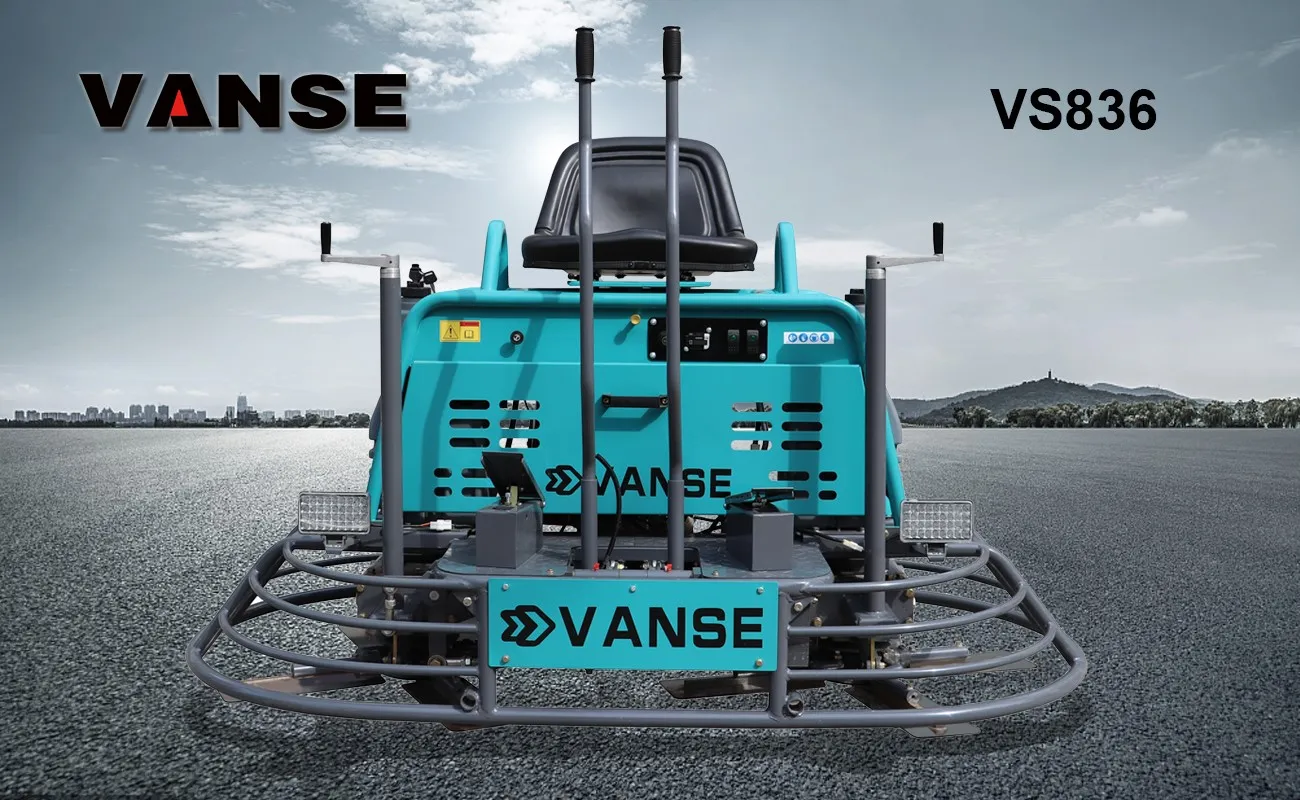
The working principle of the concrete trowel machine is mainly to drive the trowel device to rotate through the power device to smooth, compact and smooth the concrete surface.
Specifically, the motor or internal combustion engine provides power and transmits the power to the trowel device through the transmission system. The trowel device usually consists of a trowel blade and a connecting plate. The trowel blade contacts the concrete surface during rotation to smooth, compact and smooth it. Under the weight of the machine itself, the trowel is close to the ground to complete the compaction and smoothing operations.
In addition, some concrete trowel machines are also equipped with adjustable handles or joysticks so that the operator can adjust the height and angle of the trowel as needed, so as to better adapt to different construction environments and requirements.
Thanks to All the Friends Who Support and Trust Shandong Vanse Machinery Technology Co., Ltd.
If you want to know more about Shandong Vanse Machinery Technology Co., Ltd. or have any questions, please feel free to contact us:
Our Factory
Shandong Vanse Machinery Technology Co., Ltd.








Share this article

About the Author: Shandong Vanse Machinery Technology Co., Ltd.
Shandong Vanse Machinery Technology Co., Ltd. is a high-tech manufacturer specializing in concrete construction machinery, including laser screeds and related equipment. The company integrates R&D, production, and global sales, with products exported to over 60 countries and widely used in infrastructure projects worldwide.
Previous Post
Next Post
Related Articles
You Might Also Like
What are the specific advantages of concrete laser leveling machine in construction efficiency?
As a leading domestic laser leveling machine company, with a 60% market share and exported to more than 60 countries, we are well aware that the advantages in construction efficiency are crucial for customers to choose our products. The following is a specific analysis of the advantages of concrete laser leveling machines in construction efficiency. Introduction With the rapid development of the construction industry, the requirements for construction efficiency and project quality are increasing. As a high-tech construction equipment, concrete laser leveling machines have shown excellent performance in construction efficiency with their unique advantages. 1. Significant improvement in construction speed Compared with traditional manual leveling, the construction speed of concrete laser leveling machines has been significantly improved: High degree of automation: The laser leveling machine has achieved automated leveling, reduced manpower requirements, and greatly increased the construction speed. Continuous operation capability: The machine can operate continuously without being restricted by the workers' rest time, further accelerating the construction progress. 2. Strict control of construction accuracy Construction accuracy directly affects the quality of the project and the subsequent use effect: Laser positioning technology: Using laser positioning technology, ensure that the flatness and levelness of the concrete floor meet the design requirements. Precision control system: The precision control system equipped with the leveling machine can adjust the working parameters in real time to maintain construction accuracy. 3. Guarantee the consistency of construction quality Consistency of construction quality is an important indicator to measure construction efficiency: Standardized operation: The laser leveling machine operates according to the preset standards to ensure the consistency of construction quality. Reducing human factors: Reducing the uncertainty of human operation and avoiding quality problems caused by differences in workers' technical levels. 4. Effective reduction of construction costs Reducing construction costs is a direct reflection of improving construction efficiency: Reducing labor costs: Reducing dependence on workers, thereby reducing labor costs. Increasing material utilization: Accurately controlling the laying thickness of concrete, reducing material waste and improving material utilization. 5. Enhanced construction safety Construction safety is an important guarantee for construction efficiency: Reducing construction risks: Automated operations reduce the exposure time of workers at the construction site and reduce construction risks. Safety protection design: Laser leveling machines are usually equipped with safety protection designs, such as emergency stop buttons, guardrails, etc. 6. Adaptability to construction environment Adapting to different construction environments is the key to improving construction efficiency: Multiple terrain adaptation: The laser leveling machine can adapt to different terrain conditions, such as indoors, outdoors, slopes, etc. Different climatic conditions: The equipment design takes into account the influence of different climatic conditions, such as waterproofing and dustproofing. 7. Improved construction flexibility Flexibility during the construction process is crucial to cope with emergencies: Quick adjustment: The laser leveling machine can quickly adjust the leveling parameters according to construction needs. Versatility: Some laser leveling machines have multiple functions, such as leveling and compaction, which improves the flexibility of construction. 8. Intelligent management of construction data Intelligent management of construction data to provide decision support for construction efficiency: Construction data collection: The laser leveling machine can collect key data during the construction process. Data analysis and optimization: Through data analysis, optimize the construction plan and improve construction efficiency. 9. Continuous innovation of construction technology Technological innovation is the driving force for improving construction efficiency: R&D investment: Continuous investment in R&D, and continuous introduction of new technologies and new products. Industry cooperation: Cooperate with scientific research institutions and universities to jointly promote technological progress in the industry. 10. Future prospects Looking to the future, concrete laser leveling machines will make greater breakthroughs in intelligence, automation, green environmental protection, etc.: Intelligent development: Introduce more intelligent technologies, such as artificial intelligence, the Internet of Things, etc., to achieve intelligent management of the construction process. Green and environmental protection: Develop more energy-saving and environmentally friendly equipment to reduce the impact of construction on the environment. Conclusion The advantages of concrete laser leveling machines in construction efficiency are multifaceted, including the improvement of construction speed, the control of construction accuracy, the consistency of construction quality, the reduction of construction costs, the enhancement of construction safety, the adaptability of the construction environment, the improvement of construction flexibility, the intelligent management of construction data, the continuous innovation of construction technology and the prospect of future development. These advantages not only win us a leading position in the domestic market, but also make our products highly competitive in the international market.How to evaluate the smoothness of concrete pavement through quality inspection?
Assessing the smoothness of concrete pavements through quality testing ♢♢♢♢ Introduction The smoothness of concrete pavement is one of the important indicators for evaluating its construction quality and performance. Good flatness not only improves the aesthetics of the road, but also helps ensure driving safety and extend the service life of the road. Therefore, it is crucial to inspect and evaluate the flatness quality of concrete pavement. This article aims to discuss how to evaluate the smoothness of concrete pavement through quality testing, including testing methods, evaluation standards, and improvement measures. ♢♢♢♢ Method for testing the flatness of concrete pavement 1. Ruler method The ruler method is a common method for evaluating the flatness of concrete pavement. This method uses a ruler placed on the road surface and determines the smoothness of the road surface by observing the gap between the ruler and the road surface. The larger the gap, the worse the smoothness of the road surface. The ruler method is simple and easy to implement, but it is greatly affected by human factors and requires experienced inspectors. 2. Laser scanning method The laser scanning method is an advanced flatness detection method. It uses the principle of laser ranging to scan the road surface with high precision through a laser scanner to obtain the three-dimensional topography data of the road surface. Through data processing and analysis, the smoothness index of the road surface can be obtained. The laser scanning method has the advantages of high precision and high efficiency, and is suitable for large-area, high-precision road surface smoothness detection. 3. Level method The level method uses a level to measure the elevation of each point on the road surface, and determines the smoothness of the road surface by comparing the elevation differences between adjacent points. This method has high measurement accuracy, but requires more measurement points and complex calculation processes, and the detection efficiency is relatively low. ♢♢♢♢ Evaluation criteria for concrete pavement smoothness The evaluation standards for concrete pavement flatness are usually formulated according to relevant national and regional specifications. Generally speaking, the evaluation criteria include the following aspects: 1. Maximum gap The maximum gap refers to the maximum gap value between the ruler and the road surface in the ruler method detection. According to the specification requirements, the maximum gap value should be within a certain range. If it exceeds this range, the smoothness of the road surface will be deemed not to meet the requirements. 2. Smoothness index Smoothness index is a comprehensive index obtained by counting and processing the elevation data of multiple measuring points on the road surface. This index can comprehensively reflect the smoothness of the road surface and is an important basis for evaluating the smoothness of the road surface. 3. Driving comfort Driving comfort refers to the smoothness and comfort of a vehicle when driving on the road. A well-smooth road surface should ensure the smoothness and comfort of vehicle driving and reduce vehicle wear and driver fatigue. ♢♢♢♢ Measures to improve the smoothness of concrete pavement 1. Optimize construction technology: Construction technology is one of the important factors affecting the smoothness of concrete pavement. Optimizing construction techniques, such as reasonably controlling the water-cement ratio and using efficient vibration equipment, can improve the compactness and uniformity of concrete, thereby improving the smoothness of the road surface. 2. Strengthen construction quality control: Quality control during the construction process is the key to ensuring the smoothness of concrete pavement. Construction units should strictly carry out construction in accordance with design requirements and technical specifications, and strengthen control over raw materials, construction equipment, construction techniques, etc., to ensure that construction quality meets requirements. 3. Deal with pavement defects in a timely manner: During and after construction, pavement defects, such as honeycombs, pitted surfaces, cracks, etc., should be discovered and dealt with in a timely manner. For minor defects, repair measures can be taken to deal with them; for serious defects, rework should be carried out to ensure the smoothness and flatness of the road surface. 4. Strengthen care and maintenance. Concrete pavement will be affected by natural factors and traffic loads during use, causing the smoothness of the pavement to gradually decrease. Therefore, it is crucial to strengthen the maintenance and maintenance of road surfaces. Regular cleaning of the road surface, timely repair of damaged parts, and preventive maintenance can extend the service life of the road surface and maintain its smoothness and smoothness. ♢♢♢♢ Summary and Outlook The flatness assessment of concrete pavement is a complex and important task involving multiple testing methods and evaluation standards. By rationally selecting testing methods and applying evaluation standards, the flatness of concrete pavement can be accurately evaluated, and corresponding improvement measures can be taken to improve the performance of the pavement. With the continuous advancement of science and technology and the emergence of new detection technologies, the evaluation method of concrete pavement flatness will be more accurate and efficient. In the future, we can look forward to the application of more intelligent and automated testing equipment and methods in concrete pavement flatness assessment, providing strong support for improving pavement construction quality and performance.How to make laser leveling machine parts last longer?
As a brand-new floor construction equipment, the laser leveling/ leveling machine has been widely concerned by the industry due to its excellent construction efficiency and construction accuracy once it has entered the market, and has been more and more used in warehouses, basements, parking lots, Large-area concrete floors such as industrial plants are under construction. Like other construction machinery, the laser leveling/ leveling machine is also a whole composed of many parts, and the construction environment is relatively complicated, so it is easier to wear than the parts of general machinery during long-term work. In order to prolong the effective life of the laser leveling/ leveling machine, the following is a brief introduction to the main components of its components and the skills of use and maintenance. —-THE CORE COMPONENTS AND FUNCTIONS OF LASER LEVELING/ leveling MACHINE— ➤Drive Train: mainly composed of transmission, universal joint, drive shaft and drive axle; ➤Driving System: composed of frame/axle/suspension/wheels, etc. The function is to support the quality of the whole vehicle and ensure the driving of the laser leveling machine; ➤Steering system: composed of steering wheel, steering gear, steering knuckle, steering knuckle arm, tie rod, straight tie rod, etc., the function is steering; ➤Hydraulic brake: The hydraulic brake device is composed of brake pedal, brake pump, wheel cylinder, drum brake and oil pipe and other parts; ➤Transmission: It is composed of transmission housing, transmission cover, first shaft, second shaft, intermediate shaft, reverse gear shaft, gears, bearings, operating mechanism and other parts, used for changing speed and output torque of laser leveling machine; ➤Leaf Spring and Shock Absorber: The role of the leaf spring is to maintain an elastic connection between the frame and body and the wheels or axles. The function of the shock absorber is to ease the vibration when the laser leveling machine is subjected to shock; ➤Starter: The function is to convert electrical energy into mechanical energy, drive the crankshaft to rotate, and start the engine. If the continuous starting time is too long, it will cause a large amount of battery discharge and the starter coil will overheat and smoke, which will easily damage the laser leveling machine parts; ➤Battery: The role of the battery is to supply electricity to the starter, and to supply power to the engine ignition system and other electrical equipment when the engine is started or running at low speed. When the engine is running at high speed, the generator generates enough electricity, and the battery can store excess electricity; ➤Motor: The motor is the power device of the laser leveling machine. Its main function is to generate driving torque as a power source for electrical appliances or various machinery. Its main function is to convert mechanical energy into electrical energy. At present, it is more commonly used to use heat energy, water energy, etc. to drive the rotor of the generator to generate electricity. —USE AND MAINTENANCE OF CORE COMPONENTS OF LASER LEVELING MACHINE— ➤Change lubricating oil regularly: Regularly replace the lubricating oil to ensure that all parts of the machine are well lubricated and reduce the wear of the parts; ➤Clean the whole machine and parts regularly: Keep regular cleaning of the whole and each part, and fasten loose parts in time to prevent parts from being worn or lost due to looseness; ➤Pay attention to the working load of each component during the running-in period: Pay attention to the workload of each component during the running-in period. Generally, the workload during the running-in period should not exceed 80% of the rated workload, and an appropriate workload should be deployed to prevent damage caused by the long-term continuous operation of the laser leveler. The occurrence of overheating; ➤Start the leveling engine every half a month: Start the leveling engine once every half a month, charge the battery, and run all hydraulic actuators at the same time, such as rotating hydraulic motors, telescopic cylinders, etc. Do not remove the battery from the machine to prevent damage to the controller caused by long-term parking of the equipment Symptoms of missing internal software programs; ➤Start the leveling regularly: Start the leveling machine regularly and turn on all hydraulic functions on the machine, so that the hydraulic drive components work regularly to prevent the related seals from being damaged due to long-term parking, and metal components such as cylinder rods from rusting and other failures. Shrink all the cylinder rods into the hydraulic cylinder chamber to better protect the surface of the cylinder rods. Reasonable use and regular maintenance of various parts are effective ways to prolong the service life of the laser leveling machine and improve the economic efficiency of the operation. It is suggested that before using the leveling machine, one should be fully familiar with the composition and function of each component of the machine, master the correct operation method, and strengthen daily maintenance and maintenance.