Technical Knowledge
How to operate concrete topping spreaders on uneven base layers without affecting material distribution accurac
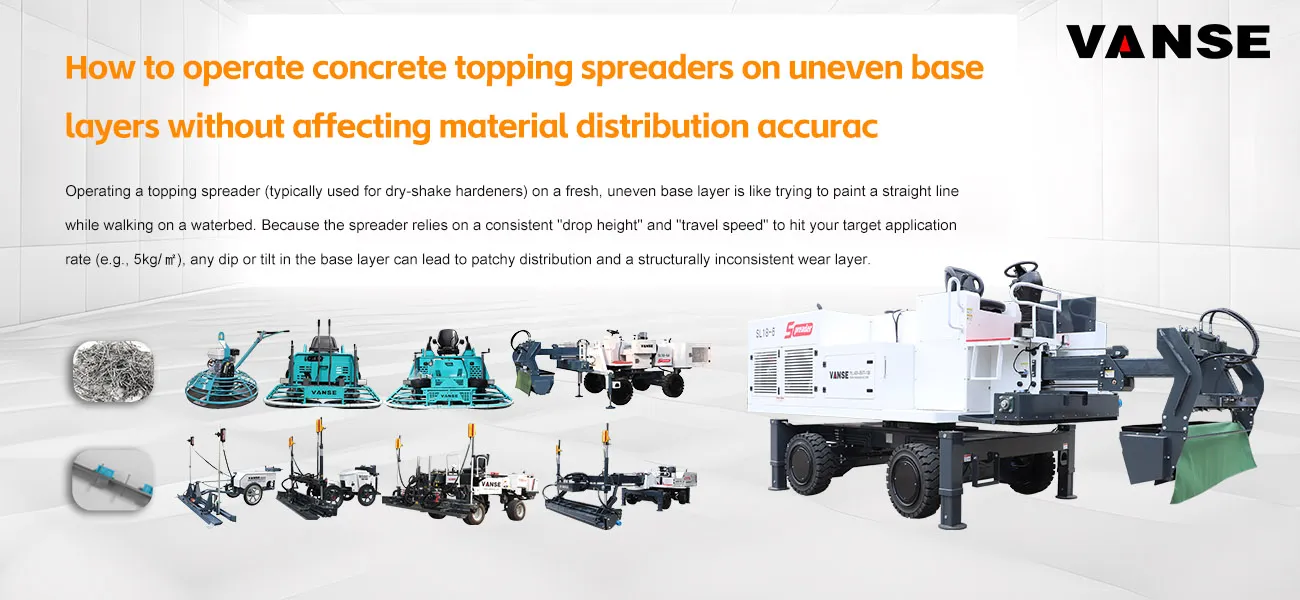
Operating a topping spreader (typically used for dry-shake hardeners) on a fresh, uneven base layer is like trying to paint a straight line while walking on a waterbed. Because the spreader relies on a consistent "drop height" and "travel speed" to hit your target application rate (e.g., 5kg/㎡), any dip or tilt in the base layer can lead to patchy distribution and a structurally inconsistent wear layer.
Here is how to maintain precision when the ground beneath you isn't cooperating.
1. Use a Telescopic Boom Spreader (The "Off-Slab" Solution)
The most effective way to handle an uneven base is to avoid driving on it entirely. * How it works: Large-scale spreaders use a telescopic boom that extends over the fresh concrete.
The Advantage: Since the machine’s tracks or wheels stay on the stable, leveled subgrade or the previously poured (and hardened) lane, the "head" of the spreader remains perfectly level regardless of the "hills and valleys" in the wet concrete.
Accuracy: This setup allows for a computer-controlled discharge rate that is decoupled from the unevenness of the wet slab.
2. Speed-to-Discharge Synchronization
If you are using a spreader that must travel on the fresh concrete (like a walk-behind or a ride-on), your accuracy depends on Variable Rate Control.
The Problem: When a spreader hits a "low spot" or soft patch, the wheels often slip or the operator slows down. If the hopper continues to drop material at a fixed rate, you end up with a "heavy" pile in the low spot.
The Fix: Modern spreaders use encoders on the wheels. If the machine slows down due to the uneven terrain, the computer automatically slows the discharge rotor.
Pro Tip: If your machine isn't automated, the operator must consciously "feather" the discharge trigger as they navigate difficult patches to avoid material "slugs."
3. The "Two-Pass" Distribution Method
On high-tolerance projects with uneven bases, never try to drop the full amount of topping in a single pass.
The 50/50 Rule: Apply 50% of the material in one direction (e.g., North-South) and the remaining 50% in the perpendicular direction (East-West).
The Benefit: This cross-hatching pattern naturally "averages out" any distribution errors caused by the spreader tilting or surging over uneven spots. It ensures that even if one pass was slightly "light" due to a bump, the second pass will likely compensate for it.
4. Interaction with the Laser Leveling
Accuracy starts before the spreader arrives. The laser Leveling must be used to create a "flat-enough" surface for the spreader to navigate.
| Strategy | Action | Result |
| Initial Strike-off | Laser Leveling makes a fast, leveling pass. | Provides a consistent "bed" for the topping. |
| Wait Time | Allow the "bleed water" to disappear. | Firms up the base so the spreader doesn't sink/bog down. |
| Mechanical Integration | Attach the spreader head to the laser Leveling (if compatible). | Uses the laser’s elevation accuracy to drop material at a precise height. |
5. Avoiding "Wheel-Track" Segregation
The Solution: Use low-pressure flotation tires or wide tracks to spread the weight of the machine.
Immediate Follow-up: A bull float or a "highway straightedge" must follow the spreader immediately to "knit" the topping into the base and erase the tracks before the material begins to hydrate.
Technical Warning: If you are using metallic dry-shakes, distribution accuracy is even more critical. "Clumps" of metallic topping caused by uneven spreading can lead to localized delamination because the topping won't have enough moisture from the base slab to hydrate properly.
Would you like me to detail the "Wash-out" test used to verify if your spreader is actually hitting the kg/㎡ target across the entire floor?
Slump Consistency: If the concrete slump varies by even 1 inch (e.g., from a 5-inch slump to a 6-inch slump), the vibratory Leveling will "sink" differently. For Superflat results, the concrete must be identical truck-to-truck.
Head-to-Head Overlap: When using a handheld vibratory Leveling, ensure each pass overlaps the previous one by 20–30%. This "erases" the line between passes.
Would you like a list of the specific F-number tolerances required for "Category 1" VNA (Very Narrow Aisle) floors versus standard warehouse floors?. Contact us NOW
Note: The parameters provided in this document are for reference only and are not mandatory. Due to differences in technical characteristics between different brands and models of laser levelers, please consult the manufacturer for a suitable solution before actual operation. This reference document assumes no responsibility for any issues arising from failure to follow the manufacturer's instructions.
Thanks to All the Friends Who Support and Trust Shandong Vanse Machinery Technology Co., Ltd.
If you want to know more about Shandong Vanse Machinery Technology Co., Ltd. or have any questions, please feel free to contact us:
Our Factory
Shandong Vanse Machinery Technology Co., Ltd.








Share this article

About the Author: Shandong Vanse Machinery Technology Co., Ltd.
Shandong Vanse Machinery Technology Co., Ltd. is a high-tech manufacturer specializing in concrete construction machinery, including laser screeds and related equipment. The company integrates R&D, production, and global sales, with products exported to over 60 countries and widely used in infrastructure projects worldwide.
Previous Post
Next Post
Related Articles
You Might Also Like
How to ensure the laser transmitter of the concrete laser leveling machine is installed stably?
It is very important to ensure that the laser transmitter of the concrete laser leveler is installed stably. Here are the specific methods: – Select a suitable location: According to the shape, size and obstacle distribution of the construction site, choose an open, flat location that can fully cover the construction area to install the laser transmitter. Generally speaking, it can be placed near the center of the site or at the edge of the site where the terrain is higher, and avoid placing it in places that are susceptible to vibration and collision. – Clean the installation surface: Use cleaning tools such as brooms and rags to thoroughly remove dust, debris, oil and loose particles on the surface of the installation location to ensure that the surface is clean and flat, providing a good foundation for subsequent installation. – Check the appearance of the transmitter: Carefully check whether the laser transmitter has any external damage, such as cracked or deformed shell, and whether the lens has scratches, stains, looseness, etc., to ensure that the laser transmitter itself has no quality problems and damage, so as to avoid affecting its normal operation and installation stability. – Use the level adjustment device: When installing, use the level adjustment foot or level meter that comes with the laser transmitter. By adjusting the height of the level adjustment foot, the level bubble of the laser transmitter is located in the center position to ensure that the transmitter is in a horizontal state. For some high-precision laser transmitters, a high-precision electronic level may also be required for auxiliary calibration. – Fix with a fastening device: After placing the laser transmitter in the selected position, use the matching bolts, nuts, washers and other fastening devices to firmly fix it on the mounting bracket or foundation. When tightening the bolts, operate according to the specified torque value to ensure that the tightening force of each bolt is uniform to prevent the transmitter from tilting or loosening due to uneven force. – Perform angle calibration: According to the construction requirements, use the angle adjustment mechanism on the transmitter to accurately adjust the angle of the laser emission so that it maintains the correct angle relationship with the construction plane or reference plane. During the calibration process, angle measurement tools such as theodolites and total stations can be used for auxiliary measurement to ensure that the angle error is within the allowable range. – Inspect installation stability: After installation, gently shake the laser transmitter to check for looseness or shaking. At the same time, observe whether the horizontal state and angle of the transmitter have changed. If there is any abnormality, readjust and tighten it in time. – Regular maintenance and calibration: During the use of the concrete laser leveling machine, the laser transmitter should be inspected and maintained regularly. At regular intervals of working time or construction mileage, the transmitter's horizontality, angle, and accuracy of the laser beam should be calibrated and debugged to ensure that it always maintains a stable and accurate working state. – Set up protective measures: To prevent the laser transmitter from being disturbed and damaged by external factors, protective devices such as guardrails and protective covers can be set around it. The height and strength of the guardrail should be able to effectively prevent personnel and equipment from colliding with the transmitter, and the protective cover should be able to prevent rain, dust, and sun, providing a good working environment for the transmitter.Power Trowel trowelling machine
Daily maintenance After each work, clean the concrete and dust on the machine timely. It is recommended to replace the air filter once every 100 hours. In many dust areas, the frequency of cleaning and replacement should be increased. Replace the oil after the first 20 hours of operation, and then replace it every 100 hours. When disposing of the waste oil, it is recommended to put it in a sealable container and give it to the recycling center to protect the environment and soil Grease the grease nipple above the cross for daily maintenanceHow to improve the safety of concrete laser leveling machine?
Operator safety training and qualification management 1. Professional training requirements Certification required: Operators must pass the training of manufacturers or professional institutions, master the equipment principles, operation procedures and emergency shutdown methods, and hold valid certificates to work after passing the assessment. Regular refresher training: Safety operation refresher training is carried out every six months, focusing on strengthening practical skills such as coping with new working conditions (such as slope operation, night construction), emergency handling of equipment abnormalities, etc. Case warning education: Analyze typical accident cases in the industry (such as leveling beam falling, laser system misjudgment leading to collision), and clarify the hazards of illegal operations. 2. Safety awareness training It is strictly forbidden to work after drinking or fatigue, stay focused during operation, and it is forbidden to make phone calls or distracted operations during operation. Establish a "double confirmation" system: key actions (such as equipment displacement, parameter modification) require two people to check and confirm to avoid single-person misoperation. Equipment safety protection device upgrade and maintenance 1. Mechanical safety protection Emergency stop button The machine body and operating handle are equipped with red emergency stop buttons. When pressed, the power system is immediately cut off, and the response time is ≤0.5 seconds. Anti-fall protection The leveling beam lifting system is equipped with a double brake device (hydraulic lock + mechanical lock). When the hydraulic system fails, the mechanical lock automatically locks to prevent the beam from falling. Overload protection The hydraulic system is equipped with a relief valve, which automatically relieves the pressure when the pressure exceeds 110% of the rated value; the motor is equipped with an overload protector to prevent the motor from being burned by excessive current. Protective cover for moving parts Metal protective covers are installed on rotating parts such as chains and pulleys. The protective covers must pass the 100N force test without deformation to prevent people from contacting and getting injured. 2. Electrical and laser system safety Leakage protection: The electrical system is equipped with a leakage circuit breaker (operating current ≤30mA, operating time ≤0.1 second), and the cable joints are waterproof and sealed to prevent rainwater from seeping in and causing electric shock. Laser safety level: Use Class 3B or lower laser transmitters (wavelength 630-670nm, power ≤50mW), avoid direct exposure to human eyes, and set up "Laser Danger" warning signs in the operating area. Anti-electromagnetic interference: The control system line uses shielded cables, away from interference sources such as electric welders and high-frequency equipment, to prevent laser signal misjudgment from causing equipment out of control. Safety management specifications for the working environment 1. Site pretreatment Survey the site before construction, remove hidden dangers such as underground pipelines, steel bar heads, and water pits, and lay steel plates (thickness ≥ 20mm) on soft ground to prevent the equipment from sinking and rolling over. Define the working area, set up cordons and warning signs, and keep non-operating personnel at least 5 meters away from the equipment to avoid collision when the leveling beam rotates. 2. Safety measures for special working conditions Night/low-light operation: Install LED work lights (brightness ≥ 200lux) to ensure that there is no shadow in the operating area; add reflective signs to the laser receiver to assist manual observation of the equipment position. Slope operation: When the slope exceeds 5°, the stability of the equipment must be tested first (run without load for 10 minutes), and the walking speed must be controlled to ≤1.5km/h during operation to avoid sudden stops and sudden turns. Rainy days/humid environment: Stop open-air operations. If construction is necessary, check the waterproof performance of electrical components, and operators must wear insulating shoes and gloves. The grounding resistance of the equipment must be ≤4Ω. Operation process safety control 1. "Three-step inspection" before operation Mechanical inspection: Test the lifting and traveling system of the leveling beam to confirm that there is no jamming in each action and the pressure of the hydraulic system is normal (the pressure gauge shows within the rated value ±0.5MPa). Electrical inspection: Test the calibration accuracy of the laser system (target ruler measurement error ≤3mm), check whether the sensor signal transmission is stable, and the backup battery power is ≥80%. Safety device test: Press the emergency stop button to confirm that the equipment stops immediately; simulate the loss of pressure in the hydraulic system to verify whether the mechanical lock starts automatically. 2. Key points for safe operation during operation It is forbidden to climb the fuselage or adjust the components when the equipment is running. When maintenance is required, the equipment must be shut down and the power must be cut off. When transferring the site, the leveling beam must be raised to the lowest position and locked, the driving speed must be ≤5km/h, and the height and weight limit must be confirmed before passing through the bridge and tunnel (equipment height + 0.5m safety margin). When multiple people work together, a dedicated person should be assigned to direct, and an intercom (fixed channel) or hand signals (such as the "stop" gesture is to extend the arm horizontally forward) should be used to avoid communication errors. V. Safety regulations in maintenance 1. Power-off and sign-out system Before maintenance, turn off the main power switch and hang a "no closing" warning sign. The key is kept by the maintenance personnel to prevent accidental start-up. Hydraulic system pressure relief: Loosen the cylinder exhaust valve and confirm that the pressure drops to 0MPa before disassembling the pipeline to avoid high-pressure oil spray and injury. 2. High-altitude work protection When inspecting the laser transmitter (height ≥ 2 meters), use an anti-slip ladder (load bearing ≥ 150kg) or a lifting platform, and the operator wears a safety belt (hook fixed to an independent anchor point). It is forbidden to stand or walk on the leveling beam. When the beam needs to be inspected, it needs to be supported by a safety bracket (support point load bearing ≥ 1.5 times the weight of the equipment). Emergency response and safety plan 1. Emergency response process for sudden failures Fault type Emergency measures Laser system failure Immediately switch to manual mode, stop operation, evacuate personnel, and notify technicians to calibrate or replace the receiver. Hydraulic system oil leakage Turn off the engine, surround the oil leak area with sandbags to prevent spread, use oil-absorbing cotton to clean, and strictly prohibit open flames from approaching (hydraulic oil ignition point ≥ 180℃). Risk of equipment tipping over Operators immediately evacuate to a safe area, slowly reset with a jack (the support point must be at the specified position of the frame), and it is strictly forbidden to force the equipment to start. 2. Safety plan and drills Formulate the "Laser Leveler Safety Accident Emergency Plan", clarify the handling procedures for electric shock, mechanical injury, laser burns, etc., and equip first aid kits (including tourniquets, burn ointments, etc.). Organize emergency drills every quarter to simulate scenarios such as equipment out of control and personnel injuries, improve the team's response speed, and archive the drill records for future reference. Strengthening the safety management system Daily inspection form: Formulate an "Equipment Safety Inspection Form", which includes 20 inspection items such as braking system, lighting, safety devices, etc., and the operator signs and confirms before daily operation. Responsibility traceability mechanism: Incorporate safety indicators into the performance appraisal of operators. For those who violate the regulations and cause accidents, deduct bonuses or pursue legal liability according to the degree of responsibility. Technology upgrade investment: Regularly update equipment safety modules (such as installing GPS positioning anti-crossing system and blind spot camera), and use intelligent monitoring system to warn abnormal data in real time (such as alarm when hydraulic oil temperature exceeds 90℃). Through the above measures, the operation risk of concrete laser leveling machine can be systematically reduced. It is recommended to combine the equipment instruction manual and industry safety standards (such as GB 2894-2008 "Safety Signs and Guidelines for Their Use"), formulate a personalized safety manual, and continuously track the application of new technologies (such as AI visual anti-collision system) to dynamically improve the level of safety protection.