Technical Knowledge
How to match the spreading speed of concrete spreaders with laser leveling construction progress?
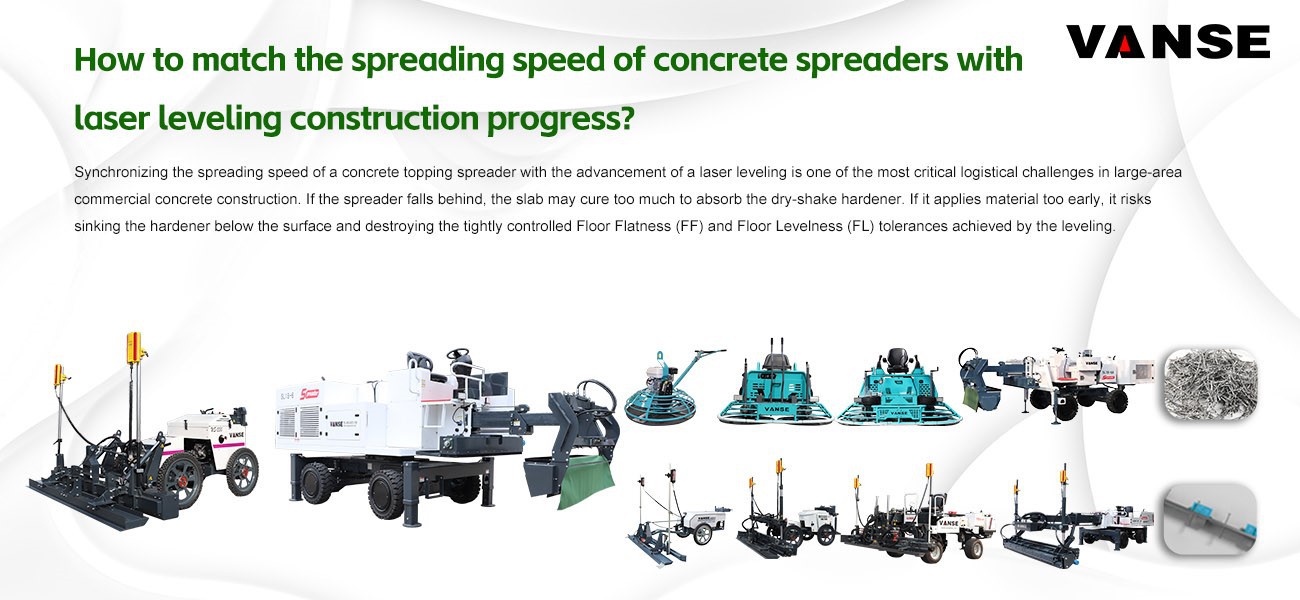
Synchronizing the spreading speed of a concrete topping spreader with the advancement of a laser leveling is one of the most critical logistical challenges in large-area commercial concrete construction. If the spreader falls behind, the slab may cure too much to absorb the dry-shake hardener. If it applies material too early, it risks sinking the hardener below the surface and destroying the tightly controlled Floor Flatness (FF) and Floor Levelness (FL) tolerances achieved by the leveling.
Here is the technical framework for matching the operational speeds of these two vital pieces of equipment:
1. Establish the Laser leveling as the "Pacemaker"
The laser leveling dictates the ultimate speed of the pour. High-efficiency telescopic boom laser leveling can level thousands of square meters per day, pulling a wide leveling head (often 3 to 4 meters) continuously.
Calculate the leveling’s average output in square meters per hour (m²/hr) based on the concrete delivery rate (truck arrivals) and the specific machine's boom extension and retraction cycle time.
The topping spreader’s theoretical maximum speed must exceed the laser leveling’s continuous output. This buffer is required because the spreader operates in intermittent bursts, waiting for specific sections of the slab to reach the correct curing stage.
2. Manage the "Bleed Water" Delay Window
Unlike the laser leveling, which levels wet concrete immediately after placement, the topping spreader cannot follow immediately behind.
The Rule of Timing: The spreader must wait until the concrete’s initial bleed water has evaporated and the surface can support the weight of the machine and operator (typically when a footprint leaves an indentation of only 3 to 5 mm).
Depending on environmental conditions (temperature, humidity, wind) and the concrete mix design, this delay can range from 1 to 3 hours.
Therefore, the spreader is not matching the leveling's current position, but rather matching the leveling's output rate from 1 to 3 hours prior.
3. Match Daily Capacity and Pass Rates
Dry-shake hardeners often require multiple passes. If the project specifies a heavy application (e.g., 5 to 8 kg/m²), it is standard practice to apply 50-60% of the material on the first pass, let it absorb moisture, power-trowel it, and then apply the remaining 40-50% on a second pass.
The Math: If a laser leveling levels 2,000 m² in a day, the spreader doesn't just need to cover 2,000 m²; it may need to cover 4,000 m² to accommodate a two-pass application within the same curing window.
To match progress, ensure the chosen topping spreader has a variable speed hydrostatic drive and a hopper capacity large enough to minimize reloading downtime.
4. Coordinate Traffic and Reloading Logistics
A high-speed topping spreader is useless if it spends half the day driving off the slab to refill its hopper.
Strategic Reloading: Position bulk bags of dry-shake hardener at strategic intervals along the edge of the pour or utilize a telehandler to bring material directly to the spreader on the slab.
Tire Management: Ensure the spreader is equipped with the correct wide-profile, low-pressure tires. If the machine has to slow down excessively to avoid creating deep ruts that ruin the FL metrics, it will lose pace with the leveling's historical output.
By calculating the square-meter-per-hour output of the leveling, factoring in the multi-pass requirements of the hardener, and maintaining a strict staging area for fast material reloading, contractors can ensure their spreading operations perfectly shadow the rapid advancement of modern laser leveling equipment.
Note: The parameters provided in this document are for reference only and are not mandatory. Due to differences in technical characteristics between different brands and models of laser levelers, please consult the manufacturer for a suitable solution before actual operation. This reference document assumes no responsibility for any issues arising from failure to follow the manufacturer's instructions.
Thanks to All the Friends Who Support and Trust Shandong Vanse Machinery Technology Co., Ltd.
If you want to know more about Shandong Vanse Machinery Technology Co., Ltd. or have any questions, please feel free to contact us:
Our Factory
Shandong Vanse Machinery Technology Co., Ltd.








Share this article

About the Author: Shandong Vanse Machinery Technology Co., Ltd.
Shandong Vanse Machinery Technology Co., Ltd. is a high-tech manufacturer specializing in concrete construction machinery, including laser screeds and related equipment. The company integrates R&D, production, and global sales, with products exported to over 60 countries and widely used in infrastructure projects worldwide.
Previous Post
Next Post
Related Articles
You Might Also Like
In low temperature conditions, besides using heating equipment, what other methods can be used to speed up the setting of concrete?
In low temperature conditions, in addition to using heating equipment, the following are some methods that can speed up the setting of concrete: 1. **Adjust the mix ratio**: Choose an appropriate type of cement, such as early-strength silicate cement, which has a large hydration heat and releases the highest strength at an early stage. Try to reduce the water-cement ratio and slightly increase the amount of cement to increase the hydration heat and shorten the time to reach the age strength. 2. **Use air-entraining agent**: While keeping the concrete mix ratio unchanged, the bubbles generated after adding the air-entraining agent will increase the volume of the cement slurry accordingly, improve the fluidity of the mixture, improve its cohesion and water retention, buffer the water pressure generated by the freezing of water in the concrete, and improve the frost resistance of the concrete. 3. **Add early-strengthening admixture**: Shorten the setting time of concrete and improve the early strength. Commonly used early-strengthening admixtures include sodium sulfate (2% of the amount of cement) and composite early-strength water test agent (5% of the amount of cement). 4. **Select high-quality aggregate**: Select aggregates with high particle hardness and few gaps, so that their thermal expansion coefficient is similar to that of the surrounding mortar to improve the frost resistance of concrete. 5. **Heat storage method**: Mainly used for projects with relatively thick structures at temperatures around -10℃. By heating the raw materials (water, sand, stone), the concrete can still store considerable heat after mixing, transportation and pouring, so that the cement hydration releases heat faster and strengthens the insulation of the concrete. 6. **External heating method**: Mainly used for projects with temperatures above -10℃ and not thick components. By heating the air around the concrete components, the heat is transferred to the concrete, or the concrete is directly heated so that the concrete can harden normally under positive temperature conditions. 7. **Use antifreeze admixture**: In temperatures above -10℃, a chemical that can lower the freezing point of water is added to the concrete mixture, so that the concrete is still in a liquid state at negative temperatures, and the hydration reaction can continue, thereby continuing to increase the strength of the concrete. Commonly used antifreeze agents include single antifreeze agents such as calcium oxide and sodium chloride, and composite antifreeze agents of sodium nitrite and sodium chloride. 8. **Optimize concrete pouring control**: In winter construction, it is necessary to continuously optimize and control the pouring of concrete, and strictly control the quality of materials. Do a good job of review to improve the basic quality of concrete. Through the above method, the setting speed of concrete under low temperature conditions can be accelerated without relying on external heating equipment, thereby improving construction efficiency.Concrete laser leveling machine’s skill requirements and cultural quality requirements for workers
The concrete laser leveling is a high-precision construction equipment that requires high skills and cultural quality of workers. At the same time, in order to ensure safe operation, workers need to strictly abide by safe operating procedures. The following are considerations for the skill requirements, cultural quality requirements, and understanding and compliance of safe operating procedures for workers with concrete laser levelings. 1. Skill requirements 1】Operating skills: Operating a concrete laser leveling requires certain skills and experience. Workers need to master equipment operation methods, basic maintenance skills, and simple troubleshooting skills. In addition, workers also need to understand the performance characteristics, scope of application and usage limitations of the equipment to ensure correct and safe operation. 2】Construction skills: When using a concrete laser leveler for construction, workers need to have corresponding construction skills. This includes understanding of concrete materials, basic knowledge of concrete construction technology, mastery of laser leveling technology, and the ability to coordinate with other types of work. 3] Safety skills: Workers need to master the safe operating procedures of concrete laser leveling machines and have corresponding safety awareness. During the operation, workers need to abide by safety regulations and use safety protective equipment correctly to avoid safety accidents caused by improper operation. 2. Cultural quality requirements 1] Cultural level: Workers who use concrete laser leveling machines need to have basic cultural qualities. They should be able to understand operating instructions, safety procedures and other relevant technical documentation and be able to perform simple reading and writing. 2】Professional ethics: Workers should have professional ethics, abide by professional ethics, be serious and responsible for their work, and ensure construction quality and safety. 3】Learning ability: Workers should have the ability to learn, be able to master the operating skills and construction techniques of concrete laser leveling machines through training and practice, and continuously improve their professional level and comprehensive quality. 3. Understanding and complying with safe operating procedures 1] Safety awareness: Workers should have safety awareness and be aware of the safety risks and precautions when using concrete laser leveling machines. During the operation, you should always remain vigilant to discover and eliminate safety hazards in a timely manner. 2】Safe operating procedures: Workers should carefully study and strictly abide by the safe operating procedures of the concrete laser leveler. This includes the starting, running, stopping of equipment and handling of emergencies. Only by correctly following safe operating procedures can the safety of equipment and workers be ensured. 3] Safety protective equipment: Workers should use and wear safety protective equipment correctly. When using a concrete laser leveling, workers should wear professional protective glasses, protective clothing, earplugs and other supplies to avoid injuries caused by noise, vibration and splashing concrete particles during operation. 4】Construction site safety: Workers should pay attention to safety management at the construction site. When operating the concrete laser leveling, make sure there are no other irrelevant people or obstacles around to avoid accidental injuries or property losses caused by improper operation. At the same time, workers should pay attention to on-site fire protection, electrical and other aspects to ensure safe production at the construction site. 5】Maintenance safety: When performing maintenance on the concrete laser leveling, workers should strictly abide by the maintenance procedures. When the equipment is shut down, workers should perform necessary inspection, lubrication and cleaning work. When the equipment is in operation, workers should not perform any maintenance work to avoid safety accidents. In short, workers who use concrete laser levelinging machines need to have certain skills and cultural quality requirements, and strictly abide by safe operating procedures. Only in this way can the normal operation of equipment and the safety of workers be ensured, and high-efficiency, high-quality construction goals be achieved.Introduction to the construction process and precautions of laser leveling machine
Regarding the construction process and precautions of the laser leveling machine, I believe this is also a question that operators are more concerned about. We all know that if we want to use the laser leveling machine better, we need to understand its construction process and precautions. In order to help everyone use the equipment better, we will introduce this aspect to you in the next article. I hope you will be interested in it. Check whether the outer template has been fully supported, confirm that the laser leveling construction equipment is intact, find the specified elevation, and install the laser transmitter; check whether the slump of the concrete on site meets the requirements of laser leveling. When using the precision laser leveling machine, the slump of the concrete is required to be 160±10mm; and confirm that the concrete can be supplied continuously. Be careful to avoid obstacles when installing the laser transmitter; the speed of the laser leveling machine should not be too fast during leveling; the concrete should be initially leveled before leveling, and the concrete after initial leveling should be higher than the established elevation. 1. Before starting work, one operator shall check the machine equipment, set up the transmitter with the operator, and install the handheld receiver; adjust the scraper of the floor machine in a static state, and there shall be no error at two points; operate the laser leveling machine, observe whether the machine is working properly, check whether the laser receiver is in a horizontal position, and supervise whether the material replenisher is scraping and filling in time; at the end of the construction on the same day, clean the machine after the machine cools down, and check whether the functions of the machine are normal; check the power of the transmitter. 2. One operator shall assist the operator in installing and debugging the machine, and set up the transmitter with the main operator and install the handheld receiver. Check whether the transmitter is placed safely; measure the height of the concrete after preliminary paving; measure the height of the concrete after leveling. Focus: the edge of the concrete and the concrete surface scraped by hand; at the end of the construction on the same day, clean the machine after the laser leveling machine cools down, and check the power of the handheld receiver. 3. When the laser leveling machine is not operated, two material replenishers shall perform preliminary leveling of the concrete with the paving worker. When following the machine, they shall obey the instructions of the main operator and scrape and fill the machine scraper position. 4. 2-4 pavers need to follow the command of the operator and perform preliminary leveling of the concrete. The above are the precautions and construction processes for the use of laser leveling machines introduced by the manufacturer. I hope it can provide you with some effective reference opinions. If you have any questions or don't understand the above issues, you can call us for consultation. We will patiently answer your questions.