Technical Knowledge
How to calibrate the dosage of spreaders to avoid material waste on large-area super flat floors?
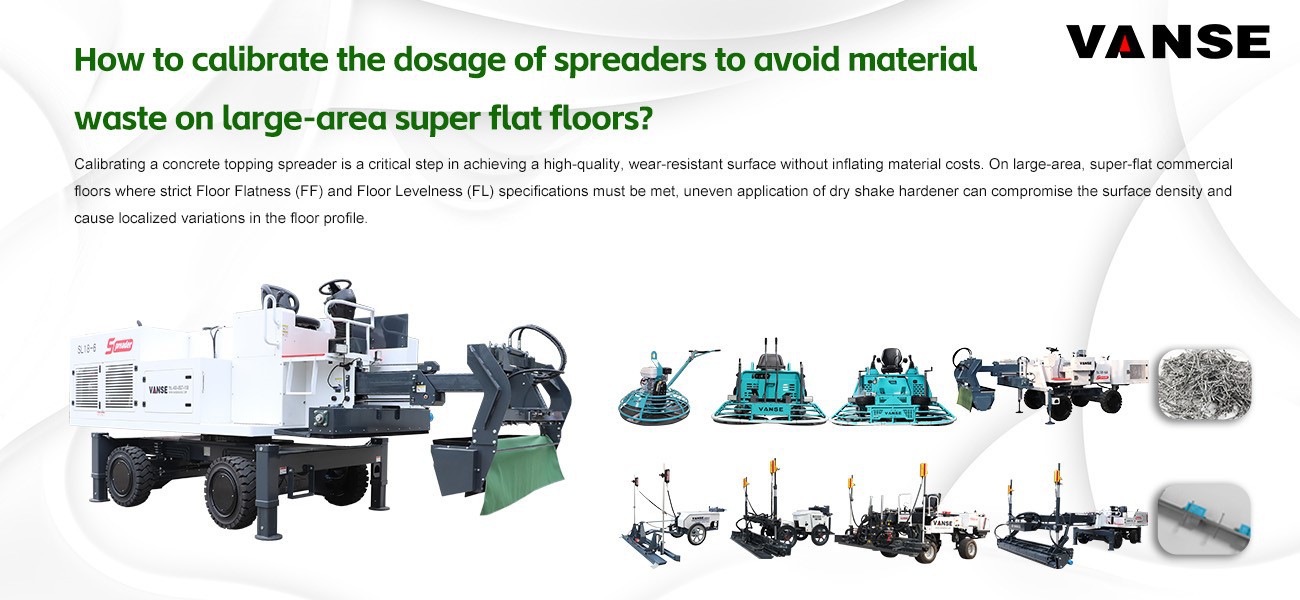
Calibrating a concrete topping spreader is a critical step in achieving a high-quality, wear-resistant surface without inflating material costs. On large-area, super-flat commercial floors where strict Floor Flatness (FF) and Floor Levelness (FL) specifications must be met, uneven application of dry shake hardener can compromise the surface density and cause localized variations in the floor profile.
Here is a step-by-step professional guide to calibrating the dosage of automatic topping spreaders to ensure precision and eliminate material waste:
1. Determine the Required Dosage Rate
Before any machine adjustment, establish the exact application rate required by the project specifications. This is typically measured in kilograms per square meter (kg/㎡) or pounds per square foot (lbs/sq ft).
Light to medium duty: Usually 3 to 5 kg/㎡.
Heavy duty (industrial/logistics): Often requires 5 to 8 kg/㎡ or more.
If a heavy application is required, it is usually best practice to calibrate the spreader to apply the material in two separate passes (e.g., 60% on the first pass, 40% on the second) to allow proper moisture absorption from the concrete paste.
2. Synchronize Travel Speed and Dispensing Rate
Automatic topping spreaders, such as those used in tandem with advanced laser leveling or ride-on power trowels, control dosage through two primary variables:
Forward Travel Speed: How fast the machine moves across the slab.
Dispenser/Auger Speed: How fast the material is pushed through the drop-gate.
To avoid waste, these two must be locked in. If the operator slows the machine down but the auger speed remains constant, too much material will be dumped in one area. Ensure the equipment's variable speed controls are set so that the dispensing mechanism is directly proportional to the drive speed.
3. Perform a Dry Run Calibration (The Tarp Test)
Never perform the initial calibration directly over the fresh concrete. Use the "tarp test" method to dial in the settings:
Lay out a pre-measured heavy-duty plastic tarp or catch-tray on a dry, flat surface (e.g., 2 meters by 2 meters).
Load the hopper with the specific dry-shake material being used for the project (different materials have different bulk densities and flow characteristics).
Set the spreader gate opening and auger speed to the estimated settings.
Drive the spreader over the tarp at the exact operational speed that will be used during the pour.
Collect and weigh the dispensed material.
Divide the weight of the collected material by the square meter area of the tarp. Adjust the gate aperture or auger speed up or down until the exact target weight per square meter is achieved.
4. Adjust for Material Flowability
Moisture in the air or variations in the hardener鈥檚 aggregate size (e.g., metallic vs. mineral aggregates) can change how the material bridges or flows through the hopper grate.
Ensure the vibrating screen or agitation shaft inside the hopper is functioning correctly to prevent "rat-holing" (where material forms a tunnel and stops flowing).
A smooth, continuous curtain of material is required. If the material clumps, it will drop in piles, requiring aggressive manual finishing that disrupts the FL (levelness) of the slab.
5. Monitor and Adjust During the Pour
Once the large-area pour begins, keep a running tally of the total square meters covered versus the number of bags (or bulk weight) loaded into the hopper.
Example: If the target is 5 kg/m虏 and you have covered 1,000 square meters, exactly 5,000 kg of material should have been consumed.
Perform this audit early in the pour (e.g., after the first 200 square meters) so minor micro-adjustments can be made to the drop-gate before significant material waste occurs.
By dialing in the calibration precisely, operators ensure that the concrete matrix receives the exact surface hardening required for long-term durability, protecting both the project's profit margins and the stringent FF/FL requirements demanded by modern logistics and industrial clients.
Note: The parameters provided in this document are for reference only and are not mandatory. Due to differences in technical characteristics between different brands and models of laser levelers, please consult the manufacturer for a suitable solution before actual operation. This reference document assumes no responsibility for any issues arising from failure to follow the manufacturer's instructions.
Thanks to All the Friends Who Support and Trust Shandong Vanse Machinery Technology Co., Ltd.
If you want to know more about Shandong Vanse Machinery Technology Co., Ltd. or have any questions, please feel free to contact us:
Our Factory
Shandong Vanse Machinery Technology Co., Ltd.








Share this article

About the Author: Shandong Vanse Machinery Technology Co., Ltd.
Shandong Vanse Machinery Technology Co., Ltd. is a high-tech manufacturer specializing in concrete construction machinery, including laser screeds and related equipment. The company integrates R&D, production, and global sales, with products exported to over 60 countries and widely used in infrastructure projects worldwide.
Previous Post
Next Post
Related Articles
You Might Also Like
Laser leveling machine manufacturers explain to you in detail: Six major effects of engine oil on equipment
The laser leveling machine has attracted the attention of consumers since its launch, which has a lot to do with its own role. The engine oil has the unique role of lubrication and wear reduction, cooling, sealing and leak prevention, shock absorption and buffering on the equipment. It is precisely because of these humanized roles that the equipment has been welcomed by consumers. During use, the engine oil can effectively reduce the wear of the equipment. The following laser leveling machine manufacturer will take you to learn about the six major roles of engine oil on the laser leveling machine in detail. ★ Lubrication and wear reduction: In recent years, in order to pursue a smoother and more perfect ground, more and more people use laser leveling machines for construction. The use of equipment construction can ensure that the entire ground is dense and uniform, which has been well received by the construction industry. The laser leveling machine needs necessary maintenance after using it for a period of time. During maintenance, engine oil has a very large effect on the laser leveling machine. There is very fast relative sliding between the piston and the cylinder, and between the spindle and the bearing. Therefore, to prevent the parts from wearing too quickly, an oil film must be established between the two sliding surfaces. As long as there is a sufficient thickness of the oil film, the surfaces of the relatively sliding parts will be separated, so as to achieve the purpose of reducing wear. ★ Cooling and cooling: The engine oil can bring heat back to the oil tank and then dissipate it into the air to help the water tank cool the engine. Cleaning and cleaning: Good engine oil can bring carbides, sludge, wear metal particles, etc. on engine parts back to the oil tank through circulation, and wash the dirt generated on the working surface of the parts through the flow of lubricating oil. ★ Sealing and leakproof: The engine oil can form a sealing ring between the piston ring and the piston to reduce gas leakage and prevent external pollutants from entering the engine. Rust and corrosion prevention: Lubricating oil can be adsorbed on the surface of the parts to prevent water, air, acidic substances and harmful gases from contacting the parts. ★ Shock absorption and buffering: When the pressure at the cylinder port of the laser leveling machine engine rises sharply, the load suddenly added to the piston, piston chips, connecting rod and crankshaft bearings will be very large. This load will be transmitted and lubricated by the bearings and will buffer the impact load. The relevant knowledge points shared by the laser leveling machine manufacturer for you are basically explained here. If you have good suggestions or opinions, you can contact us in time. We will have professional technicians to help you solve the problem. Thank you for your continued attention and support.VANSE leveling machine speaks with quality and service!
VANSE leveling machine speaks with quality and service! The laser transmitter of the concrete laser leveling machine generates a rotating laser. The laser receiver on the laser leveling machine receives the signal and is analyzed by the laser measurement and control system. The deviation will be fed back to the sensitive computer control system on the laser leveling machine. The linear actuator will adjust the height of the scraper to ensure leveling accuracy. Shandong VANSE Machinery, as the earliest and most professional manufacturer of laser leveling machines in China, believes that occasional quality problems are not enough to negate the strength of the entire brand. Does a brand have strength? The key lies in whether the company has a sound after-sales system and whether it can provide high-quality after-sales service in the first place. High-quality products are the theme of long-term development of enterprises, and high-quality services are the key to the sublimation of corporate brand image. Shandong VANSE laser leveling machine manufacturer has been committed to the research and development and production of concrete laser leveling machine products for many years. The product quality has also experienced the test of various working conditions, and the high-quality after-sales service has been recognized by the majority of users. Our service tenet As long as there is a VANSE laser leveling machine, we only need a call from you, and we can always provide you with high-quality services in the first time. We insist on making high-quality products and high-quality services!What operations should be avoided when using a concrete laser leveler to vibrate and compact concrete?
Improper operation of a concrete laser leveling machine during compaction can lead to problems such as segregation, uneven surfaces, and insufficient density. The following key practices should be avoided: Over-vibration: Excessive vibration frequency (exceeding the equipment's recommended range, such as over 5,000 vibrations per minute) or prolonged vibration time can cause aggregate to sink and mortar to float, resulting in segregation (gravel concentrates at the bottom and excessive laitance on the surface), impacting structural strength and durability. Insufficient vibration: Excessive vibration frequency or insufficient vibration depth (failure to reach the bottom of the concrete) can prevent internal bubbles from being expelled and gaps between aggregates from being filled, leading to honeycombs and voids, and reduced density. Parameters not adapted to concrete characteristics: Parameters not adjusted according to concrete slump (e.g., using a low frequency for dry, hard concrete and a high frequency for plastic concrete) can result in either inadequate vibration or segregation. Repeatedly vibrating the same area: Repeatedly vibrating the same location will damage the concrete's initial structure and exacerbate segregation, especially when performed on concrete in the initial setting stage. This can cause sanding and cracking of the surface. Missed edges or corners: The vibrator fails to reach areas such as the edge of the formwork or areas with dense rebar. These areas are prone to honeycombing due to insufficient vibration energy and require manual assisted vibration (such as using an inserted vibrator). However, this should avoid interfering with the laser leveling machine. Mismatching vibration and travel speed: If the machine travels too fast, the vibrator will stay in a specific area too short, failing to achieve adequate compaction. If the machine travels too slowly, excessive vibration may cause segregation, impacting construction efficiency. Failure to promptly level after vibration: After vibration, the concrete surface will fluctuate due to vibration. If this is not promptly leveled using the laser leveling system, the surface will exceed the required flatness, requiring additional repairs and increasing costs. Forced vibration when the concrete slump exceeds the specified value: Concrete with a large slump (e.g., over 200mm) is inherently fluid and can easily segregate due to excessive vibration. Concrete with a small slump (e.g., less than 50mm) has difficulty transmitting energy through vibration, which can lead to insufficient density. Therefore, the concrete mix proportions should be adjusted before construction. Vibrating after initial setting: After initial setting (loss of plasticity), vibration can damage the existing structural framework, causing surface cracking and reduced strength. Vibration timing must be strictly controlled and synchronized with the concrete pouring rhythm. Continuing to use a vibrator when the vibrator is worn or stuck: Wear on the vibrator blades will attenuate the vibration energy, while sticking can cause localized severe impact, resulting in localized concrete segregation or surface damage. Regularly inspect the equipment. Failure to adjust the vibration depth based on the construction thickness: Too shallow a vibration depth (less than 2/3 of the concrete thickness) can result in a loose, deeper layer; too deep a vibration depth (contacting the formwork or base) can damage the formwork due to vibration impact or introduce impurities into the base, affecting concrete quality. By avoiding these practices, the laser leveling can ensure efficient concrete compaction during the vibration process while maintaining surface accuracy and structural strength, reducing subsequent repair costs. Click the below to jump immediately!!! ARMOUR JOINT CONCRETE LASER LEVELING MACHINE LIGHT TOWER POWER TROWEL SLIPFORM MACHINE STEEL FIBER TOPPING SPREADER TRACKED MINI DUMPER