Technical Knowledge
Power trowel VS manual polishing—Which saves more cost?
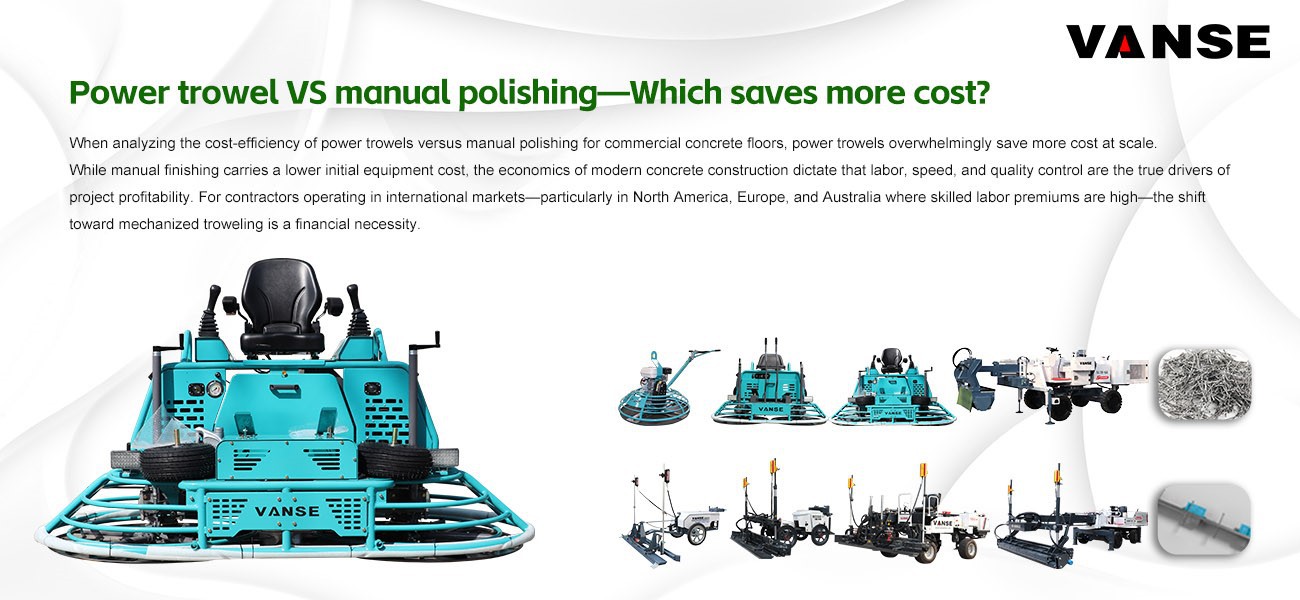
When analyzing the cost-efficiency of power trowels versus manual polishing for commercial concrete floors, power trowels overwhelmingly save more cost at scale. While manual finishing carries a lower initial equipment cost, the economics of modern concrete construction dictate that labor, speed, and quality control are the true drivers of project profitability. For contractors operating in international markets-particularly in North America, Europe, and Australia where skilled labor premiums are high-the shift toward mechanized troweling is a financial necessity.
Here is a breakdown of where the actual costs and savings lie:
1. Labor Costs (Operational Expenditure – OpEx)
Manual Polishing: Finishing a large commercial slab by hand requires a massive crew of skilled laborers working simultaneously to beat the concrete's curing clock. The hourly wages, overtime, and sheer number of personnel required make manual finishing financially unsustainable for anything larger than a residential driveway or tight edge-work.
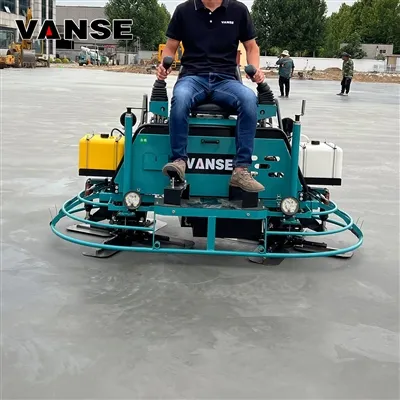
Power Trowels: A single operator on a ride-on power trowel can finish exponentially more square meters per hour than an entire manual crew. By drastically reducing the headcount required on the slab, contractors immediately slash their largest operational expense. The labor savings generated from just a few large-scale logistics or warehouse pours typically cover the entire initial purchase price of the machine.
2. Time and Project Turnaround
Manual Polishing: Manual work is slow and highly vulnerable to environmental factors. If the concrete sets faster than the crew can work, it leads to cold joints or poor surface finishing. This slows down the entire construction schedule.
Power Trowels: Mechanized equipment allows for massive daily pour volumes. Faster surface finishing means the concrete contractor completes the job sooner, reducing on-site overhead costs and allowing the general contractor to advance the build schedule. Faster turnaround directly translates to higher annual revenue capacity for the contracting business.
3. The Hidden Cost of Rework and Quality Control
Manual Polishing: Human application is inconsistent. Achieving the strict Floor Flatness (FF) and Floor Levelness (FL) metrics demanded by modern automated warehouses is virtually impossible by hand. Failing to meet these specifications results in the hidden, catastrophic costs of remedial grinding, surface leveling, or even slab rejection. Furthermore, manual pressure cannot achieve the deep surface compaction needed to prevent future dusting and wear.
Power Trowels: The mechanical weight and high-speed blade rotation of a power trowel compress the concrete matrix aggressively. This brings the cement paste to the top and drives the aggregate down, creating a dense, highly wear-resistant "burnished" finish. This precision guarantees that the high FF/FL numbers established during the laser leveling process are maintained, eliminating the cost of expensive post-pour corrections.
The Bottom Line
Manual polishing only wins on Day 1 regarding Capital Expenditure (CapEx). However, when factoring in the total lifecycle cost of a commercial pour, power trowels deliver a massive cost advantage. They insulate contractors from labor shortages, eliminate the risk of specification failures, and drive the high-efficiency output necessary to compete in the global construction market.
Note: The parameters provided in this document are for reference only and are not mandatory. Due to differences in technical characteristics between different brands and models of laser levelers, please consult the manufacturer for a suitable solution before actual operation. This reference document assumes no responsibility for any issues arising from failure to follow the manufacturer's instructions.
Thanks to All the Friends Who Support and Trust Shandong Vanse Machinery Technology Co., Ltd.
If you want to know more about Shandong Vanse Machinery Technology Co., Ltd. or have any questions, please feel free to contact us:
Our Factory
Shandong Vanse Machinery Technology Co., Ltd.








Share this article

About the Author: Shandong Vanse Machinery Technology Co., Ltd.
Shandong Vanse Machinery Technology Co., Ltd. is a high-tech manufacturer specializing in concrete construction machinery, including laser screeds and related equipment. The company integrates R&D, production, and global sales, with products exported to over 60 countries and widely used in infrastructure projects worldwide.
Previous Post
Next Post
Related Articles
You Might Also Like
Causes and Treatment of Concrete Cracking
Concrete cracking is a very common and complex problem. Below, I will explain in detail the main causes of concrete cracking, how to identify different types of cracks, and the corresponding treatment and prevention measures. Concrete cracking can be categorized into two main types: early cracking and late cracking. Plastic settlement cracking: Cause: After pouring, concrete is still in a plastic state. Aggregates (gravel, sand) sink, while the cement slurry rises (called "bleeding"). When this settling is hindered by rebar, formwork, or larger aggregate, cracks develop on the concrete surface along the direction of the rebar. Characteristics: Surface cracks typically occur along the direction of the rebar. Plastic shrinkage cracks: Cause: Before the concrete finally sets, surface moisture evaporates faster than the rate at which moisture seeps upward, causing the surface to shrink rapidly while the concrete inside remains plastic, resulting in irregular, network-like cracks and crazing. Causes: High temperatures, strong winds, low humidity, and inadequate curing. Temperature stress cracks (caused by hydration heat): Cause: After pouring large volumes of concrete (such as foundation slabs and beams), the cement hydration reaction releases a large amount of heat, causing the internal temperature to rise sharply (up to 50-70°C). This rapid heat dissipation from the surface creates a significant temperature difference between the inside and outside, generating thermal stress. When the tensile stress exceeds the concrete's early tensile strength, cracking occurs. Characteristics: Cracks are deep and wide, often occurring at cross-sectional changes or in the middle of the structure. Construction process issues: Excessive water addition: Adding water arbitrarily for ease of construction increases the water-cement ratio, severely reducing concrete strength. Improper vibration: Excessive vibration causes aggregate sinking and water seepage; inadequate vibration results in loose concrete. Failure to apply a secondary trowel to the surface before initial setting prevents the closure of early plastic cracks. Drying shrinkage cracks: Cause: After concrete hardens, excess moisture gradually evaporates, causing volumetric shrinkage. When this shrinkage is constrained by external forces (such as foundations and columns) or internal forces (such as rebar), tensile stresses are generated, leading to cracking. This is the most common type of crack. Characteristics: Cracks are shallow and fine, often forming an irregular network or parallel lines. Load-induced cracking: Cause: The loads borne by the structure (such as deadweight or operational load) exceed its design capacity. Characteristics: The cracks are relatively wide, and their direction is related to the nature of the load (e.g., vertical cracks in the middle of the beam bottom are bending cracks, while diagonal cracks at the ends of the beam are shear cracks). These cracks require special attention, as they may affect structural safety. Uneven foundation settlement: Cause: Uneven foundation soil quality, softening due to waterlogging, or excessive loads lead to uneven foundation settlement, resulting in additional stress within the structure and cracking. Characteristics: Cracks are often penetrating, with their direction related to settlement. Alkali-aggregate reaction: Cause: The alkali in the cement reacts chemically with the active silica in the aggregate, forming an expansive gel. This gel expands in volume after absorbing water, causing concrete cracking. Characteristics: A map-like or network-like pattern of cracks with silicone gel seeping out of the surface. Rebar Corrosion Cracks: Cause: Insufficient concrete cover or carbonization reaching the rebar surface. In the presence of water and oxygen, the rebar rusts, causing the rust to expand several times in volume, cracking the concrete. Characteristics: Cracks run along the rebar, later accompanied by brown rust. Before treating cracks, it is necessary to first analyze and determine the crack type, width, depth, stability, and impact on structural safety. Treatment methods are primarily categorized as surface sealing and internal reinforcement. Surface Sealing Method (Suitable for Micro-Cracks <0.2mm) Brushing method: Apply a cement-based penetrating crystallizing waterproofing material, epoxy resin, or polymer-modified cement slurry directly to the crack surface to seal the crack and prevent the intrusion of moisture and harmful substances. Grooving and filling method (suitable for static cracks 0.2-0.5mm wide): Steps: Chisel a "V" or "U"-shaped groove along the crack → Clean thoroughly → Apply a primer → Fill with epoxy resin mortar, polymer cement mortar, or a specialized sealant. Low-pressure grouting (injection method) (suitable for cracks 0.1-1.5mm wide) Steps: Surface cleaning: Clean the area around the crack. Inserting grouting nozzles: Attach grouting nozzles at regular intervals along the crack. Crack sealing: Use sealant to seal the crack surface to prevent grout from leaking. Pressure grouting: Use a low-pressure syringe to inject epoxy or polyurethane grout into the crack from a grouting nozzle until grout is released from the adjacent grouting nozzle. Surface finishing: After the grout has solidified, remove the grouting nozzle and smooth the surface. Structural reinforcement method (suitable for wide cracks that affect bearing capacity) Bonding fiber composite materials (carbon fiber cloth/plate): High-strength carbon fiber cloth is bonded to the surface of the cracked area, utilizing its high tensile strength to share the load. Bonding steel plates: Steel plates are bonded to the concrete surface using structural adhesive to increase structural rigidity. Enlarging the cross-section: A layer of concrete is wrapped around the existing component to increase its cross-sectional dimensions and reinforcement. Prestressing: Prestressed tendons are used to actively apply pressure to the structure, offsetting some of the tensile stress. Important: For cracks caused by uneven foundation settlement, alkali-aggregate reaction, etc., the root cause must be addressed first (such as strengthening the foundation) before crack repair. Prevention is far better than cure. Strict control should be applied to all aspects of the process, including materials, design, construction, and maintenance. Materials: Optimize mix proportions, reduce the water-cement ratio, and use high-efficiency water reducers. Use well-graded aggregates and reduce cement dosage to reduce hydration heat and shrinkage. Use low-heat or medium-heat cement for large-volume concrete. Design aspects: Ensure proper reinforcement placement and add structural reinforcement (such as crack-resistant steel mesh) in areas prone to cracking (such as around holes and at cross-section changes). Properly establish expansion joints and post-cast joints (for extra-long structures). Ensure sufficient concrete cover thickness. Construction: The addition of water on site is strictly prohibited. Strictly control the pouring and vibration processes to ensure uniform compaction and avoid over-vibration and missed vibration. Implement cooling measures (such as water-cooling aggregates) during hot seasons and insulation measures in winter. Perform secondary troweling and compaction promptly to eliminate plastic cracks. Maintenance (critical!): Early Curing: Immediately cover with plastic sheeting or a curing blanket after pouring to prevent rapid evaporation. Sufficient Moisturization: After final set, begin regular watering or use a curing agent to keep the concrete surface moist for at least 7-14 days. Insulation Curing: For large concrete volumes, monitor the temperature difference between inside and outside, implement insulation and moisture curing, and maintain the temperature difference within 25°C. Crack Types Main causes: Treatment Focus Prevention of core problems Plastic Shrinkage/Settlement Cracks Early water loss and impeded settlement Surface Sealing Timely screeding and covering to retain moisture Temperature Cracks Heat of hydration and large temperature difference between inside and outside Grouting Reinforcement Use low-heat cement, cooling, and thermal insulation Desiccation Shrinkage Cracks Later water evaporation and shrinkage Surface Sealing/Grouting Reduce the water-cement ratio and enhance moisture retention Load/Settlement Cracks Overloading and foundation problems Structural Reinforcement + Root Cause Treatment Reasonable design to ensure construction quality When you encounter concrete cracks, don't blindly address them. First, determine their nature and severity. For cracks that are wide, persistent, or potentially impacting structural safety, consult a professional structural engineer or testing company for evaluation. Based on the results, develop a sound treatment plan. Note: The parameters provided in this document are for reference only and are not mandatory. Due to differences in technical characteristics between different brands and models of laser levelers, please consult the manufacturer for a suitable solution before actual operation. This reference document assumes no responsibility for any issues arising from failure to follow the manufacturer's instructions.By adjusting the operating parameters of the power trowel, what quality problems of the concrete surface can be solved?
Adjusting the operating parameters of the trowel machine can solve the following quality problems of the concrete surface: Adjust the speed: The speed of the trowel machine has an important influence on the flatness of the concrete surface. If the speed is too fast, the trowel blade may produce too much cutting force on the concrete surface, resulting in uneven surface; if the speed is too slow, the concrete surface may not be effectively smoothed. By appropriately reducing or increasing the speed of the trowel machine, the blade can act evenly on the concrete surface, which can improve the surface flatness. Adjust the trowel time: If the trowel time is too early, the concrete has not reached a certain strength, and it is easy to produce dents or marks during the trowel process; if the trowel time is too late, the concrete strength is too high, and the trowel machine is difficult to effectively trim the surface. According to factors such as the concrete mix ratio and ambient temperature, reasonable adjustment of the trowel time can make the concrete surface achieve better flatness. Adjusting the pressure: If the pressure applied by the trowel is too high during operation, the cement slurry on the concrete surface will be over-extruded, resulting in a thin cement slurry layer on the surface, which is prone to sanding; if the pressure is too low, the concrete surface cannot be compacted, which will also affect the surface quality. Properly adjusting the pressure of the trowel so that it can make the concrete surface compact while not over-extruding the cement slurry during operation will help solve the problem of surface sanding. Choose the right blade: Trowel blades of different materials and shapes have different effects on the concrete surface. For example, a blade with higher hardness and sharper edge may cut off some tiny particles on the concrete surface during troweling, increasing the risk of sanding; while a blade with a softer or blunter edge may not be able to effectively compact the surface. Choosing a blade with moderate material and appropriate edge shape can reduce surface sanding caused by blade factors. Control the troweling speed: If the water on the concrete surface evaporates quickly, if the trowel speed is too fast, it will accelerate the loss of surface water, causing cracks on the concrete surface due to drying shrinkage. Reduce the operating speed of the trowel machine to allow the concrete surface enough time for water migration and cement hydration reaction, which can reduce cracks caused by drying shrinkage. Adjust the number of trowel passes: Too many trowel passes may cause excessive disturbance to the concrete surface, destroy the formed structure, and cause cracks on the surface; too few passes may not make the surface achieve sufficient density and finish. According to the performance and surface condition of the concrete, reasonably adjust the number of trowel passes to ensure surface quality and avoid cracks caused by excessive troweling. AMOUR JOINT CONCRETE LASER LEVELING MACHINE LIGHT TOWER POWER TROWEL STEEL FIBER TRACKED MINI DUMPERWhat to do if the efficiency of laser leveling machine drops?
In the process of using the laser leveling machine, pay attention to the harm caused by unfavorable factors to the leveling machine, because the working environment of the leveling machine has always been relatively harsh, so when the leveling machine is working, it will inevitably be damaged by the surrounding unfavorable factors, and it will also lead to a decline in the working efficiency of the laser leveling machine. Later, the failure will inevitably become more and more serious, so everyone should be careful when using it. 1. Avoid impurities: For laser leveling machines that work in harsh environments and complex conditions, first of all, use high-quality and matching parts, lubricating oil, and grease to block the source of harmful impurities; secondly, do a good job of mechanical protection at the work site to ensure that the corresponding mechanisms can work normally and prevent various impurities from entering the interior of the machine. For the faulty laser leveling machine, try to go to the regular repair place for repair. When on-site repairs, protective measures must also be taken to prevent the parts replaced during on-site repairs from being polluted by impurities such as dust before entering the machine. 2. Applicable temperature: During the use of the laser leveling machine, firstly, it is necessary to prevent overload operation at low temperature, ensure the normal operation in the low-speed preheating stage, and make the machine reach the specified temperature before driving or working. Do not ignore its important role because there is no problem at that time; secondly, prevent the laser leveling machine from operating at high temperature. During the operation of the machine, the values on various thermometers should be checked frequently. For those who can't find the reason for a while, the laser leveling machine must still work with the disease without treatment. In normal work, pay attention to check the working condition of the cooling system. For water-cooled machines, it is necessary to check and add cooling water before work every day; for air-cooled machines, the dust on the air-cooling system should also be cleaned regularly to ensure the smooth flow of cooling air ducts. 3. Anti-corrosion: In the use of laser leveling machines, management and operators should take effective measures according to the local weather conditions and air pollution conditions at that time to reduce the impact of chemical corrosion on laser leveling machines. The focus is to prevent the intrusion of rainwater and chemical components in the air to the machinery. Based on all the above contents, do you have a comprehensive understanding of the laser leveling machine to avoid the infringement of unfavorable factors? If the content we shared has helped you, welcome to continue to pay attention to our website, we will continue to update the newsletter for you, and strive to provide customers with better services.