Technical Knowledge
When supplying antimicrobial mesh,how should the concentration of the antimicrobial mesh be determined?

When laying double-layer steel mesh, the determination of the steel mesh spacing needs to consider multiple factors. The following is a detailed introduction
Design specification requirements
– Different building structure types and usage functions have clear steel mesh spacing requirements in the design specifications. For example, for general concrete slab structures, according to the "Concrete Structure Design Code", the spacing of steel bars should not be less than 70mm, when the slab thickness is not more than 150mm, the steel bar spacing should not be more than 200mm; when the slab thickness is more than 150mm, the steel bar spacing should not be more than 1.5 times the slab thickness, and should not be more than 250mm. For structures with special requirements, such as basement top slabs, hydraulic structures, etc., the specifications may have stricter regulations.
Force analysis calculation
– Through structural mechanics calculations, determine the load size, distribution, and force transmission path of the concrete structure during use. According to the calculation results, the steel mesh is reasonably arranged to meet the bearing capacity and deformation requirements of the structure. For example, in a two-way slab subjected to a large bending moment, in order to effectively resist the bending moment in both directions, it is necessary to determine the spacing of the steel mesh in different areas according to the bending moment diagram. Generally speaking, in areas with large bending moments, the spacing of the steel mesh should be appropriately reduced to provide sufficient bending resistance; while in areas with small bending moments, the spacing of the steel mesh can be appropriately increased, but it must meet the minimum spacing requirements of the specification.
Concrete pouring and vibration process
– Consider the pouring method of concrete and the performance of the vibration equipment to ensure that the concrete can fully wrap the steel bars and vibrate densely during the pouring and vibration process. If the spacing of the steel mesh is too small, it will affect the fluidity of the concrete and the insertion of the vibrator, making it difficult to pour the concrete densely, and it is easy to have quality problems such as honeycombs and rough surfaces; if the spacing is too large, it will affect the restraint of the steel bars on the concrete and reduce the integrity of the structure. For example, when pumping concrete, due to the large fluidity of the concrete, the spacing of the steel mesh can be relatively small, but it is also necessary to ensure that the vibrator can be smoothly inserted for vibration. In general, in order to facilitate the operation of the vibrator, the net spacing of the steel mesh should not be less than 1.5 times the diameter of the vibrator.
Specifications and types of steel bars
– Steel bars of different specifications and types have different bearing capacities and deformation properties, which will affect the determination of the spacing of the steel mesh. For example, high-strength steel bars can withstand greater tensile forces, and their spacing can be appropriately larger than ordinary steel bars on the premise of meeting the structural force requirements. For steel bars with larger diameters, in order to ensure sufficient bonding between the steel bars and concrete, and to avoid excessive concentration of steel bars leading to difficulties in concrete pouring, the spacing of the steel meshes also needs to be increased accordingly. Generally speaking, the larger the diameter of the steel bar, the larger the spacing of the steel meshes should be. For example, when using steel bars with a diameter of 10mm, the spacing may be 150-200mm; and when using steel bars with a diameter of 12mm, the spacing may be 180-250mm.
In actual projects, the determination of the spacing of the steel meshes needs to be determined by professional structural engineers based on the specific project conditions, taking into account the above factors, through rigorous calculation and analysis, and following relevant design specifications and standards to ensure the safety, applicability and durability of the structure.
Thanks to All the Friends Who Support and Trust Shandong Vanse Machinery Technology Co., Ltd.
If you want to know more about Shandong Vanse Machinery Technology Co., Ltd. or have any questions, please feel free to contact us:
Our Factory
Shandong Vanse Machinery Technology Co., Ltd.








Share this article

About the Author: Shandong Vanse Machinery Technology Co., Ltd.
Shandong Vanse Machinery Technology Co., Ltd. is a high-tech manufacturer specializing in concrete construction machinery, including laser screeds and related equipment. The company integrates R&D, production, and global sales, with products exported to over 60 countries and widely used in infrastructure projects worldwide.
Previous Post
Next Post
Related Articles
You Might Also Like
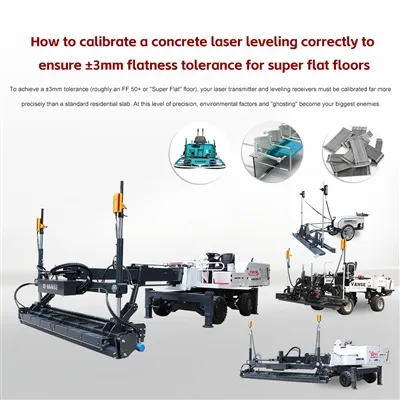
How to calibrate a concrete laser leveling correctly to ensure ±3mm flatness tolerance for super flat floors
To achieve a ±3mm tolerance (roughly an FF 50+ or "Super Flat" floor), your laser transmitter and leveling receivers must be calibrated far more precisely than a standard residential slab. At this level of precision, environmental factors and "ghosting" become your biggest enemies. Here is the professional procedure for calibrating a laser leveling system for super flat requirements. Before the pour, you must verify the laser transmitter itself. Even a high-end unit can drift. The Set-up: Place the laser exactly halfway between two walls (or stakes) approximately 30m (100ft) apart. Step A: Turn the laser to Face 1 (X-axis). Mark the beam height on Wall A and Wall B. Step B: Rotate the laser 180° to Face 2. Re-mark Wall A and Wall B. The Math: If the difference between the two marks on either wall exceeds 1.5mm, the internal pendulum or diode is out of spec. The "Super Flat" Rule: For ±3mm floors, your transmitter should ideally be accurate to ±1.5mm per 30m to allow for cumulative errors in the receiver and leveling hydraulics. If you are using a laser leveling (e.g., Vanse), you must calibrate the relationship between the laser receivers and the leveling head. Hydraulic Warm-up: Run the machine for 15–20 minutes. Cold hydraulic fluid moves slower, causing a "lag" in the auto-leveling that will blow your FF numbers. Auto-Cal Sequence: Set the transmitter 20–30m away. Place the leveling boom at 100% extension. Enter the machine's "Tuning" or "Service" menu and select Auto-Cal. The machine will move the cylinders through their full range to "learn" the exact voltage needed to move the head 1mm. Vibration Check: Ensure the vibrator is ON during the final stages of calibration. The vibration causes "settling" in the head that must be accounted for. Once the machine is calibrated, you must sync it with the physical site datum. Establish a Master Benchmark (usually a brass plug or a column mark) away from the pour area. Set your hand-held laser receiver (grade rod) to this benchmark. Place the grade rod on the leveling's finish blade (not the plow). Adjust the leveling's offset until the machine's "On Grade" light matches the grade rod's "On Grade" signal. Factor Requirement Why? Wind/Heat Use a "dead" zone Wind can vibrate the laser transmitter tripod, causing "beam bounce" (a 1mm shake at the source becomes 5mm at the leveling). Receiver Height Keep it low The higher the receivers are on the masts, the more they amplify any "sway" or vibration from the machine. Tripod Stability Concrete/Solid Earth Never set the transmitter on a wood deck or loose fill. Use a heavy-duty fiberglass tripod. Overlap 10–20% On super flat pours, each pass must overlap the previous one significantly to "erase" the transition line. If your numbers are off despite calibration, check for Refraction. On hot days, the laser beam can "bend" as it passes through heat shimmering off the ground. Solution: Raise the transmitter tripod to 2 meters (6.5 ft) high. This keeps the beam above the hottest air layer near the ground, providing a more stable reference line. Would you like me to explain how to conduct a "Dipstick" or Floor Profiler test to verify these numbers once the concrete has cured? Contact us NOW Note: The parameters provided in this document are for reference only and are not mandatory. Due to differences in technical characteristics between different brands and models of laser levelers, please consult the manufacturer for a suitable solution before actual operation. This reference document assumes no responsibility for any issues arising from failure to follow the manufacturer's instructions.Don’t throw away your scrapped laser levelings anymore, they can be turned into treasures!
Even the best laser levelers will likely age or even become scrapped as they age or are used more and more, or due to improper maintenance, untimely after-sales service from the manufacturer, and other factors. Faced with such machines, many construction units usually abandon them, not knowing that many manufacturers have launched activities such as "recycling old machines at high prices and exchanging old for new". For scrapped laser levelers, customers can participate in the above activities in the following ways. ● Sell the idle laser levelers directly, and the manufacturers will recycle them at a high price For the idle and aging scrapped laser levelers in your hands, it may be due to the large amount of engineering, long service life, old software system, or replacement with a newer or larger laser leveler, or the transformation of the industry and no longer direct concrete paving construction, and no longer intend to reuse the original idle laser levelers. As long as the laser system is intact, it can be sold directly to manufacturers with "old for new" activities. They will definitely conduct professional evaluation of your equipment and help you realize cash. ● Repair and refurbish the laser leveler in your hands, and the manufacturer provides you with remanufacturing services At the end of the year, many construction units will sort out the construction equipment in their hands after they are idle, in preparation for the construction next year. They hope to reuse the idle and aging laser levelers in their hands, but they often do not have professional skills and cannot repair them. The cost of purchasing a new machine is too high. At this time, you can contact the manufacturer of "old machine recycling at a high price" to remanufacture your laser leveler. In addition to solving the problems of your current equipment and replacing damaged parts, you can also use your own technical advantages to upgrade and transform your equipment software system to "turn waste into treasure". ● Replace the scrapped equipment in your hands with a new machine, and the manufacturer provides "old for new" service As a precision equipment, some friends ignored the after-sales service, brand technology, product quality and other factors when they bought the laser leveler. They often bought low-quality products without after-sales service because they only wanted to be "cheap" for a while. Although there are concrete paving projects in hand, they cannot be used normally due to problems with the equipment or the manufacturer has not provided systematic and professional training to the operator. I want to buy a product with higher intelligence, guaranteed service and excellent quality, but due to financial pressure, I can't buy it for the time being. In order to meet the needs of such friends, we carry out the "old for new" service, conduct replacement evaluation, and replace the new intelligent laser leveling machine after making up the price difference. After the laser leveling machine has been used for a long time, it will inevitably be idle or scrapped, but as long as we handle it reasonably, we can successfully turn waste into treasure and obtain unexpected benefits. Therefore, if the laser leveling machine in your hand has become old or scrapped, do not discard it at will. You can contact the manufacturer with recycling activities to let the equipment "turn waste into treasure".What is the leveling accuracy of concrete laser leveling machine?
The leveling accuracy of the concrete laser leveling machine varies depending on the equipment performance and construction requirements, and has a high standard in the industry. In actual construction, its leveling accuracy can usually reach a high level. 1. Industry accuracy standard: Concrete floor measurement generally adopts the F numerical standard, FF represents flatness, and FL represents height difference. FF≥100, FL≥100 (about 3m±1.5mm height difference) is a special floor (super flat floor); FF≥50, FL≥50 (about 3m±3mm height difference) is a class I floor; FF≥35, FL≥30 is a class II floor; FF≥25, FL≥20 (about 3m±6mm height difference) is a class III floor. Generally, those with higher ground requirements have FF≥50, and general floors are usually between FF20/FL15 (about 3m±7.5mm height difference). 2. Manshi equipment precision: Equipped with automatic leveling system and laser receiving device, it can achieve high-precision control. For example, some models are compatible with 3D contour system, which can accurately control complex terrain, and also have functions such as "one-key leveling", "fast fine-tuning of receiver height", and "anti-slip system" to ensure construction accuracy. The equipment's leveling accuracy can reach a high level, which can meet the needs of scenes with high requirements for flatness. The error is within 3mm, which meets or even exceeds the accuracy standards of some industries. Some models such as YZ30-4E can have higher leveling accuracy. Click the below to jump immediately!!! ARMOUR JOINT CONCRETE LASER LEVELING MACHINE LIGHT TOWER POWER TROWEL SLIPFORM MACHINE STEEL FIBER TOPPING SPREADER TRACKED MINI DUMPER