Technical Knowledge
How much labor does a laser leveling truly save compared to traditional methods?
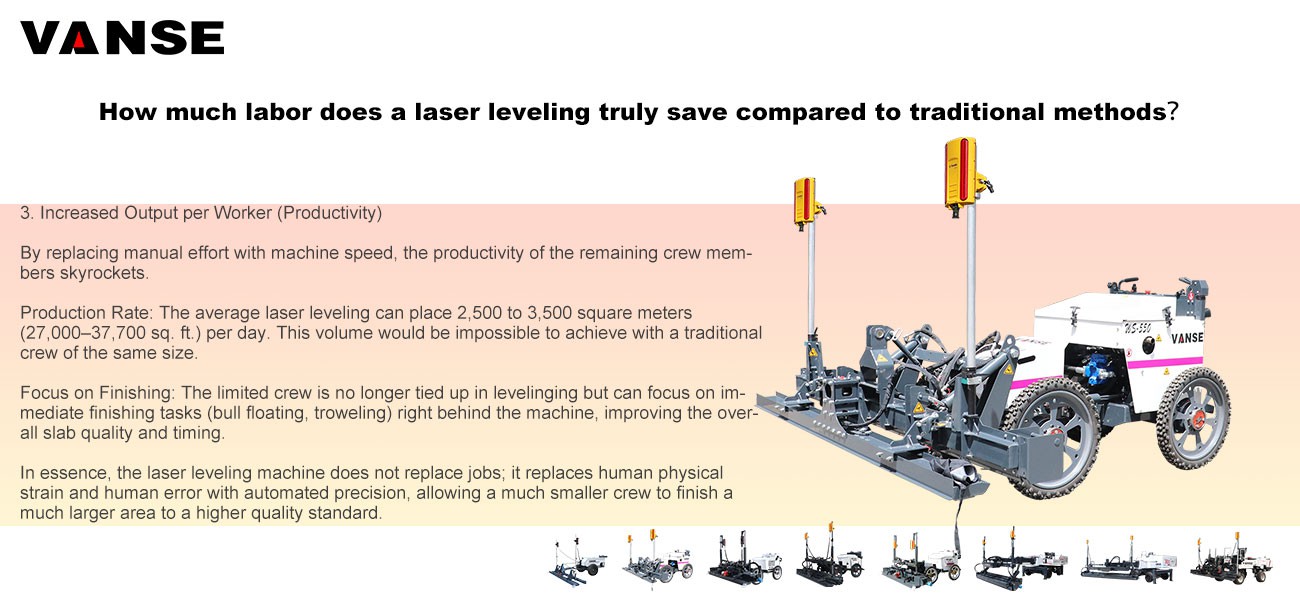
The labor savings from using a concrete laser leveling machine are significant and represent the primary financial justification for the equipment.
Compared to traditional methods (using manual leveling, straightedges, and string lines), a laser leveling typically saves 50% to 70% of the high-intensity labor required for the pouring and leveling process.
Here is a breakdown of how the labor is saved:
1. Crew Size Reduction
The most direct saving comes from the reduction in the number of people needed to level the concrete.
| Factor | Traditional levelinging | Laser leveling (Ride-On) | Labor Difference |
| Typical Crew Size | 6 to 8 workers minimum (sometimes 10–12 for a large pour) | 3 to 4 workers (operator + small support crew) | 50%–70% reduction |
| Skill Requirement | Highly dependent on the skill of multiple finishers to pull and place the concrete to grade. | Relies on one trained operator; the machine automates the precision. | Reduced need for expensive, high-level skilled labor. |
2. Elimination of Manual, Repetitive Tasks
The machine automates the three most labor-intensive and error-prone tasks:
| Manual Task Eliminated | Laser leveling Function | Labor Saved |
| Setting Grade/Forms | Uses a single laser transmitter (or 3D system) to establish the grade automatically in real-time. | Eliminates the hours of manual work setting leveling rails, string lines, and formwork for elevation control. |
| Striking Off | The automated leveling head moves across the slab, striking off the concrete to the exact, laser-guided elevation. | Eliminates the intense physical labor of workers manually dragging a heavy leveling or truss across the slab. |
| Vibration/Consolidation | A high-frequency vibrator integrated into the leveling head consolidates the concrete during the strike-off. | Eliminates the separate, often manual task of consolidating the concrete after it is leveled. |
3. Increased Output per Worker (Productivity)
By replacing manual effort with machine speed, the productivity of the remaining crew members skyrockets.
Production Rate: The average laser leveling can place 2,500 to 3,500 square meters (27,000–37,700 sq. ft.) per day. This volume would be impossible to achieve with a traditional crew of the same size.
Focus on Finishing: The limited crew is no longer tied up in levelinging but can focus on immediate finishing tasks (bull floating, troweling) right behind the machine, improving the overall slab quality and timing.
In essence, the laser leveling machine does not replace jobs; it replaces human physical strain and human error with automated precision, allowing a much smaller crew to finish a much larger area to a higher quality standard.
Note: The parameters provided in this document are for reference only and are not mandatory. Due to differences in technical characteristics between different brands and models of laser levelers, please consult the manufacturer for a suitable solution before actual operation. This reference document assumes no responsibility for any issues arising from failure to follow the manufacturer's instructions.
Thanks to All the Friends Who Support and Trust Shandong Vanse Machinery Technology Co., Ltd.
If you want to know more about Shandong Vanse Machinery Technology Co., Ltd. or have any questions, please feel free to contact us:
Our Factory
Shandong Vanse Machinery Technology Co., Ltd.








Share this article

About the Author: Shandong Vanse Machinery Technology Co., Ltd.
Shandong Vanse Machinery Technology Co., Ltd. is a high-tech manufacturer specializing in concrete construction machinery, including laser screeds and related equipment. The company integrates R&D, production, and global sales, with products exported to over 60 countries and widely used in infrastructure projects worldwide.
Previous Post
Next Post
Related Articles
You Might Also Like
How much money does a laser leveling truly save compared to traditional methods?
The financial savings from using a laser leveling are substantial, but they are realized primarily through reduced labor, increased speed, and minimized rework, rather than just equipment cost. Here is a summary of the true cost savings and efficiency gains compared to traditional levelinging methods: A laser leveling dramatically reduces the size and skill level required of a crew, leading to significant savings on payroll and associated costs. Labor Reduction: Up to 60% fewer workers needed for the levelinging and leveling process. Example: A large commercial pour might require 20+ people using traditional methods, but only 3–4 people with a ride-on laser leveling. Skill Dependency: The machine automates the critical leveling function, reducing reliance on expensive, highly specialized skilled laborers (who would otherwise be needed to set string lines and pour guides). Operational Flexibility: Laser leveling allow for staggered start times, helping contractors avoid overtime and reducing worker fatigue, leading to a healthier, more productive, and less error-prone crew. The speed of placement is where high-volume contractors generate major savings and gain a competitive edge. Increased Speed: Laser leveling can work 4 to 5 times faster than manual levelinging. Output: A typical ride-on unit can place and level 6,000–10,000 square feet (550–930 m^2) per hour, or potentially 2,500–3,500 m^2 in a single day. Shorter Construction Period: Contractors report completing slab installations 30%–40% faster, which reduces overall project timelines, minimizes formwork rental costs, and allows follow-up trades (e.g., floor finishing, racking installation) to start sooner. By delivering high FF/FL numbers, the machine eliminates costly grinding and maintenance down the line. Minimized Rework: The laser's high precision 1mm accuracy) virtually eliminates the need for expensive post-pour corrections like bump grinding or filling low spots. This dramatically reduces the risk of the slab failing ACI standards. Material Uniformity: The consistent vibration and leveling action leads to a denser, more uniform slab, improving the floor's strength and compactness by an estimated 25%. Equipment Maintenance: In high-tolerance environments (like VNA warehouses), a flatter floor reduces wear and tear on material handling equipment (like forklifts) by reducing bouncing and vibrations. One study suggested eliminating joint mismatches could save over $12 per square foot annually in material handling vehicle maintenance over the long term. For a high-volume concrete contractor, the cumulative, long-term savings from buying a laser leveling can total 740,000$ to 920,000$ in avoided labor and rework costs over the equipment's lifespan. However, for a smaller contractor, the saving is realized in the short-term by renting the machine for a large job, avoiding the multi-hundred thousand dollar capital investment while still capturing the labor efficiency and quality gains. Note: The parameters provided in this document are for reference only and are not mandatory. Due to differences in technical characteristics between different brands and models of laser levelers, please consult the manufacturer for a suitable solution before actual operation. This reference document assumes no responsibility for any issues arising from failure to follow the manufacturer's instructions.How to ensure that the parameters and performance of the concrete laser leveling machine meet the requirements
To ensure that the parameters and performance of the concrete laser leveling machine meet the standards, the core is to establish " Source selection → Preoperative calibration → Intraoperative verification → Postoperative maintenance "The whole process is closed-loop controlled, and each link is closely linked to "parameter standards" and "matching of actual working conditions", avoiding single reliance on debugging or calibration. The factory parameters of the equipment itself are the performance bottom line and must be strictly checked upon purchase and arrival to avoid "innate deficiencies". Selection and benchmarking parameter standards: Clarify core parameter requirements: Based on construction requirements (such as ground flatness grade and working area), benchmark against national standards (such as "Concrete Laser Leveling Machine" GB/T 37497-2019), and lock in key parameters – laser system accuracy (≤±0.1mm/m), maximum leveling thickness (such as 100-300mm), travel speed (0-6m/min adjustable), and flatness error (≤3mm/2m) to ensure that the selected parameters cover construction requirements. Give priority to brands with "parameter traceability": require manufacturers to provide calibration certificates for laser transmitters and receivers (such as those issued by a third-party metrology agency) to confirm that the parameters of core components are within the validity period, and avoid purchasing equipment with "three no's" or ambiguous parameters. After unpacking, check the "document compliance" first: check the product certificate and instruction manual, and confirm that the standard values of each parameter (such as the effective distance of the laser signal and the working pressure of the hydraulic system) are clearly marked in the manual. Simple core performance test: Use a high-precision level (0.02mm/m) to check the levelness of the laser transmitter. After powering on, observe the signal stability of the receiver within a range of 5 meters (uninterrupted flashing). Manually push the leveler to check that the travel wheels are not stuck and the blade rises and falls smoothly, preliminarily eliminating mechanical faults. Calibration before use is the key to "making the equipment work according to the standard". The core system needs to be calibrated item by item according to the instructions and standards. Transmitter calibration: Place it on a stable base and adjust the bottom feet so that the built-in level bubble is centered (or the electronic level displays "0±0.1mm"). Set the "elevation reference" according to the instructions and use a tape measure to measure the height from the center of the transmitter to the ground. The deviation from the designed elevation must be ≤1mm. Receiver and mechanical linkage: Fix the receiver to the "zero point scale" of the lifting rod and ensure that the receiver sensing surface is flush with the bottom surface of the leveling blade (verify by placing a ruler close to the blade); start the equipment and let the receiver sense the laser signal. If the display on the operation panel is not "0", adjust it to zero using the "zero point calibration" button to ensure that "signal deviation = mechanical action deviation". Travel system: Mark a 10-meter straight line on the ground, start the leveling machine and move it along the straight line. After the line is drawn, use a tape measure to measure the deviation of the machine body. The requirement is ≤5mm/10m. If it exceeds the standard, use the "travel speed fine-tuning" function on the operation panel to calibrate the speed difference of the motors on both sides. Level the blade: Use a spirit level to press against both ends of the blade. If the bubble is offset, adjust the hydraulic cylinders on both sides of the blade until the spirit level shows level (deviation ≤ 0.02mm/m) to prevent the blade from tilting and causing a height difference on the ground. After calibration, performance needs to be verified through actual operation, and parameters must be monitored in real time during construction to avoid "calibration passed but operation failed". Pour 2-3㎡ concrete test blocks according to the normal process. After completion, use a 2-meter ruler + feeler gauge to check the flatness. The deviation is required to be ≤3mm/2m (in accordance with the "Concrete Structure Engineering Construction Quality Acceptance Code" GB 50204); use a laser altimeter to check the ground elevation. The deviation from the design value is ≤2mm. If it does not meet the standard, return for calibration. Test performance stability: Operate continuously for 30 minutes to observe whether the laser signal is continuously stable (the receiver indicator light does not flicker) and whether the blade raises and lowers in a timely manner (the blade moves within 0.5 seconds after the signal offset) to avoid parameter drift caused by long-term operation. For every 100 square meters of work, stop the machine and randomly check 3-5 points with a ruler. If the flatness deviation exceeds 3mm, stop the machine immediately to check whether the laser transmitter is shifted or the receiver is blocked by dust, and recalibrate in time. Pay attention to abnormal signals: If the operation panel displays errors such as "weak laser signal" or "low hydraulic pressure", stop the machine immediately for investigation to avoid operating with faults that may cause parameters to lose control. Equipment parameters will decay with use, and long-term maintenance is required to prevent performance degradation. The core is "regular inspection + recalibration upon expiration." Daily maintenance: preventing parameter drift After each use: Clean the lenses of the laser transmitter and receiver (wipe with a dust-free cloth to avoid scratches), and check whether the travel wheel and blade connecting bolts are loose (tightening torque is in accordance with the instructions, such as M16 bolt torque 40-50N·m). Weekly inspection: Check the hydraulic oil level (must be between the oil mark "MIN-MAX") and the circuit terminals for oxidation to avoid delayed operation due to insufficient hydraulic pressure or poor circuit contact. Perform a "simple recalibration" once a month: focus on calibrating the laser transmitter level and the receiver zero point to ensure that the parameters are within the standard range. Perform a "full recalibration" every 3 months or after 500 hours of operation: contact the manufacturer or a third-party metrology agency to conduct professional testing of the laser system's accuracy, travel linearity, and blade levelness, and issue a calibration report. If any parameters are out of tolerance, immediately adjust or replace components (such as aging laser modules). Ensuring that equipment parameters and performance meet requirements is essentially "Don't let standards remain on paperFrom benchmarking during model selection to precise calibration before use, real-time verification during operation, and regular maintenance, every step is based on measurable parameters, avoiding empirical judgment. Only by establishing a "traceable and verifiable" control system throughout the entire process can we continuously ensure leveling accuracy.How to maximize the leveling efficiency of the laser leveler while ensuring flatness?
In concrete construction, the use of laser leveling machines has greatly improved construction efficiency and ground flatness. However, while ensuring flatness, how to maximize the leveling efficiency of the laser leveling machine is a challenge that the construction team needs to face. The following is a detailed analysis of this issue. Introduction As an advanced construction equipment, the high efficiency and high precision of the laser leveling machine have brought revolutionary changes to building construction. This article will explore how to maximize the working efficiency of the laser leveling machine while ensuring construction quality. 1. Preparation before construction Sufficient pre-construction preparation is the basis for improving the efficiency of the laser leveling machine: – **Equipment inspection**: Ensure that all components of the laser leveling machine are in good condition, especially the laser system and control system. – **Construction plan**: Develop a detailed construction plan according to the project requirements, including concrete mix ratio, pouring thickness and leveling process. – **Operator training**: Ensure that the operator is familiar with the equipment operation and construction process, and understands how to balance efficiency and flatness. 2. Quality control of construction materials The quality of construction materials directly affects the leveling efficiency of the laser leveler: – **Concrete ratio**: Strictly control the ratio of concrete to ensure its fluidity and plasticity, and reduce the working pressure of the laser leveler. – **Raw material quality**: Select high-quality cement, aggregates and additives to avoid affecting construction efficiency due to material problems. 3. Quality monitoring during construction Quality monitoring during construction is the key to ensuring flatness and improving efficiency: – **Laser system monitoring**: Real-time monitoring of the stability of the laser system to ensure the accuracy of the laser plane. – **Flatness detection**: Regularly use professional equipment to detect the flatness of the concrete surface and adjust the working parameters of the laser leveler in time. 4. Laser leveler operating skills Skilled operating skills can improve the leveling efficiency of the laser leveler: – **Equipment adjustment**: Adjust the height and speed of the leveler according to the actual situation of the concrete to achieve the best leveling effect. – **Operation continuity**: Maintain the continuity of operation to avoid inconsistent flatness or reduced efficiency due to operation interruptions. 5. Control of construction environment A good construction environment helps improve the leveling efficiency of the laser leveling machine: – **Environmental factor control**: Control the temperature, humidity and light conditions of the construction site to ensure a suitable construction environment for concrete. – **Construction site layout**: Rationally plan the construction site layout to reduce the time for equipment movement and material transportation. 6. Post-construction maintenance management Reasonable maintenance management is crucial to ensure construction results and improve efficiency: – **Timely covering**: Cover the concrete surface in time after construction to prevent moisture from evaporating too quickly. – **Curing time**: Ensure sufficient curing time to fully harden the concrete and avoid affecting the flatness due to improper curing. 7. Recording and analysis of construction data Detailed recording and analysis of construction data helps to continuously improve construction efficiency: – **Data recording**: Record various parameters during the construction process, such as concrete temperature, pouring speed, leveling speed, etc. – **Data analysis**: Analyze the data, find out the factors that affect construction efficiency, and formulate improvement measures. 8. Maintenance and upgrading of construction machinery Regular maintenance and timely upgrading of construction machinery are the guarantee for maintaining construction efficiency: – **Regular maintenance**: Develop equipment maintenance plans to ensure that the equipment is in good condition. – **Technology upgrade**: Pay attention to the development of industry technology, upgrade the equipment technology in a timely manner, and improve its work efficiency. 9. Prevention and control of construction risks Preventing and controlling construction risks can reduce construction interruptions and improve efficiency: – **Risk assessment**: Conduct construction risk assessments regularly to identify potential risk factors. – **Emergency plan**: Develop emergency plans to ensure that risks can be responded to quickly when they occur. 10. Technological innovation and application Technological innovation is an important way to improve the leveling efficiency of laser leveling machines: – **New process exploration**: Continuously explore and experiment with new construction processes to improve construction efficiency. – **Technology integration**: Integrate the latest technologies, such as intelligent control systems, to improve the level of construction intelligence. 11. Conclusion To maximize the leveling efficiency of the laser leveler while ensuring flatness requires comprehensive consideration of multiple aspects, including preparation before construction, quality control of construction materials, quality monitoring during construction, operation skills of the laser leveler, control of the construction environment, maintenance management after construction, recording and analysis of construction data, maintenance and upgrading of construction machinery, prevention and control of construction risks, and technological innovation and application. Through the implementation of these measures, construction efficiency can be effectively improved while ensuring construction quality.